wayground logo

Free Printable Worksheets

Font size

S
M
L
XL
Worksheets

VCE Chemistry Unit 1 quiz 2023

Total questions: 93

Worksheet time: 3hrs 44mins

Name
Class
Date
1.

Look at this picture of Argon off the periodic table. Which of the following is true for this element?

a)

18 protons

b)

40 protons

c)

22 protons

d)

21.9 protons

2.

Which part of an atom is used to identify it?

a)

number of protons

b)

number of neutrons

c)

number of electrons

3.
Which of these phrases best describes an atom?
a)
a positive nucleus surrounded by a hard negative shell
b)
a positive nucleus surrounded by a cloud of negative charges
c)
a hard sphere with postive and negative charges on the outside
d)
a negative nucleus surrounded by protons and neutrons
4.
What is true about an atom?
a)
Most of the space in an atom is taken up by the nucleus
b)
Atoms are mostly empty space
c)
Atoms have no mass
d)
Electrons have much more mass that protons or neutrons.
5.
What atom matches this electron configuration?
1s2s2p3s2
a)
Neon
b)
Magnesium
c)
Aluminum
d)
Potassium
6.
Which is the electron configuration for an oxygen atom?
a)
1s22s22p63s23p64s2
b)
1s22s22p4
c)
1s22s22p6
d)
1s22s22p63s23p6
7.
What is the maximum number of electrons that an orbital can have?
a)
1 electron
b)
2 electrons
c)
3 electrons
d)
4 electrons
8.
How many d orbitals are there in a given sublevel?
a)
1
b)
3
c)
5
d)
7
9.
How many p orbitals are there in a sublevel?
a)
2
b)
1
c)
4
d)
3
10.
How many electrons can the d sublevel hold?
a)
8
b)
10
c)
2
d)
4
11.
How many electrons can the first energy level hold?
a)
1
b)
2
c)
8
d)
0
12.
The electron configuration of an atom is 1s22s22p6.  The number of electrons in the atom is 
a)
3
b)
6
c)
8
d)
10
13.
Identify the Electron Configuration for Aluminum (Al)
a)
1s2s2p3s3p1
b)
1s2s2p3s3p3
c)
1s2s2p3s4p1
14.
What is this element? 
1s22s22p63s23p6
4s23d104p6
a)
Argon
b)
Krypton
c)
Selenium
d)
Bromide
15.

The energy it takes to remove one electron from an atom

a)

Atomic Radii

b)

Ionization Energy

c)

Electronegativity

d)

Electron Afinity

e)

Oxidation Number

16.

The tendency of an atom to attract a shared pair of electrons

a)

Atomic Radii

b)

Ionization Energy

c)

Electronegativity

d)

Electron Afinity

e)

Oxidation Number

17.

The atomic radii...

a)

generally decrease along each period of the table, from the alkali metals to the noble gases; and increase down each group.

b)

generally increase along each period of the table, from the alkali metals to the noble gases; and increase down each group.

c)

generally increase along each period of the table, from the alkali metals to the noble gases; and decrease down each group.

d)

generally decrease along each period of the table, from the alkali metals to the noble gases; and decrease down each group.

18.

In which group would an element that is very reactive most likely be located?

a)

1

b)

5

c)

15

d)

18

19.

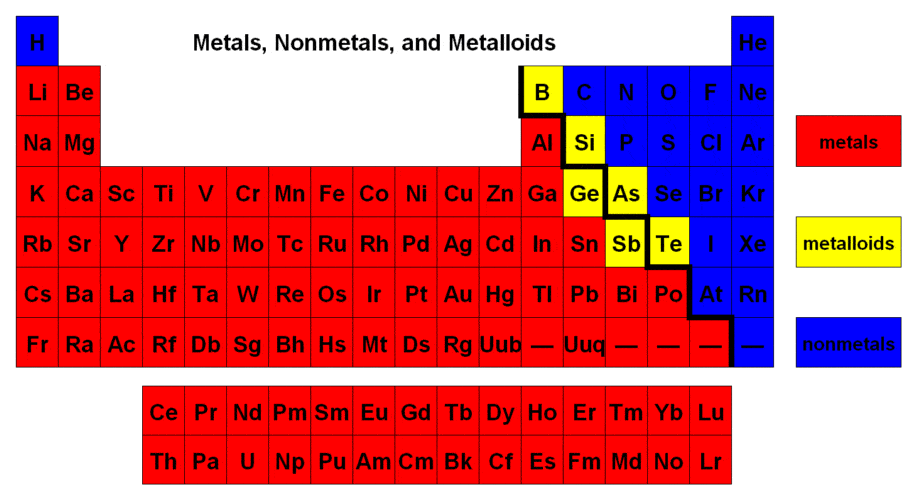
Which of the following elements is most likely a metal?

a)

W

b)

X

c)

Y

d)

Z

20.

Which of the following elements is most likely a poor conductor of electricity?

a)

Beryllium (Be)

b)

Gold (Au)

c)

Phosphorus (P)

d)

Copper (Cu)

21.

The term valence electron refers to…

a)

The total number of electrons in an atom

b)

The electrons in the first energy level

c)

The electrons in the outermost energy level

d)

Electrons that are found in the nucleus

22.

A periodic trend is a feature or pattern that occurs due to the arrangement of the elements on the periodic table. Which of the following is not a correct periodic trend?

a)

Elements located in the same group have the same number of valence electrons and tend to react in similar ways.

b)

Elements located within the same period have valence electrons located in the same energy level.

c)

Metals tend to be grouped together, and take up the majority of the periodic table.

d)

Non-Metals tend to be grouped together, and can be found primarily on the left side of the periodic table.

23.

Which of the following reasons explains why there is a decimal for most atomic masses?

a)

The mass of one atom can have a fraction.

b)

Since electrons are very small mass they only add a little bit, usually only a decimals worth.

c)

It is the average mass of all the potential isotopes of an atom.

d)

Neutrons have a mass of 1.1 meaning that fractions are common.

24.

Which of the following is true of atomic radius?

a)

The radius is mainly due to how large an atom's nucleus is.

b)

The radius is mainly due to the size of the electron cloud.

c)

The atomic radius is a way we measure the mass of an atom.

d)

Neutrons account for the majority of an atom's radius.
25.
What elements generally make an ionic bond?
a)
metal and nonmetal
b)
2 or more nonmetals
c)
metal
d)
none of the above
26.
What elements generally make a covalent bond?
a)
metal and nonmetal
b)
2 or more nonmetals
c)
metal
d)
none of the above
27.
Predict the bond that will form between Sr and S.
a)
Ionic
b)
Covalent
28.
In this type of bond, electrons are delocalized in a "sea"
a)
Ionic
b)
Covalent
c)
Metallic
d)
Nonpolar
29.

Identify the type of bonding between the oxygen and hydrogens in one water molecule.

a)

covalent bonding

b)

hydrogen bonding

c)

ionic bonding

30.

What type of bond holds the atoms together in C6H12O6?

a)

ionic

b)

covalent

c)

metallic

d)

Hydrogen

31.

Multiple Zn atoms are bonded together by what type of bond?

a)

ionic

b)

covalent

c)

metallic

d)

hydrogen

32.

Which of the following types of structure has a low melting point? (Choose 1)

a)

ionic

b)

covalent

c)

metallic

d)

hydrogen

33.
Which substance contains bonds that involve a transfer of electrons from one atom to another?
a)
CO2
b)
NH3
c)
KBr
d)
Cl2
34.

______ molecules are found in nature as pairs of two atoms of the same type covalently bonded together.

a)

Diatomic

b)

Monatomic

c)

Polyatomic

d)

Network

35.
What type of bond is illustrated above?
a)
Metallic
b)
Ionic
c)
Covalent
d)
Wiggly
36.
A solid substance is an excellent conductor of electricity. The chemical bonds in this substance are most likely?
a)
ionic, because the valence electrons are shared between atoms
b)
covalent, because the valence electrons are mobile
c)
metallic, because the valence electrons are stationary
d)
metallic, because the valence electrons are mobile
37.

Bonds formed by transferring electrons from one atom to another are

a)

ionic

b)

metallic

c)

non polar covalent

d)

covalent

38.

Bonds formed by sharing electrons between atoms are

a)

ionic

b)

metallic

c)

covalent

d)

dipole-dipole

39.

A compound is made of two nonmetals. It is

a)

ionic

b)

metallic

c)

covalent

40.

Which compound is held together by electrostatic forces?

a)

NO2

b)

CaSO4

c)

Aluminum

d)

P4O10

41.

Which compound would be a good conductor when in solution?

a)

aluminum

b)

sulfur dioxide

c)

ammonia

d)

sodium nitrate

42.
What explains the very high melting and boiling point of water
a)
Strong dipole-dipole bonds between water molecules
b)
Strong hydrogen bonds between water molecules
c)
Dispersion forces which are present in all molecules
d)
Asymmetrical shape of the polar bonds.
43.
Hydrogen bonding occurs when hydrogen is bonded to N, O, or F.  Which of the following has hydrogen bonding?
a)
CBr4
b)
NO2
c)
H2S
d)
NH3
44.
Does NH3 have hydrogen bonding?
a)
yes
b)
no
45.
Which is the second strongest intermolecular force, after hydrogen bonding?
a)
dipole-dipole attraction
b)

Dispersion forces

46.

Which substance would have the weakest intermolecular forces of attraction?

a)

CH4

b)

NaCl

c)

H2O

d)

MgF2

47.

________________________ have the strongest intermolecular forces of attraction.

a)

Dipole- Dipole

b)

Dispersion

c)

Hydrogen Bonds

48.
Which of the following factors plays an important role in the identification of specific intermolecular forces in a molecule?
a)
bond type
b)
density
c)
solubility
d)
molecular polarity
49.

Propane is a gas while bromine is a liquid. Which statement correctly explains these observations?

a)
Bromine has weaker intermolecular forces than propane does
b)
Bromine has greater molecular polarity than propane does
c)
Bromine has weaker molecular polarity than propane does
d)
Bromine has stronger intermolecular forces than propane does
50.

Intermolecular forces for: CO2

a)

Dispersion Force

b)

Dipole dipole

c)

Hydrogen bonding

51.

Type of intermolecular forces present in HF.

a)

dipole dipole

b)

Dispersion

c)

H-bond

d)

ionic

52.

The weaker the intermolecular forces of a substance the _____________ the boiling point

a)

higher

b)

lower

53.

Which of the following will NOT have hydrogen bonding?

a)
b)
c)
d)
54.

Which of the following will have the lowest melting point?

a)
b)
c)
d)
55.

Intermolecular forces are the forces

a)

within molecules

b)

between molecules

56.

This is an example of a(n) __________.

a)

Hydrogen Bonding

b)

Dipole

c)

Nonpolar Molecule

d)

Intermolecular Force

57.

Which of the following is an intramolecular force?

a)

hydrogen bonding

b)

polar covalent bonding

c)

Dispersion forces

d)

dipole-dipole interaction

58.
If fluorine is stronger then carbon, what charge will the fluorine receive?
a)
negative
b)
slight negative
c)
positive
d)
slight positive
59.

Which of the following organic liquids dissolves most readily in water ?

a)

CCl4

b)

CH3(CH2)2OH

c)

CH3(CH2)4COOH

d)

C6H5OH

60.
Which of the following compounds is an example of hydrocarbon?
a)
CO2
b)
C2H6
c)
C2H5OH
d)
CH3COOH
61.
Which formula represents a saturated hydrocarbon?
a)
A
b)
B
c)
C
d)
D
62.
Name this compound
a)
2,2-dimethyl-4-ethylhexane
b)
4-ethyl-2,2-dimethylhexane
c)
3-ethyl-5,5-dimethylhexane
d)
4-ethyl-2-methylhexane
63.

Name the compound.

a)

nonene

b)

2,2-dimethylhept-3-ene

c)

1,1,5-trimethylhex-2-ene

d)

2,6-dimethylhept-3-ene

64.

Name this organic molecule.

4 lines
65.

Which compound belongs to the alkene family?

a)

C2H2

b)

C2H6

c)

C6H6

d)

C6H14

66.

Name this organic molecule.

4 lines
67.

Name this organic molecule.

4 lines
68.

A molecule of 2,3 dimethyl hexane would have how many TOTAL carbons?

a)

6

b)

7

c)

8

d)

9

69.

What functional group is -OH

a)

Hydroxyl

b)

Carboxyl

c)

Amino

d)

Carbonyl Ketone

70.

Name this compound.

a)

butyne

b)

but-1-yne

c)

but-3-yne

d)

butane

e)

butene

71.

4 Fe + 3 O2 → 2 Fe2O3


How many moles of Fe is needed to react with 9.75 moles of O2?

a)

3

b)

4

c)

13

d)

39

72.

What number should be in front of each substance in the chemical equation?

___N2+___F2 --> ___ NF3

a)

1, 2, 3

b)

2, 1, 3

c)

1, 3, 2

d)

3, 1, 2

73.
What is the molar mass of NaOH?
a)
40 g/mol
b)
38.989 g/mol
c)
23.998 g/mol
d)
57.004 g/mol
74.
How many molecules are in 2.5 mol of NaCl?
a)
1.51x10²³
b)
146
c)
4.15
d)
1.51x1024
75.
How many molecules of sugar (C6H12O6) are in a mole?
a)
24 molecules
b)
180 molecules
c)
180 g
d)
6.02 x 10²³ molecules
76.
How many atoms of carbon are in 6.00g of carbon?
a)
1.20x1024atoms C
b)
6.02x10²³atoms C
c)
3.01x10²³atoms C
d)
1.50x10²³atoms C
77.
How many moles are in 3.01 x 10²² atoms of magnesium?
a)
0.05 moles
b)
1.81 x 1046 moles
c)
5.00 x 10²¹ moles
d)
5 moles
78.
What is the mass of 0.89 mol of CaCl2?
a)
111 grams
b)
0.008 grams
c)
98.9 grams
d)
none of the choices
79.

A sample of silver contains 5.71 x 10²² atoms. How many moles of silver are present?

a)

3.43 x 1046 moles

b)

0.0529 moles

c)

0.0948 moles

d)

10.5 moles

80.
Calculate the mass of iron in a sample of iron ore containing 2.61x10²³ iron atoms.
a)
0.433g
b)
24.2g
c)
44g
d)
6.02g
81.

How many molecules are present in a 135 g sample of Teflon, which has a formula of C2F4?

a)

6.13 x 10²³ molecules

b)

5.13 x 10²³ molecules

c)

8.13 x 10 23 molecules

d)

9.13 x 10²³ molecules

82.
A compound consists of 72.2% magnesium(Mg) and 27.8% nitrogen(N) by mass. What is the empirical formula?
a)
Mg4N3
b)
MgN2
c)
Mg3N
d)
MgN
83.
You are given the following percentages: 40.05% S and 59.95% O. Find the empirical formula for these elements.
a)
SO
b)
SO2
c)
SO3
d)
SO4
84.
A formula with the lowest whole # ratio of elements in a compound is called
a)
Molecular Formula
b)
Chemical Formula
c)
Empirical Formula 
d)
Distance Formula
85.

2.40 g of an explosive, J, contains 0.473 g of nitrogen. J also contains 33.8% carbon and 1.41% hydrogen by mass. The remainder of J is oxygen.


What is the empirical formula of J?

a)

C4HNO2

b)

CH2N2O

c)

C2HNO2

d)

CHNO

86.

Calculate the molar mass for Al(OH)3

a)

78.0 g/mol

b)

72 g/mol

c)

28 g/mol

d)

25 g/mol

87.

Basic aluminium diacetate – Its molecular formula is HOAl(CH3CO2)2 How many total atoms are in this molecule?

a)

4

b)

12

c)

17

d)

20

88.
4.35% of all X atoms have a mass of 39.946 amu. 83.79% have a mass of 41.941 amu, 9.50% have a mass of 42.941 amu, and 2.36% have a mass of 43.939 amu. What is the average atomic mass of atom X?
a)
41.97 amu
b)
42.19 amu
c)
10.43 amu
d)
40.04 amu
89.
What is the percent by mass of oxygen in MgO?
a)
20%
b)
40%
c)
50%
d)
60%
90.
What is the molecular formula if the empirical formula is CH2O and the molecular molar mass is 180.18?
a)
CH2O
b)
C2H4O2
c)
C4H8O4
d)
C6H12O6
91.

Empirical Formula = CF2

Molecular formula mass = 192

Molecular Formula = ?

a)

C4F8

b)

C4F

c)

CF8

d)

C2F4

92.

Calculate the average atomic mass from the mass spec.

a)

85.56 amu

b)

85.75 amu

c)

86.44 amu

d)

86.74

93.

Based on the mass spec data, which Iron isotope is the most abundant?

a)

Fe-54

b)

Fe-56

c)

Fe-57

d)

Fe-58