Worksheets
Rate of reaction 92Q for M5 (BMS-EP)
Total questions: 92
Worksheet time: 2hrs 18mins
List four factors that affects the rate of a reaction
temperature
concentration
surface area
volume
catalysts
A temperature increase causes the particles ......
to slow down
move faster
collide higher
in the right order
How does a catalyst work in speeding up a reaction?
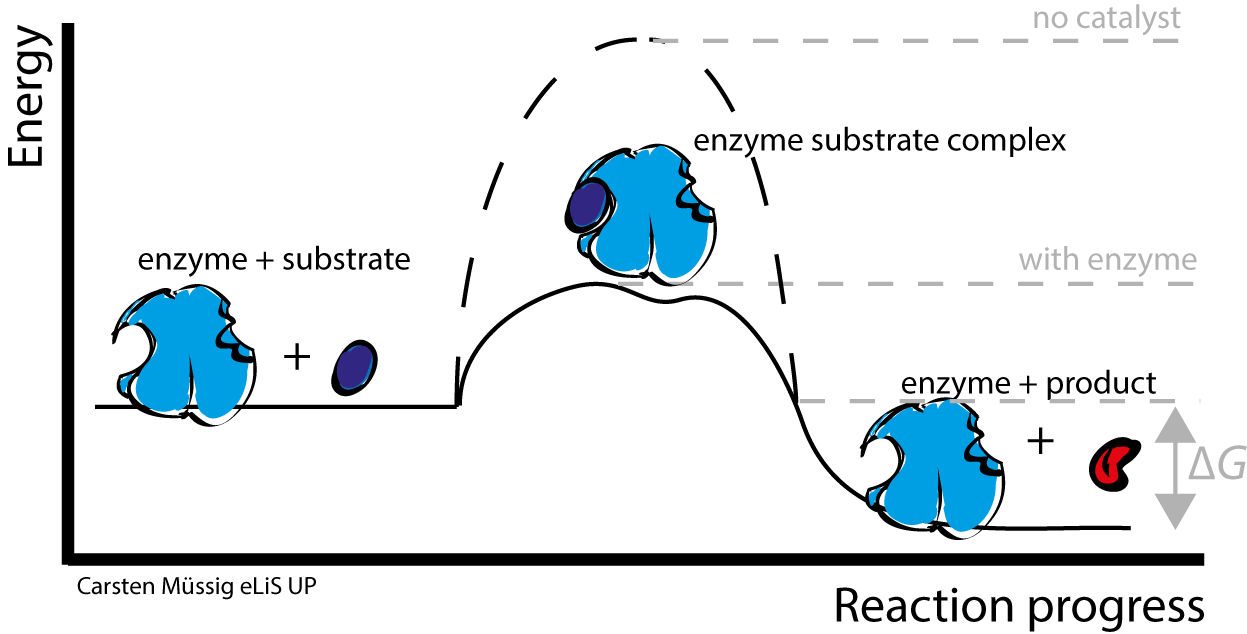
By lowering the activation energy or reaction
by giving them more energy
by making them more available

Why does a higher concentration increase the rate of reaction?
it increases the amount of reactants
it lowers the activation energy
it increases the energy of particle collisions
it increases the frequency of particle collisions
Why does a higher temperature increase the rate of a reaction?
it increases both the frequency and energy of particle collisions
it only increases the frequency of particle collisions
it only increases the energy of particle collisions
it reduces the activation energy of the reaction
The ______________is required to break the bonds of the reactants.
Kinetic energy
Activation energy
Potential energy
Gibbs energy
The minimum amount of energy needed for colliding particles to react is called
Chemical Energy
Kinetic Energy
Activation Energy
Potential Energy
A temperature increase causes the particles ......
to slow down
move faster
collide higher
in the right order
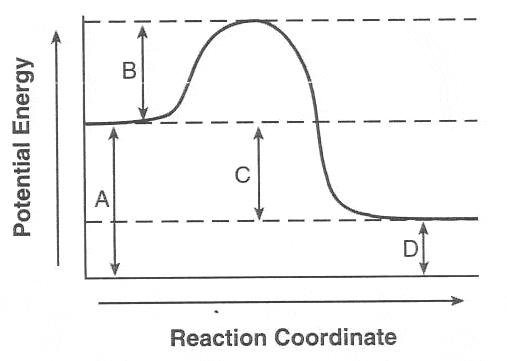
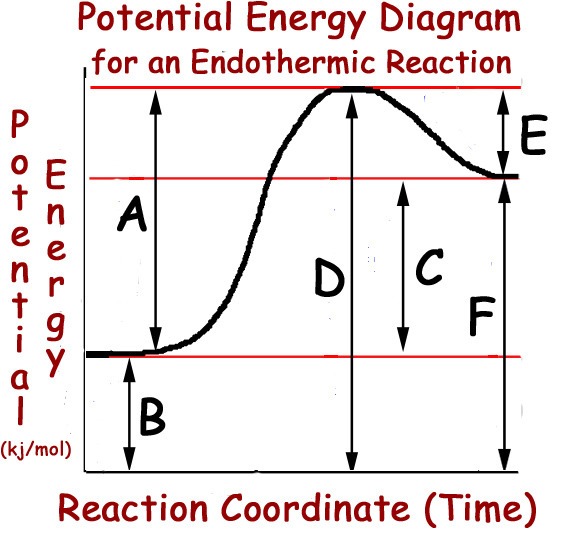
What type of reaction is this?
Endothermic
Exothermic
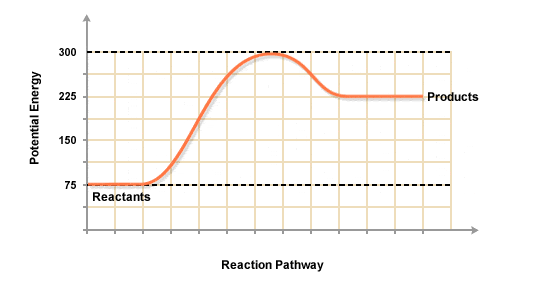
What is the energy of the activated complex?
75 kJ
225 kJ
300 kJ
50 kJ
What is the name given to a catalyst in the human body?
Biology
Catalyst
Chemical
Enzyme
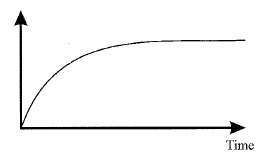
The reaction between zinc and hydrochloric acid may be represented by the equation:
Zn(s) + 2HCl(aq) → ZnCl2(aq) + H2(g);
In an investigation of this reaction using excess Zn and 2 M HCl(aq) in an open flask, the graph shown was plotted from the data collected.
Which of the following would be a suitable quantity for the vertical axis of the graph?
mass of zinc per second
volume of hydrogen gas produced per second
Temperature.
mass loss per second
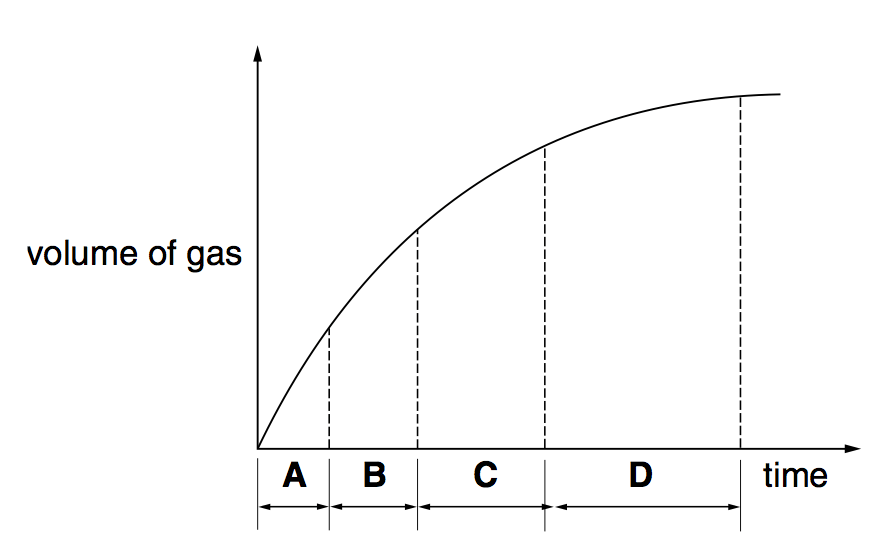
If 5 cm3 of gas is produced in 20 seconds what is the average rate of reaction?
5 cm3 s-1
0.25 cm3 s-1
4 cm3 s-1
why is the reaction fastest at the start ?
The reactants are in their greatest concentration
this statement is untrue the reaction is same rate through out whole reaction
Which unit is correct for the rate of reaction?
g mol-1
g min-1
mol dm-3
kJ mol-1
What is the meaning of the rate of reaction?
Decrease in amount of product
Decrease in amount of product against time
Increase in amount of products against time
Increase in amount of reactants against time
Which of the following has the lowest rate of reaction?
Combustion of ethanol
Fermentation of glucose
Oxidation of magnesium
Precipitation of silver chloride
Which reactions has the highest rate of reaction?
Rusting of water pipe
Photosynthesis in green plant
Burning of a small piece of charcoal in the air
Formation of stalactites and stalagmites
Which process has the highest rate of reaction?
Rusting
Respiration
Combustion
Photosynthesis
The following equation represents a chemical equation.
CaCO3 + 2HCl --> CaCl2 + CO2 + H2O
Which graph shows the correct change in mass of reactant used in excess against time?
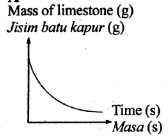
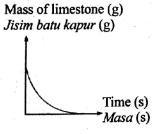
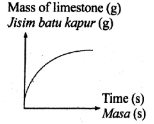
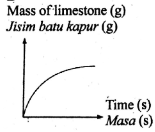
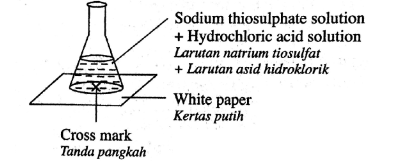
Diagram shows the apparatus set up for an experiment to determine the rate of reaction.
Which of the following techniques is the most suitable to determine the rate of reaction?
Record the time as soon as precipitate is formed
Record the time taken to obtain the maximum temperature
Record the times as soon as the cross mark cannot be seen
Record the times taken for the change of the pH value until a fixed pH value is obtained
The following equation represents the reaction between calcium carbonate, CaCO3 and hydrochloric acid, HCl.
CaCO3 + 2HCl --> CaCl2 + CO2 + H2O
Which changes can be used to determine the rate of reaction?
I : mass of calcium carbonate per unit time
II : Volume of carbon dioxide released per unit time
III : Colour of solution per unit time
IV : Mass of precipitate produced per unit time
I and II
I and III
II and IV
III and IV
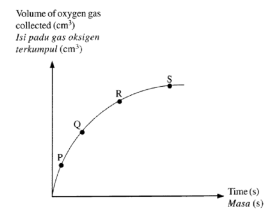
Diagram shows a graph of volume of oxygen gas collected against time in the decomposition reaction of hydrogen peroxide when using manganese dioxide as catalyst.
Which point shows the highest rate of reaction?
P
Q
R
S
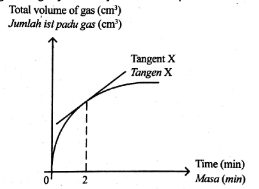
Diagram shows a graph to study the effect of total surface area on the rate of reaction.
What is represented by gradient tangent X?
Average rate of reaction in the first 2 minutes
Average rate of reaction in the 2nd minute
Overall average rate of reaction
Rate of reaction at the 2nd minute
Na2S2O3(aq) + 2HCl(aq) → 2S(s) + SO2(g) + 2NaCl(aq) + H2O(l)
Which list below contains only changes that will decrease the rate of this reaction?
C6H12(g) → C6H6(g) + 3H2(g); ΔH=+206 kJ mol-1
Which two changes could be used to increase the rate of reaction?
Zn(s) + 2HCl(aq) → ZnCl2(aq) + H2(g); ΔH = -154 kJ mol-1
In an investigation of this reaction using excess Zn and 2 M HCl(aq) in an open flask, the graph shown was plotted from the data collected.
Which of the following would be a suitable quantity for the vertical axis of the graph?

According to the information provided on this profile, the activation energy for the reaction:
0.5CO2(g) + H2O(g) → 0.5CH4(g) + O2(g)
would be
I. addition of a catalyst
II. grinding reactant lumps into a powder
III. increasing the concentration of reactants

Which of the following is an incorrect conclusion from the data presented?
Reaction between calcium carbonate and hydrochloric acid will produce what type of gas?
CO2 gas
H2 gas
O2 gas
Cl2 gas

hydrogen peroxide → water + oxygen
The diagrams show the effect of adding blood to the solution. What could be the reason for the observed change?
1 decreasing the concentration of hydrochloric acid
2 decreasing the particle size of calcium carbonate
3 decreasing the temperature
What will happen to the rate of reaction if the concentration of A is doubled and the concentration of B is tripled?
The only factor that can change the value of k is:
concentration
pressure
surface area
temperature
For the reaction: 2HI → 2H2 + I2
If HI is first order, which of the following will yield a linear plot?
log [HI] vs time
1/[HI] vs time
[HI]2 vs time
[HI] vs time
ln[HI] vs time
For the reaction: 2HI → 2H2 + I2
If HI is first order, which of the following will yield a negative exponential plot?
log [HI] vs time
1/[HI] vs time
[HI]2 vs time
[HI] vs time
ln[HI] vs time
For the reaction: 2HI → 2H2 + I2
If HI is second order, which of the following will yield a linear plot?
log [HI] vs time
1/[HI] vs time
[HI]2 vs time
[HI] vs time
ln[HI] vs time
For which order reaction is the half-life of the reaction independent of the initial concentration of the reactant(s)?
zero order
first order
second order
all of these
none of these


What is the rate law for the reaction?
Consider the reaction and its rate law given below.
2 A (g) + B(g) --> 2 C(g)
Rate = k[A][B]
At the beginning of one trial of this reaction, [A] = 3.0 M and [B] = 1.0 M. The observed rate for the formation of C is 0.36 mol L-1 s-1.
The numerical value of k, the rate constant is closest to
0.040
0.12
108
6.0

State the equation shown in diagram below
Activation energy
Arrhenius equation
Rate equation
Arrhenius Constant