
 Worksheets
Unit 7 Bonding and Compounds Review Game
Total questions: 89
Worksheet time: 1hrs 15mins
Name
Class
Date
1.
Covalent bonds are between...
a)
Metal and Non-metal
b)
Non-metal and Non-metal
c)
Metal and Metal
2.
How are covalent bonds formed?
a)
Sharing of electrons
b)
Transfer of electrons
3.
How are ionic bonds formed?
a)
Transfer of electrons
b)
Sharing of electrons
4.

Where are metals located on the periodic table?
a)
Blue
b)
Green
c)
Red
5.

Where are the nonmetals located on the periodic table?
a)
Blue
b)
Red
c)
Green
6.
Atoms that gain & lose electrons are called _________
a)
ions
b)
isotopes
c)
radioactive
d)
corrosive
7.
Atoms that gain electrons become...
a)
negatively charged
b)
positively charged
c)
remain neutrally charged
d)
21
8.
What happens when an atom loses an electron?
a)
It becomes Negatively Charged
b)
It remains neutral because the proton also leaves.
c)
It becomes Positively Charged
d)
It stays the same.
9.
Ionic bonds are between...
a)
Metal and Non-metal
b)
Non-metal and Non-metal
c)
Metal and Metal
10.
What is is called when atoms share one pair of electrons?
a)
Double Bond
b)
Single Bond
c)
Triple Bond
11.
What usually forms a negative ion?
a)
Non-metals
b)
metals
12.
What usually forms a positive ion?
a)
Non-metals
b)
metals
13.
What is the name of the compound NO?
a)
nitrogen dioxide
b)
nitrogen monoxide
c)
dinitrogen trioxide
14.
What is the formula for magnesium phosphide?
a)
Mg3P2
b)
Mg2P3
c)
Mg2PO3
d)
Mg3(PO3)2
15.
Name this compound:
NaBr
NaBr
a)
Bromide sodide
b)
Sodium bromide
c)
Sodium bromate
d)
Sodium bromite
16.
Name this compound:
KF
KF
a)
Potassium fluoride
b)
Potassium fluorite
c)
Fluorine potasside
d)
Potassium fluorate
17.
The name of Al₂O₃ is
a)
aluminum oxide
b)
aluminum (II) oxide
c)
aluminum (III) oxide
d)
dialuminum trioxide
18.
How can you tell if it's an ionic compound?
a)
If it contains a non-metal
b)
It if contains a metal or ammonium ion at the beginning
c)
If it has a noble gas
d)
If it shares electrons to make eight
19.
The name of CaI₂ is
a)
Calcium iodine
b)
carbon iodide
c)
calcium (II) iodide
d)
calcium iodide
20.
Which is most likely to form a negative ion?
a)
an element from group 17
b)
a metal
c)
an element from group 1
d)
an element with atoms that have eight valence electrons
21.
Why do ionic bonds form?
a)
so the number of protons equals the number of electrons
b)
to achieve a full outer shell
c)
so an atom can become unstable
22.
Why do elements bond?
a)
To be friends
b)
To create a new element
c)
To become stable
23.
Molecular compounds have covalent bonds, which gives them what type of melting point?
a)
High
b)
Low
c)
Medium
d)
Below low
24.
Ionic compounds have what type of melting point?
a)
High
b)
Low
c)
Medium
d)
Very High
25.
An ionic bond will always be a bond between what?
a)
Anion and Cation
b)
Cation and Cation
c)
Anion and Anion
d)
Neutral Atoms
26.
What is it called when three pairs of electrons are being shared?
a)
double bond
b)
triple bond
c)
three bond
d)
tres bond
27.
In order to have a stable arrangement most elements need ___________ electrons in the outer shell
a)
5
b)
6
c)
7
d)
8
28.
Ions that are made of more than one atom are called
a)
ionic compounds
b)
crystals
c)
polyatomic atoms
d)
ionic bond
29.
In a chemical formula and a chemical name which ion is written first
a)
positive ion
b)
negative ion
30.
If the negative ion is a single element the end of its name is changed to
a)
-ide
b)
-ate
c)
-ite
31.
The melting point of table salt which is formed from an ionic bond is __________________ the melting point of sugar which is formed from covalent bonds.
a)
greater than
b)
less than
c)
equal to
32.
This is an attraction between a positive metal ion and the electrons surrounding it
a)
ionic bond
b)
covalent bond
c)
chemical bond
d)
metallic bond
33.
Metals are good conductors of electricity because they
a)
form crystal lattices
b)
contain positive ions
c)
contain mobile valence electrons
d)
form ionic bonds
34.
Which element when combined with chlorine would most likely form an ionic compound?
a)
Lithium
b)
Carbon
c)
Phosphorus
d)
Bromine
35.
Which subatomic particles are involved in bonding?
a)
Protons
b)
Neutrons
c)
All electrons
d)
Valence electrons
36.
How many electrons should Hydrogen have around its Lewis dot model?
a)
1
b)
2
c)
7
d)
8
37.
How strongly an atom attracts electrons is called....................
a)
Ionization energy
b)
Electronegativity
c)
Electricity
d)
Nuclear force
38.

Which of the following is the correct Lewis dot structure for the molecule fluorine (F2)?
a)
A
b)
B
c)
C
d)
D
39.

Which of the following is the correct Lewis structure for the compound PBr3?
a)
structure A
b)
structure B
c)
structure C
d)
structure D
40.
How many electrons can be used in the Lewis Structure for : NO3 -
a)
23
b)
20
c)
18
d)
24
41.

After drawing in your bonds, what do you do if you don't have enough electrons to get each atom to its octet?
a)
Place dots until everything has eight
b)
Place dots only around the terminal atoms
c)
Add a multiple bond
d)
Have eight only around the central atom
42.
In a Lewis structure, what do you do with the total number of valence if your ion is 2- charged?
a)
Add 2 to the valence number
b)
Subtract 2 from the valence number
c)
Multiply the valence number by 2
d)
Divide the valence number by 2
43.
Where can hydrogen be placed in a Lewis Structure?
a)
Only in the center
b)
Only on the left
c)
Only as a terminal atom
d)
Only on the right
44.
How many electrons does each line indicate are shared?
a)
1
b)
2
c)
3
d)
4
45.
Which of the following is a covalent bond?
a)
NaCl
b)
HCl
c)
NH4Cl
d)
ZnCl2
46.
Which of the following is an ionic bond?
a)
H3N
b)
CaCl2
c)
NO2
d)
SCl
47.
What kind of bond occurs between the carbon and the nitrogen in HCN?
a)
single
b)
double
c)
triple
d)
quadruple
48.
What is the formula for copper (II) hydroxide?
a)
CuOH
b)
Cu(OH)2
c)
Cu2OH
d)
Cu2O
49.
The formula for magnesium cyanide is...
a)
Mg(CN)2
b)
MgCN2
c)
MgCN
d)
(Mg)2CN
50.
The formula created from the ions Al+3 and (PO4)-3 is
a)
Al(PO3)4
b)
Al(PO4)
c)
Al(PO4)3
51.
What is the formula for lead (II) phosphate
a)
PbPO4
b)
Pb2PO4
c)
Pb3(PO4)2
d)
Pb2(PO4)3
52.
Write the formula for vanadium (IV) carbonate
a)
V(CO3)2
b)
V4C
c)
V(CO3)4
d)
V4(CO3)
53.
Name this compound:
CaCO3
CaCO3
a)
Calcium carbon oxide
b)
Calcium carbonate
c)
Calcium carbonate
d)
Carbonate calcide
54.
What is the chemical name for NH4Cl?
a)
Nitrogen Hydrogen Chloride
b)
Nitrogen Tetrahydrogen Chloride
c)
Ammonium Chloride
d)
Ammounium Calcide
55.
What is the chemical name for Fe(NO3)3?
a)
Iron (III) Nitrate
b)
Iron (III) Nitride
c)
Iron (VI) Nitrate
d)
Iron Nitrate
56.
What is the name for Pb(SO4)2?
a)
Lead (II) Sulfate
b)
Lead (IV) Sulfate
c)
Lead Sulfate
d)
Lead (I) Sulfate
57.
What is the name for Al(CN)3?
a)
Aluminum Cyanide
b)
Aluminum Carbon Nitrogen
c)
Aluminum Tricarbon trinitride
d)
Aluminum Tricarbonitride
58.
Li+ combines with P3- to form
a)
LiP
b)
Li3P
c)
LiP3
d)
Li3P3
59.
Co+2 combines with NO2- to form
a)
Co3(NO)2
b)
Co(NO2)2
c)
NO(Co)2
d)
CO(No)3
60.
What formula results when Fe+3 and CO3-2 ions bond?
a)
FeCO3
b)
Fe2CO3
c)
Fe2(CO3)3
d)
Fe3(CO3)2
61.
what is the name of CCl4?
a)
carbon tetrachloride
b)
monocarbon tetrachloride
c)
tetracarbon monochloride
d)
carbon chloride
62.
What is the formula for hexasulfur decoxide?
a)
SO
b)
S6O10
c)
S3O5
d)
S10O6
63.
What is the name for PBr5?
a)
Phosphorus Bromide
b)
Phosphorus Pentabromide
c)
Pentaphosphorus bromide
d)
Phosphorus Bromine
64.
What is the formula for Phosphorous trichloride?
a)
PCl3
b)
P3Cl
c)
P3Cl3
d)
PCL
65.
What kind of bond do you have?
K and Br?
a)
Ionic
b)
Covalent
66.
What is the VSEPR theory used to predict?
a)
Bond Strength
b)
Polarity
c)
Molecular Shape
d)
Electronegativity
67.
According to VSEPR, molecules adjust their shapes to keep which of the following as far away as possible?
a)
Pairs of valence electrons
b)
Inner shell electrons
c)
Mobile Electrons
d)
Electrons closest to the nucleus
68.
What is the measure of a tetrahedral bond angle?
a)
90 Degrees
b)
109.5 Degrees
c)
120 Degrees
d)
180 Degrees
69.
Which of the following shapes has unshared pairs of electrons on the central atom?
a)
Bipyramidal
b)
Bent
c)
Trigonal Planar
d)
Tetrahedral
70.
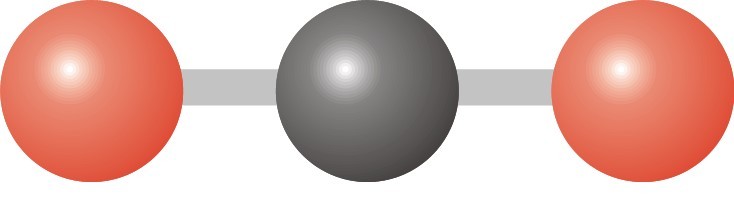
Which molecule would have this shape?
a)
BF3
b)
CH4
c)
PCl5
d)
CO2
71.
Which of the following molecular shapes would have a bond angle of 180 Degrees?
a)
Bent
b)
Trigonal Planar
c)
Tetrahedral
d)
Linear
72.
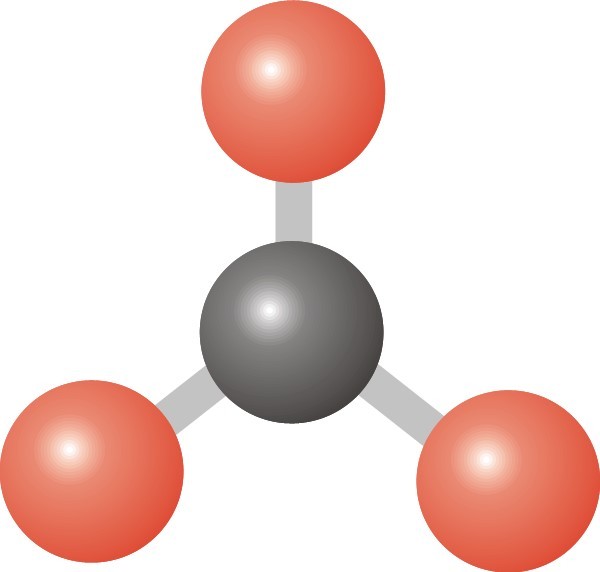
What molecule could this be?
a)
BF3
b)
CH4
c)
H2O
d)
CO2
73.
The bond angle for a trigonal planar molecule is
a)
90 Degrees
b)
109.5 Degrees
c)
120 Degrees
d)
180 Degrees
74.
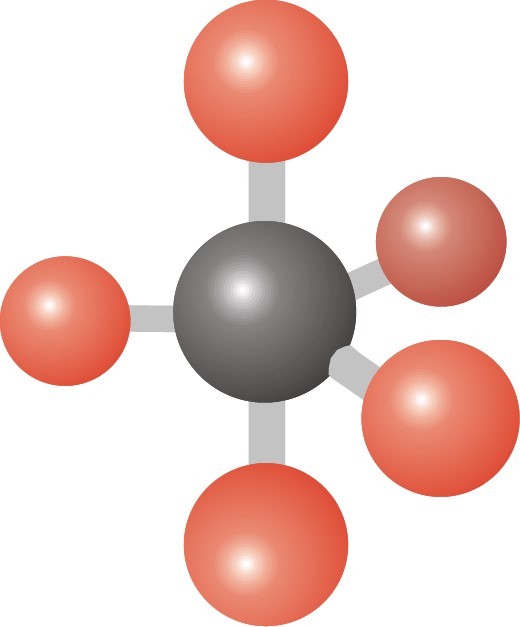
What molecular shape is this?
a)
Trigonal Planar
b)
Trigonal Bipyramidal
c)
Tetrahedral
d)
Pyramidal
75.
How many different bond angles will a Trigonal Bipyramidal molecule have?
a)
1
b)
2
c)
3
d)
4
76.
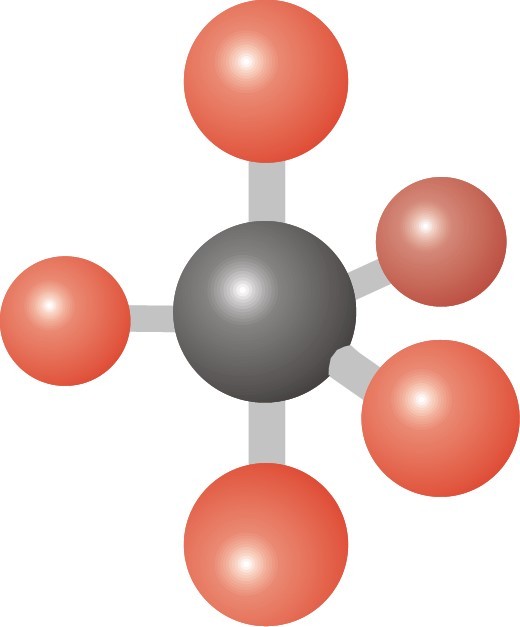
What molecule could this be?
a)
H2O
b)
CCl4
c)
PCl5
d)
NaCl
77.
Which shapes are altered by unshared pairs of electrons?
a)
Bent and Pyramidal
b)
Trigonal Planar and Bent
c)
Tetrahedram and Bipyramidal
d)
Pyramidal and Linear
78.
How many unshared pairs of electrons will a bent molecule have?
a)
1
b)
2
c)
3
d)
4
79.
How many unshared pairs of electrons will a pyramidal molecule have?
a)
1
b)
2
c)
3
d)
4
80.
What is the bond angle for a pyramidal molecule?
a)
90
b)
107
c)
109.5
d)
120
81.
What is the bond angle in a bent molecule?
a)
90
b)
105
c)
107
d)
180
82.
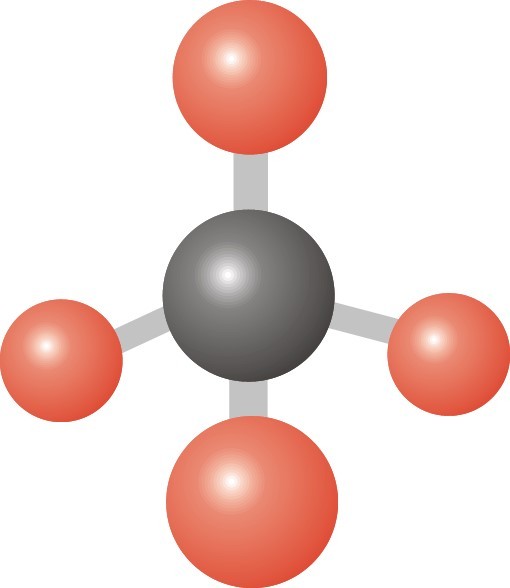
Who could this molecule be?
a)
CH4
b)
CO2
c)
PCl5
d)
BF3
83.
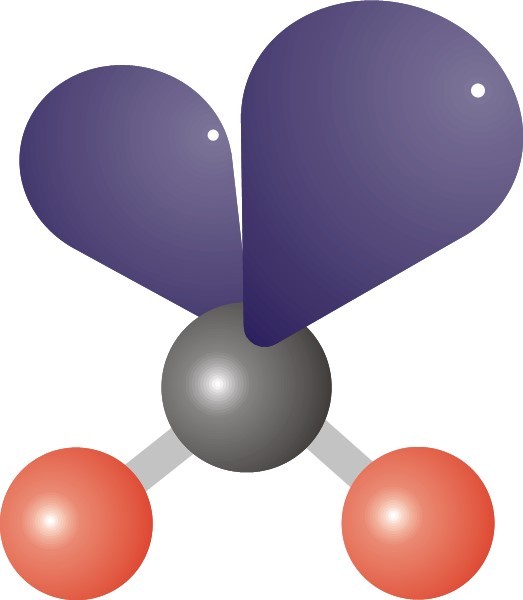
Who could this be?
a)
CO2
b)
NH3
c)
H2S
d)
CH4
84.
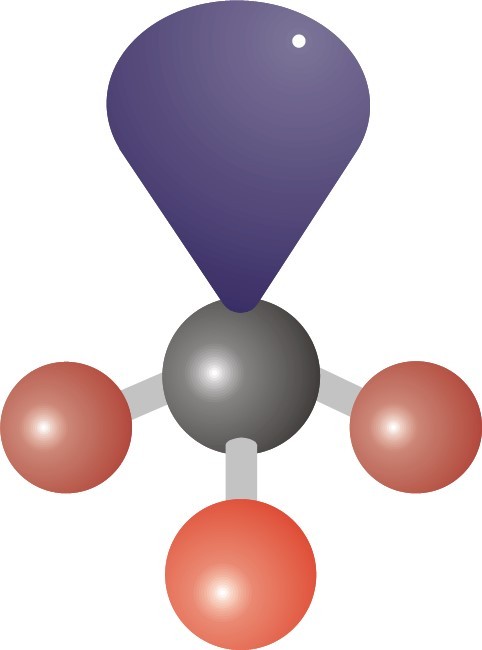
Who could this be?
a)
H2O
b)
NH3
c)
CO2
d)
CH4
85.
What shape would PH3 have?
a)
Trigonal Planar
b)
Trigonal Bipyramidal
c)
Bent
d)
Linear
86.
Which of the following is a polar molecule?
a)
CH4
b)
Xe
c)
H2O
d)
CO2
87.
Which of the following geometries could be nonpolar?
a)
bent
b)
tetrahedral
c)
trigonal pyrimidal
d)
none of the above
88.
Which formula represents a nonpolar molecule?
a)
HBr
b)
H2S
c)
CBr4
d)
PCl3
89.
A molecule containing polar covalent bonds is always polar.
a)
True
b)
False
100 %

