
 Worksheets
Chemistry Review Part 1
Total questions: 95
Worksheet time: 49mins
Use the chemical reaction to answer the question. CH4 (g) + 2O2 (g) → CO2 (g) + 2H2O (g) Determine the mass of H2O (g) produced in the combustion of 3.5 moles of methane (CH4).
22.4 g of H2O
0.38 g of H2O
126 g of H2O
63 g of H2O
Assuming STP, what is the volume of bromine gas produced if 82.60 L of Cl2 reacts with HBr?
123.9 L
41.3 L
82.6 L
172.4 L
How many moles of water will be produced by the complete combustion of 0.5 moles of propane, C3H8?
2
1
0.5
3
Nitrogen gas is a diatomic molecule. What is the mass of one mole of nitrogen gas?
7g
14g
28g
6 x 10²³ g
Find the mass in grams of 3.01x10²³ molecules of F2.
12 g
19 g
32 g
48 g
What would be the molar mass of C6H12O6?
140 g/mol
180 g/mol
174 g/mol
96 g/mol
What is the number of molecules in 0.25 moles of hydrogen gas?
6.0x10²³
1.5 x 10^23
1.5 x 10^25
2.5x10²³
What is the mass in grams of one mole of sulfur dioxide (SO₂)?
48.1g
64.1g
80.1g
96.1g
A student has one mole of an unknown compound in a test tube. The mass of the compound is 58.5 g. Drag and drop the answer into the box that indicates the compound.
CaCl₂
NaCl
AgNO₃
CuCl
What is the molar mass of Sr(NO₃)₂?
212g
298g
118g
205g
How many atoms are there in a 1.00 mole sample of water?
1.20 × 10²³ atoms
6.02 × 10^23 atoms
1.20 × 10^24 atoms
1.81 × 10^24 atoms
How many molecules are in 48.0 grams of oxygen, O₂?
6.02×10²³
9.03×10²³
1.20 × 10^24
1.81 × 10^24
How many molecules of oxygen gas (O₂) are in 8.00 grams of oxygen?
1.51 × 10^23 molecules
3.01 × 10^23 molecules
4.52 × 10^23 molecules
6.02 × 10^23 molecules
What is the volume of 12.0 grams of oxygen gas at STP? (atomic mass: O = 15.99 grams/mole)
4.20 liters
8.40 liters
16.8 liters
22.4 liters
How many grams of methane gas (CH4) occupy a volume of 11.2 liters at STP?
6.51 grams
8.03 grams
26.0 grams
32.1 grams
How many moles are in 199 grams of CCl4?
0.77 mol
1.29 mol
3.06 × 10^4 mol
3.31 × 10^22 mol
The chemical equation shows the reaction between sodium bicarbonate and hydrochloric acid to produce sodium chloride, water, and carbon dioxide.
NaHCO3(s)+HCl(aq) → NaCl(s)+H2O(l)+CO2(g
A teacher reacts 84.0 g of sodium bicarbonate with excess hydrochloric acid. If 56.0 g of sodium chloride is produced, the percent yield for sodium chloride is (a) .
8.01%
92.0%
95.8%
4.20%
Look at the reaction. 2CH₃OH + 3O₂ → 2CO₂ + 4H₂O If 30g of methanol (CH₃OH) reacts with 20g of oxygen to produce 16.6g of CO₂, what is the percent yield of CO₂?
90%
88%
93%
58%
Use the chemical reaction to answer the question. PCl₃ + Cl₂ --> PCl₅ Phosphorus pentachloride is produced by reacting 22.8 g of phosphorus trichloride with 14.9 g of chlorine gas. What is the percent yield of PCl₅ if 26.2 is produced?
56.9%
75.8%
59.8%
42.3%
Use the reaction and type your answer in the box. Do not include units.
8Fe + S → 8FeS
How many grams of iron are needed to react with 30.0 g of sulfur?
105
56
84
150
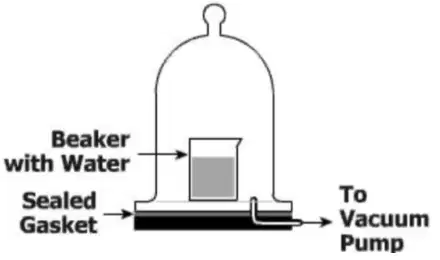
A beaker of water is placed in a large sealed jar that is attached to a vacuum pump. As air is pumped out of the jar, the water begins to boil because -
the temperature of the water decreases as the surrounding pressure decreases.
the lower the pressure inside the jar causes water to contract.
the air pressure in the has been lowered until it is equal to the vapor pressure of the water.
the pressure of the water is insufficient to hold the hydrogen and oxygen atoms together, resulting in a decomposition reaction.
Use the reaction to answer the question by typing the answer in the box provided.
CH + 2O → CO + 2H O
If 1.0 mole of methane gas reacts with oxygen to produce carbon dioxide and water, what is the mass of the water produced?
36
18
44
54
Evaluate the chemical reaction and Indicate your answer by selecting the correct answer from the drop-down box.
Br + H → 2HBr
8.60 L of hydrogen gas reacts with bromine to yield what mass of hydrogen bromide at STP? (a)
15.7
31.5
92.3
6.21
Look at the reaction.
2Al + 3Cl → 2AlCl
How much aluminum chloride will be produced if 24.00 grams of aluminum reacts with 30.00 grams of chlorine?
118.6g
18.80 g
37.61 g
42.63 g
Which of the following will solve for the number of moles found in 22.98 g of NaCl? (Atomic masses: Na = 22.98 g/mol and Cl = 35.45 g/mol)
22.98g NaCl × 1/58.43g/mol NaCl
22.98g NaCl × 58.43g/mol NaCl/1
58.43g/mol NaCl × 1/22.98g NaCl
58.43 g/mol NaCl × 35.45 g/mol Cl/22.98 g/mol Na
When this equation is correctly balanced, the coefficients in order are – ___ AlCl₃(aq) + ___ Ba(OH)₂(aq) → ___ Al(OH)₃(aq) + ___ BaCl₂(aq)
1,1,1,1
2,1,1,2
2,3,2,3
3,2,3,2
A substance has a molecular formula of C₈H₁₀N₄O₂. The empirical formula is -
C₂H₆N₂O
C₄H₅N₂O
C₈H₇N₃O
CHNO
The unbalanced equation below shows the combustion of methane. ___ CH₄ + ___ O₂ → ___ CO₂ + ___ H₂O Which series of numbers represents the coefficients necessary to balance the equation?
2, 2, 1, 4
1, 1, 1, 2
1, 2, 1, 2
0, 3, 2, 2
Choose three (3) of the chemical equations that would be considered to be balanced from the provided answer choices.
Na2 + Br2 → 2NaBr
H2 + O2 → H2O2
P4 + O2 → 2P2O
Na + O2 → Na2O
Use the chemical equation to answer the question.
NH + O --> N + H O
Use the chemical equation to answer the question. What are the reactants in this equation? Select all that apply.
NH2
N2
H2O
O2
How many atoms are in one formula unit of the compound FeC5O5?
5
11
15
26
How many atoms of oxygen are in a molecule of glucose, C6H12O6?
1
6
12
24
What is the molecular formula of a compound whose molar mass is 88.0 and whose percent composition is 54.5% carbon, 9.1% hydrogen, and 36.4% oxygen?
C2H4O
C3H4O3
C4H8O2
C5H12O
What is the molecular formula of a compound whose molar mass is 112 and whose empirical formula is CH2?
C4H8
C6H12
C7H14
C8H16
A compound is analyzed and determined to be 54.5% carbon, 9.1% hydrogen, and 36.1% oxygen. What is the empirical formula of the compound?
C2H4O
C2H6O
C4H8O2
C5H8O3
A compound is analyzed and determined to be 30.4% nitrogen and 69.6% oxygen. What is the empirical formula of the compound?
NO
NO2
N2O
N2O2

If the pressure of the substance is reduced significantly from the conditions of Point A, while keeping the temperature constant, what change will occur?
The substance will boil.
The substance will sublime.
The substance will freeze.
The substance will melt.
When water evaporates from Earth’s surface into the atmosphere, its molecules enter the gas state. What subsequent change causes gas molecules to condense into the small water droplets that form clouds?
Mass is reduced.
Volume is increased.
Temperature is reduced.
Pressure is increased.
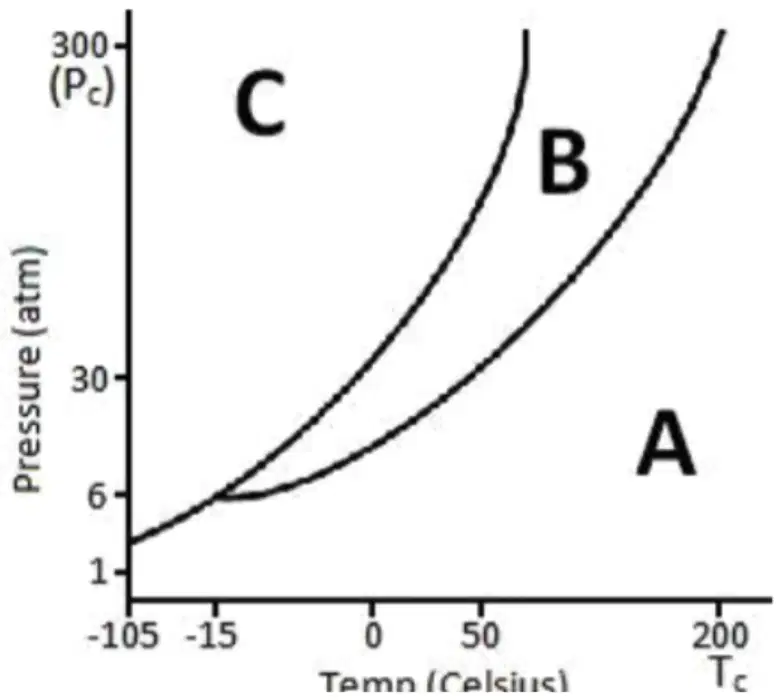
At 30 atm, the boiling point of the substance is -
-105
0
50
200
The temperature and pressure at STP are:
273K and 760 mmHg
273ºC and 1 atm
0K and 1 atm
500ºC and 760 mmHg
Chemical systems undergo three (3) main processes that change their energy, identify the three correct answers that support this statement
Heating/cooling
Chemical reactions
Sedimentary relationships
Phase transitions
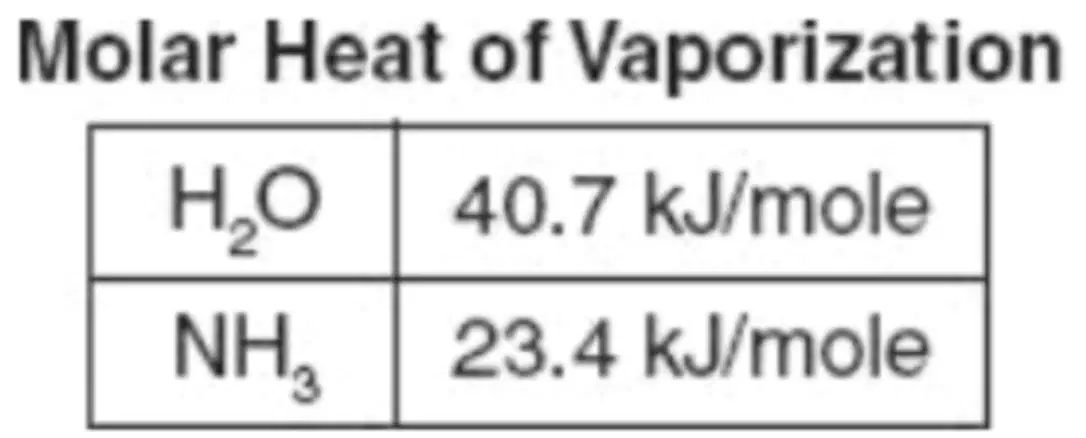
Water and ammonia have different molar heats of vaporization. The best interpretation, at the molecular level, is that water molecules -
occupy large molecular volumes
have stronger intermolecular attractions
set up strong repulsive nuclear forces
collide more frequently with each other
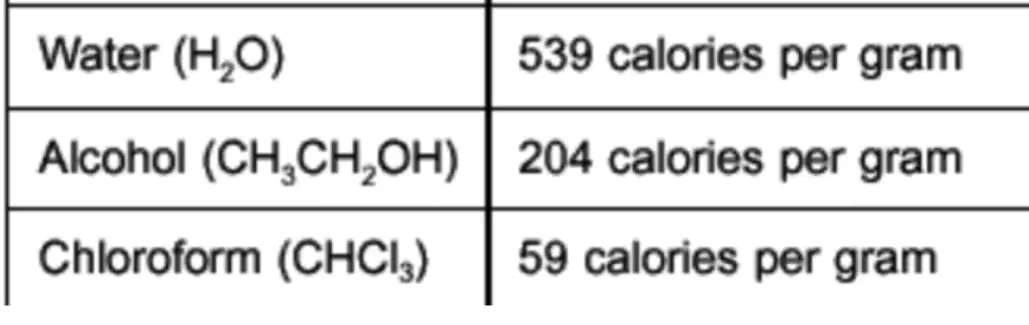
What probably causes chloroform to have the lowest heat of vaporization?
The smallest size of the molecules listed
The smallest mass of the molecules listed
Smallest intermolecular forces of attraction
The fewest number of bonds

Use the graph to answer the question. The graph shows the phase diagram of a substance. Which point on the diagram is the triple point?
1
2
3
4
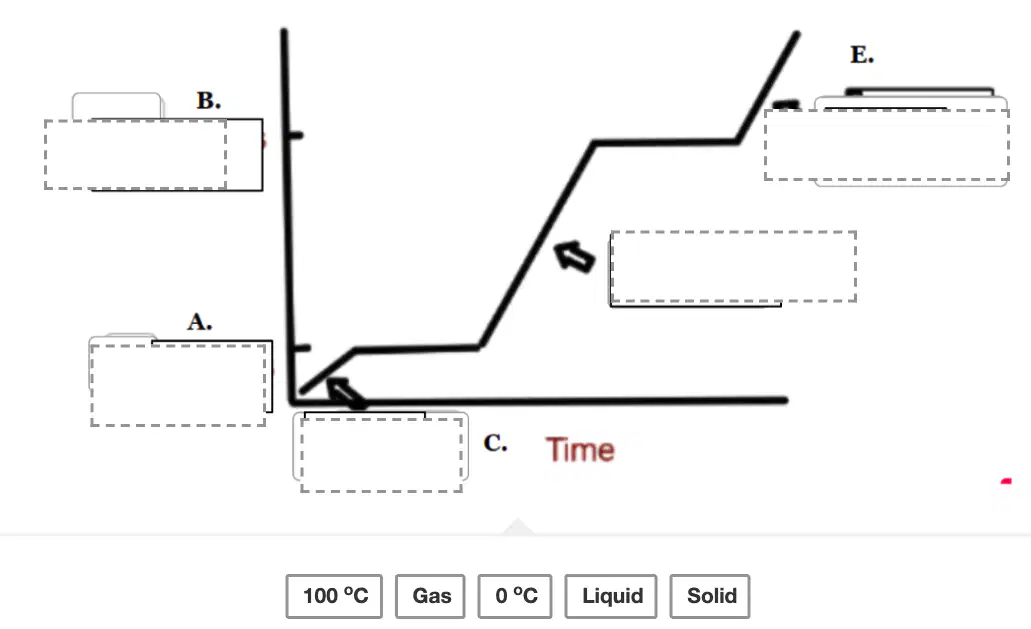
If water is heated from its solid state it undergoes a phase change and a graph called a heating curve is obtained as shown below. Label the boiling and melting point, the line segment that represents the liquid, solid, and gas phases. Drag and drop the correct answer in the appropriate spot.
100°C
0°C
Gas
Solid
0°C
Liquid
Liquid
Gas
Solid
100°C
The specific heat of aluminum is 0.900 J/g°C. How much heat is required to raise the temperature of a block of aluminum from 25°C to 75°C?
0.540 J
1.50 J
1350 J
1670 J
How much energy would it take to melt 30.0g of ice at 0°C and warm the resulting liquid to 35.0°C? (Heat of fusion = 6.01 kj/mole and Specific heat of water = 4.184 j/g°C)
14.4
4.14
144
1.44
A beaker of water, a beaker of ethanol, and a beaker of pentane were left out in the open. The next day, the pentane had completely evaporated. All of the water was still there and only half of the ethanol had evaporated. Based on these observations, which of the liquids has the weakest intermolecular forces?
Water
Ethanol
Pentane
Bromine
If 89.6 joules of heat are needed to heat 20.0 grams of iron from 30.0°C to 40.0°C, what is the specific heat of the iron in J/(g·°C)?
0.448
2.23
8.96
896

The graph shows change in volume of gas produced over time during a chemical reaction. How would the graph most likely change if the reaction temperature were decreased?
The graph would not change.
The slope would increase.
The slope would decrease.
The slope would level off faster.
A mug of hot coffee at 73°C is sitting on a table in a room at 20°C. Several minutes pass, and the temperature of the coffee decreases. Which statement ACCURATELY describes the energy in the scenario?
Energy moves from the surroundings (coffee) to the system (room).
Energy moves from the surroundings (room) to the system (coffee).
Energy moves from the system (coffee) to the surroundings (room).
Energy moves from the system (room) to the surroundings (coffee).

Which cell in the chart depicts a gain in energy?
1
2
3
4
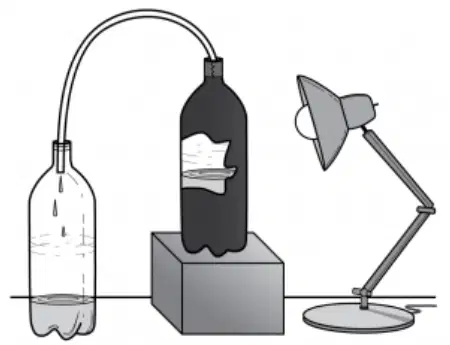
Taylor uses two clear-plastic soda bottles, tubing, black paint, a platform, and a heat source to build the setup shown below. Salt water is placed into the black bottle. Water evaporates, rising into the tube, and drips into the clear bottle. Which best explains why salt remains in the black bottle?
Salt absorbs less energy than water absorbs.
Water releases its impurities when it is heated.
Salt has a higher mass than water.
More energy is required to change salt from a solid to a gas.
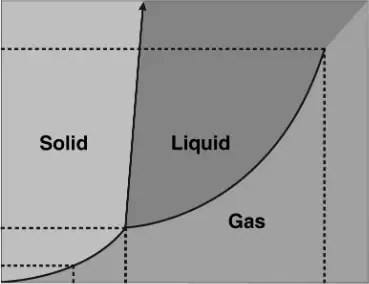
What is the triple point of carbon dioxide?
A. 1 atm, -78.5°C
B. 5.11 atm, -56.4°C
C. 73.0 atm, -56.4°C
D. 73.0 atm, 31.1°C
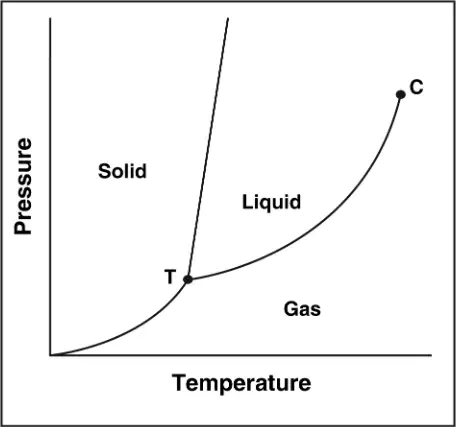
What does the point labeled T represent?
boiling point
melting point
conditions under which the material exists in all three phases
conditions under which the phase of the material cannot be determined
Which phase change occurs during sublimation?
liquid to solid
liquid to gas
solid to liquid
solid to gas
What type of reaction releases energy upon completion and is signified by negative enthalpy?
Exothermic reactions
Endothermic reactions
Mechanical reactions
Polar reactions
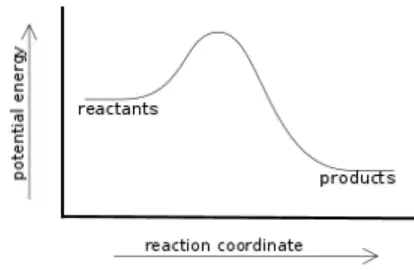
Examine the potential energy diagram for a chemical reaction. Which statement BEST describes the reaction in the diagram?
Energy is released, and the reaction is endothermic.
Energy is released, and the reaction is exothermic.
Energy is absorbed, and the reaction is endothermic.
Energy is absorbed, and the reaction is exothermic.
This general chemical equation shows an example of energy availability in a theoretical reaction. A (100 cal) + CD (200 cal) → AC (120 cal) + D (100 cal) + heat (80 cal) Which statement is true about the equation?
The equation is missing products.
The equation is missing reactants.
Energy was released.
Energy was absorbed.
Which of the statements is the most accurate in describing the chemical equation shown below? 2H₂ (g) + O₂ (g) → 2H₂O (g) + energy
A. A solid is produced.
B. A liquid is produced.
C. Energy is released.
D. Energy is absorbed.
A scientist spilled a few drops of dilute hydrochloric acid (HCl) on a lab table. The scientist sprinkled some baking soda (NaHCO₃) onto the spill for safety purposes. Which observation would provide the best evidence that a chemical reaction occurred?
The baking soda absorbed the hydrochloric acid
The baking soda and hydrochloric acid combined, and gas bubbles formed
Some of the baking soda dissolved in the hydrochloric acid
The hydrochloric acid evaporated, leaving only the baking soda
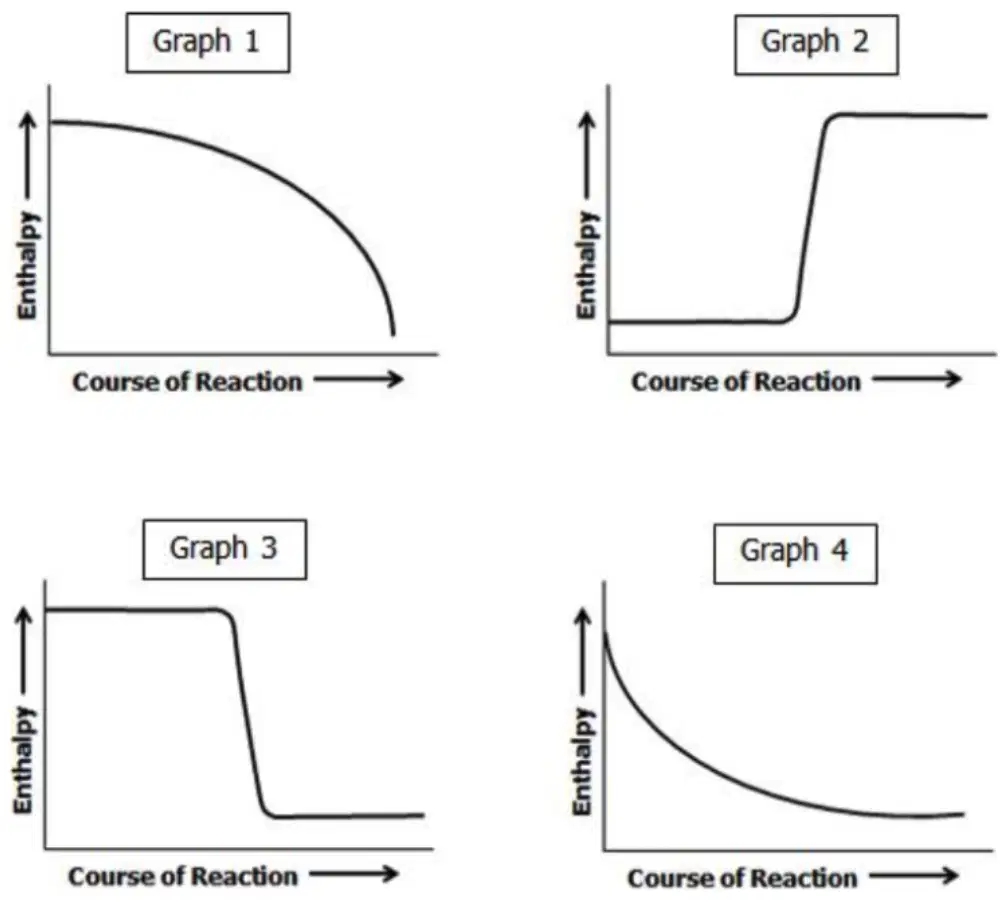
Which graph represents an endothermic reaction pathway? Indicate your answer in the box provided.
Graph 2
Graph 1
Graph 3
Graph 4
A lab group was finding the heat of combustion of a 0.50 g peanut. After burning the peanut completely, 40 g of ice had melted. Assuming negligible heat loss to the surroundings, and given that the heat of fusion of ice is 330 J/g, what was the energy content of the peanut in J/g? Record the answer to 2 significant figures.
2.6×10⁴J/g
1.3 × 10^4 J/g
6.6×10³J/g
3.3 × 10⁴ J/g
Which statement best describes the phase change of a 34.6 g sample of water vapor to liquid water?
The vaporization released 78.2 kJ of energy.
The vaporization absorbed 78.2 kJ of energy.
The condensation released 78.2 kJ of energy.
The condensation absorbed 78.2 kJ of energy.
A scientist distilled a quantity of water to use in an experiment. How much water did he collect if the condensation process released 9040 J of energy? H₂O(l) → H₂O(g) ΔHᵥ = 2260 J/g
0.0138 mol
0.222 mol
0.250 mol
4.00 mol
A block of ice is normally kept at exactly 0 °C. The reaction for ice melting is shown below. H₂O(s) → H₂O(l) ΔHᶠ = 334 J/g How much ice will melt if 5.78 kJ of heat are added to the ice?
0.0173 g
0.0578 g
17.3 g
57.8 g
What will happen if the pressure is increased in the following reaction mixture at equilibrium? CO₂ (g) + H₂O (l) ⇌ H⁺ (aq) + HCO₃⁻ (aq)
The equilibrium will shift to the right and the pH will decrease.
The equilibrium will shift to the right and the pH will increase.
The equilibrium will shift to the left and the pH will increase.
The equilibrium will shift to the left and the pH will decrease.
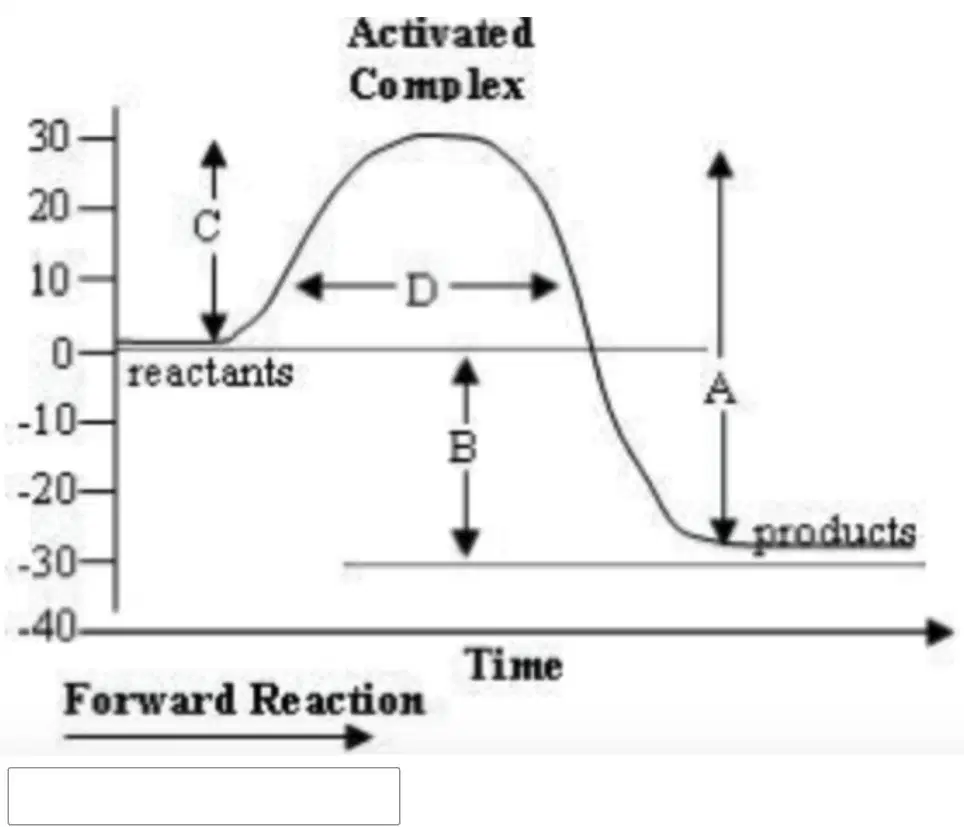
In this diagram, which letter represents the activation energy of the forward reaction? Indicate your answer in the box provided.
C
A
B
D
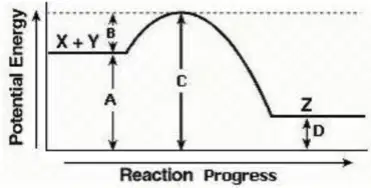
The addition of a catalyst to this reaction in this figure could change the value - For the reaction X + Y → Z
A. A & D
B. B & C
C. A
D. D
(a) is the amount of energy needed to start a chemical reaction.
Chemical energy
Nuclear energy
Activation energy
Molecular bonding energy
What role does a catalyst play in a chemical reaction?
It adds to the reactants to make more product.
It lowers the activation energy of the reaction.
It increases the rate of reaction.
It gets used up during the reaction.

What does the line indicated by the letter A in the diagram below refer to?
an exothermic reaction
an endothermic reaction
activation energy of a reaction
effect of temperature on a reaction
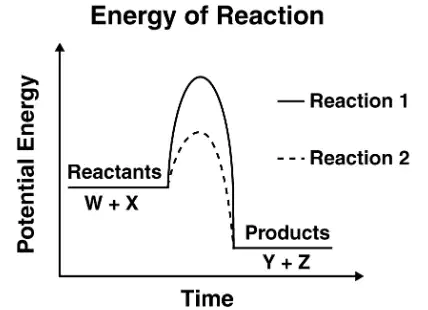
The graph shows two reactions where Reactants W and X yield Products Y and Z. Which statement best describes how Reaction 1 and Reaction 2 are different from each other?
Reaction 1 requires a catalyst to proceed.
Reaction 2 releases less energy than Reaction 1.
Reaction 2 happens in the presence of a catalyst.
Reaction 2 requires a greater activation energy than Reaction 1.
Which statement defines the role of activation energy?
Activation energy is energy that causes a reaction rate to increase.
Activation energy is energy that causes a reaction rate to decrease.
Activation energy is the minimum energy needed to start a reaction.
Activation energy is the minimum energy needed to complete a reaction.
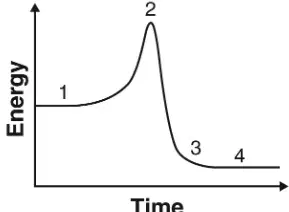
Before World War I, sources of naturally occurring nitrogen-rich fertilizers were dwindling. Chemical manufacturers were looking for efficient ways to combine nitrogen from the air with hydrogen to form ammonia. Haber, a German chemist, developed a method of using iron as a catalyst to increase the reaction rate. The graph shows the curve for the reaction without the catalyst.
What effect will adding the catalyst have on the shape of the reaction graph?
1 will begin lower on the energy axis.
2 will be closer to the time axis.
3 will shift to the right on the time axis.
4 will rise on the energy axis.
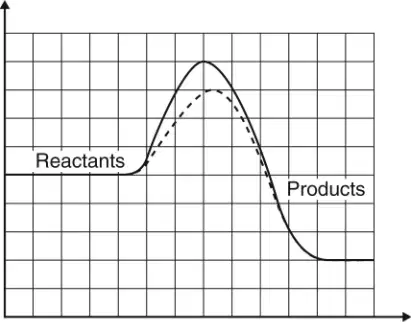
Activation energy is required to begin a reaction. The graph shows a reaction with two different activation energies. In each reaction, the temperature and concentration of the reactants was the same. Which best explains the reduction in the activation energy for Reaction 2?
A. A catalyst was present during Reaction 2.
B. The investigation was conducted closer to the heat source.
C. Higher quality reactants were used during Reaction 1.
D. A different type of glassware was used during Reaction 1.
In a mixture of oxygen (O2) and nitrogen (N2) gas, 80.0 percent of the total gas pressure is exerted by the nitrogen. If the total pressure is 2.0 atm, what pressure does the oxygen exert?
0.20 atm
1.7 atm
0.80 atm
0.40 atm
A gas occupies a volume of 2.4L at 14.1kPa. What volume will the gas occupy at 84.6kPa?
0.40 L
40 L
4.0 L
0.04 L
If the temperature remains constant, 800 mL of nitrogen at 2.0 atm must be compressed to what pressure to reach 500 mL?
3.2 atm
2.3 atm
0.80 atm
1.3 atm
A container consists of 25% oxygen, 25% hydrogen and 50% nitrogen. The total pressure of the container is 60.0 atm. What is the partial pressure of hydrogen in the container?
15 atm
30 atm
50 atm
25 atm
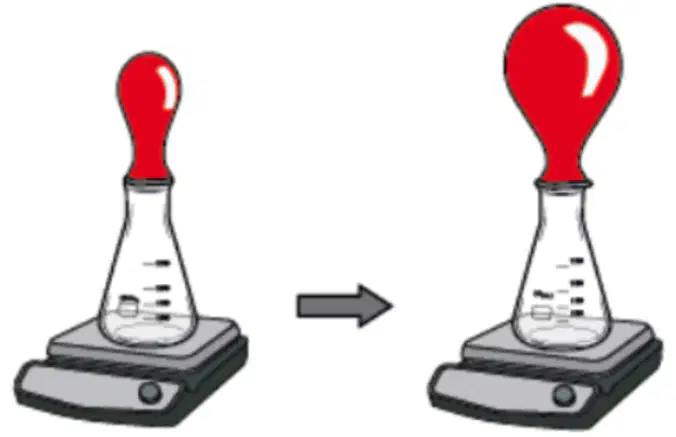
Look at the balloon over time. If the beginning volume of gas in the balloon is 2 milliliters at 28 degrees Celsius, what would be the volume of gas in the balloon if it were heated to 48 degrees Celsius?
2.1328 mL
2.31 mL
21.328 mL
213.28 mL
Which law states that the pressure and volume of a sample of gas at constant temperature are inversely proportional?
Charles’ Law
Summation Law
Boyle’s Law
Bohr’s Law
The combined gas law (P1V1/T1 = P2V2/T2) relates to which three (3) of the following?
A. Pressure
B. Length
C. Volume
D. Temperature
Drag and drop the gas laws to their variables.
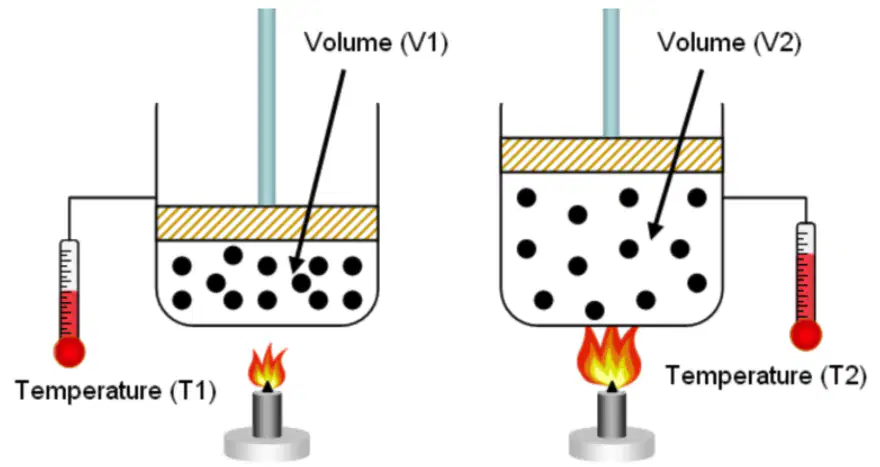
Which of the following gas laws is being investigated in this experiment?
Boyle’s Law
Charles’s Law
Gay Lussac’s Law
Pascal’s Principle
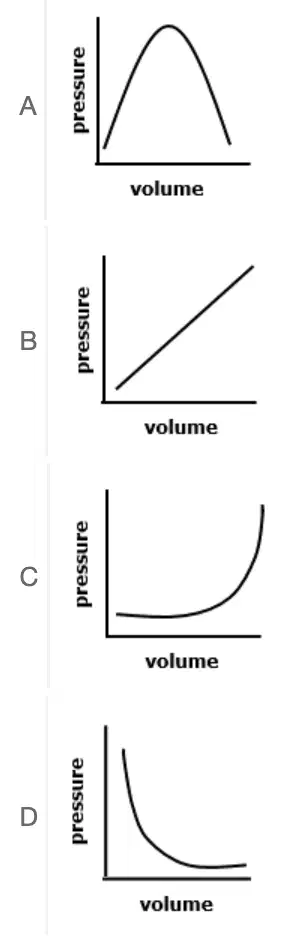
Which graph represents the relationship between the pressure and the volume of an ideal gas at constant temperature?
A. [Graph A]
B. [Graph B]
C. [Graph C]
D. [Graph D]
How does the pressure of a gas in a closed, rigid container change as the temperature of the gas increases?
The pressure increases.
The pressure decreases.
The pressure decreases and then increases.
The pressure increases and then decreases.
What is the mass of a sample of N₂ gas held at 1.200 atm and 303 K in a closed 0.500 L container? [gas constant = 0.0821 L · atm/K · mol]
0.024 g
0.244 g
0.336 g
0.678 g
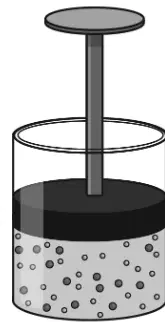
A glass cylinder contains a mixture of two gases that react with each other slowly. A piston can be raised or lowered inside the glass cylinder. Which action will most likely increase the rate of reaction between the two gases in the cylinder?
decreasing the temperature of the gases
removing the product as the gases react
increasing the volume by raising the piston
increasing the pressure by lowering the piston
A sample of 0.02 mol of oxygen has a temperature of 399K and a volume of 5.00 L. What is its pressure? (Ideal gas law: PV = nRT, R = 0.082 atm·L/mol·K)
0.13 atm
0.66 atm
3.28 atm
19.5 atm
A sample of 0.500 mol of hydrogen has a pressure of 3.00 atm and a temperature of 799K. What is its volume? (Ideal gas law: PV = nRT, R = 0.082 atm·L/mol·K)
10.9 L
32.8 L
73.2 L
98.4 L
A sample of carbon dioxide has a pressure of 1.2 atm, a volume of 50.0 L, and a temperature of 650K. How many moles of carbon dioxide are included in the sample?
0.1 mol
0.9 mol
1.1 mol
2.6 mol
What is the volume of 0.881 mole of a gas at standard temperature and pressure?
0.0401 L
19.7 L
22.4 L
39.4 L
A sample of helium gas is stored in a tank at 18 atm and 20°C. How do these conditions compare to the conditions of a gas at STP?
lower pressure and lower temperature than STP
higher pressure and lower temperature than STP
lower pressure and higher temperature than STP
higher pressure and higher temperature than STP
The total pressure of a gas mixture is 1.05 atm. The mixture contains 55% carbon dioxide, 31% nitrogen, and 14% hydrogen. What is the partial pressure of the carbon dioxide in the mixture?
0.15 atm
0.33 atm
0.47 atm
0.58 atm

