wayground logo

Free Printable Worksheets

Font size

S
M
L
XL
Worksheets

FALL FINAL REVIEW 2021

Total questions: 90

Worksheet time: 3hrs 3mins

Name
Class
Date
1.
What is the mass number?
a)
The average atomic mass
b)
the number of protons and neutrons in the nucleus
c)
the number of protons in the nucleus
d)
the number of protons and electrons in the nucleus
2.
A negative subatomic particle
a)
proton
b)
neutron
c)
electron
d)
positron
3.
How many protons in Neon - 22?
a)
22
b)
10
c)
12
d)
32
4.
Discovered the electron with the cathode ray tube experiment.
a)
John Dalton
b)
J.J. Thomson
c)
E Rutherford
d)
Neils Bohr
5.
How many neutrons does the isotope of lithium have?
a)
8
b)
3
c)
4
d)
5
6.

Isotopes of an element have a different number of...

a)

Protons

b)

Neutrons

c)

Electrons

d)

Mass

7.
The scientist responsible for "discovering" the nucleus is:
a)
Bohr
b)
Rutherford
c)
Schroedinger
d)
Einstein
8.
Rutherford's gold foil experiment provided evidence that...
a)
Negative and positive charges are spread evenly throughout the atom.
b)
Alpha particles have a positive charge.
c)
Gold is not a dense as previously thought.
d)
There is a dense positively charged nucleus at the center of an atom.
9.
An element has two naturally occurring isotopes. One is 10.013 amu and is 19.9% abundant. The other is 11.01 amu and is 80.1% abundant. What is the average atomic mass? What element is it?
a)
9.012, Beryllium
b)
12.011, Carbon
c)
6.941, Lithium
d)
10.812, Boron
10.
What atom matches this electron configuration?
1s2s2p3s2
a)
Neon
b)
Magnesium
c)
Aluminum
d)
Potassium
11.
Which element is pictured?
a)
neon
b)
fluorine
c)
magnesium
d)
argon
12.
Which electron configuration belongs to Chlorine (Cl)?
a)
1s2s2p3s3p5
b)
1s2s2p3s3p6
c)
1s2s2p3s3p7
13.
What is the shorthand electron configuration for Sulfur atom?
a)
[Ar] 3p4
b)
[He] 3s23p4
c)
[Ne] 3s23p4
d)
[Na] 3s23p3
14.
A certain photon of light has a wavelength of 4.22x10⁻⁷nm. What is the frequency? (v=c/λ)
a)
7.11x10¹⁴ Hz
b)
7.11Hz
c)
1.41x10⁻¹⁵
d)
-1.41x10¹⁵
15.

What is the wavelength, in nm, for a quantum of light with energy of 7.56x10⁻¹⁹J? (λ=hc/E) 

a)

262 nm

b)

200 nm

c)

2.64x10-45 nm

d)

756 nm

16.
Elements which are shiny, conduct electricity and heat are called
a)
metal
b)
nonmetal
c)
metalloid
d)
nonexistent
17.
Atoms with similar properties are most likely located...
a)
in the same period.
b)
in the same group.
c)
in different periods.
d)
to the right and left of each other.
18.
The Modern Periodic Table of Elements is arranged by
a)
atomic mass
b)
atomic number
c)
valence electrons
d)
number of isotopes
19.

Which elements are colored red?

a)

nonmetals

b)

metals

c)

metalloids

20.
Which element listed will have the highest ionization energy?
a)
Sulfur (S)
b)
Chlorine (Cl)
c)
Tellerium (Te)
d)
Iodine (I)
21.
Atomic radius ________ going across a row, and ________ going down a group.
a)
increases, increases
b)
increases, decreases
c)
decreases, decreases
d)
decreases, increases
22.
Which of the following will have a larger radius than Zinc?
a)
Gallium
b)
Aluminum
c)

Neon

d)
Strontium
23.
Francium (Fr) has the lowest ionization energy in Group 1 because - 
a)
it has the smallest number of valence electrons
b)
it has the greatest atomic mass
c)
it has the greatest number of protons, so it attracts its electrons the strongest
d)
its 1 valence electron is very far from the nucleus, so little energy is needed to remove it
24.
Electronegativity is...
a)
the ability of an atom to attract/ accept electrons
b)
the ability of an atom to lose electrons
c)
the energy required to remove an electron from a specific atom
d)
how easy it is to make friends. 
25.

Which scientist developed the first published periodic table where elements were placed in order of increasing atomic mass?

a)

Henry Moseley

b)

Johann Dobereiner

c)

John Dalton

d)

Dmitri Mendeleev

26.

Which of the following elements will have a lower ionization energy (IE) than Selenium?

a)

Sulfur

b)

Tellurium

c)

Oxygen

27.

Which of the following shows a correct Lewis dot structure?

a)
b)
c)
d)
28.
A charged particle that has gained or lost electrons is called a _____.
a)
molecule
b)
ion
c)
isotope
d)
element
29.

Nitrogen, N, will form which of the following ions?

a)

N

b)

N-3

c)

N-5

d)

N+5

30.

Beryllium, Be, will ____ valence electrons when forming an ionic bond.

a)

lose 4

b)

gain 4

c)

lose 2

d)

gain 2

31.
Ionic bonds form between metals and ____.
a)
metalloids
b)
metals
c)
nonmetals
32.
Write the formula for barium + nitrogen
a)
Ba2N3
b)
Ba3N2
c)
BaN
d)
BaN3
33.

Which is the correct formula for aluminum sulfide?

a)

AlS

b)

Al3S2

c)

S3Al2

d)

Al2S3

34.
Which is the correct name for CaBr2?
a)
Calcium Bromine
b)
Bromine Calcium
c)
Calcium Bromide
d)
Carbon and Bromine
35.
What is the name of Al(NO3)3?
a)
Aluminum trinitrate
b)
Monoaluminum nitrate
c)
Aluminum (III) nitrate
d)
Aluminum Nitrate
36.
copper(II) chloride
a)
CuCl2
b)
CuCl
c)
Cu2Cl
d)
Cu2Cl2
37.
Name the ionic compound SnSe2
a)
Tin diselenide
b)
Tin (IV) Selenide
c)
Tin selenide
d)
Tin (II) triselenide
38.

Name the compound CuCO3

a)

cobalt carbonate

b)

copper (III) carbonate

c)

copper (II) carbonate

d)

copper carbonate

39.

Strontium Oxide

a)

Sr2O2

b)

SrO2

c)

Sr2O

d)

SrO

40.
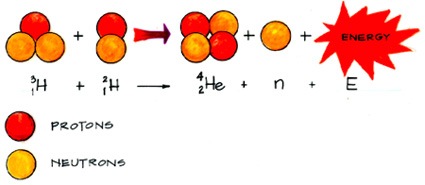
Which process involves the joining of small nuclei?
a)
Beta decay
b)
Alpha decay
c)
Nuclear fission
d)
Nuclear fusion
41.
Which process involves the splitting of large nuclei?
a)
Beta decay
b)
Alpha decay
c)
Nuclear fission
d)
Nuclear fusion
42.
The technetium-99 isotope has a half-life of 6.0 hours. If 100.0 mg were injected into a patient how much remains after 18 hours?
a)
33.0 mg
b)
12.5 mg
c)
.33 mg
d)
15.8 mg
43.
What happens to the atomic number during alpha decay?
a)
The atomic number decreases by 4
b)
The atomic number increases by 1
c)
The atomic number decreases by 2.
d)
The atomic number stays the same.
44.
If Thorium-234 undergoes a beta decay, What element will be left in its place?
a)
Actinium-234
b)
Thorium-233
c)
Protactinium-234
d)
Radium-230
45.
Balance the following equation:
146C --> 0-1e + ________
a)
145B
b)
146C
c)
147N
d)
42He
46.

Complete the nuclear reaction

85209At = ___ + 24He

a)

83205Bi

b)

86209Rn

c)

81207Tl

d)

85208At

47.

What type of radiation is the most penetrating?

a)

Alpha

b)

Beta

c)

Gamma

48.
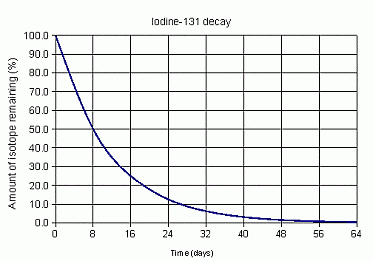
What is the half-life of iodine-131?
a)
32 days
b)
8 days
c)
16 days
d)
24 days
49.

Which of the following is the best representation of a molecule of fluorine (F2)?

a)

A

b)

B

c)

C

d)

D

50.
What two types of atoms make a covalent bond?
a)
2 Nonmetals
b)
1 Nonmetal & 1 Metal
c)
2 Metals
d)
2 Noble Gases
51.

Which formula is for phosphorus trichloride?

a)

KCl3

b)

PCl3

c)

K3Cl

d)

P3Cl

52.
The chemical formula of sulfur hexabromide is
a)
SBr₆
b)
S₆Br
c)
S(VI)Br
d)
S6Br
53.
What is the correct name for NO?
a)
Mononitrogen Monoxide
b)
Nitrogen Monoxide
c)
Mononitrogen Dioxide
d)
Nitrogen Oxide
54.

What is the correct Lewis Dot Structure for NH3?

a)
b)
c)
d)
55.

Which is the correct molecular structure for carbon dioxide CO2?

a)
b)
c)
d)
56.
What molecular shape is the structure shown here? (H2O)
a)
tetrahedral
b)
trigonal planar
c)
bent
d)
trigonal pyramidal
57.
bromic acid
a)
HBr
b)
H2Br
c)
HBrO3
d)
HBrO4
58.
HI
a)
iodic acid
b)
hydroiodic acid
c)
iodous acid
d)
hypoiodous acid
59.
What is the formula for phosphorous acid?
a)
H3PO4
b)
H2PO4
c)
H3P
d)
H3PO3
60.
Which of the following is a sign that a chemical reaction has occurred?
a)
change in shape
b)
melting
c)
formation of a gas
d)
dissolving
61.
What is the volume of the rock? The water level is displaced from 20 mL to 23 mL with the rock.
a)
3 mL
b)
23 mL
c)
20 mL
d)
43 mL
62.

A bar of copper has a mass of 216g and a volume of 24 cm3. What is the density of copper?

a)

9g/cm3

b)

5184g/cm3

c)

.11g/cm3

d)

322mL

63.

A mixture in which the composition is NOT uniform throughout is called a _____ mixture.

a)

Heterogeneous

b)

Homogeneous

64.
Pure oxygen (O) is an example of...
a)
an element
b)
a mixture
c)
a compound
65.
Combination of two or more substances that are not chemically combined.
a)
mixture
b)
solution
c)
solvent
d)
solute
66.
A mixture that appears to be evenly mixed throughout:
a)
an atom
b)
a compound
c)
a homogeneous mixture
d)
a heterogeneous mixture
67.

15 m = _____ mm

a)

15,000

b)

1,500

c)

0.015

d)

150

68.

762 cL = _____ L

a)

7.62

b)

0.762

c)

76.2

d)

7,620

69.
648 g = ____ mg
a)
6,480
b)
64,800
c)
648,000
d)
64.8
70.
490,000 g =____ kg
a)
490
b)
49
c)
4,900
d)
0.49
71.
How many significant figures: 216 m
a)
1
b)
2
c)
3
d)
0
72.
How many significant figures: 0.012 km
a)
1
b)
2
c)
3
d)
4
73.

What is 78.5 rounded to one significant figure?

a)

79

b)

78.5

c)

70

d)

80

74.

Round off 509.96 to 4 significant figures

a)

509.9

b)

509.0

c)

510.0

d)

510

75.
Write in standard form: 
6.254 x 10⁶
a)
6,254,000
b)
6,254,000,000
c)
625,400
76.
Write in scientific notation: 
540,020,000
a)
5.4002 x 10⁸
b)
5.4 x 10⁸
c)
5.4002 x 10⁴
77.
The group that does not receive the experimental treatment in an experiment is the:
a)
Control group
b)
Experimental group
c)
Data
d)
Variable
78.

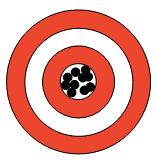
This bullseye demonstrates...

a)

High Accuracy & High Precision

b)

High Accuracy & Low Precision

c)

Low Accuracy & High Precision

d)

Low Accuracy & Low Precision

79.

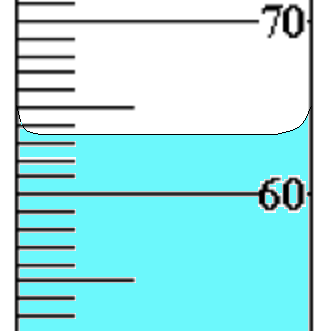
Based on the markings of this graduated cylinder, what is the estimated volume?

a)

63.5 mL

b)

63 mL

c)

63.55 mL

d)

0.063 L

80.

Measurements: 24.9, 25.2, 25.1, 24.8

True Value: 25.0

These measurements are…

a)

Accurate, but not precise

b)

Precise, but not accurate

c)

Both precise and accurate

d)

Neither precise nor accurate

81.
The students measured length during a science experiement, they got 12 cm. But the actual measurement was 14.25 cm. What was the percent error?
a)
15.79%
b)
18.75%
c)
2.25%
d)
18%
82.

what is the name of CCl4?

a)

carbon tetrachloride

b)

monocarbon tetrachloride

c)

tetracarbon monochloride

d)

carbon chloride

83.
Name the following ionic compound: LiNO3
a)
lithium nitrate
b)
lithium III nitrate
c)
lithium nitride
d)
lithium oxide
84.

Name the compound NH4OH

a)

ammonium hydroxide

b)

ammonia oxyhydride

c)

mononitrogen tetraoxihydride

d)

hydrogen nitrate

85.
Write the correct name for PN.
a)
monophosphorus nitride
b)
phosphorus mononitrogen
c)
phosphorus mononitride
d)
monophosphorus mononitride
86.
What is the correct formula for Sodium Oxide?
a)
NaO
b)
NaO2
c)
Na2O
d)
Na2O2
87.
What is the formula for Lead II Phosphate?
a)
Pb₃(PO₃)₂
b)
Pb₃(PO₄)₂
c)
Pb₂PO₄
d)
Pb₂P
88.
In a well designed experiment, you should change how many variables?
a)
only one
b)
no more than two
c)
none at all
d)
as many as are needed
89.
An experiment is performed on plants to see how different liquids affect plant growth. Each plant in the experiment is given a different liquid; water, apple juice, or milk. Each plant has the same amount of soil, sunlight, and listens to the same music. In this investigation, what is the dependent variable?
a)
Type of plant
b)
Water, apple juice, milk
c)
Plant growth
90.

Mr. S wants to know the best way to train his dog, so he sets up an experiment to find out if there is a better way to get his dog to respond to commands. He uses doggie treats for one week, play time for one week, and praise for one week. What is his independent variable?

a)

Type of reward

b)

One week for each reward

c)

Type of dog

d)

Amount of time the dog follows commands