
 Worksheets
American Revolution
Total questions: 75
Worksheet time: 43mins
Name
Class
Date
1.

Where were the first armed conflicts of the American Revolution?
a)
Yorktown
b)
Saratoga
c)
Lexington and Concord
d)
Bunker Hill
2.

What was the name of the British king during the American Revolution?
a)
Charles III
b)
George III
c)
William III
d)
James III
3.

This American victory was the turning point in the war.
a)
Saratoga
b)
Yorktown
c)
Bunker Hill
d)
Lexington and Concord
4.

Who was the major author of the Declaration of Independence?
a)
Benjamin Franklin
b)
John Adams
c)
Thomas Jefferson
d)
Patrick Henry
5.

Surrounded by French and Continental armies, a large British army surrendered here.
a)
Saratoga
b)
Yorktown
c)
Bunker Hill
d)
Lexington and Concord
6.

This member of the Continental Congress helped gain French support for American independence.
a)
Thomas Jefferson
b)
Benjamin Franklin
c)
Patrick Henry
d)
John Adams
7.

This patriot made a daring ride to warn colonists that British soldiers were approaching.
a)
Patrick Henry
b)
Paul Revere
c)
Phillis Wheatley
d)
Samuel Adams
8.

Of the following events, which happened first?
a)
Saratoga
b)
Yorktown
c)
Declaration of Independence
d)
Treaty of Paris of 1783
9.

Of the following people, who did not help write the Declaration of Independence?
a)
Thomas Jefferson
b)
Patrick Henry
c)
John Adams
d)
Benjamin Franklin
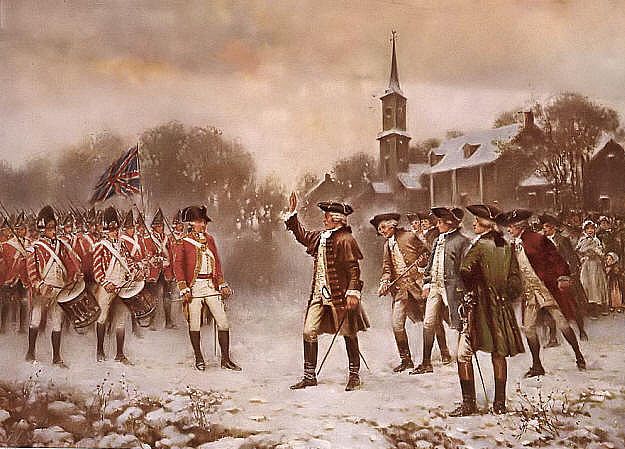
10.

What event is depicted in this image?
a)
Boston Massacre
b)
Saratoga
c)
Lexington and Concord
d)
Yorktown
11.

Which one of these is not an advantage that helped the American patriots defeat Great Britain.
a)
defense of their own land, principles and beliefs
b)
support from France
c)
superior numbers of soldiers and greater experience
d)
strong leadership from men like George Washington
12.

The U.S. was founded on July 4, 1776, by the approval of this document.
a)
the Treaty of Paris
b)
the Constitution
c)
the Declaration of Independence
d)
the Virginia Charter
13.

The location of what event is shown on this map?
a)
Lexington and Concord
b)
First Continental Congress
c)
Saratoga
d)
Yorktown
14.
Early revolutionary battle where 1,000 British troops died and realized the American Colonists were tougher than they though.
a)
Battle of Bunker Hill
b)
Lexington and Concord
c)
Battle of Saratoga
d)
Battle of Yorktown
15.
This type of American Colonist was in support of the British parliament.
a)
Patriot
b)
Loyalist
c)
Yes man
d)
Neutral
16.
The Second Continental Congress addressed the steps to the colonies governing themselves and the creation of what military group?
a)
Colonial militias
b)
Marines
c)
Continental Army
d)
Navy
17.
Who was the first choice to command the Continental Army?
a)
Thomas Jefferson
b)
Benjamin Franklin
c)
Thomas Paine
d)
George Washington
18.
This type of colonist was ready for rebellion and the fight for independence.
a)
Loyalist
b)
Patriot
c)
Neutral
d)
British
19.
Arguably the first "battle" of the Revolutionary War occurred when the Massachusetts Minutemen fired on British troops at -
a)
Boston
b)
Philidelphia
c)
Saratoga
d)
Lexington and Concord
20.
Where were the first armed conflicts of the American Revolution?
a)
Yorktown
b)
Saratoga
c)
Lexington and Concord
d)
Bunker Hill
21.
What was the name of the British king during the American Revolution?
a)
Charles III
b)
George III
c)
William III
d)
James III
22.
This American victory was the turning point in the war.
a)
Saratoga
b)
Yorktown
c)
Bunker Hill
d)
Lexington and Concord
23.
Who was the major author of the Declaration of Independence?
a)
Benjamin Franklin
b)
John Adams
c)
Thomas Jefferson
d)
Patrick Henry
24.
What is another name for British soldiers?
a)
Redcoats
b)
Patriots
c)
Minutemen
d)
Continental Soldiers
25.

What did we call colonists who did NOT want independence from England?
a)
Minutemen
b)
Traitors
c)
Militia
d)
Loyalists
26.

"No ________ without representation"
a)
voting
b)
taxation
c)
rights
d)
liberty poles
27.

Who were the Minutemen?
a)
Patriots who were ready to fight at a minutes notice
b)
British soldiers who were ready to fight at a minutes notice
c)
Sons of Liberty who were ready to fight at a minutes notice
d)
Hessians who were ready to fight at a minutes notice
28.
Which side had more resources and training at the beginning of the war?
a)
British
b)
Colonists
29.
Who won the American Revolution?
a)
The British
b)
The American Colonists
30.

Who fired "the shot heard round the world?"
a)
the British
b)
the minutemen
c)
it is a mystery!
31.
What country joined the colonists to help them win the war?
a)
Germany
b)
France
c)
Netherlands
d)
Africa
32.
Who was the major author of the Declaration of Independence?
a)
Benjamin Franklin
b)
John Adams
c)
Thomas Jefferson
d)
Patrick Henry
33.
Which side had more resources and training at the beginning of the war?
a)
British
b)
Colonists
34.
Was the beginning of the Declaration of Independence that served as the introduction?
a)
Resolution
b)
Virginia Compromise
c)
Preamble
d)
Thesis
35.
Didn’t want independence from England and wanted to remain loyal to the crown?
a)
patriots
b)
bengals
c)
loyalists
d)
nerds
36.
Written by Thomas Paine, this pamphlet sold 500,000 copies and helped sway colonists towards independence
a)
Declaration of Independence
b)
Constitution
c)
2 Treatise of Government
d)
Common Sense
37.
Saw economic opportunity in an independent America? (weren’t loyal)
a)
patriots
b)
bengals
c)
loyalists
d)
nerds
38.
Was the main writer of the Declaration of Independence?
a)
Herbie Hancock
b)
Mr. Dangel
c)
Samuel Adams
d)
Thomas Jefferson
39.
What are rights given to every human being on earth that they get when they are born (include life liberty and pursuit of happiness
a)
divine rights
b)
dynamite rights
c)
natural rights
d)
garrison rights
40.
What was the purpose of the Declaration of Independence
a)
List the Rights of all human beings
b)
Declare Independence from England
c)
Set up a Parliament in the United States
d)
Emphasize rules in the Magna Carta
41.
According to the DOI governments should “derive their powers from”…?
a)
The King
b)
The President
c)
Consent of the Governed
d)
Military
42.
If governments abuse their power the DOI says the people are entitled to do this?
a)
alter or abolish them
b)
move
c)
disobey them
d)
put them in jail
43.
What are “grievances”?
a)
Rules
b)
Laws
c)
Excuses
d)
Formal Complaints
44.
Who were the grievances in the DOI addressed to?
a)
King John
b)
King George III
c)
King Philip
d)
King Henry VIII
45.
Which country had the stronger army
a)
British
b)
Patriots
46.
Much of the patriot army was made up of citizen soldiers called
a)
lobster backs
b)
militias
c)
red coats
d)
mariens
47.
Colonists who sided with the British were known as
a)
patriots
b)
militias
c)
loyalists or torries
d)
lobsterbacks
48.
Professional German soldiers used by the British
a)
sell swords
b)
hessians
c)
militia
d)
lobsterbacks
49.
The defeat of General Burgoyne at this battle would be a major turning point in the war
a)
Philadelphia
b)
Harrisburg
c)
Saratoga
d)
New york
50.
First Battle of the American Revolution was also know as
a)
French and Indian War
b)
7 Years War
c)
Dead Man's Day
d)
Shot Heard Around the World
51.
After the Treaty of Paris 1783, what was the new natural boundary of the United States?
a)
Appalachian Moutains
b)
Ohio River Valley
c)
Mississippi River
d)
Great Lakes
52.
What are your 3 Unalienable Rights, as expressed by Thomas Jefferson?
a)
Peace, Love and Joy
b)
Life, Liberty, and Property
c)
Life, Leadership and Pursuit of Happiness
d)
Life, Liberty and Pursuit of Happiness
53.
Which group is in the correct order?
a)
Yorktown, Valley Forge, Saratoga, Lexington and Concord
b)
Lexington/Concord, Saratoga, Valley Forge, and Yorktown
c)
Lexington/Concord, Valley Forge, Saratoga, and Yorktown
d)
Valley Forge, Yorktown, Lexington/Concord, and Saratoga
54.
The last major battle fought by Washington's army was...
a)
Cowpens
b)
Charleston
c)
Yorktown
d)
Saratoga
55.
The Battle of Lexington and Concord was important because
a)
it was the last battle
b)
it was the first battle
c)
it was the longest battle
56.
What battle was the turning point?
a)
Saratoga
b)
Cowpens
c)
Yorktown
d)
Bunker Hill
57.
What battle was the "shot hear round the world?"
a)
Lexington and Concord
b)
Saratoga
c)
Bunker Hill
d)
Cowpens
58.
Which part of the Declaration means everyone should be treated equally?
a)
All men are created equal
b)
everyone can be free
c)
the people's rights are protected
59.
Why did they write the Declaration of Independence?
a)
colonies were now independent of Britain
b)
declare they were going to have a war
c)
ask for help paying for taxes
60.
Why did France decide to help?
a)
the colonists helped during the French and Indian War
b)
They were also under control of the British
c)
France considered England an enemy, too
61.
Thomas Paine wrote a pamphlet called
a)
Common Sense
b)
Common Nonsense
c)
Everyday Stuff
62.
How did France help win the war?
a)
Send ships, supplies, and soldiers
b)
Send food
c)
They didn't help
63.

Which phrase became popular after passage of the Stamp Act?
a)
“The rights of Englishmen”
b)
“Give me liberty or give me death”
c)
“Life, liberty, and the pursuit of happiness”
d)
“No taxation without representation“
64.

Soldiers froze here because of the harsh winter
a)
Paris
b)
Valley Forge
c)
Rio Grande Valley
d)
Yorktown
65.

Who was the volunteer from France who became Washington’s trusted aide?
a)
Benjamin Franklin
b)
Francis Marion
c)
Marquis de Lafeyette
d)
Thomas Pain
66.

Who commanded the Continental Army?
a)
Henry Knox
b)
John Hancock
c)
Benedict Arnold
d)
George Washington
67.

The French began to support the Americans after this battle
a)
Lexington and Concord
b)
Yorktown
c)
Saratoga
d)
Treaty of French
68.
Why did the colonists decide to rebel against the British?
a)
Colonists didn't like King of England
b)
Colonists were angry about being taxed without voting
c)
King of England didn't allow them to worship
69.
What is partisan warfare that the Patriots fought using?
a)
lining up in open fields and firing
b)
surprise attacks
c)
fighting taking place in swamps
70.
Who won the Revolutionary War?
a)
British
b)
Americans
c)
Native Americans
71.
Patriots were people who ___?
a)
were against British rule
b)
supported British rule
c)
neither side
72.
Colonists supporting the British rule were?
a)
patriots
b)
loyalists
c)
colonists
73.
What did the Declaration of Independence state?
a)
13 colonies wanted to be ruled by British
b)
13 colonies wanted to be ruled by Spain
c)
13 colonies wanted to be free from British rule
74.
When was the Declaration of Independence approved?
a)
July 4, 1776
b)
July 14, 1776
c)
December 25, 1776
75.
Where did the British surrender to the Americans?
a)
York, SC
b)
Yorktown, Virginia
c)
New York City
100 %

