wayground logo

Free Printable Worksheets

NEW

Font size

S
M
L
XL
Worksheets

Semester II Midterm Review: Genetics and Evolution

Total questions: 50

Worksheet time: 40mins

Name
Class
Date
1.
Who is the father of evolution?
a)
Darwin
b)
Mendel
c)
Newton
d)
Einstein
2.
What is another name for natural selection?
a)
survival of the smartest
b)
survival of the fastest
c)
survival of the biggest
d)
survival of the fittest
3.

Evidence for evolution that is the study of organisms at the early stages of development?

a)

DNA studies

b)

embryology

c)

extinction

d)

fossil record

4.
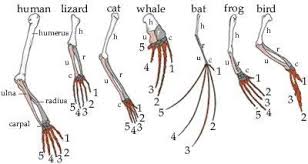
What is this an example of?
a)
vestigial structures
b)
embryology
c)
homologous structures
d)
fossil record
5.
Which layer is the oldest?
a)
1
b)
2
c)
3
d)
4
6.
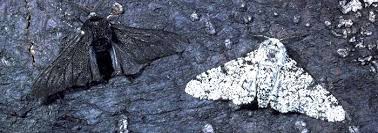
Predict which moth would increase in population
a)
light 
b)
dark
7.
The cause of artificial selection is…
a)
The environment
b)
Humans
c)
Mutation
d)
Gene Flow
8.
Darwin wrote that organisms with traits that are best suited to the environment will ________________
a)
increase in number
b)
become extinct
9.
Which term refers to the process by which individuals that are better suited to the environment survive and reproduce therefore passing down their genes to their offspring? 
a)
Evolution 
b)
Variation 
c)
Adaptation
d)
Natural Selection 
10.
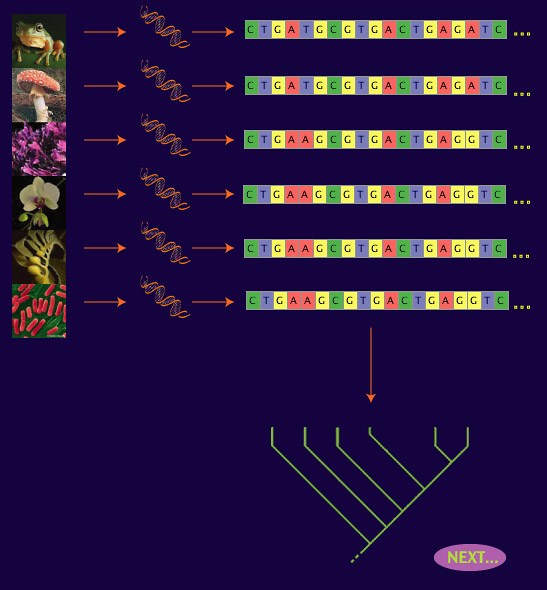
Which species’ DNA is most similar to the DNA of the toothed whale? 
a)
Hippopotamus 
b)
Baleen Whale
c)
Grazing Mammals
d)
Camels
11.
Two organisms that are closely related would have
a)
very similar DNA sequence
b)
exactly the same DNA sequences
c)
no proteins in common
d)
completely different DNA sequence
12.

What are mineralized bone, an imprint or amber that are evidence for evolution.

a)

Ancestors

b)

Skeletons

c)

Fossils

d)

Imprints

13.
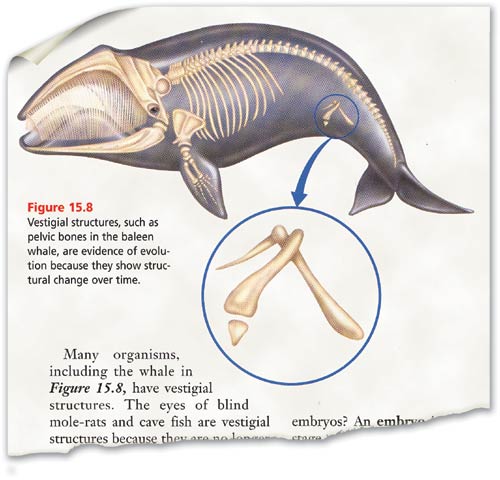
Which of the following is an example of a vestigial structure?
a)
the wings of a red-tailed hawk
b)
the hind limbs of a house cat
c)
the fins of sharks
d)
the tailbone of a human
14.

Which of the following is a term for a group of similar organisms that can interbreed and produce fertile offspring?

a)

individual

b)

population

c)

species

d)

fossil

15.
What is knowing the age of something in comparison to other things?
a)
carbon dating
b)
relative dating
c)
vestigial 
d)
DNA studies
16.
When an organism is completely wiped out of existence, we call it?
a)
extinction
b)
adaptation
c)
evolution
d)
inbreeding
17.
Genetic variation can arise from a random change in the DNA of a gene.  The change is called a(n)
a)
mutation
b)
gene flow
c)
gene pool
d)
allele
18.
This animal is a product of...
a)
Natural Selection 
b)
Environmental Pressures 
c)
Nature 
d)
Artificial Selection 
19.
What type of natural selection is this: When a group of deer migrated to a cold mountain, the thin-furred deer and average-furred deer died. The thick-furred deer survived and eventually the population became thicker-furred.
a)
Disruptive Selection
b)
Directional Selection
c)
Stabilizing Selection
d)
Slippery Selection
20.
Which type of selection does this graph represent?
a)
Disruptive selection
b)
Stabilizing selection
c)
Directional selection
d)
Artificial selection
21.
Which type of selection does this graph represent?
a)
Disruptive selection
b)
Stabilizing selection
c)
Directional selection
d)
Artificial selection
22.
The chance change in a gene pool is called _______?
a)
evolution
b)
natural selection 
c)
genetic drift
d)
genetic equilibrium
23.
A scientists studies a population blue footed boobies on the Galapagos Islands and notices that one population has developed a unique song to attract mates that other populations of the same species do not use.  This can lead to speciation from ________.
a)
behavioral isolation
b)
temporal isolation
c)
geographic isolation
d)
Tri Wizard Cup
24.

The change in a gene pool following a drastic population crash caused by a natural disaster is

a)

founder effect

b)

bottleneck effect

c)

artificial selection

d)

natural selection

25.

Isolation caused by different mating times

a)

temporal

b)

behavioral

c)

geographic

d)

other

26.
Only populations can evolve.
Individuals can not evolve.
a)
True
b)
False
27.
If organisms become more alike, what type of evolution occured
a)
convergent
b)
divergent
c)
co evolution
d)
mutualism
28.
If organisms become less alike, what type of evolution has occurred
a)
convergent
b)
divergent
c)
co-evoluntion
d)
mutualism
29.
If organisms have similar bone structures, this is evidence of
a)
common ancestors
b)
they are the same animal
c)
the have no ancestors
d)
they are different from other animals
30.

Mountains, rivers, and canyons separating populations. This is an example of

a)

geographic isolation

b)

reproductive isolation

c)

symbiosis

d)

pre zygotic conditions

31.
The hypothesis that evolution of a species occurs in periods of rapid change separated by periods of little or no change is called
a)
divergence
b)
gradualism
c)
punctuated equilibrium
d)
isolation
32.
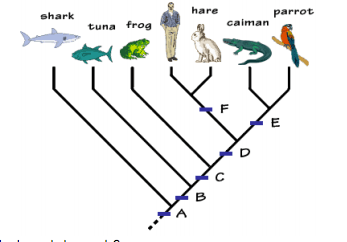
On the cladogram, which organism is the closest relative of the human?
a)
Frog
b)
Hare
c)
Caiman
d)
Parrot
33.
All genes present in a population is called:
a)
Genetic Drift
b)
Gene Flow
c)
Gene Pool
34.
The hypothesis that evolution of a species occurs gradually over time as a slow and constant process is known as
a)
speciation
b)
punctuated equilibrium
c)
gradualism
d)
microevolution
35.
Spontaneous Generation was a theory that tried to explain...
a)
how life came to be from non-life
b)
how species changed over time
c)
how new species came to be
d)
how life got here from outer space
36.
The theory of Endosymbiosis explains
a)
The origin of eukaryotes
b)
How species develop
c)
How bacteria live
d)
Why cells rely on one another
37.

The two-word naming system that gives all organisms their scientific name

a)

binomial nomenclature

b)

biogenesis

c)

phylogeny

d)

spontaneous generation

38.

The theory that living things come only from other living things

a)

binomial nomenclature

b)

biogenesis

c)

homeostasis

d)

spontaneous generation

39.
 Genetic drift is more likely to happen in... 
a)
Aquatic populations
b)
Small populations
c)
Large populations
d)
Older populations
40.

The Earth is about _______________ years old.

a)

4.6 billion

b)

2 billion

c)

200 million

d)

6,000

41.

The first organisms on Earth.

a)

plants

b)

bacteria

c)

humans

d)

reptiles

42.

It is believed that cyano-bacteria released ____________ and changed the atmosphere of Earth.

a)

carbon dioxide

b)

nitrogen

c)

oxygen

d)

methane

43.

When two species evolve in response to each other.

a)

punctuated evolution

b)

Convergent evolution

c)

divergent evolution

d)

co-evolution

44.

What period did the first flowering plants appear?

a)

Cretaceous

b)

Devonian

c)

Paleozoic

d)

Jurassic

45.

Asexual reproduction creates______________, sexual reproduction ___________________.

a)

identical; different

b)

Different; identical

c)

both identical

d)

both unique

46.

Mitosis create ________ cells; Meiosis creates ________ cells.

a)

2; 4

b)

2; 2

c)

4; 2

d)

4;4

47.

A phenotype is

a)

what I see, the physical

b)

the genes

c)

HH

d)

mutations

48.

An example of a homozygous recessive genotype

a)

TT

b)

Tt

c)

tt

d)

BW

49.

R is dominant for round eyes. What percentage of offspring will have almond shaped eyes?

a)

75%

b)

100%

c)

25%

d)

50%

50.

The largest category of Taxonomy is ...

a)

Phylum

b)

Class

c)

Genus

d)

Domain