
 Worksheets
Physical Science Unit 7 LIFT
Total questions: 50
Worksheet time: 1hrs 15mins
Name
Class
Date
1.
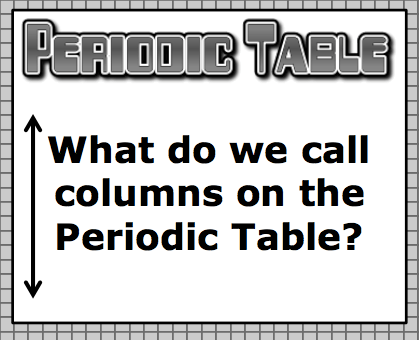
a)
Periods
b)
Groups
2.
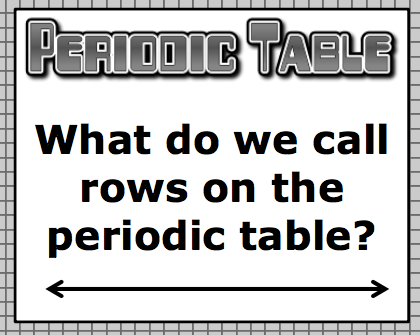
a)
Periods
b)
Groups
3.

a)
energy levels
b)
valence electrons
c)
protons
d)
neutrons
4.
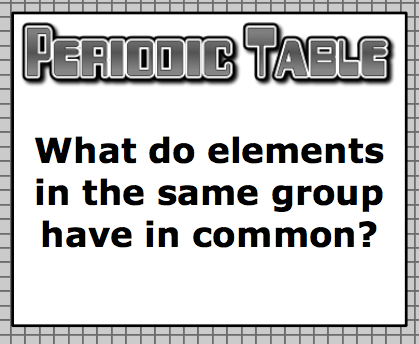
a)
energy levels
b)
valence electrons
c)
protons
d)
neutrons
5.
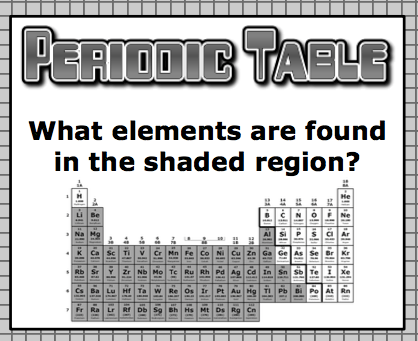
a)
Metals
b)
Nonmetals
c)
Metalloids
6.
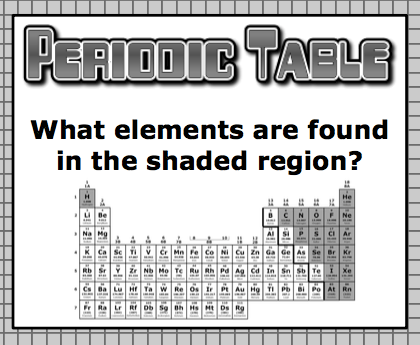
a)
Metals
b)
Nonmetals
c)
Metalloids
7.
What is the Law of Conservation of Mass?
a)
It states that no matter can be created or destroyed.
b)
It states that no energy can be created or destroyed.
c)
It states that matter can be created or destroyed.
d)
It states that no sound can be created or destroyed.
8.
What is a coefficient?
a)
The small number on the right of the chemical symbol.
b)
The large number in front of a chemical formula.
c)
The number in between the chemical symbols.
d)
The number behind a chemical formula.
9.

Is this equation balanced?
a)
yes
b)
no
c)
Not enough information
10.
What goes in the missing blanks?
SnO2 + __ H2 → Sn + __ H2O
SnO2 + __ H2 → Sn + __ H2O
a)
5
b)
1
c)
3
d)
2
11.
What is the little number after an element in a chemical equation called.
Example: H2
Example: H2
a)
Coefficient
b)
Subscript
c)
Atom
d)
Equation
12.
When balancing equations a ____ can be placed to the left of a formula of a substance to make the equations balanced
a)
charge
b)
subscript
c)
random number
d)
coefficient
13.
Which problem is balanced?
(Check ALL answers)
(Check ALL answers)
a)
PbO2 + 2H2
b)
SO2 + H20 --> H2SO4
c)
2Na + 2H2O --> 2NaOH + H2
14.

In this image, what are the information to the right of the arrow (in black) is called the_______.
a)
Product
b)
Reactant
c)
Chemical Subscript
15.
What is the arrow in a chemical equation...
H2 + O --> H2O
H2 + O --> H2O
a)
Reactants
b)
Products
c)
Yields
d)
Chemical Equation
16.
How many valence electrons does hydrogen have?
a)
1
b)
2
c)
3
d)
4
17.
How many valence electrons does calcium have?
a)
2
b)
4
c)
6
d)
7
18.
Nitrogen will ____ electrons when forming an ionic bond.
a)
gain 1
b)
lose 1
c)
gain 3
d)
lose 3
19.
Ionic bonds form between metals and ____.
a)
metalloids
b)
metals
c)
nonmetals
20.
Beryllium will ____ valence electrons when forming an ionic bond.
a)
lose 4
b)
gain 4
c)
lose 2
d)
gain 2
21.

What type of bond is this? Lithium with Fluorine?
a)
ionic
b)
covalent
22.
Which of the following is ionic?
a)
NO2
b)
MgO
c)
CO
d)
CH4
23.
The maximum number of electrons that can be in the outer energy level of most atoms is
a)
2
b)
4
c)
6
d)
8
24.
What two types of atoms make a covalent bond?
a)
2 Nonmetals
b)
1 Nonmetal and 1 Metal
c)
2 Metals
d)
2 Noble Gases
25.
How are covalent bonds explained?
a)
When one atom takes the other atom's electron
b)
When the atom shares an electron with an another atom
c)
When the two nucleus merge
d)
When the neutrons leave the nucleus
26.
Which of the following word pairs correctly completes the sentence below?
_______ are corrosive substances characterized as having a strong smell, a sour taste, and a _______.
_______ are corrosive substances characterized as having a strong smell, a sour taste, and a _______.
a)
Acids; pH less than 7
b)
Acids; pH greater than 7
c)
Bases; pH greater than 7
d)
Bases; pH less than 7
27.
If an acid is combined with a base of equal strength, the result will most likely be
a)
a neutral solution.
b)
a stronger acid.
c)
impossible to tell without testing the pH.
d)
a stronger base
28.
Holly has an unknown substance in a beaker. She wants to determine the relative pH of the unknown substance. She places a piece of blue litmus paper into the substance, and the litmus paper stays blue.
The substance in the beaker
The substance in the beaker
a)
is a base.
b)
has a neutral pH.
c)
is an acid.
d)
does not have a pH.
29.
The pH of a solution is tested, and it is found to be a basic solution. Of the following choices, what could the pH have been?
a)
3
b)
9
c)
7
d)
5
30.
A ___ is formed when an positive ion bonds with a negative ion.
a)
Acid
b)
base
c)
salt
d)
neutral ion
31.
A solution with a pH of 7 is considered a(n) _____.
a)
Acid
b)
Base
c)
neutral solution
d)
salt
32.
An organic substance that changes color in the presence of an acid or base
a)
indicator
b)
inhibitor
c)
catalyst
d)
salt
33.
The positive particles of an atom are
a)
electrons
b)
positrons
c)
neutrons
d)
protons
34.
the central region of an atom where its neutrons and protons are is its
a)
nucleus
b)
electron cloud
c)
core
d)
center
35.
an atom with atomic number 6 would have how many protons
a)
6
b)
12
c)
3
d)
cannot be determined
36.
Particles in an atom that are neutral and have no charge are
a)
negatrons
b)
electrons
c)
neutrons
d)
protons
37.

How many protons does this atom have?
a)
2.5
b)
6
c)
5
d)
10.811
38.
If the number of protons equal the number of _____, the atom will have no charge
a)
protons
b)
neutrons
c)
electrons
d)
nucleus
39.
Fluorine is atomic number 9, and has a mass of 19. How many electrons would it have?
a)
9
b)
6
c)
19
d)
10
40.
Fluorine is atomic number 9, and has a mass of 19. How many neutrons would it have?
a)
9
b)
6
c)
19
d)
10
41.
If an atom temporarily gains or loses one or more electrons, it is considered a/an ___.
a)
ion
b)
isotope
c)
new element
d)
metalloid
42.

What element is this?
a)
Helium
b)
Hydrogen
c)
Argon
d)
Silver
43.

What element is represented in this Bohr Model?
a)
Carbon
b)
Hydrogen
c)
Aluminum
d)
Lithium
44.

How many valence electrons?
a)
2
b)
3
c)
5
d)
10
45.

This could be the dot diagram of
a)
Be
b)
B
c)
C
d)
Ne
46.

This could be the dot diagram of
a)
P
b)
Ar
c)
Na
d)
B
47.
What is the charge of an ion in group 2?
a)
+2
b)
-6
c)
-2
d)
+6
48.
What is the charge of an ion in group 5?
a)
+5
b)
-5
c)
+3
d)
-3
49.
What is the charge of an ion in group 7?
a)
+7
b)
-7
c)
+1
d)
-1
50.
What is the oxidation number of Magnesium (Mg)?
a)
+2
b)
-2
c)
whats an oxidation number
100 %

