
 Worksheets
3rd 9 Week Exam Review
Total questions: 50
Worksheet time: 2hrs 25mins
Name
Class
Date
1.
In the modern periodic table elements are arranged by:
a)
atomic mass
b)
atomic number
c)
valence electrons
d)
number of isotopes
2.
Each column in the periodic table is called a
a)
period
b)
group
c)
cluster
d)
unit
3.
The atomic number tells you what?
a)
number of electrons
b)
number of protons & electrons
c)
number of neutrons
d)
both electrons and protons in an atom.
4.

The atoms along the staircase are called
a)
metals
b)
nonmetals
c)
metalloids
d)
noble gases
5.
what is the definition of chemical change?
a)
any change that results in the formation of new chemical substances.
b)
changing clothes
c)
matter cannot be created or destroyed, only change form
d)
changes affecting the form of a chemical substance, but not its chemical composition.
6.
which one is the definition of chemical property?
a)
a property or characteristic of a substance that is observed during a reaction where the chemical composition of a substance is changed
b)
any change that results in the formation of new chemical substances
c)
combustibility
7.
what is the definition of physical change?
a)
any change that results in the formation of new chemical substances.
b)
rusting
c)
changes affecting the form of a chemical substance, but not its chemical composition.
d)
any property that is measurable, whose value describes a state of a physical system
8.

Photosynthesis is an example of a
a)
physical change
b)
chemical change
9.
Which of the following represents an element?
a)
H2O
b)
H2
c)
NaCl
d)
CaCO3
10.
Which of the following is not a compound?
a)
HCl
b)
Cl
c)
NaCl
d)
CO2
11.
What cannot be broken down into other substances?
a)
Compound
b)
Mixture
c)
Solids
d)
Element
12.
How many elements are represented in the compound?
Na2CO3
Na2CO3
a)
1
b)
2
c)
3
d)
4
13.
A combination of substances that are not chemically combined is called a(n)____________.
a)
mixture
b)
compound
c)
physical
14.
Mixtures are separated through ___________changes.
a)
mixture
b)
compound
c)
physical
15.

The blue numbers in the image below are called ___________.
a)
compounds
b)
coefficients
c)
subscripts
d)
chemical formulas
16.
How is a compound different from a mixture?
a)
Solids, liquids, and gases can form compounds
b)
Each substance in a compound loses its characteristic properties
17.

This picture represents which of the following?
a)
element
b)
compound
c)
mixture
18.

This picture represents which of the following?
a)
element
b)
compound
c)
mixture
19.

This picture represents which of the following?
a)
element
b)
compound
c)
mixture
20.
The four fundamental forces of nature are:
a)
Electromagnetism, Gravity, Strong Nuclear, Weak Nuclear
b)
Gravity, Strong Nuclear, Weak Nuclear, Medium Nuclear
c)
Normal Force, Force due to gravity, Magnetism, Nuclear
d)
Nuclear, Electricity, Gravity, Atomic
21.
Rank the four fundamental forces of nature in order from weakest to strongest:
a)
Electromagnetism, Gravity, Strong Nuclear, Weak Nuclear
b)
Weak Nuclear, Gravity, Electromagnetism, Strong Nuclear
c)
Gravity, Weak Nuclear, Electromagnetism, Strong Nuclear
d)
Weak Nuclear, Electromagnetism, Gravity, Strong Nuclear
22.
Gravity is due to:
a)
the pull between Earth and the moon.
b)
the pull between the Sun and Earth.
c)
the pull between any objects with mass.
d)
the pull between atomic nuclei.
23.
The weakest of the four fundamental forces is:
a)
Gravity
b)
Electromagnetism
c)
Strong Nuclear
d)
Weak Nuclear
24.
The strongest of the four fundamental forces is:
a)
Gravity
b)
Electromagnetism
c)
Strong Nuclear
d)
Weak Nuclear
25.
________ can be either a force of attraction or repulsion while ____________ is only a force of attraction.
a)
Gravity; Electromagnetism
b)
Electromagnetism; Gravity
c)
Gravity; Strong nuclear force
d)
Magnetism; Electricity
26.
Name this reaction, Cl2 + 2KI --> I2 + 2KCl
a)
Synthesis
b)
Single Replacement
c)
Double Replacement
d)
Decomposition
27.
Which type of reaction takes place in the presence of oxygen and produces carbon dioxide and water?
__ +__ --> CO2 + H2O
__ +__ --> CO2 + H2O
a)
double replacement
b)
decomposition
c)
combustion
d)
single replacement
28.
A compound is reacted and forms two new substances. What type of reaction is this?
AB --> A + B
AB --> A + B
a)
combustion
b)
synthesis
c)
decomposition
d)
single replacement
29.

When balancing equations, you can change...
a)
Subscripts only
b)
Coefficients only
c)
Both subscripts & coefficients
d)
None of the above
30.
An element plus additional element reacts to form one product is an example of which type of chemical reaction?
A + B --> AB
A + B --> AB
a)
combustion
b)
decomposition
c)
synthesis
d)
single replacement
31.

In an exothermic reaction, heat is ...
a)
taken in or absorbed
b)
given out or released
32.
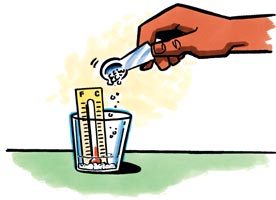
In an endothermic reaction, heat is ...
a)
taken in or absorbed
b)
given out or released
33.

If a chemical reaction is EXOTHERMIC, the temperature would....
a)
Stay the same
b)
Increase
c)
Decrease
34.

Alka-seltzer in water is an example of a
a)
Endothermic reaction
b)
Exothermic reaction
c)
Dissolving a salt
d)
physical change
35.
A wave with a large wavelength will have a ______ frequency and _____ energy
a)
high, low
b)
high, high
c)
low, high
d)
low, low
36.
Select the correct order of waves on the EMS
a)
Radio, Micro, Infra, Visible, Ultra, X-ray, Gamma
b)
Gamma, X-ray, Ultra, Vis, Infra, Micro, Radio
c)
Vis, Micro, Infra, Ultra, X-ray, Gamma, Radio
d)
Micro, Radio, Vis, Infra, Ultra, X-ray, Gamma
37.
Which section of the spectrum is the ONLY one we can see?
a)
X-rays
b)
Visible Light
c)
Gamma Rays
d)
Ultraviolet Rays
38.
Put the visible light colors in order from longest wavelength to shortest wavelength
a)
Violet, Indigo, Blue, Green, Orange, Yellow, Red
b)
Red, Yellow, Green, Orange, Violet, Blue, Indigo
c)
Red, Orange, Yellow, Green, Blue, Indigo, Violet
39.
During an endothermic reaction in a beaker if we are part of the surroundings and touched the beaker, it would feel _______.
a)
Warm
b)
Cold
40.
Chemical reactions always involve energy
a)
TRUE
b)
FALSE
41.
In an exothermic reaction, heat is ...
a)
taken in or absorbed
b)
given out or released
42.
In an endothermic reaction, heat is ...
a)
taken in or absorbed
b)
given out or released
43.
Which of the following is a sign that a chemical reaction has occurred?
a)
change in shape
b)
melting
c)
bubbles of gas appear
d)
dissolving
44.

a)
2
b)
8
c)
3
d)
13
45.

a)
2
b)
3
c)
5
46.

The yellow atoms are called
a)
metals
b)
nonmetals
c)
metalloids
d)
noble gases
47.
What two types of atoms make a covalent bond?
a)
2 Nonmetals
b)
1 Nonmetal and 1 Metal
c)
2 Metals
d)
2 Noble Gases
48.

Atoms gain or lose electrons because they ...
a)
are too full.
b)
want to lose weight.
c)
want a full outer shell.
d)
can
49.

For a given element, the atomic number indicates the number of _____
a)
protons and electrons in the atom
b)
neutron in the nucleus
c)
electrons in the atom
d)
nucleons in the atom
50.

For an atom, the number of electrons is equal to the number of _____
a)
protons
b)
protons plus neutrons
c)
neutrons
d)
nucleons
100 %

