
NEW
Font size
S
M
L
XL
 Worksheets
WINDS Pretest
Total questions: 36
Worksheet time: 37mins
Name
Class
Date
1.
Winds are named for the direction they are blowing from?
a)
True
b)
False
2.
Which statement correctly defines wind?
a)
Wind is the movement of air from an area of low pressure to an area of high pressure
b)
Wind is the movement of air to a colder area in the atmosphere.
c)
Wind is the movement of air from an area of high pressure to an area of low pressure.
d)
Wind is the movement of air pushed around and bouncing off Earth's surface.
3.
Which statement correctly describes the properties of cold air?
a)
less dense and less pressure than warm air
b)
more dense and more pressure than warm air
c)
more dense and less pressure than warm air
d)
less dense and more pressure than warm air
4.
Where does the initial source of energy come from that creates winds?
a)
the moon
b)
the Sun
c)
the Earth's surface
d)
the rotation of the Earth
5.

Why does warm air rise?
a)
Warm air is more dense than cooler air.
b)
Warm air has more pressure than cooler air.
c)
Warm air is less dense than cooler air.
d)
Warm air has a higher dew point than cooler air.
6.
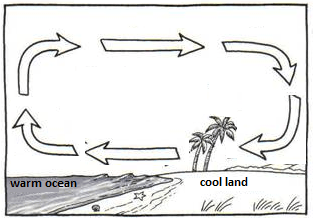
What kind of breeze is this and when would it form?
a)
Land breeze - daytime
b)
Land breeze - nighttime
c)
Sea breeze - daytime
d)
Sea breeze - nighttime
7.
Winds are created by differences in ______
a)
air temperature
b)
air pressure
c)
altitude
d)
humidity
8.
Air always blows from
a)
High pressure to low pressure
b)
Hot air to cold air
c)
low pressure to high pressure
d)
East to west
9.

Which diagram shows the formation of a land breeze?
a)
diagram Y
b)
diagram X
c)
neither
d)
both
10.

Which diagram shows the formation of a sea breeze?
a)
diagram Y
b)
diagram X
c)
neither
d)
both
11.
Why do sea breezes occur during the day?
a)
Water heats up faster than land, so the air above water is warmer.
b)
Water cools off faster than land, so the air above land is cooler.
c)
Land heats up slower than water, so the air stays cooler during the day.
d)
Land heats up faster than water, so the air above land is warmer.
12.
Cold air exerts _____________ pressure than warm air.
a)
the same
b)
less
c)
more
d)
impossible to tell
13.
Which term best describes how the earth's atmosphere is heated?
a)
Spirally
b)
Unevenly
c)
Circularly
d)
Kinetically
14.
What causes warm air to rise?
a)
the fact that it's less dense than cold air
b)
The fact that it weighs more than cold air
c)
The fact that it has higher pressure than cold
d)
the fact that its more dense than cold air
15.
What is the name for cooler air blowing from the land to the sea?
a)
Sea Breeze
b)
Land Breeze
c)
Mountain Breeze
d)
None of the Above
16.
True or False:
Land heats and cools faster than water causing wind and weather.
Land heats and cools faster than water causing wind and weather.
a)
True
b)
False
17.
Trade winds move towards the ____.
a)
Polar regions
b)
Western Hemisphere
c)
Humid subtropical climates
d)
Equator
18.
What is the name for cooler air blowing from the sea to land?
a)
Sea Breeze
b)
Land Breeze
c)
Mountain Breeze
d)
None of the Above
19.
What do you call winds that blow in the same direction all over the Earth?
a)
global winds
b)
Coriolis effect
c)
Greenhouse effect
d)
sea breezes
20.
What winds blow from west to east in the temperate zone and move weather patterns across the United States?
a)
prevailing westerlies
b)
polar easterlies
c)
trade winds
d)
jet streams
21.
What are cold winds that blow from east to west in the polar regions?
a)
polar easterlies
b)
trade winds
c)
prevailing westerlies
d)
jet streams
22.
Global winds over the United States blow in which direction?
a)
east to west
b)
north to south
c)
south to west
d)
west to east
23.
As you climb up a mountain what happens to the air pressure?
a)
decreases
b)
increases
c)
stays the same
24.
Why does a sea breeze at the beach keep you cool and comfortable during the hottest part of the day?
a)
warm air rising over land lets cooler air from the ocean blow in
b)
a storm is approaching
c)
cool air rising over land lets warm air from the ocean blow in
d)
Similarities in temperature between land and water
25.
Wind blows from ______ pressure areas to _____ pressure areas.
a)
high; low
b)
warm; cool
c)
cool; warm
d)
low; high
26.
Uneven heating of the Earth's atmosphere causes which of the following?
a)
Greenhouse Effect
b)
Local and global winds
c)
Infrared Radiation
d)
Global temperature increase
27.
The Westerlies move
a)
from east to west
b)
from west to east
c)
from north to south
d)
south to north
28.
___________is the result of the weight of a column of air pushing on an area.
a)
air pressure
b)
density
c)
volume
d)
none of the above
29.
A _____________ is the scientific instrument used to measure air pressure.
a)
barometer
b)
thermometer
c)
mercury
d)
watch
30.
Warm air sinks, and cold air rises.
a)
True
b)
False
31.
The Coriolis Effect explains why winds don’t blow north to south.
a)
True
b)
False
32.
Why do most weather systems in the United States move from west to east?
a)
The West Coast is at a higher elevation than the East Coast and weather systems go downhill
b)
Prevailing westerlies carry weather systems to the east across most of the United States
c)
The West Coast is warmer and weather systems always move from warmer to colder places
d)
Mountain ranges prevent the movement of weather systems from west to east
33.
Which is true about sea breezes?
a)
They form when both the land and the ocean have cooler temperatures
b)
They form when both the land and the ocean have warmer temperatures
c)
They form because the land warms up more quickly than the cooler ocean waters
d)
They form because the ocean warms up more quickly than the land
34.
Which most affects the path of a weather system in the United States?
a)
the width of the jet stream
b)
the speed of the jet stream
c)
the location of the jet stream
d)
the temperature of the jet stream
35.
Which is the best explanation for how air masses move across the United States?
a)
The prevailing westerlies move air masses from west to east across the United States but may be deflected by the jet stream
b)
The trade winds move air masses from west to east across the United States
c)
The jet stream moves air masses from the Pacific Ocean across the United States
d)
The warm air of the Gulf Stream causes air masses to move from the Atlantic Ocean to the Pacific Ocean
36.
What will most likely result when the jet stream moves south of North Carolina?
a)
North Carolina will experience tropical weather conditions
b)
North Carolina will experience hot, dry weather
c)
North Carolina will experience mild weather
d)
North Carolina will experience cold weather
Reset

