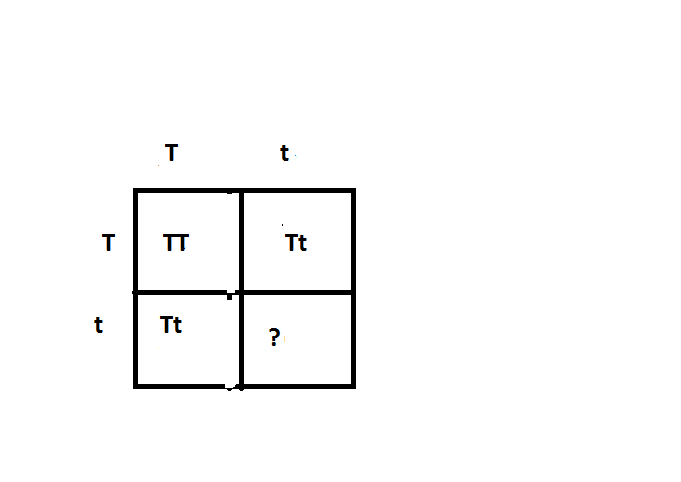
Wayground logo

Free Printable Worksheets

Font size

S
M
L
XL
Worksheets

Genetics

Total questions: 50

Worksheet time: 28mins

Name
Class
Date
1.

The passing of traits from parent to offspring.

a)

genetics

b)

heredity

c)

genotype

2.

The Father of Genetics who used pea plants for the study

a)

James Watson

b)

Francis Crick

c)

Rosalind Franklin

d)

Gregor Mendel

3.

Genetic makeup of an organism

a)

genotype

b)

phenotype

c)

heterozygous

4.

The way an organism looks

a)

phenotype

b)

homozygous

c)

genotype

5.

An organism with two alleles that are the same

a)

homozygous

b)

heterozygous

c)

hybrid

6.

An organism that has two different alleles for a trait

a)

heterozygous

b)

phenotype

c)

homozygous

7.

This is an example of a heterozygous trait

a)

Dd

b)

dd

c)

DD

8.

This is an example of a phenotype trait

a)

dimples

b)

TT

c)

Tt

9.

What is the difference between a dominant and a recessive trait?

a)

A dominant trait will cover up the recessive trait.

b)

A dominant trait is weaker than the recessive trait.

c)

Both have the same effect on the organism.

10.

A mother with the genotype Bb and a father with the genotype bb produce an offspring. What is the percentage that the offspring will gave the genotype Bb and bb?

a)

50 %; 50%

b)

75%; 25%

c)

100%; 100%

11.

An example of a homozygous dominant genotype would be...

a)

HH

b)

Hh

c)

hh

d)

XHXh

12.

An example of a homozygous recessive genotype would be

a)

HH

b)

Hh

c)

hh

d)

XHXH

13.

How many X chromosomes does a male have?

a)

1

b)

2

c)

3

d)

4

14.

How many X chromosomes does a female have?

a)

1

b)

2

c)

3

d)

4

15.

Red flower and white flower making a pink flower is an example of

a)

codominance

b)

incomplete dominance

c)

polygenic traits

d)

multiple alleles

16.
A homozygous dominant dog with brown fur is crossed with a heterozygous dog with brown fur. What are the percentages of the possible genotypes?
a)
100% BB
b)
75% BB and 25%Bb
c)
50 % BB and 50% Bb
d)
50% Bb and 50% bb
17.
An allele whose trait only shows up when no dominant allele is present.
a)
hidden allele
b)
dominant allele
c)
recessive allele
d)
present allele
18.
Two heterozygous (Tt) tall pea plants are crossed. Which describes their offspring?
a)
50% tall and 50% short
b)
75%tall and 25% short
c)
100%short
19.
How many affected females are present? 
a)
1
b)
2
c)
3
d)
4
20.
How many offsprings did generation 2 have? 
a)
5
b)
8
c)
9
d)
10
21.
Complex molecule that carries genetic information that defines an organism's traits. It is stored in the nucleus.
a)
DNA
b)
protein
c)
RNA
d)
glucose nucleic acid (GNA)
22.
Dominant alleles are represented by a:
a)
Male gene
b)
lowercase letter
c)
recessive trait
d)
capital letter
23.
Aa, DD, bB, yy are all examples of
a)
genotypes
b)
phenotypes
24.
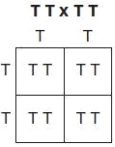
T - tall and t = short
In the punnett square below, what belongs in the missing square
a)
tt
b)
Tt
c)
Bb
d)
TT
25.
What ratio of the offspring from the cross shown will be homozygous recessive for the  trait of tallness? 
a)
0 in 4
b)
1 in 4
c)
2 in 4
d)
4 in 4
26.
Sex cells are produced through the process of
a)
mitosis
b)
cytokinesis
c)
binary fission
d)
meiosis
27.
A human usually has _____ total chromosomes.
a)
6
b)
22
c)
4
d)
46
28.
What are the 4 nitrogen bases?
a)
adenine, thymine, cytoplasm, and guanine
b)
adenine, thymine cytosine, and guanine
c)
adenine, thymine, cytosine, and gylcerol
d)
adenine, thymine, cytosine, and glucose
29.
Adenine bonds with ______________.
a)
Guanine
b)
Thymine
c)
Cytosine
d)
Adenine
30.
Guanine bonds with ______________.
a)
Adenine
b)
Guanine
c)
Cytosine
d)
Thymine
31.
Which 2 molecules forms the sides (backbone) of the DNA ladder?
a)
deoxyribose and adenine
b)
deoxyribose and a hydrogen bond
c)
sugar and the nucleus
d)
deoxyribose (sugar) and phosphate
32.
The hereditary material in corn plants can be altered by scientists so the plants produce more corn.  Which term identifies this process?
a)
cloning
b)
ecological succession
c)
natural selection
d)
genetic engineering
33.
This produces 2 identical cells.
a)
mitosis
b)
meiosis
34.
Any change in the sequence of DNA is...
a)
transgenic shift
b)
Single Genotype
c)
Monohybrid Trait
d)
Mutation
35.
Are all mutations bad?
a)
Yes
b)
No
36.
How many individuals are there in the 3rd generation?
a)
2
b)
3
c)
4
d)
6
37.
How many parents do you have in asexual reproduction?
a)
1
b)
2
c)
3
d)
4
38.
How many parents do you have in sexual reproduction
a)
1
b)
2
c)
3
d)
4
39.
In asexual reproduction the offspring look ________ as their parent.
a)
identical
b)
different
c)
the opposite
d)
happy
40.
Which process ends with two daughter cells?
a)
Mitosis
b)
Meiosis
41.
A form of asexual reproduction
a)
Mitosis
b)
Meiosis
c)
Both Mitosis and Meiosis
42.
Occurs in bacteria, sponges, starfish
a)
asexual
b)
sexual
c)
both
43.
Occurs in humans, birds, and dogs
a)
asexual
b)
sexual 
c)
both
44.
___________________________ is the study of how traits are passed on, or inherited.
a)
dominant traits
b)
ratio
c)
phenotype
d)
genetics
45.
When humans breed purebred dogs to look a certain way and have traits that they like, this is an example of ___________________________
a)
Probably Breeding
b)
Sectional Breeding
c)
Selective Breeding
d)
Suspended Breeding
46.
A chart that shows all the possible combinations of alleles that can result from a genetic cross
a)
Gene
b)
Pedigree
c)
Punnett Square
d)
Dominant
47.
Process by which humans cross organisms to produce offspring with certain desirable traits
a)
Homozygous
b)
Selective Breeding
c)
Mutation
d)
Carrier
48.
Original: ATC CAT
Mutation: ATC GCAT
What mutation occurred?
a)
deletion
b)
insertion
c)
silent
d)
transverse
49.
Original DNA: CAT GAT
New DNA: CAT AT
What mutation occurred?

a)
deletion
b)
substitution 
c)
tranverse
d)
insertion
50.
Examples of environmental mutagens include:
a)
Chemicals
b)
Radiation
c)
Viruses
d)
All of these