
 Worksheets
Science STAAR Review Category 1: Properties of matter and energy
Total questions: 65
Worksheet time: 53mins
Name
Class
Date
1.
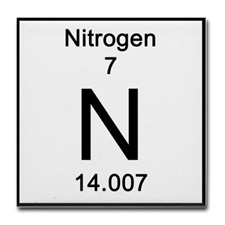
What is the number of protons that the element in this image contain?
a)
14
b)
7
c)
15
d)
18
2.

What is the atomic mass of "F"
a)
9
b)
18
c)
17
d)
19
3.
The positive particles of an atom are
a)
electrons
b)
positrons
c)
neutrons
d)
protons
4.
the central region of an atom where its neutrons and protons are is its
a)
nucleus
b)
electron cloud
c)
core
d)
center
5.
an atom with atomic number 6 would have how many protons
a)
6
b)
12
c)
3
d)
cannot be determined
6.
Particles in an atom that are neutral and have no charge are
a)
negatrons
b)
electrons
c)
neutrons
d)
protons
7.
Which of the following is a negatively charged subatomic particle?
a)
Electron
b)
Proton
c)
Neutron
d)
Quark
8.
The particles that are found in the nucleus of an atom are
a)
neutrons and electrons
b)
electrons only
c)
protons and neutrons
d)
protons and electrons
9.
The atomic number of an elements is the total number of which particles in the nucleus?
a)
neutrons
b)
protons
c)
electrons
d)
protons and electrons
10.
Which of the following is a positively charged subatomic particle found in the nucleus of an atom?
a)
Electron
b)
Proton
c)
Neutron
d)
Quark
11.
Which of the following is a subatomic particle with no charge that is found in the nucleus of an atom?
a)
Electron
b)
Proton
c)
Neutron
d)
Quark
12.
Where are electrons of an atom found?
a)
Nucleus
b)
Electron Cloud
c)
Some are in the nucleus and some in the electron cloud.
d)
They are moving everywhere.
13.
electrons have this type of charge?
a)
negative
b)
positive
c)
neutral
14.
What is the atomic number for an element with three protons?
a)
2
b)
1
c)
3
d)
6
15.
A particle that moves around the nucleus is a(n)...
a)
Proton
b)
Neutron
c)
Electron
d)
Quark
16.
Most of the mass in an atom is concentrated in the...
a)
electrons
b)
nucleus
c)
protons
d)
empty space
17.
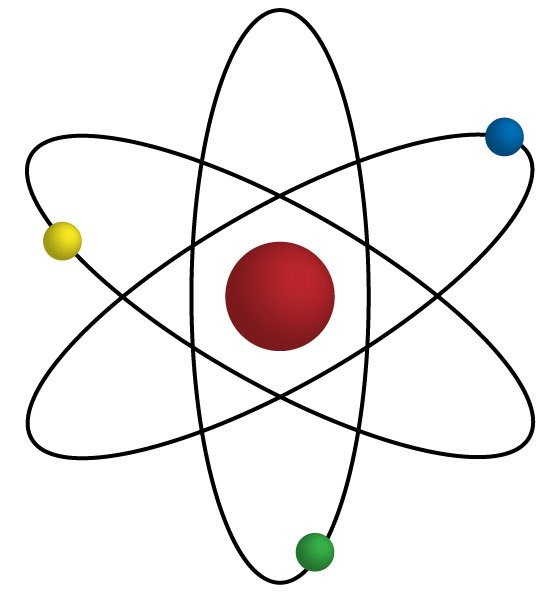
What are the 3 particles that make-up the atom?
a)
protons, neutrons, and isotopes
b)
neutrons, isotopes, and electrons
c)
positives, negatives, and electrons
d)
protons, neutrons, and electrons
18.

What does the 1.00794 stand for?
a)
Hydrogen
b)
atomic number
c)
atomic mass
d)
atomic explosion
19.
If an atom has 10 protons, 10 neutrons, and 10 electrons, what is the mass of the atom?
a)
10
b)
20
c)
30
20.
Which subatomic particles contribute the most to the mass of an atom?
a)
Protons, Neutrons, Electrons
b)
Protons only
c)
Protons and Electrons
d)
Protons and Neutrons
21.

Which is an electron?
a)
A
b)
B
c)
C
22.

Which is a neutron?
a)
A
b)
B
c)
C
23.

Which item on this element square is the chemical symbol?
a)
Copper
b)
29
c)
Cu
d)
63.546
24.

a)
2
b)
8
c)
3
d)
13
25.

a)
2
b)
3
c)
5
26.

a)
1
b)
2
c)
3
d)
4
27.

What's a valence electron?
a)
electrons in the second energy level
b)
electrons in the outermost energy level
c)
the atomic number
d)
electrons in the first level
28.
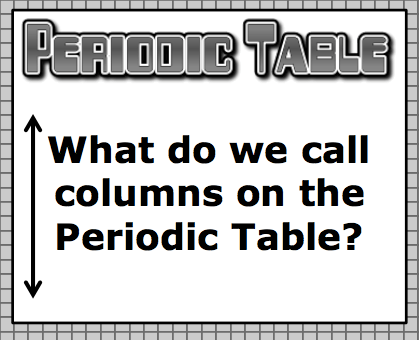
a)
Periods
b)
Groups
29.
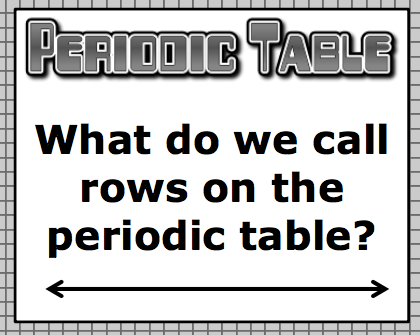
a)
Periods
b)
Groups
30.
Which group of the periodic table is composed of inert (not reactive) gases?
a)
alkali metals
b)
alkaline earth metals
c)
halogens
d)
noble gases
31.
Elements which are shiny, conduct electricity and heat are called
a)
metal
b)
nonmetal
c)
metalloid
d)
nonexistent
32.

The atoms along the staircase are called
a)
metals
b)
nonmetals
c)
metalloids
d)
noble gases
33.

In what section would Transition Metals be found?
a)
orange
b)
light blue
c)
blue
d)
white
34.

What section is the least reactive?
a)
yellow
b)
red
c)
dark blue
d)
orange
35.

Nonmetals are located in what section of this periodic table?
a)
Blue
b)
Yellow
c)
Pink
36.
What does the atomic mass tell you?
a)
Basically,the number of electrons and protons
b)
The number of neutrons
c)
Basically, the number of protons and neutrons
d)
The number of protons.
37.
How many elements are in C6H12O6?
a)
1
b)
2
c)
3
d)
4
38.
How many atoms of carbon (C) are in C6H12O6?
a)
3
b)
6
c)
12
d)
24
39.
Element or compound?
H2O
H2O
a)
element
b)
compound
40.
Element or compound?
O2
O2
a)
Element
b)
Compound
41.
Which of the following is a compound?
a)
Co
b)
O2
c)
C
d)
CO2
42.
How many elements are in H2O?
a)
1
b)
2
c)
3
d)
4
43.

What is the arrow pointing to?
a)
coefficient
b)
subscript
c)
banana
d)
a number
44.

What are the arrows pointing to?
a)
coefficient
b)
subscript
c)
pineapple
d)
a number
45.
What is the Law of Conservation of mass?
a)
Mass is created in a chemical reaction
b)
Mass is created in a physical change
c)
New chemicals formed from a chemical reaction have a larger overall mass than the original reactants
d)
Mass is never created or destroyed
46.
A chemical reaction is balanced when
a)
both sides have the same elements
b)
Both sides have the same number of atoms
c)
Same subscripts
d)
Same coefficients
47.
The number in front of a compound or element is a
a)
Subscript
b)
Coefficient
c)
Superscript
d)
Charge
48.
The number to the lower side of an element is a
a)
Subscript
b)
Superscript
c)
Coefficient
d)
Charge
49.
How many nitrogen atoms does NH3 have?
a)
1
b)
2
c)
3
d)
4
50.

How many oxygen atoms are in this chemical formula?
a)
6 oxygen atoms
b)
2 oxygen atoms
c)
3 oxygen atoms
d)
4 oxygen atoms
51.
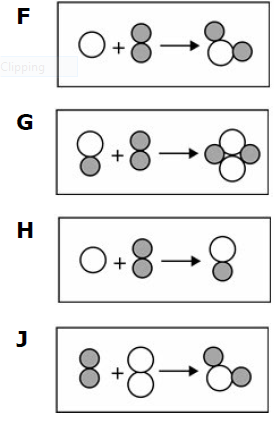
Which of the following models best demonstrates a balanced chemical equation?
a)
F
b)
G
c)
H
d)
J
52.
Two clear colorless solutions were combined.
The student observed that the temperature changed from 25 •C to 23 •C when the solutions were combined and that a white substance rapidly formed and settled to the bottom of the container. What most likely happened to produce these results?
The student observed that the temperature changed from 25 •C to 23 •C when the solutions were combined and that a white substance rapidly formed and settled to the bottom of the container. What most likely happened to produce these results?
a)
One of the original compounds came out of solution
b)
The solutions reacted chemically
c)
Some of the water froze into ice crystals
d)
Rapid evaporation of water occurred, leaving a solid
53.
Coal contains carbon and other elements. Carbon dioxide forms when coal burns in the presence of oxygen. Which of these is the best evidence that a chemical reaction occurs when coal burns?
a)
The shape of the coal changes
b)
Oxygen is present
c)
A new substance is produced
d)
Coal is made up of more than one element
54.

a copper penny turning greenish after a few years.
a)
Chemical Change
b)
Physical Change
55.
Which of the following IS a physical change?
a)
Getting a haircut
b)
Rusty metal
c)
sour milk
d)
A compound
56.
Which of the following is a physical change?
a)
A rusting bike
b)
Folding paper
c)
Fireworks
d)
Baking a cake
57.
When a scientist mixed two chemicals, an exothermic reaction takes place. Which of the following would be proof that the reaction was exothermic?
a)
a change of color
b)
a change of state
c)
a temperature decrease
d)
a temperature increase
58.
Which of the following represents a chemical change?
a)
cutting a piece of paper with scissors
b)
cooling a mixture of air and kerosene vapor to obtain liquid kerosene
c)
burning a piece of notebook paper in the presence of oxygen
d)
heating water over a flame to its boiling point
59.
How many F atoms are in this compound?
6MgF2
6MgF2
a)
2
b)
6
c)
8
d)
12
60.

An gel ice pack getting cold after you put it in the freezer for an hour.
a)
Chemical Change
b)
Physical Change
61.
In the modern periodic table elements are arranged by:
a)
atomic mass
b)
atomic number
c)
valence electrons
d)
number of isotopes
62.

How many protons are in Beryllium?
a)
4
b)
9
c)
5
d)
2
63.
Why is water NOT on the periodic table?
a)
It is naturally occuring
b)
It is a compound, not an element
c)
It exists as a solid, a liquid, and a gas
d)
Its chemical formula doesn't fit
64.
How many electrons can the second electron shell hold?
a)
2
b)
8
c)
16
d)
18
65.
1st shell of an atom can hold maximum of
a)
2
b)
4
c)
6
d)
8
100 %

