
 Worksheets
Pedigrees Practice
Total questions: 40
Worksheet time: 24mins
Name
Class
Date
1.

In the second generation-how many people are carriers of the trait?
a)
2
b)
3
c)
5
d)
6
2.

Examine the pedigree. The allele for the presence of a widow’s peak is dominant. Therefore, we can tell from the chart that in the couple labeled 2:
a)
the male is heterozygous and the female is homozygous.
b)
the male is homozygous and the female is heterozygous.
c)
the male is homozygous and the female is homozygous.
d)
the male is heterozygous and the female is heterozygous.
3.

How are individuals III-2 and II-4 related?
a)
Cousins
b)
Dad and Daughter
c)
Uncle and Niece
d)
Grandpa and Granddaughter
4.

Why do all the daughters in Generation II carry the colorblind gene?
a)
Because mom passed on the gene.
b)
Because dad passed on the X chromosome.
c)
Because their brother has it.
d)
Because their brother gave it to them.
5.

Why does individual IV-7 have colorblindness?
a)
Because his mom is a carrier.
b)
Because his dad has it.
c)
Because his siblings have it.
d)
Because his uncle has it.
6.

Give the genotype for person III-3
a)
GG
b)
Gg
c)
gg
7.

Give the genotype for person II-1
a)
GG
b)
Gg
c)
gg
8.

Which individual in the first generation is a carrier?
a)
The male
b)
The female
c)
individual 1
d)
None of the above
9.

If this pedigree shows a recessive disorder, what MUST the genotype of individual II-3 be?
a)
HH
b)
Hh
c)
hh
d)
None of the above
10.

What is the mode of inheritance shown here?
a)
Recessive
b)
Sex Linked
c)
Dominant
11.

What type of heredity is shown in the pedigree?
a)
Autosomal
b)
Sex-Linked
12.

Is this trait (the shaded individuals) dominant or recessive?
a)
dominant
b)
recessive
13.
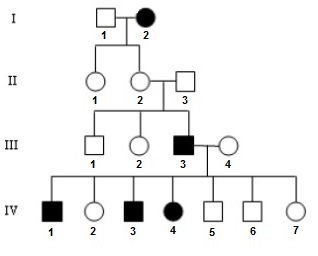
This pedigree represents the inheritance of hemophilia in this family. How many of the females have the hemophilia trait?
a)
8
b)
5
c)
2
d)
3
14.
Is this trait (the shaded individuals) dominant or recessive?
a)
dominant
b)
recessive
15.

What type of heredity is shown in the pedigree?
a)
Sex-Linked Dominant
b)
Sex-Linked Recessive
c)
Autosomal Dominant
d)
Autosomal Recessive
16.

What type of heredity is shown in the pedigree?
a)
Sex-Linked Dominant
b)
Sex-Linked Recessive
c)
Autosomal (normal) Dominant
d)
Autosomal (normal) Recessive
17.

What type of heredity is shown in the pedigree?
a)
Sex-Linked Dominant
b)
Sex-Linked Recessive
c)
Autosomal Dominant
d)
Autosomal Recessive
18.

What type of heredity is shown in the pedigree?
a)
Sex-Linked Dominant
b)
Sex-Linked Recessive
c)
Autosomal Dominant
d)
Autosomal Recessive
19.
Is the following genotype homozygous or heterozygous?
TT
TT
a)
homozygous
b)
heterozygous
20.

The genotype of the affected son and daughter at the bottom of this pedigree...
a)
could be homozygous dominant
b)
could be homozygous recessive
c)
could be heterozygous
d)
Can't tell
21.

How many children did I-3 and I-4 have?
a)
2
b)
3
c)
4
d)
5
22.
How are individuals III-2 and II-4 related?
a)
Cousins
b)
Dad and Daughter
c)
Uncle and Niece
d)
Grandpa and Granddaughter
23.
If hemophilia is a sex-linked recessive trait, what genotype would individual III-3 have?
a)
XBXb
b)
XbXb
c)
XBY
d)
XbY
24.
If hemophilia is a sex-linked recessive trait, what genotype would individual IV-2 have?
a)
XBXb
b)
XbXb
c)
XBY
d)
XbY
25.

Which members of this family are afflicted with (have) Huntington's Disease?
a)
I-1, II-2, II-3, II-7, and III-3
b)
I-1, I-2, II-3, II-7, and III-5
c)
I-1, I-3, II-8, and III-2
d)
I-2, II-1, II-4, II-5, II-6, II-8, III-1, III-2, III-4, and III-5
26.

Huntington's Disease is a dominant trait.
What is the correct genotype for individual I-2?
What is the correct genotype for individual I-2?
a)
HH
b)
Hh
c)
hh
d)
H_
27.

What is the genotype for individual IV-3?
a)
TT
b)
Tt
c)
tt
d)
T_
28.

What is the genotype for individual III-2?
a)
TT
b)
Tt
c)
tt
d)
T_
29.

Does this pedigree show a dominant or recessive trait?
a)
Dominant
b)
Recessive
30.

Is it possible for individual IV-2 to be a carrier? Why?
a)
No, because her parents don't have the trait.
b)
No, because she doesn't have the trait.
c)
Yes, because her siblings have it.
d)
Yes, because her parents are carriers.
31.

From this pedigree, give the genotype for person II-1
a)
GG
b)
Gg
c)
gg
d)
G_
32.

What type of trait is shown in the pedigree? (look at the difference between males and females)
a)
Autosomal Recessive
b)
Sex-Linked
c)
Autosomal Dominant
33.
This pedigree shows the inheritance of colorblindness.
What is the genotype for individual III-5?
What is the genotype for individual III-5?
a)
XBXB
b)
XBXb
c)
XBY
d)
XbY
34.
This pedigree shows the inheritance of colorblindness.
What is the genotype for individual III-4?
What is the genotype for individual III-4?
a)
XBXB
b)
XBXb
c)
XBY
d)
XbY
35.

What is the phenotype of IV-3?
a)
IBIB
b)
IBi
c)
IAIB
d)
Could be IBIB or IBi
36.
What is the phenotype of III-3?
a)
IBIB
b)
IBi
c)
IAIB
d)
Could be IBIB or IBi
37.
What is the phenotype of II-4?
a)
IBIB
b)
IBi
c)
IAIB
d)
Could be IBIB or IBi
38.
What is the phenotype of I-2?
a)
IBIB
b)
IBi
c)
IAIB
d)
Could be IBIB or IBi
39.
What is the phenotype of III-2?
a)
IAIA
b)
IAi
c)
IAIB
d)
Could be IAIA or IAi
40.
What is the phenotype of III-1?
a)
IAIA
b)
IAi
c)
IAIB
d)
Could be IAIA or IAi
100 %

