wayground logo

Free Printable Worksheets

NEW

Font size

S
M
L
XL
Worksheets

Reproduction, Heredity, and Evolution

Total questions: 50

Worksheet time: 38mins

Name
Class
Date
1.

Mitosis produces cells that are genetically different.

a)

True

b)

False

2.

This type of reproduction involves two parents.

a)

Asexual reproduction

b)

Sexual reproduction

3.

Which answer choice is NOT a type of asexual reproduction?

a)

budding

b)

fragmentation

c)

fertilization

d)

binary fission

4.

Which type of reproduction produces an identical copy of the parent?

a)

Sexual reproduction

b)

Asexual reproduction

5.

What is the purpose of MITOSIS?

a)

to create sex cells

b)

to kill off body cells

c)

to repair or replace body cells

6.

In sexual reproduction, how much DNA is given by each parent?

a)

10%

b)

30%

c)

100%

d)

50%

7.
How many parents do you have in sexual reproduction
a)
1
b)
2
c)
3
d)
4
8.
How much DNA do you receive from one parent in asexual reproduction?
a)
25%
b)
50%
c)
75%
d)
100%
9.
In asexual reproduction the offspring look ________ as their parent.
a)
identical
b)
different
c)
the opposite
d)
as happy
10.
Dominant or recessive?
tt
a)
Dominant 
b)
Recessive
11.
Dominant or recessive?
Dd
a)
Dominant
b)
recessive
c)
neither
d)
homozygous
12.
the passing of genetic traits from parent to offspring.
a)
heredity
b)
trait
c)
gene
d)
allele
13.
Dominant alleles are represented by a:
a)
Male gene
b)
lowercase letter
c)
recessive trait
d)
capital letter
14.
AA and Aa always show up as
a)
dominant
b)
recessive
15.
aa always shows up as
a)
dominant
b)
recessive
16.
The purpose of selective breeding is to 
a)
Get bigger animals
b)
get smaller animals
c)
create animals with desirable traits
d)
create animals with bad traits
17.
The evolution of dogs from wolves is due to:
a)
Natural Selection
b)
Sexual Selection
c)
Artificial Selection
d)
Vestigial Structures
18.

Which statement explains how a population’s genetic variability and diversity can be affected by selective breeding?

a)

Genetic variability and diversity decrease because only select individuals are bred.

b)

Genetic variability and diversity increase because only select individuals are bred.

c)

Genetic variability increases and diversity decreases because only select individuals are bred.

d)

Genetic variability decreases and diversity increases because only select individuals are bred.

19.

What word describes a trait that helps an organism survive in its environment?

a)

natural selection

b)

mutation

c)

camouflage

d)

adaptation

20.
Which organisms are most likely to survive?
a)
the best adapted
b)
the fastest
c)
the strongest
d)
the most domesticated (tamed)
21.
Almost all adaptations started off as?
a)
selective breeding
b)
physiological
c)
structural
d)
mutation
22.
Which of the following means "genetic change over time"
a)
natural selection
b)
speciation
c)
evolution
d)
fitness
23.
Do organisms "decide" to evolve and change?
a)
Yes, they know they need to change to survive 
b)
No, they change because of natural selection
24.
Why are advantageous traits more likely to be passed onto offspring?
a)
Because they are more likely to survive and reproduce.
b)
Because they come from dominant alleles.
c)
Because they come from recessive alleles.
d)
Because the trait is an acquired phenotype.
25.
What is another name for natural selection?
a)
survival of the smartest
b)
survival of the fastest
c)
survival of the biggest
d)
survival of the fittest
26.
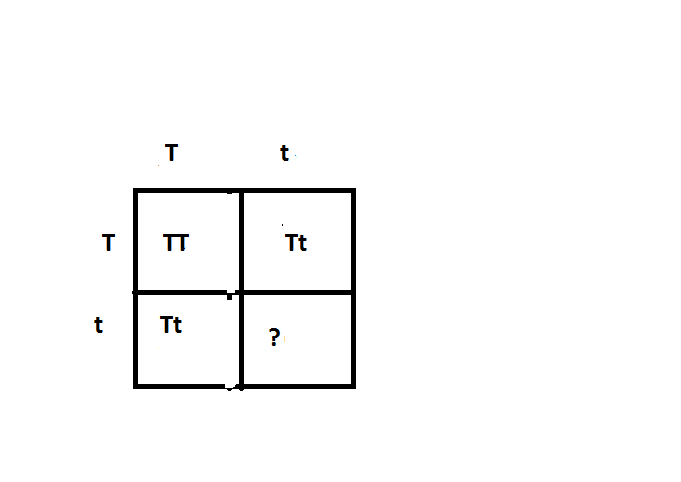
T - tall and t = short
In the punnett square below, what belongs in the missing square
a)
tt
b)
Tt
c)
Bb
d)
TT
27.
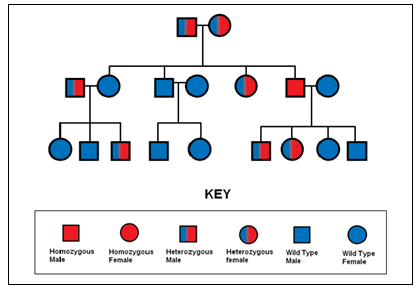
In a pedigree, what shape represents a male?
a)
circle
b)
square
c)
triangle
d)
diamond
28.
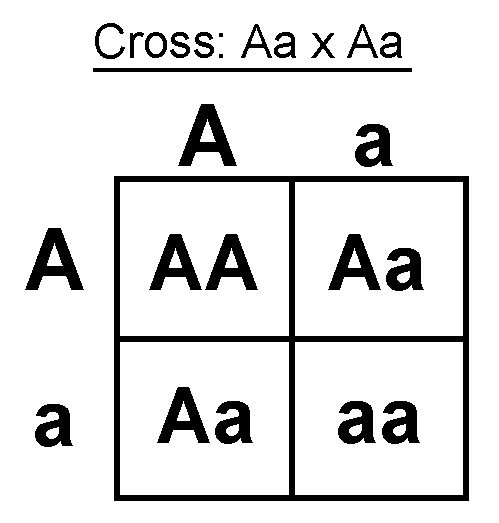
Each one of the boxes on the Punnett Square represents what probability of an offsprings' genotype?
a)
25%
b)
1%
c)
10%
d)
0%
29.
What is the phenotype of the offspring? (A-Brown hair; a-blond hair) 
a)
50 % Brown Hair and 50% Blond Hair 
b)
25 % Brown Hair and 75% Blond Hair 
c)
75 % Brown Hair and 25% Blond Hair 
d)
0% Brown Hair and 100% Blond Hair 
30.
In the second generation-how many people are carriers of the trait?
a)
2
b)
3
c)
5
d)
6
31.
How many individuals are there in the 3rd generation?
a)
2
b)
3
c)
4
d)
6
32.
What do we use pedigrees for?
a)
To look at families
b)
To make determinations about the offspring
c)
To track traits in families
d)
Nothing
33.
The joining of a sperm cell and an egg cell is called...
a)
Fertilization
b)
Labor
c)
Zygote
d)
STOP ASKING ME THESE IMPOSSIBLE QUETSIONS!!
34.
What is an advantage of sexual reproduction?
a)
Allows genetic variation
b)
Only needs one parent
c)
Happens very quickly
d)
Offspring are exact copies of parent
35.
External fertilization is common for organisms that live in:
a)
Trees
b)
Water
c)
Land
d)
Ummm, I'm pretty sure you didn't teach us this...
36.
Growth of embryo inside the body of the female parent 
a)
Internal Fertilization
b)
External Fertilization
c)
Internal Development
d)
External Devlopment
37.
Growth of embryo outside the body of the parent organism (water and land)
a)
Internal Fertilization
b)
External Fertilization
c)
Internal Development
d)
External Devlopment
38.
Gametes join inside the female reproductive tract (Land adaptation)
a)
Internal Fertilization
b)
External Fertilization
c)
Internal Development
d)
External Devlopment
39.
The diagram below shows a cellular process that occurs in organisms.
What is the name of this process?
a)
meiosis
b)
mitosis
c)
endocytosis
d)
phagocytosis
40.

The diagram on the right represents an event in human reproduction. The numbers on the diagram represent the number of

a)

genes

b)

cells

c)

chromosomes

d)

DNA

41.

Identify the sexual reproductive process represented at A.

a)

development

b)

asexual reproduction

c)

fertilization

d)

regeneration

42.

In mice, the gene for black fur, B, is dominant over the gene for white fur, b. The Punnett square below shows the probability of the results of a cross between two mice, BB 􏰀 Bb. How many of the offspring will be black?

a)

0%

b)

25%

c)

50%

d)

100%

43.

Which sequence lists the hereditary material

found inside cells from the smallest unit to the

largest unit?

a)

chromosome → gene → nucleus

b)

chromosome → nucleus → gene

c)

gene → nucleus → chromosome

d)

gene → chromosome → nucleus

44.

The hereditary material in corn plants can be

altered by scientists so the plants produce more

corn. Which term identifies this process?

a)

genetic engineering

b)

natural selection

c)

selective breeding

d)

evolution

45.

The diagram shows compares two kinds of reproduction. Which of the following statements is true?

a)

Both diagrams show sexual reproduction

b)

Both diagrams show asexual reproduction

c)

One diagram shows sexual reproduction, and the other shows asexual reproduction

d)

You cannot determine whether the diagrams are asexual or sexual reproduction

46.

The diagram shows the hereditary material in a basic animal cell. In the diagram, structure A represents structure made of many tightly wound units of DNA, known as a

a)

chromsoome

b)

gene

c)

nucleus

d)

trait

47.

The diagram shows the hereditary material in a basic animal cell. In the diagram, structure B represents a single unit of hereditary information, known as a

a)

chromsoome

b)

gene

c)

nucleus

d)

trait

48.

The diagram shows the hereditary material in a basic animal cell. In the diagram, structure C represents a double stranded molecule made of genetic material, known as

a)

chromsoome

b)

gene

c)

nucleus

d)

DNA

49.

The diagram shows a bird sitting on a nest with her eggs. What type of fertilization and development does the bird use?

a)

external fertilization, internal development

b)

internal fertilization, internal development

c)

internal fertilization, external development

d)

external fertilization, external development

50.

The drawings below represent three different birds. The beak shape makes it easy for each bird to obtain food in a different way.

a)

camouflage

b)

competition

c)

dynamic equilibrium

d)

biological adaptation