
 Worksheets
Unit 5 Adaptations
Total questions: 41
Worksheet time: 26mins
Name
Class
Date
1.
Survival of the Fittest and Evolution were proposed by what scientist?
a)
Charles Darwin
b)
Albert Einstein
c)
Steven Hawking
d)
Isaac Newton
2.
When every organism of a species has died.
a)
Evolution
b)
Natural Selection
c)
Extinction
d)
Artificial Selection
3.
Where the better adapted organisms survive to pass traits along to offspring.
a)
Evolution
b)
Natural Selection
c)
Extinction
d)
Artifical Selection
4.
The theory of evolution by natural selection means that what is changing over time?
a)
The inherited traits of a population.
b)
The acquired traits of a population.
c)
Hair color and eye color
d)
Attractive features.
5.
Why are advantageous traits more likely to be passed onto offspring?
a)
Because they are more likely to survive and reproduce.
b)
Because they come from dominant alleles.
c)
Because they come from recessive alleles.
d)
Because the trait is an acquired phenotype.
6.
"Survival of the Fittest" describes which theory
a)
a) natural selection
b)
b) gravity
c)
c) heredity
d)
d) string theory
7.
Why are advantageous traits more likely to be passed onto offspring?
a)
Because they are more likely to survive and reproduce.
b)
Because they come from dominant alleles.
c)
Because they come from recessive alleles.
d)
Because the trait is an acquired phenotype.
8.
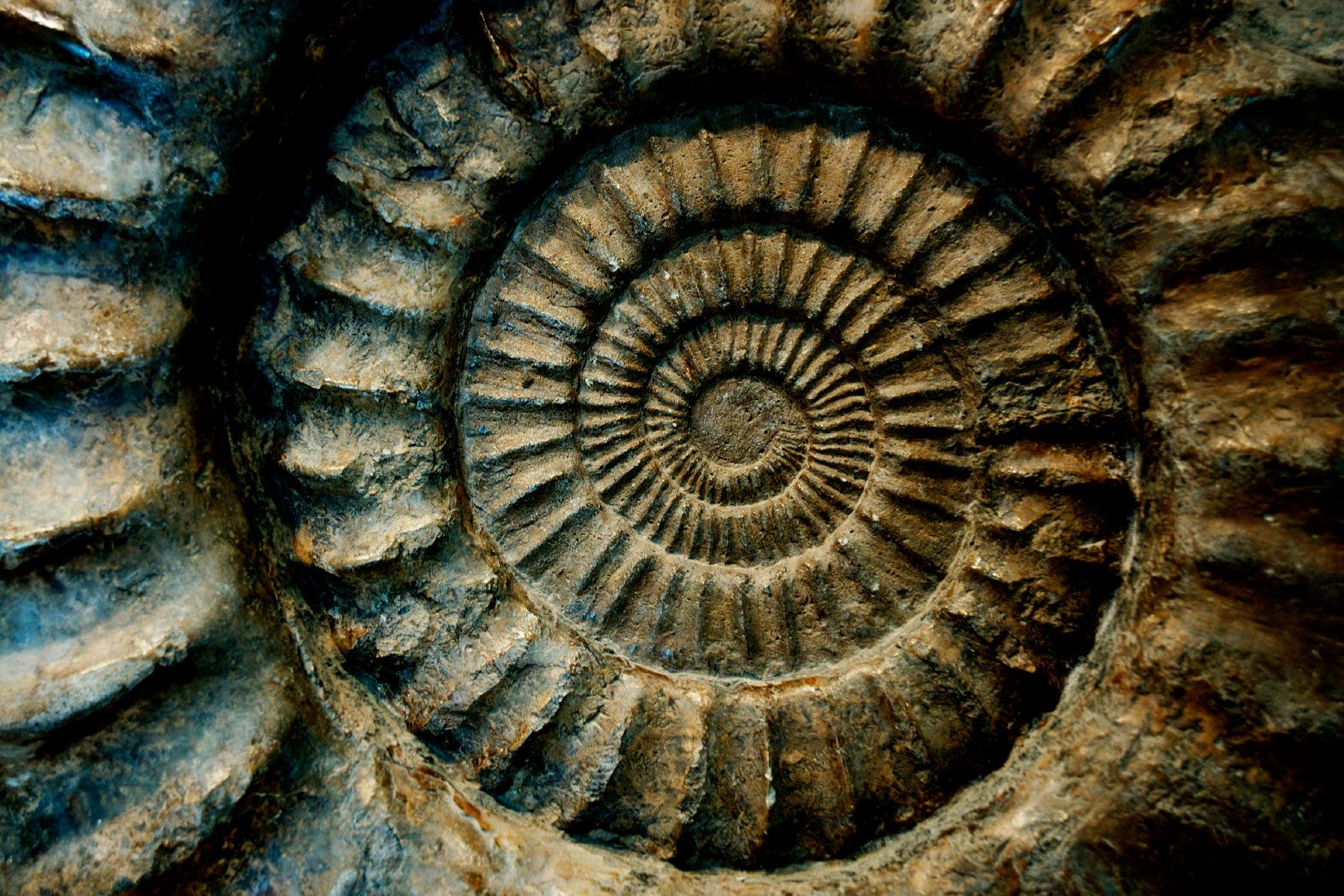
The difference in the physical traits of an individual from those of other individuals in a group is called a(n)
a)
change
b)
adaption
c)
species
d)
variation
9.

The long and sharp beak of a woodpecker is an example of:
a)
Natural Selection
b)
Selective Breeding
10.
What is the advantage of having different shaped beaks?
a)
To look different from other species.
b)
To be able to eat the food readily available in the environment.
c)
To protect itself against predators.
d)
To protect itself against prey.
11.
Which of the following is an example of natural selection?
a)
Race horses got faster and faster through breeding programs until race times peaked.
b)
Beef cows have been bred to produce offspring that produce lean and tender beef.
c)
Very small dogs, which make good house pets, have been produced by selective breeding.
d)
Dogs with extremely thick fur have thrived in cold climates for thousands of years.
12.

The picture below shows long and short necked giraffes and what happened to shorter necked giraffes over time. What does this demonstrate?
a)
Fossil evidence
b)
Anatomical structures
c)
Extinction
d)
Natural selection
13.

The diagram below shows fossils in different rock layers. Which of these statements about the age of these fossils is most likely correct?
a)
Fossil 1 and 3 are the same age.
b)
Fossil 2 is older than fossil 3.
c)
Fossils 2 and 4 are the same age.
d)
Fossil 4 is older than fossil 3.
14.
How does natural selection lead to evolution?
a)
Stronger offspring kill weaker members of the species.
b)
Helpful traits accumulate among surviving members of the species.
c)
Overproduction provides food for stronger members of the species.
d)
Environmental changes kill weaker members of the species.
15.
The fossil record shows that:
a)
Most species have not evolved.
b)
Some species are evolutionary transitions between major groups of organisms.
c)
All species are today just as they were when they were created.
d)
All of the above.
16.
Which of the following is a proper example of natural selection?
a)
Human beings continue to get taller because of thousands of years of proper nutrition.
b)
A community of lady bugs begin having offspring with dark shells.
c)
Albino rodents die off quickly in a community, being more vulnerable to certain pancreatic cancers.
d)
Seagulls begin to eat so many fish, that only those with a dark blue scale color survive.
17.

Which rock layer most likely contains fossils of the most recently evolved organisms?
a)
1
b)
2
c)
3
d)
4
18.
The fossil record is
a)
incomplete: scientists do not have a continuous record of changes in life on Earth
b)
complete: scientists have a continuous record of changes in life on Earth
19.
What can scientists learn from strudying the relationships between fossils?
a)
how old all rock layers are
b)
how life changed over time
c)
how many relatives fossils had
20.
What type of dating indicates an approximate age of a fossil in relationship to other layers of rock in an area?
a)
Relative dating
b)
Absolute Dating
21.
The millions of fossils that scientists have collected are called
a)
The Geologic Time Scale
b)
The Origin of Species
c)
The Fossil Record
d)
A really neat fossil collection
22.

Structures with the same parts have different functions; suggests that organisms share a common ancestry
a)
vestigial structures
b)
homologous structures
c)
adaptive radiation
d)
fossil
23.

If an organism has a vestigial structure, that structure likely once had a function in a(n)
a)
close relative
b)
early ancestor
c)
unrelated organism
d)
embryological stage
24.

Study of embryos of various organisms to show a common ancestor because of similarities in development
a)
natural selection
b)
embryology
c)
speciation
d)
evolution
25.
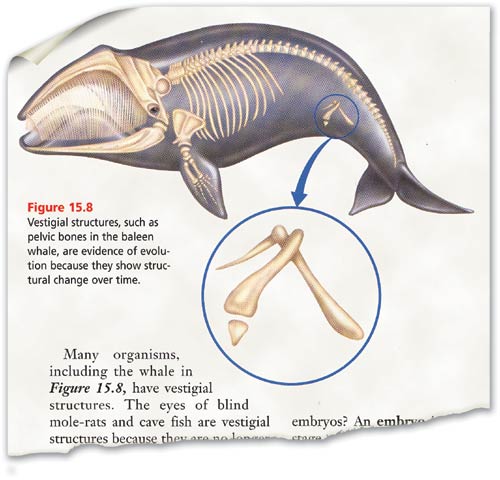
Which of the following is an example of a vestigial structure?
a)
the wings of a red-tailed hawk
b)
the hind limbs of a house cat
c)
the fins of sharks
d)
the tailbone of a human
26.
Structures that have the same function but different structures are...
a)
homologous structures
b)
analogous structures
c)
vestigial structures
d)
embryology
27.

The diagram shows fossils in different rock layers. Which of these statements about the age of these fossils is most likely correct?
a)
Fossil A and C are the same age
b)
Fossil B is older than fossil C
c)
Fossils A is older than fossil B
d)
Fossil D is older than fossil C
28.
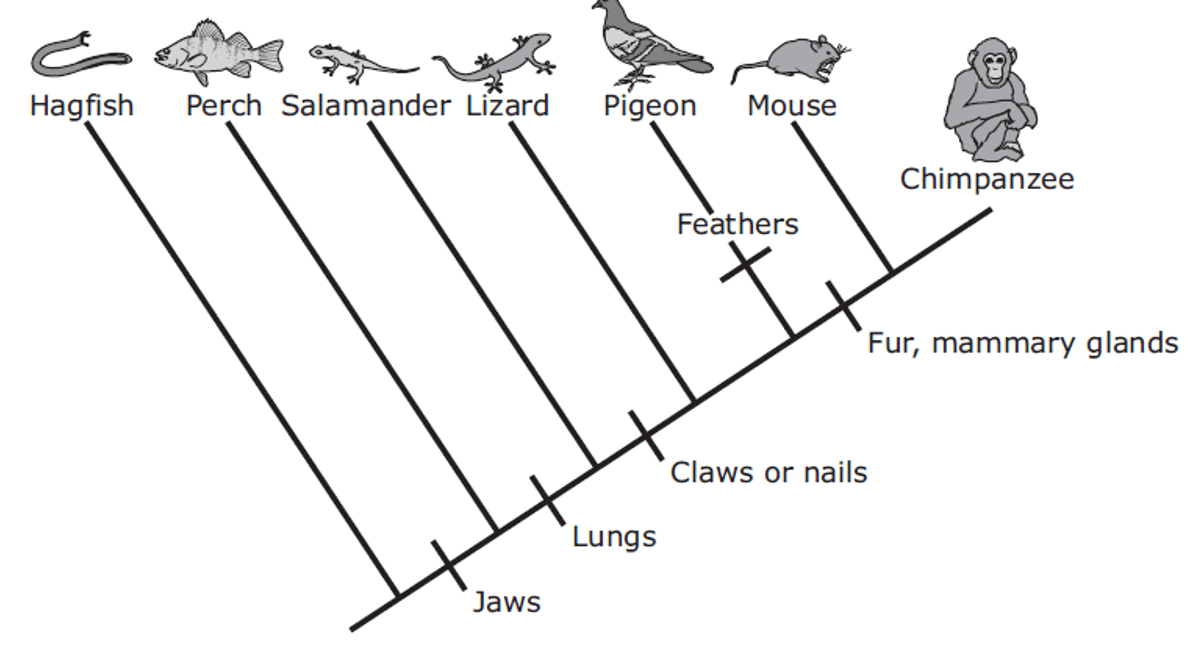
All the animals to the right of the hagfish would have the common characteristic of -
a)
Fur
b)
Claws or nails
c)
Lungs
d)
Jaws
29.

According to this cladogram, birds are LEAST related to -
a)
Amphibians
b)
Sharks
c)
Ray Finned Fish
d)
Crocodiles
30.

Individuals that are well adapted to their environment will survive and produce:
a)
Fewer mutations
b)
Stronger genes
c)
More offspring
d)
Better traits
31.

The hind leg bones in a whale are examples of
a)
homologous structures
b)
analogous structures
c)
fossils
d)
vestigal structures
32.
What process is most responsible for the extinction of most species of plants and animals that have lived on Earth?
a)
gene mutation
b)
environmental changes
c)
selective breeding
d)
decrease in reproduction
33.
A characteristic that can be passed from parent to offspring through genes is called a _________
a)
resistance
b)
selective breeding
c)
genetic change
d)
trait
34.
Scientists compare organisms' DNA to support the theory that all species share a common _________________
a)
separation
b)
ancestor
c)
population
d)
environment
35.
What is suggested by the similarity of early embryos of different species of vertebrates?
a)
no evolutionary relationships between the groups
b)
recent common ancestry
c)
similar environments in the past
d)
evolution from a distant common ancestor
36.
What does the prefix "HOMO" mean?
a)
different
b)
same
c)
cell
37.
What is the word for differences between individuals in a species? ex. hair color
a)
Natural selection
b)
Adaptation
c)
Variation
38.
A process of nature that favors organisms that are best adapted to their environment
a)
Succession
b)
Evolution
c)
Natural Selection
39.
Any physical characteristic or behavior that helps an organism to better survive.
a)
Adaptation
b)
Mutation
40.
A group of similar organisms that can interbreed and produce fertile offspring
a)
Kingdom
b)
Species
c)
Population
d)
Community
41.
Any change in the sequence of DNA is...
a)
transgenic shift
b)
Single Genotype
c)
Monohybrid Trait
d)
Mutation
100 %

