
NEW
Font size
S
M
L
XL
 Worksheets
DCA 2 Review (2nd Semester Stuff)
Total questions: 60
Worksheet time: 1hrs 6mins
Name
Class
Date
1.
A __________ includes all living and non-living things in an environment.
a)
population
b)
niche
c)
abitotic
d)
ecosystem
2.
_______ are consumers that eat only meat.
a)
Herbivore
b)
Omnivore
c)
Carnivore
3.
________ are consumers that eat plants and meat.
a)
Herbivore
b)
Omnivore
c)
Carnivore
4.
Which group do fungi, bacteria, and termites belong to?
a)
decomposers
b)
producers
c)
herbivores
d)
omnivores
5.
Which organism make their own food through the process of photosynthesis?
a)
decomposer
b)
consumer
c)
herbivore
d)
producer
6.
Field mice eat corn. Which would most likely happen if the field mouse population grew?
a)
There would be more corn to feed the field mice.
b)
There would be less corn due to the mice eating it.
c)
The habitat would get overpopulated because the mice woudl eat too much.
7.
If the population of prey increases, the population of predators will ________because of the availability of food.
a)
decrease
b)
stay the same
c)
increase
8.
What would most likely happen if an ecosystem no longer received sunlight?
a)
The number of herbivores would increase
b)
The number of plants would increase
c)
all organisms would adapt
d)
All living organisms would eventually die
9.
Examples of how humans negatively affect local ecosystems are
a)
Building dams, deforestation (cutting down trees), adding point sources to nearby streams to allow for run-off, building roads and structures, and salting roads.
b)
Creating laws to prohibit fishing from local streams.
c)
Planting trees and other plants to attract native species.
d)
Removing non-native species from the environment.
10.
How does energy enter an ecosystem?
a)
sunlight
b)
soil
c)
animals
d)
invasive species
11.
About how many days does it take to moon to go through a complete cycle?
a)
7 days
b)
365 days
c)
29 days
d)
20 days
12.

When the visible (lit) portion of the moon is increasing, the moon is:
a)
waning
b)
full
c)
waxing
d)
new
13.

Name the moon phase
a)
Waning Crescent
b)
Waxing Crescent
c)
Waning Gibbous
d)
Waxing Gibbous
14.
The 1st Quarter moon is lit on the:
a)
Left Side
b)
Right Side
15.

Name the moon phase
a)
waning crescent
b)
waxing crescent
c)
waning gibbous
d)
waxing gibbous
16.
As the moon's shape appears to get smaller, we say that the moon is _.
a)
swelling
b)
waxing
c)
waning
d)
disappearing
17.
How much of the moon is always lit?
a)
can't tell
b)
always changes
c)
half
d)
3/4
18.

Name the moon phase that would come AFTER this moon.
a)
waning crescent
b)
waxing crescent
c)
waning gibbous
d)
waxing gibbous
19.
The moon ____________ around the Earth.
a)
revolves
b)
rotates
c)
up
d)
down
20.

What moon phase came right BEFORE this one?
a)
First Quarter
b)
Last Quarter
c)
New Moon
d)
Full Moon
21.
All of space and its contents make up the ........
a)
Universe
b)
galaxies
c)
planets
d)
stars
22.
Which type of galaxy has no obvious shape or structure and is the site of intense star formation?
a)
Spiral galaxy
b)
Irregular galaxy
c)
Elliptical galaxy
d)
Lenticular galaxy
23.
Which of the following best describes the sun?
a)
Massive red giant star
b)
Medium main sequence star
c)
Small white dwarf star
d)
Black hole
24.
Which of the following best describes why the sun appears brighter than all other stars seen from Earth?
a)
The sun is much larger than any other star
b)
The sun is much closer than any other star to Earth
c)
Other stars have a lower temperature than the sun
d)
The sun is the only star big enough the be seen.
25.
A light year measures time in space. T or F
a)
True
b)
False
26.

What type of galaxy is this?
a)
Elliptical
b)
Spiral
c)
Irregular
27.

Which type of galaxy is this?
a)
Spiral
b)
Elliptical
c)
Irregular
28.
Which of the following best describes the position of our solar system in our galaxy?
a)
Near the edge of the galaxy
b)
In the center of the galaxy
c)
Outside of the galaxy
29.
All stars begin their life as part of a .......
a)
Stellar nebula
b)
Planet
c)
Supernova
d)
Main sequence or stable stage
30.
Place these objects in order from smallest to largest.
a)
Planets, solar system, universe, galaxy
b)
Solar system, planets, galaxy, universe
c)
Planets, solar system, galaxy, universe
d)
Galaxy, solar system, planets, universe
31.

Why do globes lean sideways?
a)
To allow them to spin easier.
b)
To demonstrate the tilt of Earth's axis.
c)
To demonstrate the effects of gravity.
d)
To demonstrate day and night.
32.

What causes the seasons to change?
a)
The warming and cooling of Earth's core.
b)
The distance from the sun.
c)
Earth's tilt in relation to the sun.
d)
Earth's rotation on its axis.
33.

What happens when the area in which you live tilts away from the sun?
a)
It is summer.
b)
It is spring.
c)
It is winter.
d)
It is fall.
34.

What season is it in the Southern Hemisphere when it is fall in the Northern Hemisphere?
a)
winter
b)
spring
c)
summer
d)
fall
35.

Why does the area around the equator stay the same temperature all year?
a)
The equator rotates slower than the poles.
b)
The equator remains the same distance from the sun.
c)
The equator always receives direct sunlight.
d)
The equator has 18 hour days.
36.

Which season is taking place in the Southern Hemisphere in Position 1?
a)
Winter
b)
Spring
c)
Summer
d)
Fall
37.

Which season is taking place in the Northern Hemisphere in Position 2?
a)
Winter
b)
Spring
c)
Summer
d)
Fall
38.
What is Earth's annual motion around the sun called?
a)
Rotation
b)
Revolution
39.
One rotation of Earth is equal to
a)
a day.
b)
a year.
40.
Which seasons have an equal amount of daylight and darkness?
a)
Spring and Fall
b)
Winter and Summer
c)
Winter and Spring
d)
Summer and Fall
41.
The type of plate boundary where two plates come together is a .....
a)
Convergent Boundary
b)
Divergent Boundary
c)
Transform Boundary
d)
Plate Boundary
42.
Which of the following causes Earth's tectonic plates to move?
a)
Energy from the Sun
b)
Magnetic Pole Reversal
c)
Convection currents in the mantle
d)
Faults in Mountain Ranges
43.
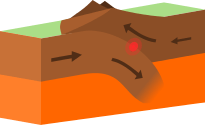
What type of plate boundary is this?
a)
Plate
b)
Divergent
c)
Convergent
d)
Transform
44.
A divergent boundary occurs when plates ....
a)
Pull apart
b)
Come together
c)
Slide past each other
d)
subducting
45.
Which of the following is the name of the ancient supercontinent formed 28 Million Years ago.
a)
Pangea
b)
Gondwanda
c)
Laurasia
d)
Neverland
46.
Which of the following is NOT evidence to support the theory of plate tectonics?
a)
Fossils
b)
Mountains
c)
Glaciers
d)
Sand Erosion
47.
A fault is formed by the movement of a __________ plate boundary
a)
Transform
b)
Convergent
c)
Divergent
48.
Islands can from from magma which is pushed up at a __________ plate boundary
a)
Divergent
b)
Convergent
c)
Transform
49.
Mountains are created when....
a)
Two continental plates collide
b)
Two oceanic plates pull apart
c)
An Oceanic plate subducts under a Continental Plate
d)
Two continental plates pull apart
50.
The Great Rift Valley in Africa and the Mid-Ocean Ridge were all created by this boundary
a)
Divergent
b)
Convergent
c)
Reform
d)
Transform
51.
What do contour lines that are farther apart represent?
a)
waterfall
b)
steep area
c)
gentle slope
d)
river
52.
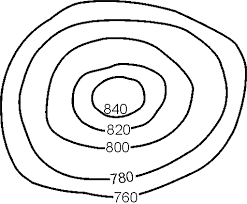
Determine the contour interval:
a)
5 m
b)
10 m
c)
15 m
d)
20 m
53.

Which topographic map matches formation C?
a)
1
b)
2
c)
3
d)
4
54.

What is the contour interval of the topographic map below?
a)
400 m
b)
200 m
c)
100 m
d)
80 m
55.

Based on the map below, which location has a greater elevation, A or B?
a)
Location A is higher.
b)
Location B is higher.
c)
Locations A and B are at the same elevation.
d)
It is impossible to determine which location is higher.
56.

What do close contour lines represent on a map?
a)
waterfall
b)
steep area
c)
gradual area
d)
river
57.

What do the v-shaped contour lines represent?
a)
mountains
b)
steep areas
c)
gradual areas
d)
rivers
58.

What would be the most likely way this coastline would change over time?
a)
A fire could destroy the vegetation
b)
The waves could erode the beach
c)
The beach would grow due to deposition
d)
The beach will disappear due to plate tectonics
59.

These images compare the same stretch of coastline. What is a possible reason for the change?
a)
A fire destroyed the beach and surrounding area
b)
Overtime, water eroded away much of the land
c)
A major catastrophe such as a hurricane or tsunami destroyed the area
d)
The beach and land went through a sever drought
60.
Deltas forming at the mouths of rivers would be an example of...
a)
Weathering
b)
Erosion
c)
Deposition
d)
Preposition
Reset

