
 Worksheets
Science QUARTERLY 3 REVIEW
Total questions: 76
Worksheet time: 1hrs 2mins
Name
Class
Date
1.
What are the three states of matter?
a)
solid, volume, mass
b)
density, volume, mass
c)
solid, liquid, gas
d)
density, gas, volume
2.
Something that takes up space and has mass.
a)
volume
b)
matter
c)
mass
d)
density
3.
A state of matter that has a definite volume and shape.
a)
solid
b)
liquid
c)
gas
d)
matter
4.
What is one way matter change states?
a)
matter loses mass
b)
heat is added
c)
it doesn't change
d)
by doing nothing
5.
Solids have a definite _______________.
a)
smell
b)
shape
c)
picture
d)
sound
6.
______________ does not have a definite shape or volume.
a)
liquid
b)
solid
c)
gas
7.
a type of matter that can be found on earth as a solid, liquid, and gas
a)
gold
b)
water
c)
oxygen
d)
rock
8.

Which state of matter has particles that are tightly packed?
a)
liquid
b)
gas
c)
solid
9.
How much does the temperature have to rise for water at 85 degrees Celsius to reach the boiling point?
a)
15 degrees Celsius
b)
100 degrees Celsius
c)
0 degrees Celsius
d)
25 degrees Celsius
10.
How far above the freezing point is 52 degrees Celcius?
a)
52 degrees C
b)
100 degrees C
c)
42 degrees C
d)
0 degrees C
11.
What is the boiling point of water
a)
0 C
b)
100 F
c)
50 C
d)
100 C
12.
What is water's freezing point?
a)
0 F
b)
32 C
c)
50 C
d)
0 C
13.
What is Evaporation?
a)
1.Process of water movement through a plant from the drying up of its aerial parts
b)
2.Occurs on the surface of a liquid as it changes into the gaseous phase.
c)
3.Occurs when rain drops fall
d)
4.All of the above
14.
the change of state from a liquid to a gas
a)
water cycle
b)
evaporation
c)
precipitation
d)
condensation
15.
Water vapor changes from a gas to a liquid in a process called
a)
transpiration
b)
precipitation
c)
condensation
d)
evaporation
16.

Sodium has an atomic number of 11, how many protons does this atom have?
a)
22
b)
11
c)
12
d)
2
17.

Where is the proton located?
a)
In the very dense nucleus
b)
Floating around in the negative electron cloud
c)
the loose nucleus
d)
the positive electron cloud
18.

The following element key shows how many protons?
a)
16
b)
15.999
c)
Oxygen
d)
8
19.

How many protons are in Beryllium?
a)
4
b)
9
c)
5
d)
2
20.
What is the mass number?
a)
the number of protons only
b)
the number of protons, neutrons and electrons
c)
the number of neutrons only
d)
the number of protons and electrons only
21.

What is the atomic number of this nucleus?
a)
1
b)
3
c)
4
d)
7
22.
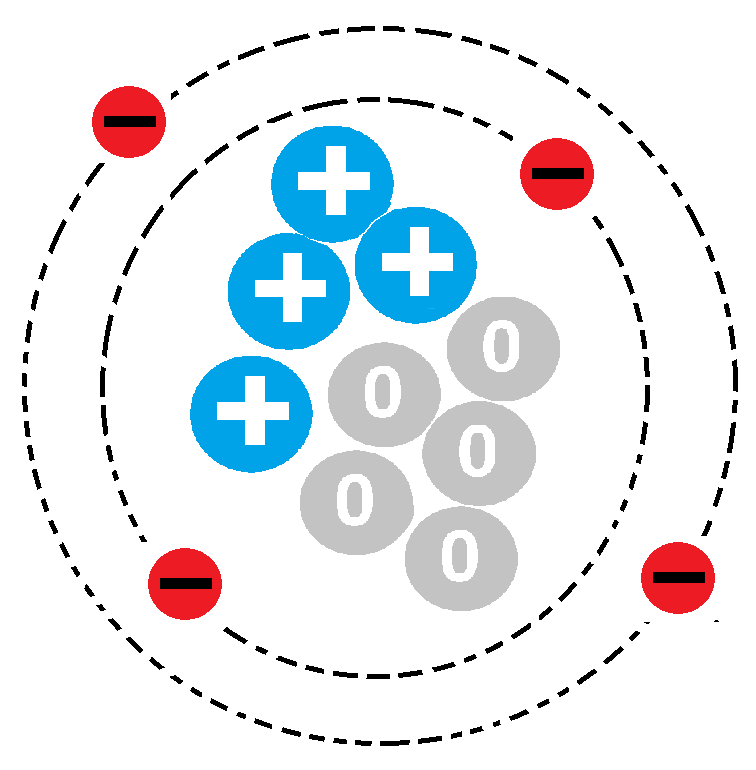
What is the atomic number of this atom?
a)
4
b)
5
c)
9
d)
none of the above
23.

What is the mass number of this atom?
a)
4
b)
5
c)
9
d)
none of the above
24.

What is the atomic number of this atom?
a)
7
b)
14
c)
21
d)
none of the above
25.
This is a negatively charged particle found outside the nucleus
a)
Electron
b)
Proton
c)
Neutron
26.
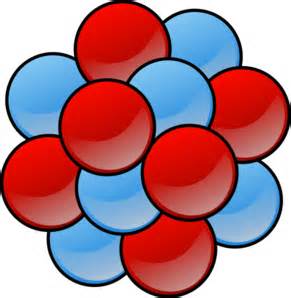
What does the nucleus of an atom contain?
a)
Electrons and neutrons
b)
Protons and neutrons
c)
Neutrinos and positrons
d)
DNA and RN
27.
Which two subatomic particles are found in the NUCLEUS of at atom?
a)
protons & nuetrons
b)
protons & electrons
c)
neutrons & electrons
d)
electrons & protons
28.
The subatomic particle with a neutral charge is:
a)
protons
b)
electrons
c)
neutrons
d)
cloud
29.

What is the mass number of this atom?
a)
7
b)
14
c)
21
d)
none of the above
30.
This particle is found in the nucleus and has a positive charge
a)
Electron
b)
Proton
c)
Neutron
31.
This contains most of the mass of an atom
a)
Electron Cloud
b)
Nucleus
c)
Electron
32.
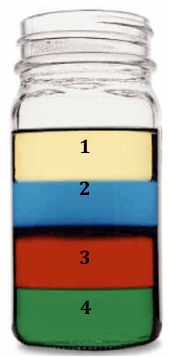
Put the liquids in order from most dense to least dense?
a)
4, 3, 2, 1
b)
1, 2, 3, 4
c)
3, 4, 2, 1,
d)
4, 3, 1, 2
33.
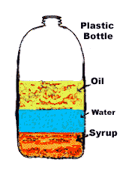
Which liquid is the least dense?
a)
oil
b)
water
c)
syrup
d)
plastic bottle
34.

Which box has a higher density?
a)
Box A
b)
Box B
c)
cannot be determined
d)
they are the same
35.
In general what is the most dense form of matter?
a)
solid
b)
liquid
c)
gas
d)
plasmas
36.
a)
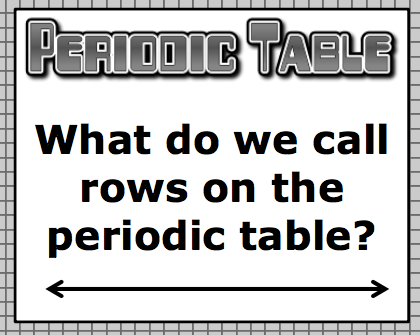
Periods
b)
Groups
37.
a)
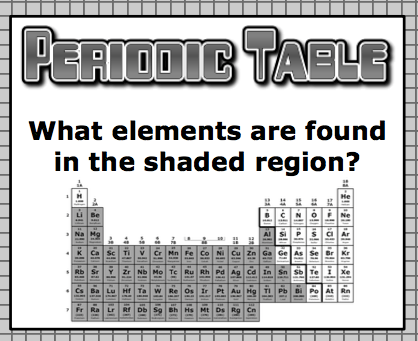
Metals
b)
Nonmetals
c)
Metalloids
38.
a)
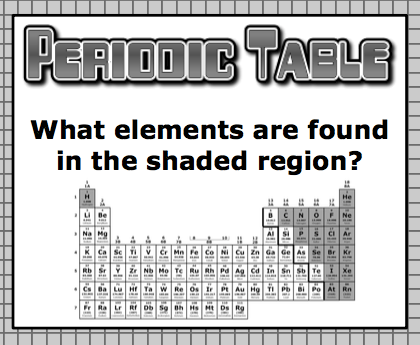
Metals
b)
Nonmetals
c)
Metalloids
39.
a)
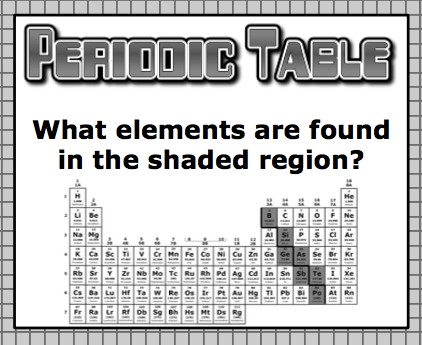
Metals
b)
Nonmetals
c)
Metalloids
40.
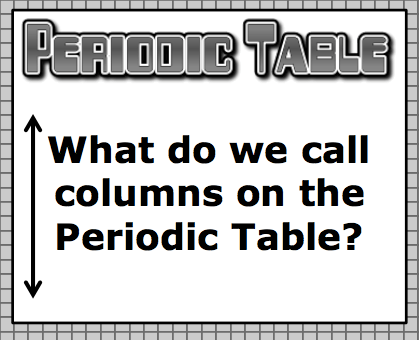
a)
Periods
b)
Groups
41.
The heat from a lamp allows a lizard to remain warm. This is an example of which type of heat transfer?
a)
radiation
b)
conduction
c)
convection
d)
insulation
42.
feet on hot sand
a)
conduction
b)
convection
c)
radiation
43.
burning your hand on a hot stove
a)
conduction
b)
convection
c)
radiation
44.
steam coming off of a pot of coffee
a)
conduction
b)
convection
c)
radiation
45.
What is the definition of CONDUCTION?
a)
When heat is transferred from objects like rays of light or electromagnetically.
b)
a hot liquid or air that expands, becomes less dense, and rises or becomes more dense, and sinks.
c)
When heat transfers from objects that are touching.
d)
When heat transfers through the heater or AC in your house.
46.

The heat from a hot burner to a pot is transferred by ______.
a)
convection
b)
insulation
c)
radiation
d)
conduction
47.
Jackson likes to cook but is always in a hurry. He needs a pot that will cook his food quickly. Which is the best material for his cooking pot?
a)
copper
b)
glass
c)
plastic
d)
wood
48.
Which is NOT an insulator.
a)
Wool
b)
Plastic
c)
Copper
d)
Glass
49.
What is a example of a conductor?
a)
wood
b)
metal
c)
rubber
d)
rock
50.
What is a example of a insulator?
a)
metal
b)
rubber
c)
water
51.
What is the difference between a conductor and an insulator?
a)
An insulator allows electricity to flow through it easily and a conductor does not
b)
A conductor allows electricity to flow through it easily and an insulator does not.
c)
An insulator is magnetic and a conductor is not
d)
A conductor is magnetic and an insulator is not
52.
A insulator does not let energy flow through easily
a)
True
b)
False
53.

Heat transfers from an area of ____temperature to an area of ___ temperature.
a)
high to low
b)
low to high
c)
high to high
54.
Poor conductors like wood and plastic are called:
a)
conductors
b)
insulators
c)
burners
55.
In heat transfer, heat always flows from the _______________ substance to the _______________ substance.
a)
Hotter to colder
b)
Colder to hotter
c)
Hotter to hotter
d)
Colder to colder
56.
What is the phase change of a solid to a liquid?
a)
freezing
b)
melting
c)
boiling
d)
condensation
57.
How are solids different from liquids?
a)
particles in solids are moving freely around each other.
b)
particles in solids have no motion.
c)
particles in solids are vibrating in place.
d)
particles in solids have more motion than in liquids
58.
2. A change of state from a liquid to a solid is called....
a)
Melting
b)
Freezing
c)
Evaporation
59.
7. All phase changes (changing states) requires energy to be added or taken away.
a)
True
b)
False
60.
Change from gas to liquid...
a)
condensation
b)
evaporation
c)
expansion
d)
movement
61.
What happens to particles when they are heated?
a)
They speed up and spread out
b)
They slow down and compress
c)
They stop moving
d)
They move closer together and speed up
62.
Boiling is ...
a)
liquid to gas
b)
gas to solid
c)
gas to liquid
d)
solid to liquid
63.
What is happening at water melting point?
a)
liquid to gas
b)
solid to liquid
c)
gas to liquid
d)
liquid to soild
64.
What is happening at freezing point?
a)
gas to liquid
b)
solid to liquid
c)
liquid to solid
d)
liquid to gas
65.
What is happening at freezing point?
a)
gas to liquid
b)
solid to liquid
c)
liquid to solid
d)
liquid to gas
66.
Do all solids melt at the same temperature?
a)
yes
b)
no
67.
3. If the atoms of an object are moving or vibrating fast, the temperature would be...
a)
Hot
b)
Cold
c)
Unknown
68.
4. If the atoms of an object are moving or vibrating slow, the object would feel...
a)
Cold
b)
Hot
c)
Unknown
69.
Many objects, such as train tracks and road joints, are specifically designed to allow extra space for ...
a)
thermal energy
b)
specific heat
c)
thermal expansion
d)
conductors
70.
Objects gain heat and _________.
a)
expand
b)
contract
71.
The liquid in the thermometer rises when it is placed in the hot water because ___________.
a)
it gains heat from the hot water and expands.
b)
loses heat from the hot water and contracts.
c)
the surrounding air is too warm.
d)
the liquid is boiling.
72.
Silicon is a semiconductor and has properties of both metals and nonmetals. What type of element is Silicon?
a)
Metal
b)
Nonmetal
c)
Metalloid
d)
Pretty
73.
Which type of elements touch the zigzag line?
a)
Metals
b)
Nonmetals
c)
Metalloids
d)
Metals and Metalloids
74.
Which of these is a property of metals?
a)
It's malleable
b)
It can't conduct electricity
c)
They are used in food
d)
It's very brittle
75.
Which of the following is a good conductor of heat?
a)
Metal
b)
Nonmetal
c)
Metalloid
76.
Which of these grouping of elements could have the characteristic of brittle?
a)
Metal
b)
Nonmetal
100 %

