
 Worksheets
Science 5 LT3 Revision
Total questions: 75
Worksheet time: 56mins

When thermal energy is increased in a solid, what change in state is happening?
Melting
Evaporation
Freezing
Condensation

When thermal energy is decreased in a liquid, what change in state is happening?
Melting
Freezing
Condensation
Evaporation

When thermal energy is increased in a liquid, what change in state is happening?
Melting
Evaporation
Condensation
Freezing

When thermal energy is decreased in a gas, what change in state is happening?
Melting
Freezing
Evaporation
Condensation

When thermal energy is increased in a liquid and evaporation occurs, what state of matter does the liquid change into?
Solid
Gas
When thermal energy is decreased in a liquid and freezing occurs, what state of matter does the liquid change into?
Gas
Solid
When a substance changes from a solid to a liquid, this is called...
Melting
Evaporation
Freezing
Condensation
When a substance changes from a liquid to a gas, this is called...
Melting
Evaporation
Condensation
Freezing
When a substance changes from a gas to a liquid, this is called...
Melting
Evaporation
Condensation
Freezing
When a substance changes from a liquid to a solid, this is called...
Melting
Evaporation
Condensation
Freezing
What happens to the movement of the particles in a substance when the thermal energy is increased?
Speed Up
Slow Down
Do particles (or the atoms) in a substance ever stop moving?!
No
Yes
What happens to the movement of the particles in a substance when the thermal energy is decreased?
Speed Up
Slow Down
What happens to the arrangement of particles as thermal energy is removed from a substance?
The particles get farther apart.
The particles get closer together.

A table is an example of a _____>
Solid
Liquid
Gas

Coffee is an example of a ______.
Solid
Liquid
Gas

The air we breathe is an example of a ___.
Solid
Liquid
Gas
When water molecules slow down and move closer together ...
the water separates into hydrogen and oxygen.
the water turns into liquid nitrogen.
the water turns into water vapor.
the water turns into ice.

The liquid nitrogen inside the cup makes the temperature of the cup so cold that oxygen in air forms as droplets on the outside of the cup. The oxygen that formed as liquid is an example of:
vaporization
freezing
condensation
melting
The molecules of a substance slow down when . . .
energy is added.
energy is taken away.
Sophia filled a small cup with water and then placed it in the freezer. Over the next few minutes, the liquid water began to turn to ice. As this was happening, the water molecules in the cup . . .
gained energy
gained mass
lost energy
lost mass
The temperature at which a liquid turns into a solid is its . . .
melting point
boiling point
condensation point
freezing point

Examine the image and select the best choice.
Molecular energy was increased and the substance evaporated.
Molecular energy was lost and the substance froze.
Molecular energy was lost and the substance boiled.
Molecular energy was increased and the substance melted.
The temperature at which a liquid changes to a gas is its
boiling point
melting point
heat index
deposition
Deposition is the phase change in which a gas turns straight into a ____________ without first turning into a liquid.
liquid
gas
solid
What phase change is occurring when substances like dry ice turn straight from a solid to a gas?
sublimation
deposition
evaporation
freezing
When you see drops of liquid water on your cold soda can caused by cooling of the water vapor in the air, ______________ has occurred.
freezing
condensation
sublimation
melting
When you boil water and it turns to steam, you are seeing an example of ________________ occur.
evaporation
melting
condensation
sublimation
When the temperature of matter increases, the particles...
speed up and move closer
speed up and move farther apart
slow down and move closer together
slow down and move farther apart
Which state of matter has NO definite shape and NO definite volume?
gas
liquid
solid
Which state of matter has a definite shape and a definite volume?
gas
liquid
solid
Which state of matter has NO definite shape, but does have a definite volume?
gas
liquid
solid
When the temperature of matter decreases, the particles...
speed up and move farther apart
speed up and move closer together
slow down and move farther apart
slow down and move closer together
A gas...
has a definite shape but no definite volume
has a definite volume but no definite shape
has fast-moving molecules
In a solid, the molecules...
vibrate in place
slide past one another
move quickly all over the place
Molecules are closest together in a...
liquid
solid
gas

Which phase change of matter is occurring in this image?
freezing
melting
deposition
evaporation

What phase change is taking place in this image?
melting
freezing
condensation
evaporation

The molecules in this state of matter are showing what phase?
solid
liquid
gas

What phase change is taking place in this image?
evaporation
melting
condensation
freezing

The molecules in this state of matter are showing what phase?
solid
liquid
gas

The state of matter being demonstrated in this phase is a...
solid
liquid
gas
Matter is _______________________________.
The amount of matter in an object.
The amount of space an object occupies.
Anything that has mass and volume.
Mass is ________________________________.
The amount of matter in an object.
Anything that has Mass and volume.
The amount of space an object occupies.
Volume is _______________________.
the amount of matter an object has.
the amount of space an object occupies.
anything that mass and volume.
What causes can cause matter particles to speed up or slow down?
temperature & pressure
time & pressure
time & heat
Gertrude is observing liquids at a birthday party. Some are sweet, some are hot, and some are sticky. If she could look at the particles of the liquids, which statement would be true?
The particles are far apart and moving fast, with no shape.
The particles may touch but they can flow past each other.
The particles are in close contact and cannot move from their places.
The particles have no arrangement.
Herbie notices that a spill on the kitchen floor was gone the next morning. The best description of what happened to the spill is
It evaporated
It sublimated.
It boiled.
It froze.
How are boiling and evaporating different?
They both are processes that change a liquid to a gas.
Boiling requires heat to be added so the particles rapidly change to a gas.
Evaporating requires heat to be added so the particles rapidly change to a gas.
Gertrude notices that a cup of hot chocolate is getting colder by losing thermal energy. What instrument would help her know this?
thermometer
spring scale
triple beam balance
microwave oven
In which area would the rate of evaporation be the lowest?
Over the ocean
Over the mountains
Over the rainforest
Over the desert
As a part of the water cycle, water from Earth's surface enters the clouds and finally falls back to the ground in the form of rain. What is the correct sequence of processes water undergoes?
Evaporation, Condensation, Precipitation
Precipitation, Condensation, Evaporation
Condensation, Evaporation, Precipitation
Evaporation, Precipitation, Condensation
What would happen if the Sun is removed from the water cycle?
The water cycle would not include precipitation but would continue with groundwater flow.
The water cycle would no longer occur because the Sun provides the energy for evaporation and transpiration.
The water cycle would no longer occur because the Sun provides energy for the formation of clouds.
The water cycle would not include evaporation and transpiration but would continue with condensation.

A student draws a model to represent the precesses involved in the water cycle, as shown. To which process is the formation of clouds related?
Condensation
Evaporation
Freezing
Melting

The image shows various stages in the water cycle. During which stage does water flow back towards the sea as runoff?
W
X
Y
Z
On Earth, what process generates most of the water vapor?
Condensation
Evaporation
Precipitation
Transpiration
Rain and snow are two different forms of precipitation that fall on Earth's surface. Which factor is responsible for there being different forms of precipitation?
Evaporation
Run-off
Temperature
Transpiration
What is precipitation?
Sweat from our bodies on hot days
Warm rain but not cold snow or sleet
Gas that we use in furnaces or ovens
Any form of water that falls from the sky

What is the energy source that drives the water cycle?
The moon T
The heat from our home in the winter all around the world
The sun
he heat generated solely from the core of the earth

What are formed when water vapor condenses?
Clouds
Mountains
Transpiration
Valleys

The movement caused within a fluid by the tendency of hotter and therefore less dense material to rise, and colder, denser material to sink under the influence of gravity, which consequently results in transfer of heat. ____________________
Evaporation
Convection
Precipitation
Transpiration

Water in its gas form is called ____________________,
water vapor
precipitation
ice
air
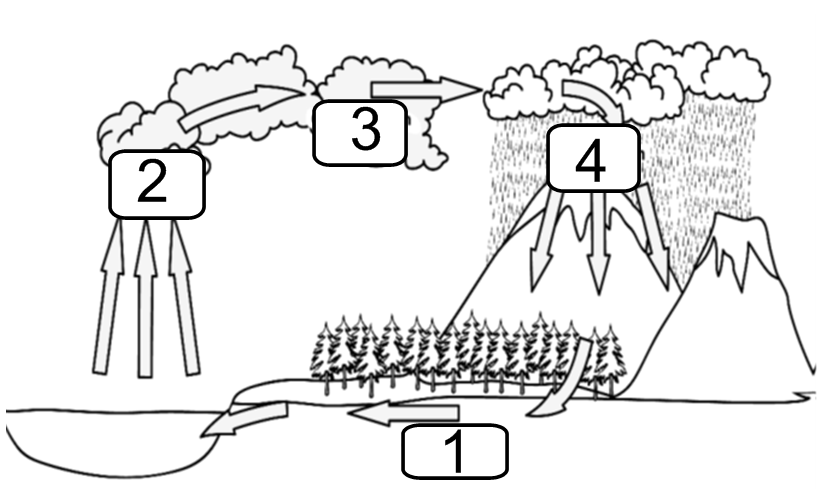


What controls whether water is a gas, liquid, or solid ice?
how long it has been in a place
if it is being used for anything
what temperature it is
what cup it is in

