
 Worksheets
DCA 2 Review
Total questions: 75
Worksheet time: 59mins
Name
Class
Date
1.

How many elements are in this compound:
a)
3
b)
6
c)
4
d)
5
2.
How many Hydrogen are in 4H2O?
a)
6
b)
8
c)
2
d)
4
3.
2H2 + O2 ----> 2H2O What is the product?
a)
------>
b)
2H2O
c)
2H2+ O2
4.
How many atoms are there TOTAL in:
H2SO4
H2SO4
a)
6
b)
5
c)
7
d)
3
5.
What is the equation to calculate time?
a)
time = speed/distance
b)
time = distance/speed
c)
time = speed x distance
d)
time = distance x speed
6.
What is velocity?
a)
the quickness of an object
b)
the location of an object
c)
acceleration
d)
speed in a specific direction
7.
F=MA
An object of mass 10 kg is accelerated upward at 2 m/s2. What force is required?
An object of mass 10 kg is accelerated upward at 2 m/s2. What force is required?
a)
20 N
b)
2 N
c)
5 N
d)
0 N
8.
A 20 kg bike accelerates at 10 m/s2. what was the force?
a)
25 Newtons
b)
20 Newtons
c)
200 Newtons
d)
10 Newtons
9.

a)
1st
b)
2nd
c)
3rd
10.

a)
1st
b)
2nd
c)
3rd
11.

a)
1st
b)
2nd
c)
3rd
12.
Which of these is a property of metals?
a)
It's malleable
b)
It can't conduct electricity
c)
They are used in food
d)
It's very brittle
13.
Which of the following is NOT a characteristic of most metals?
a)
Brittle
b)
Good conductor
c)
Ductile
d)
Malleable
14.
Which of these grouping of elements could have the characteristic of luster (shiny)?
a)
Metal
b)
Nonmetal
c)
metalloids
d)
Both metals and metalloids
15.

Describe what luster means
a)
How an object reflects light
b)
How soft an object is
c)
If an object floats
d)
If an object can be dug out of the earth.
16.
I have an object that is dull, brittle, and an insulator, what is it?
a)
metalloid
b)
non-metal
c)
metal
d)
matter
17.

What moon phase is this picture?
a)
This is the waning crescent phase.
b)
This is the waxing gibbous phase.
c)
This is the waning gibbous phase.
d)
This is the new moon phase.
18.

What is this moon phase?
a)
This is the waxing gibbous moon phase.
b)
This is the last quarter moon phase.
c)
This is the first quarter moon phase.
d)
This is the new moon phase.
19.

What moon phase is this picture?
a)
This is the new moon phase.
b)
This is the waxing crescent moon phase.
c)
This is the waxing gibbous moon phase.
d)
This is the waning crescent moon phase.
20.

What is the elevation of point B?
a)
800 ft
b)
850 ft
c)
900 ft
d)
1000 ft
21.

The distance from D to E is...
a)
A little over 2 km
b)
A little over 3 km
c)
A little over 4 km
d)
A little over 5 km
22.
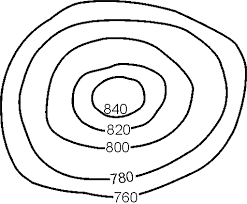
Determine the contour interval:
a)
5 m
b)
10 m
c)
15 m
d)
20 m
23.
What do contour lines that are farther apart represent?
a)
waterfall
b)
steep area
c)
gentle slope
d)
river
24.

How many mountain tops does this map have?
a)
one
b)
two
c)
three
d)
four
25.
cold air moves in behind the front
a)
cold front
b)
warm front
26.
lightning and thunder may occur
a)
cold front
b)
warm front
27.
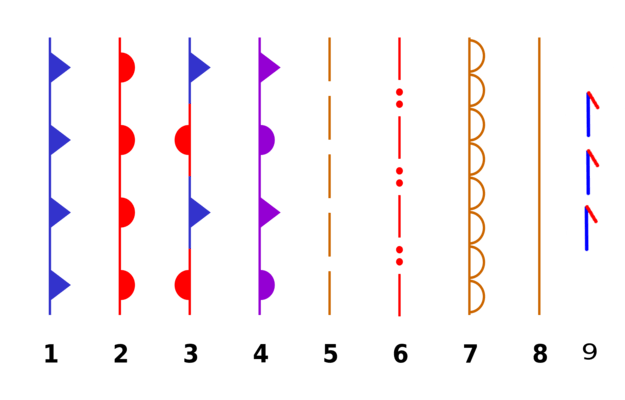
What does symbol # 3 mean?
a)
stationary front
b)
occluded front
c)
warm front
d)
cold front
28.
Which most likely produces clear, cool weather?
a)
zero air pressure
b)
stable air pressure
c)
a low pressure system
d)
a high pressure system
29.
_____________ air is more dense and tends to sink
a)
cold
b)
warm
c)
moist
d)
dry
30.

What symbol is this?
a)
warm front
b)
cold front
c)
stationary front
d)
occluded front
31.
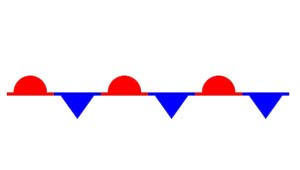
LABEL THE FOLLOWING FRONTS AND/OR WEATHER MAP SYMBOLS.
a)
warm front
b)
cold front
c)
stationary front
d)
occluded front
32.
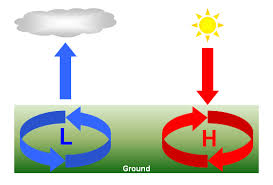
Which system results in drier, fairer weather?
a)
high pressure
b)
low pressure
c)
hurricane
d)
weather system
33.
The type of plate boundary where two plates come together is a .....
a)
Convergent Boundary
b)
Divergent Boundary
c)
Transform Boundary
d)
Plate Boundary
34.
Which of the following causes Earth's tectonic plates to move?
a)
Energy from the Sun
b)
Magnetic Pole Reversal
c)
Convection currents in the mantle
d)
Faults in Mountain Ranges
35.
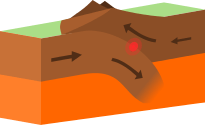
What type of plate boundary is this?
a)
Plate
b)
Divergent
c)
Convergent
d)
Transform
36.

What type of event will occur at this boundary?
a)
Earthquake
b)
Volcano Eruption
c)
Tornado
d)
Mountain Building
37.
A divergent boundary occurs when plates ....
a)
Pull apart
b)
Come together
c)
Slide past each other
d)
subducting
38.
A fault is formed by the movement of a __________ plate boundary
a)
Transform
b)
Convergent
c)
Divergent
39.
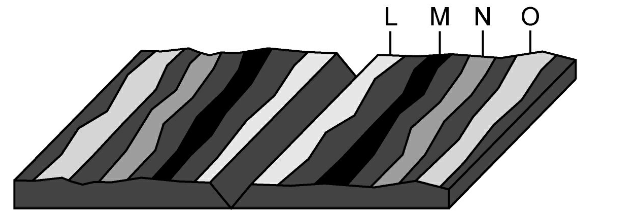
Where would the oldest rock be found?
a)
L
b)
M
c)
N
d)
O
40.
Mountains are created when....
a)
Two continental plates collide
b)
Two oceanic plates pull apart
c)
An Oceanic plate subducts under a Continental Plate
d)
Two continental plates pull apart
41.

How many electrons does an atom of Krypton have?
a)
36
b)
83.80
c)
47.80
d)
119.80
42.

How many neutrons does an Oxygen atom have?
a)
8
b)
16
c)
24
d)
7.999
43.

What is the number highlighted?
a)
Atomic number
b)
Atomic mass
c)
Number of protons
d)
Number of electons
44.
What is the mass number?
a)
the number of protons
b)
the number of protons and neutrons
c)
the number of neutrons
d)
the number of protons and electrons
45.
This particle is found in the nucleus and has a positive charge
a)
Electron
b)
Proton
c)
Neutron
46.
This is a negatively charged particle found outside the nucleus
a)
Electron
b)
Proton
c)
Neutron
47.

What is the name of this element?
a)
Helium
b)
Hydrogen
c)
Argon
d)
Silver
48.
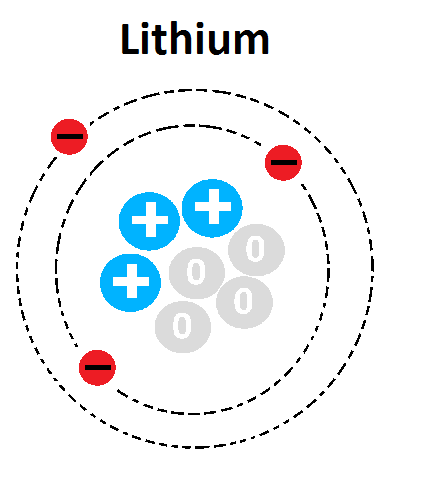
What is the mass number of this atom?
a)
1
b)
3
c)
4
d)
7
49.

What is the atomic number of this atom?
a)
2
b)
4
c)
6
d)
none of the above
50.

What group does this element belong to?
a)
Group 1: Alkali metals
b)
Group 18: Noble Gases
c)
Group 2: Alkaline-Earth Metals
d)
Group 17: Halogens
51.

How many valence electrons?
a)
2
b)
3
c)
5
d)
10
52.

What's a valence electron?
a)
electrons in the second energy level
b)
electrons in the outermost energy level
c)
the atomic number
d)
electrons in the first level
53.
Why is water NOT on the periodic table?
a)
It is naturally occuring
b)
It is a compound, not an element
c)
It exists as a solid, a liquid, and a gas
d)
Its chemical formula doesn't fit
54.
_______ are the ROWS on the periodic table.
a)
Families
b)
Groups
c)
Periods
d)
Elements
55.
________ are the COLUMNS on the periodic table and are organized by similar properties.
a)
Classifications
b)
Groups
c)
Periods
d)
Elements
56.
Atoms with similar properties are most likely located...
a)
in the same period.
b)
in the same group.
c)
in different periods.
d)
to the right and left of each other.
57.
Most of the nonmetals on the periodic table are located...
a)
on the left side
b)
at the bottom
c)
on the right side
d)
in the middle
58.
Each element is unique based on its number of protons, also known as the...
a)
atomic mass
b)
valence number
c)
atomic symbol
d)
atomic number
59.
Group 18 elements are known as the _____ _____ and have full valence shells.
a)
royal gases.
b)
supreme solids.
c)
noble gases.
d)
legit liquids.
60.
Elements in the same ________ are more chemically similar.
a)
group
b)
period
c)
club
d)
table
61.
Burning a piece of paper is an example of a
a)
Physical Change
b)
Chemical change
62.
Scrambling eggs is an example of
a)
A physical change
b)
A chemical change
c)
Solution
63.
Tearing paper into small pieces is an example of a
a)
Mixture
b)
Physical change
c)
Chemical change
64.
Which of the following is a physical change?
a)
Ice melting
b)
Baking potatoes
c)
Rusty nail
d)
Rotting wood
65.
Is hammering wood together to build a house a chemical or physical change?
a)
chemical
b)
physical
66.
Is melting butter for popcorn a chemical or physical change?
a)
chemical
b)
physical
67.
A change in the size, shape, or state of matter.
a)
chemical change
b)
physical change
c)
chemical reaction
d)
electron change
68.
In what areas of the world do hurricanes form?
a)
Warm ocean waters
b)
Polar ocean waters
c)
On lakes and rivers
d)
Over the central plains of the U.S
69.
Critical for the formation of a hurricane?
a)
lower latitudes
b)
80 degrees or warmer water
c)
None of the above
d)
All of the above
70.
A hurricane gets its energy from
a)
Warm ocean waters
b)
high air pressure
c)
winds along surface
d)
Sun
71.
What does the theory of continental drift state?
a)
The continents were once joined in a super-continent and have moved over time
b)
Continents are stationary and do not move
c)
The Earth is broken into lithospheric plates that move due to convection currents
d)
none of the above
72.
Why did no one believe Wegener's thoery?
a)
He could not explain HOW the continents moved
b)
He didn't have evidence
c)
His data was wrong
d)
He didn't use the right technology to gather data
73.
Of the following statements, which best supports the continental drift theory?
a)
All oceans are salty
b)
Igneous rocks are found on all continents
c)
Fossils of the same species of extinct land plants have been found in both South America and Africa
d)
Early humans migrated to North America over a land bridge from eastern Asia
74.
True or False : Sea-floor Spreading adds new material to the ocean floor?
a)
True
b)
False
75.
When one tectonic plate __________ under another at a convergent boundary it sinks back in the mantle.
a)
subducts
b)
falls
c)
sinks
100 %

