wayground logo

Free Printable Worksheets

Font size

S
M
L
XL
Worksheets

Light Review all mixed together

Total questions: 68

Worksheet time: 1hrs 2mins

Name
Class
Date
1.
Why do we see objects as white?
a)
They absorb all light
b)
They reflect all light
c)
They absorb some light and reflect some light
2.
Another name for light bending is ....
a)
Reflaction
b)
Absorbing
c)
Refraction
d)
mirror
3.
The Law of Reflection:
The angle of incidence is _________ the angle of reflection
a)
bigger than
b)
the same as
c)
smaller than
4.
The color you see is the color that is ___.
a)
reflected
b)
absorbed
5.
Which term means to bounce off the surface of something?
a)
Refract
b)
Absorb
c)
Reflect
d)
prism
6.

After light passes through a convex lens the light converges at a point called the __________.

a)

Spot

b)

Focal point

c)

point

d)

Local Point

7.

Allows most visible light through unchanged

a)

eflection

b)

Refraction

c)

Translucent

d)

Transparent

8.

If light strikes a mirror at a 50⁰ angle, what angle will reflect from the mirror?

a)

50⁰

b)

70⁰

c)

45⁰

d)

30⁰

9.
Which color absorbs all light?
a)
White
b)
Black
c)
Orange
d)
Green
10.
Which color reflects all light?
a)
White
b)
Black
c)
Orange 
d)
Green
11.
Wax paper or a foggy window is an example of what type of material. 
a)
transparent
b)
translucent
c)
opaque
12.
Light travels in a straight line
a)
True
b)
False
13.
What are the 3 primary colors?
a)
red, green, blue
b)
yellow, orange, violet
c)
red, black, green
d)
magenta, cyan, indigo
14.
What cells make up the retina
a)
rods and cones
b)
pupil and iris
c)
optic nerve and cornea
15.

Which is the correct order of the visible spectrum?

a)

red, orange, yellow, green, blue, violet

b)

red, yellow, orange, green, blue, indigo, violet

c)

orange, yellow, blue, green, indigo, red, violet

d)

red, orange, yellow, green, blue, indigo, violet

16.
An object appears red because it
a)
reflects light waves of all colors
b)
reflects light waves of red
c)
absorbs light waves of red
d)
transmits light waves of all colors
17.

The primary colors of light can combine to make

a)

black light

b)

white light

c)

primary pigments

d)

ultraviolet light

18.
An object that allows light to pass through producing a clear image.
a)
opaque
b)
translucent
c)
transparent
d)
luminescent
19.
An object that allows light to pass through producing a clear image.
a)
opaque
b)
translucent
c)
transparent
d)
luminescent
20.
When all 3 primary pigment colors are mixed which color is produced?
a)
black
b)
magenta
c)
white
d)
cyan
21.
Which is true of a green grape?
a)
It absorbs green light.
b)
It absorbs white light.
c)
It reflects green light.
d)
It reflects white light.
22.
Unlike mechanical waves, EM waves can travel through
a)
a vacuum
b)
water
c)
the ground
d)
air
23.

Farsighted vision is corrected when _____ lenses allow light rays to focus on the retina. (there are two correct answers.)

a)

converging

b)

diverging

c)

convex

d)

concave

24.
Why is light refracted?
a)
Light speeds up
b)
Light slows down
c)
Light speed stays the same
d)
Light can either slow down or speed up
25.
A magnified virtual image is formed by a _________ lens when the object is placed anywhere between the________.The information in which alternative completes the given statement?
a)
convex, f and C
b)
concave, f and C
c)
convex, f and lens
d)
concave, f and lens
26.
______ is a lens that is thicker on its edges and makes an object appear smaller?
a)
mirror
b)
convex lens
c)
concave lens
d)
prism
27.

_____ is a lens that is thicker in the middle and can make an object appear bigger.

a)

prism

b)

convex lens

c)

concave lens

d)

mirror

28.
a real image...
a)
is produced by virtual rays and can be projected on a screen
b)
is produced by real rays and cannot be projected on a screen
c)
is produced by virtual images and cannot be projected on a screen
d)
is produced by real rays and can be projected on a screen
29.
If a candle is placed at 2f in front of a converging lens, the image
a)
will appear at f on the opposite side of the lens
b)
the image will appear at 2f on the opposite side of the lens
c)
the image will appear between f and 2f on the opposite side of the lens
d)
the image will not appear
30.
Convex lenses can produce...
a)
Real, erect images
b)
Virtual, inverted images
c)
Real, inverted images
d)
no images form
31.
An object of height 4 cm is placed 10 cm away from a concave lens of focal length 6 cm as shown below.Image is 
a)
virtual.inverted
b)
virtual,upright
c)
real,inverted
d)
real,upright
32.
If the focal length is negative a _________ lens is being used
a)
concave (diverging)
b)
convex (converging)
33.
How does light behave as it enters these mediums?
a)
continue its path as straight line.
b)
bends toward the normal
c)
bends away from the normal
d)
reflects
34.
According to Willebord Snell, light passing from air to glass will cause the light to
a)
maintain its original speed 
b)
accelerate while it is in glass
c)
increase its speed
d)
reduce its speed
35.

The velocity of light in vacuum is _______ m/s

a)

3x10⁸

b)

3x10¹²

c)

3x10⁶

d)

3x10¹⁰

36.
Absolute refractive index of any medium is always _______.
a)
less than 1
b)
greater than 1
c)
1
d)
0
37.
The formula to calculate the refractive index is
a)
n=cv
b)
n=v/c
c)
n=c/v
d)
v=nc
38.
Which is the angle of refraction?
a)
Angle 1
b)
Angle 2
39.
Light has the highest velocity in which medium?
flint glass n=1.70
barium glass n=1.60
crown glass n=1.523
water n=1.33
diamond n=2.45
a)
diamond
b)
water
c)
flint glass
d)
barium glass
40.
Light has the lowest velocity in which medium?
flint glass n=1.70
barium glass n=1.60
crown glass n=1.523
water n=1.33
diamond n=2.45
a)
diamond
b)
water
c)
flint glass
d)
barium glass
41.
A candle is placed on the principal axis of a convex lens at a distance of 30 cm from the lens. The focal length of the lens is 10 cm. The image formed will be
a)
Real, inverted, and reduced
b)
Real, inverted, and enlarged
c)
Real, upright, and enlarged
d)
Virtual, upright, and enlarged
42.
Materials that have small critical angles are likely to cause most of the light entering them to be totally internally ____________
a)
reflected 
b)
refracted 
c)
faster 
d)
slower 
43.
The index of refraction for a material is the ratio of the speed of light in a vacuum to the speed of light in a material.
a)
true 
b)
false
44.
A normal human eye has a focal length of about 0.023 m. If you look at the tip of a pencil, 0.553 m from your eye, how far is the image from the lens of your eye? 
a)
0.024 m
b)
0.033 m
c)
0.045
d)
0.055
45.
If the distance of the image from the lens (di) is positive. The image is considered....
a)
Real 
b)
Virtual
46.
In the thin lens equation, do represents 
a)
Distance of the object from the lens
b)
Distance of the image from the lens
47.
Why is light refracted?
a)
Light speeds up
b)
Light slows down
c)
Light speed stays the same
d)
Light can either slow down or speed up
48.
If the focal length is negative a _________ lens is being used
a)
concave (diverging)
b)
convex (converging)
49.

The velocity of light in vacuum is _______ m/s

a)

3x10⁸

b)

3x10¹²

c)

3x10⁶

d)

3x10¹⁰

50.

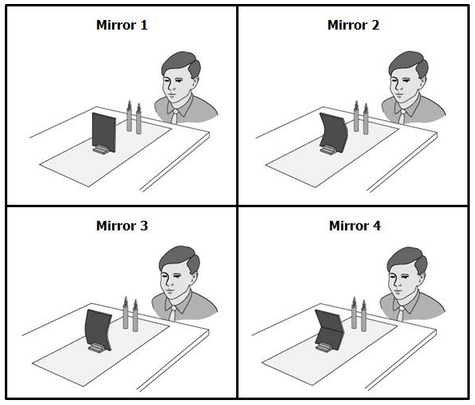
A student is conducting an experiment with four different types of mirrors. Which mirror in the experiment converges light and UP CLOSE, produces an upright, magnified image of the candles? (hint: no two mirrors are the same)

a)

mirror 1

b)

mirror 2

c)

mirror 3

d)

mirror 4

51.

A student is conducting an experiment with four different types of mirrors. Which mirror in the experiment is a convex mirror?

a)

mirror 1

b)

mirror 2

c)

mirror 3

d)

mirror 4

52.

The above lens is a type of ___.

a)

diverging lens

b)

converging lens

c)

divergent lens

d)

convergent lens

53.

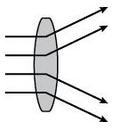
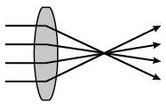
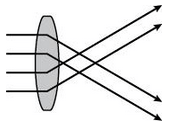
Which lens represents the path light takes through a diverging lens?

a)
b)
c)
d)
54.

Which figure represents the path light takes through a converging lens?
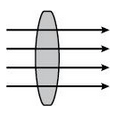
a)
b)
c)
d)
55.

The image of an object, which is placed one foot in front of a plane mirror, will be ___.

a)

behind the mirror and reversed, left to right.

b)

behind the mirror.

c)

in front of the mirror and reversed, left to right.

d)

in front of the mirror.

56.

Which optical device bends light inward?

a)

convex lens

b)

concave lens

c)

plane mirror

d)

convex mirror

57.

A shopkeeper wants to keep an eye on his store in order to prevent shoplifting. What could the shopkeeper hang on the wall in order to see a wider image of his store and his customers?

a)

a convex mirror

b)

a concave mirror

c)

a convex lens

d)

a concave lens

58.

A flat mirror is an example of a ___.

a)

plane mirror

b)

concave mirror

c)

convex mirror

d)

spherical mirror

59.

What type of lens creates the image seen in the eyeglasses?

a)

convex

b)

concave

c)

reflection

d)

plane

60.

A lens that is thicker in the middle than on the outside is called ___.

a)

diverging

b)

concave

c)

convex

d)

achromatic

61.

A lens that is thinner in the middle than on the outside is called ___.

a)

diverging

b)

concave

c)

convex

d)

achromatic

62.

A student is conducting an experiment with four different types of mirrors. Which mirror in the experiment diverges light and produces an right side up, smaller image of the candles? (hint: no two mirrors are the same)

a)

mirror 1

b)

mirror 2

c)

mirror 3

d)

mirror 4

63.

A student is conducting an experiment with four different types of mirrors. Which mirror in the experiment is a concave mirror?

a)

mirror 1

b)

mirror 2

c)

mirror 3

d)

mirror 4

64.

A student is conducting an experiment with four different types of mirrors. Which mirror in the experiment is a plane mirror?

a)

mirror 1

b)

mirror 2

c)

mirror 3

d)

mirror 4

65.

What word means to bend light rays toward each other?

a)

Converging light

b)

Diverging light

c)

Virtual Light

d)

Real Light

66.

What word means to bend light rays away from each other?

a)

Converging light

b)

Diverging light

c)

Virtual Light

d)

Real Light

67.

A dentist uses a small dental mirror to help magnify teeth in your mouth. What type of mirror is this?

a)

a convex mirror

b)

a concave mirror

c)

a convex lens

d)

a concave lens

68.

The side view mirrors on your car help shrink the image on both sides of the car, allowing you to see a larger field of view. What type of mirror is this?

a)

a convex mirror

b)

a concave mirror

c)

a convex lens

d)

a concave lens