
 Worksheets
Physics First Semester Final
Total questions: 65
Worksheet time: 5hrs 25mins

What type of force is the BLUE arrow indicating?
Applied Force
Gravity
Friction
Normal Force
What is more than likely always going to be a force present on a free body diagram?
Normal Force
Gravity
Friction
Applied Force

What is the type of force that both the ground and the wall exerts on the sitting man?
Friction
Gravity
Applied Force
Normal Force

What type of force is the RED arrow indicating?
Applied force
Tension
Spring
Friction

The sky diver is currently accelerating due to gravity, what is the other force at work?
Normal Force
Friction
Air Resistance
Applied Force

Forces that have a net force of zero Newtons
Balanced force
Unbalanced force

What is the overall Net Force?
10 N, Left
671 N, Right
601 N, Left
70 N, Right

The acceleration of an object as produced by a net force is directly proportional to the magnitude of the net force, in the same direction as the net force, and inversely proportional to the mass of the object.
or
f = ma
force = mass x acceleration
Newton's 1st Law
Newton's 2nd Law
Newton's 3rd Law
For every action there is an equal and opposite reaction,
Newtons 1st Law
Newton's 2nd Law
Newton's 3rd Law
An object at rest will remain at rest, and an object in motion will remain in motion unless acted on by an unbalanced force.
Newton's 1st Law
Newton's 2nd Law
Newton's 3rd Law
What does the F stand for on a free-body diagram?
Free
Fan
Net
Force

How do you calculate speed?
multiply distance and speed
distance divided by time
speed divided by time
divide distance and density then multiply by volume
How do you calculate distance?
multiply distance and speed
distance divided by speed
speed times time
divide distance and density then multiply by volume
How do you calculate time?
multiply distance and speed
distance divided by speed
speed divided time
divide distance and density then multiply by volume
_________ is the change in speed over time.
Distance
Speed
Velocity
Acceleration
A biker travels 25 miles in 2 hours. What is the average speed in miles per hour?
50 mph
20 mph
12.5 mph
20 km/h
If you travel 200 miles in 2 hours, how fast were you driving?
100 mph
400 mph
50 mph
impossible to calculate
What is distance?
an object's overall change in position (start to end)
how much ground an object has covered during its motion
how fast an object is moving
how long it takes an object to move from start to end
Bruno sprinted down the hallway for a science project. He ran a total of 40 meters in 20 seconds. What was his average speed?
2 meters per second
20 meters per second
40 meters per second
10 meters for second
Billy runs 400 meters to Andy's house, turns around, and runs 400 meters back home. What is Billy's distance?
0 meters
400 meters
800 meters
1600 meters
Billy runs 400 meters to Andy's house, turns around, and runs 400 meters back home. What is Billy's displacement?
0 meters
400 meters
800 meters
1600 meters

Newton's First Law says that an object that is not moving will _____.
stay at rest
keep moving with a constant velocity
resist any physical change
has mass
Newton's First Law says that an object that is moving will _____.
stay at rest
keep moving with a constant velocity
resist any physical change
has mass
What is inertia?
The resistance of any physical object to any change in its state of motion
The amount of mass an object has
A reaction in an object
No one knows
Which of the following has more inertia?
Bowling ball
Tennis ball
What equation is used to solve Newton's Second Law problems?
F = ma
M = Fa
A = m / F
F = m / a
Newton's Third Law says that every time there is an action force, there is also a reaction force that is _____ in size and acts in the _____ direction.
equal, opposite
opposite, equal
greater, different
lesser, same
In Newton's Second Law equation, what does the F stand for?
force
friction
french fries
friends
In Newton's Second Law equation, what does the m stand for?
mass
minutes
measurement
mountain
In Newton's Second Law equation, what does the a stand for?
acceleration
animals
atom
ant

What is the acceleration of freefall (gravity) equal to? (this is a constant number)

What is projectile motion?

What is Newton's 1st Law?

According to Newton's third law, if you push gently on something, it will push...


What is the unit for mass?
kg
N
ms-2
W
What is the S.I. unit for time?
century
s
N
J
What is the S.I. unit for distance?
J
m
W
s
What is the unit for speed?
N
ms-1
ms-2
seconds
What is the unit for force?
Watt
Newton
kilogram
Henry
50
An object of mass 10 kg is accelerated upward at 2 m/s2. What force is required?
Acceleration changes an object's...
speed, direction, or both
speed, gravity, or both
gravity, direction, or both
inertia, speed, or both
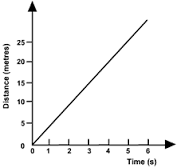
Noah, William, and Emma are observing a car on a straight road. What is the line on the graph showing the car's movement?
The car is moving away from its starting point at a constant speed
The car is moving back towards the starting point at a constant speed
The car is accelerating (getting faster)
The car is decelerating (getting slower)
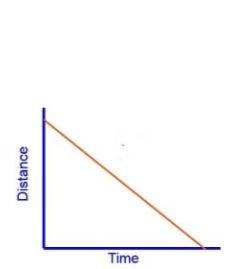
Aria, Rohan, and Maya are observing a line on a graph that represents a car's journey. What is this line of the graph showing about the car's movement?
The car is moving away from its starting point at a constant speed
The car is moving back towards the starting point at a constant speed
The car is accelerating (getting faster)
The car is decelerating (getting slower)

James kicked a soccer ball. How long did it take for the ball to travel 10 m?
0 s
10 s
15 s
20 s

Oliver and Aiden are participating in a race. If line A represents Oliver's speed and line B represents Aiden's speed, which line represents the person moving at a faster speed?
A
B
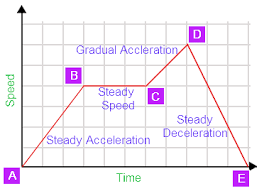
In a 100m race, at what point did Luna run the fastest?
Between 50m-75m (C-D)
Between 25m-50m (B-C)
Start to 25m (A-B)
75m to finish line (D-E)
Mathematician, Astronomer, & Physicist who discovered gravity, laws of motion, calculus, reflecting telescope.
Isaac Newton
Marie Curie
Stephen Hawkings
AlexanderFleming

If you know the distance traveled and the amount of time it took, speed may be calculated by:
dividing time by distance.
multiplying time by distance.
dividing distance by time.
multiplying distance squared by time.

from 3rd second to 5th second, the object is
moving at a constant speed
speeding up
not moving
slowing down


