
 Worksheets
1st Semester Exam Gen Physics
Total questions: 60
Worksheet time: 1hrs 11mins


What is the Total Energy at the bottom?
50 J
25 J
0 J
100 J
What is the KE half way down?
50 J
25 J
0 J
100 J
What is the GPE at the top?
50 J
25 J
0 J
100 J
The ability to do work
Energy
kinetic energy
potential energy
mechanical energy
This is the standard unit for measuring energy.
Joules
Newtons
Matter
Mass
"energy cannot be created nor destroyed"
law of energy
law of potential
law of conservation of energy
law of the eternal energy principle
Energy cannot be created nor destroyed. Just _________
heat
transferred
do it
manifested

As a pendulum swings from its highest to lowest position, what happens to its kinetic and potential energy?
The PE and KE increase and decrease together
The PE decreases while the KE increases
Impossible to know without knowing the mass
The PE and the KE decrease and increase together.
According to the Law of Conservation of energy, the amount of energy before and after a reaction must be the same. Which statement below is true?
The total amount of energy is conserved
The total amount of energy is less after a reaction
The total amount of energy is more after a reaction
Need the mass of the object to determine if energy is conserved.
When velocity triples, kinetic energy increases by ______ times. KE =1/2mv2
9
3
1.5
4.5
When something is dropped, what type of energy transfer takes place?
Kinetic -> Gravitational Potential
Gravitational Potential -> Kinetic -> Sound
Electrical -> Chemical
Heat -> Nuclear


Which of the following formulas is the correct equation for the law of Universal gravitation?
F=d2GM1M2
F=mg
F=m1m2Gd2
F= F=d2KQ1Q2
If I double the mass of one object without changing anything else, What would happen to the gravitational force between that object and any other object?
Doubles
Quadruples
Cut in Half
41 as much
What happens to Gravitational force if I double both of the masses but don't change their distance?
doubles
half as big
4 times bigger
41 as much or 4 time smaller

At what point is vy= 0 m/s?
A
B
C
D
None of these points
At what point is vx= 0 m/s?
A
B
C
D
None of these points
Which vector pair (arrow pair) correctly represents the acceleration and velocity at point P?


Who do you agree with?
Anita: “A projectile’s vx changes because of gravity, and its vy remains constant.”
Barry: “Both vx and vy are constant.”
Chris: “A projectile has no acceleration in the vertical dimension but it does accelerate horizontally.”
Dave: “A projectile has vertical acceleration and a constant horizontal velocity”

Suppose Lemming A runs off the edge of the cliff at 2 m/s and Lemming B runs off the edge at 1 m/s. Which will hit the ground first?
A
B
Both at the same time
Suppose Lemming A runs off the edge of the cliff at 2 m/s and Lemming B runs off the edge at 1 m/s. Which will hit the ground farther from the base of the cliff?
A
B
Both at the same distance
A ball is thrown into the air at some angle, with initial velocities vx (horizontal) and vy (vertical). At the very top of the ball’s path:
What is its velocity in the horizontal direction?
vx
Greater than vx
Zero
A ball is thrown into the air at some angle, with initial velocities vx (horizontal) and vy (vertical). At the very top of the ball’s path:
What is its velocity in the vertical direction?
vy
Greater than vy
Zero
In the absence of air resistance, the angle at which a thrown ball will go the farthest is?
90°
30°
60°
45°

A package is dropped from an airplane, where will the package hit the ground?
A
B
C
A ball thrown straight up takes 8 total seconds to complete its journey all the way up and down. 1 second into its journey and 7 seconds into its journey the magnitude of its velocity will be ______________ and its direction _______________.
opposite, the same
the same, opposite
the same, the same
opposite, opposite
If a ball thrown straight up into the air takes 4 seconds to reach the top (peak), how long will it take to travel from the peak back to the original position?
0s
1s
3s
4s
The initial horizontal velocity of a projectile is ____ its final horizontal velocity.
less than
equal to
greater than
If two projectiles are launched at two different heights, 2m and 10m, which one will reach the ground first?
2m
10m
they both will hit the ground at the same time
Which hits the ground first if they start at the same height: a dropped ball or a ball launched with a
horizontal velocity?
the launched ball
the dropped ball
they both hit at the same time
Once a projectile is launched, what is the only force that affects its motion?
mass
friction
inertia
gravity
Which of the following statements about the horizontal and vertical components of projectile motion is true?
Changes in the horizontal component occur only when the vertical component changes.
Both the horizontal and vertical components are always constant.
The vertical component changes while the horizontal component stays the same.
The horizontal and vertical components are dependent of each other.
Which of the following would NOT be considered a projectile?
A cannonball fired towards a distant castle.
A cannonball rolling down a slope.
A cannonball fired straight outward from a castle wall.
A cannonball after it rolls off the edge of a cliff.
How many Newton's Laws are there?
2
5
3
4
Newton's first law is also known as...
The law of inertia
The law of gravity
The law of acceleration
The law of friction
What is the mathematical formula for Newton's 2nd Law?
F= M x A
M = A x F
F = M x G
F = M x V
Newton's 1st Law of Motion states that: An object in motion stays in _____________
Flexibility
Acceleration
Motion
Rest
Which one of these is an example of a force?
Air Resistance
Acceleration
Motion
Speed
"A net force acting on an object causes the object to accelerate in the direction of the force" is which law?
Newton's 1st Law
Newton's 2nd Law
Newton's 3rd Law
Newton's 3rd Law of Motion states that __________
For every action there is an equal reaction.
For every action, there is an equal and opposite reaction.
For every action, there is a force applied on it.
For every action, acceleration will increase.
What are the units of measurement for velocity?
m
sec
m/sec
m/sec2
m*sec
What are the units of measurement for acceleration?
m
sec
m/sec
m/sec2
m*sec
Kinematics is the study of
forces and inertia.
Newton's 3 laws.
describing motion.
gravity in our solar system.
Which of the following statements is true?
Speed is a scalar | Velocity is a vector
Speed is a vector | Velocity is a scalar
Speed and velocity are the same thing.
Speed can be negative.
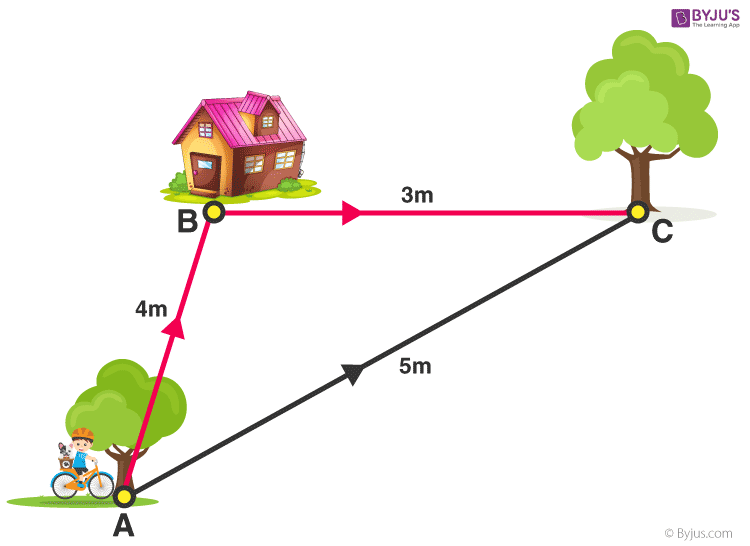
The girl bikes from A to B to C. What is her distance travelled?
3 m
4 m
5 m
7 m
12 m
The girl bikes from A to B to C. What is her displacement?
3 m
4 m
5 m
7 m
12 m
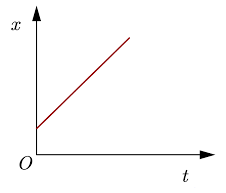
What type of graph is this?
Position v. time graph
Velocity v. time graph
Acceleration v. time graph
Speed v. time graph
The graph is wrong because the x is on the wrong axis.
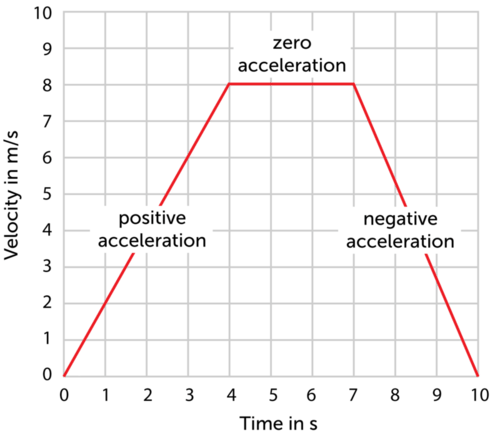
What type of graph is this?
Position v. time graph
Velocity v. time graph
Acceleration v. time graph
Speed v. time graph
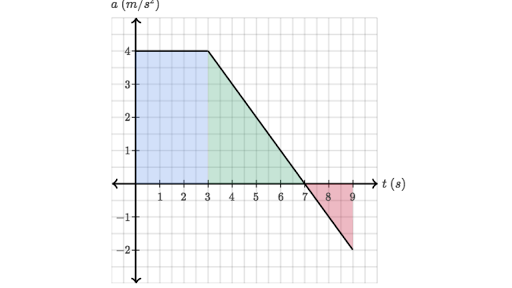
What type of graph is this?
Position v. time graph
Velocity v. time graph
Acceleration v. time graph
Speed v. time graph
Primary colors graph
(Select all that apply)
Acceleration means:
slowing down.
speeding up.
changing direction.
going very fast.
balanced forces.
Which of the following is the more accurate version of the gravitational field on planet earth?
10 m/s
10 m/s2
9.81 m/s
9.81 m/s2
Your velocity at a certain moment is called:
Instantaneous Velocity
Average Velocity
Tangential Velocity
Constant Velocity
Uniformly Accelerated Motion

