Worksheets
Unit 2: Forces
Total questions: 61
Worksheet time: 1hrs 19mins
What is force in physics?
A power in Star Wars
A push or pull on an object
A stop on an object
The start of an object
What can force do to an object?
Accelerate an object
Slow down an object
Have the object remain in place
Have the object change shape
All of the above
What is the measure of force?
Newtons
Light years
Inches
Gallons
What is the unit for FORCE?
N (Newtons)
lbs (pounds)
g (grams)
m/s (meters per second)
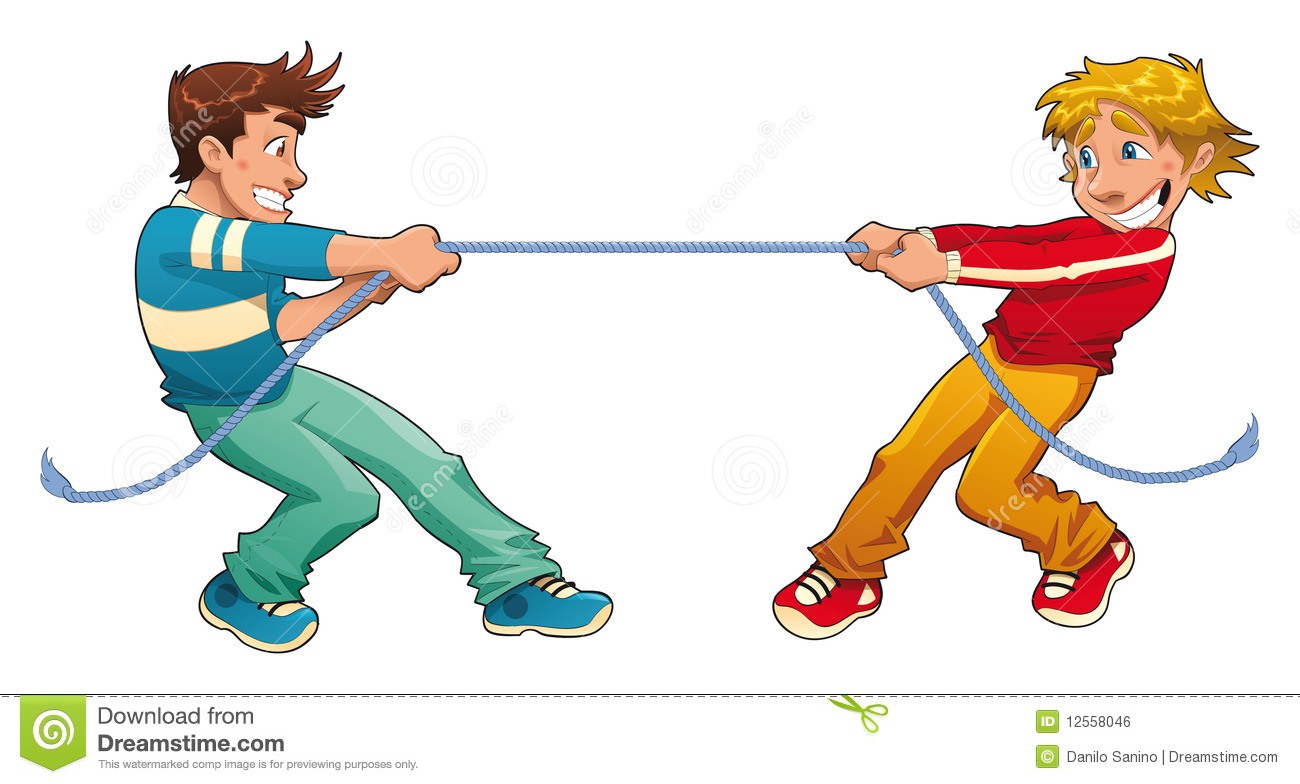
If these boys are pulling with the same amount of force, what will happen?
The boy in blue will win.
They will not move at all.
The boy in red will win.
Both will fall down.

What force holds the planets in motion around the sun?
Magnetic
Electrical
Gravitational
Air Resistance
Jupiter has about 317 times more mass than Earth. What can you infer from this fact?
That Jupiter’s gravitational force is much weaker than Earth’s gravitational force.
That Jupiter’s gravitational force is much stronger than Earth’s gravitational force.
That Jupiter’s and Earth’s gravitational forces are equal.
Mass has no effect on the gravitational force between two objects.
This type of force resists motion between two surfaces that are pressed together.
contact
gravity
friction

What type of force was at work in the parachute?
elastic spring force
frictional force (air resistance)
magnetic force
gravitational force


___________ is an opposing force that makes objects in motion slow down.
force
speed
friction
mass

The girls in this picture represent ________ forces (or 2 objects in equilibrium).
kinetic
balanced
unbalanced
chemical
What will cause an object to move?
Applied forces
Balanced forces
Unbalanced forces
With unbalanced forces, the object will move in the direction of the _______ force.
larger
smaller
equal

Which boy will have an easier time getting down the hill?
Boy A, because he is experiencing less friction than Boy B.
Boy B, because he is experiencing more friction than Boy A.
How does the mass of an object affect its motion?
It has no effect
The less the mass, the less effect a force will have
The greater the mass, the greater the effect a force will have
The greater the mass, the less effect a force will have
Static friction is present only when an object is at rest.
True.
False.
What is the friction force acting upon an object on wheels?
Static
Sliding
Rolling
Fluid
What is a friction force acting on a NON-moving object?
Static friction
Fluid friction
Rolling friction
Sliding friction
Friction always...
Resists motion
Is negative
Goes against the applied force
Is determined by weight
The rougher the surface, the faster an object will travel over the surface.
True
False
What is static friction?
The friction between two objects that are not moving.
Friction between a rolling object and the surface that it is rolling on.
Friction where an object rubs against another surface.
Friction of something going through any type of liquid or air.
How does friction affect speed?
More friction decreases speed
More friction increases speed
Less friction decreases speed
A puck slides along an icy surface. What makes it slow down?
It runs out of push
It rubs against the ice
It runs out of electricity
Newton's Law of Inertia (first law) describes the motion of:
Objects at rest only
Objects in motion only
Objects at rest and objects that are in motion
Objects that accelerate

Which one of Newton’s Laws of Motion best explains why the dishes do not move when the tablecloth is removed?
Law of Inertia
Law of Acceleration
Law of Action-Reaction
Law of Gravitation

Which law best explains why the coin sitting on top of the ring falls directly into the jar below because it wants to remain at rest?
Law of Inertia
Law of Acceleration
Law of Action - Reaction
Law of Gravitation

Which law best explains why people remain in motion when a car crashes, if they are not wearing a seatbelt?
Law of Inertia
Law of Acceleration
Law of Action - Reaction
Law of Gravitation

Which law best explains why more force must be applied to the bowling ball to make it accelerate at the same rate as the tennis ball?
Law of Inertia
Law of Acceleration
Law of Action - Reaction
Law of Gravitation
An object at rest will remain at rest, and an object in motion will remain in motion, unless acted upon by an unbalanced force.
Law of Inertia
Law of Acceleration
Law of Action - Reaction
Force is directly proportional to acceleration but inversely proportional to an object's mass.
Law of Inertia
Law of Acceleration
Law of Action - Reaction
What is Newton's 1st law of motion?
Force = mass x acceleration
An object at rest stays at rest unless acted on by an unbalanced force.
For every action, there is an equal and opposite reaction.
Weight=mass x gravity
What is Newton's 2nd law of motion?
Force =mass x acceleration
An object at rest stays at rest unless acted on by an unbalanced force.
For every action, there is an equal and opposite reaction.
Speed = timedisplacement
What is Newton's 3rd law of motion?
Force = mass x acceleration
An object at rest stays at rest unless acted on by an unbalanced force.
For every action, there is an equal and opposite reaction.
Law of gravity
Which force causes an object to speed up or slow down (accelerate or decelerate)?
unbalanced force
balanced force
A car speeding up, a dog slowing down, and a person turning around the block are examples of...
Balanced Forces
Unbalanced Forces
What is Newton's First Law known as? The Law of ________
Friction
Mass
Inertia
Gravity
Newton's Second Law is also known as the Law of _______
Inertia
Acceleration
Action - Reaction
Gravitation
In equation form, Newton's Second Law of motion can be expressed as:
F=ma
v=d/t
a=v/t
p=mv

According to Newton's Second Law, which would take more force to slow down?
The truck
The car
They would both take the same force
Cannot be determined
The SI unit for force is:
Kilogram (kg)
Meter per second (m/s)
Newtons (N)
Meter per second squared (m/s2)
The stronger the force, the ________ the acceleration.
stronger
weaker
Your 2500 kg car experiences a net force of 5000 N. How fast will it accelerate?
20 m/s2
0.5 m/s2
2 m/s2
120 N

What is the net force in this situation?
17 N Right
17 N Left
3 N Right
3 N Left
If the mass of the car/man/parachute is 150 kg, what is their acceleration?
0.02 m/s2
50 m/s2
0.11 m/s2
8.82 m/s2
If a baseball and a cannonball are dropped from the same height at the same time, which ball will hit the ground first?
The cannonball
The baseball
The balls land at the same time.
The ball with the larger volume
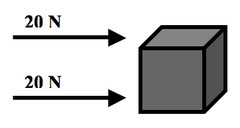
What is the net force?
40 N left
0 N Balanced
400 N right
40 N right

A man pushes a box across the floor at a constant velocity. There is a force on the box resisting its motion. This is the ...
force of gravity
normal force
force of friction
applied force
The momentum of an object depends upon the object's ___________&_____________.
size and shape
mass and speed
mass and velocity
mass and energy

The definition of momentum is:
Mass in Motion
The size of an object
The velocity of an object
A comparison between two objects
The equation to calculate momentum is:
p=mv
p=1/2mv2
p=mgh
p=mg

10. Which of the following is an example of momentum in action?
A. person jogging through the park
B.
bowling pool hitting pins
C. person playing pool
D.both B and C