
 Worksheets
AP Dynamics
Total questions: 56
Worksheet time: 37mins
An object can exert a force on itself.
True
False
A basketball is bounced against the ground. How does the force exerted by the ball on the ground compare with the force exerted by the ground on the ball?
The force exerted by the ball is greater.
The forces exerted by the ball and the wall have the same magnitude.
The force exerted by the ball is smaller.
The relative magnitudes cannot be determined.
A person is riding in an elevator going down and increasing in speed. Which of the following is correct about the force F(P) that is exerted by the floor of the elevator on the person?
F(P) is equal to the normal force, where F(P) is larger as the person moves down.
F(P) is equal to the normal force, which decreases as the person moves down.
F(P) is equal to the force of gravity, which does not change as the person moves down.
F(P) is equal to the force of gravity, which decreases as the person moves down.
Action and reaction forces are always acting
on the same object.
on different objects.
in the same direction.
up.
Action and reaction forces are always acting
on the same object.
in opposite directions.
in the same direction.
up.

Action: When a swimmer pushes on water backward
the water pushes the swimmer forward (reaction).
the swimmer moves backward (reaction).
the water moves backward (reaction).
nothing happens.
Which statement is true about friction?
Friction can act in the direction of motion.
Friction always slows an object down.
Friction is calculated using the coefficient of friction times the force of gravity.
Friction cannot occur if an object is stationary.
Two masses, m1 and m2, are attached to each other by a string on a frictionless table. m1 is pulled to the right by an applied force (Fp). What is the correct equation for the motion of block m2? Ft is the tension of the string.
Fp - Ft = m2 a
Ft = m2 a
Ft + Fp = m2 a
Fp - Ft = (m1 + m2) a
Which statement best describes the acceleration of an atwood machine?
It experiences constant acceleration.
It experiences constantly changing acceleration.
It experiences negative acceleration.
It experiences increasing acceleration.
How can you determine the acceleration of an Atwood's Machine?
(g (m1 + m2)(m1+m2))
m1 − m2(m1 + m2)
g m1+m2(m1 − m2)
m1 + m2
A metal ball with a mass of 5 kg is released at the same time as a wooden ball with a 1 kg mass. How does the acceleration of the center of mass of the metal ball compare to the wooden ball?
The acceleration of the metal ball is five times greater.
The acceleration of both is the same.
The acceleration of the wooden ball is 1/3 less.
The acceleration is initially greater on the metal ball but becomes even over time.
An elevator carrying a person of mass m is moving upward and slowing down. How does the magnitude F of the force exerted on the person by the elevator floor compare with the magnitude mg of the gravitational force?
F is greater than mg
F is less than mg
F is equal to mg
F can be greater or smaller depending on the speed of the elevator.

Wall-E throws a battery to EVE while they are floating in outer space. In what direction will Wall-E move when he throws the battery?
The opposite direction to the throw.
The same direction as the throw.
Upwards
He will not move.
Wall-E throws a battery to EVE while they are floating in outer space. In what direction will EVE move when she catches it?
The opposite direction to the throw.
The same direction as the throw.
Upwards
She will not move.
Which combination of masses for an Atwood machine will result in the greatest acceleration?
16 kg and 10 kg
12 kg and 1 kg
9 kg and 8 kg
4 kg and 4 kg
A 500 gram weight is hung from a spring. The spring extends 2 cm. What is the spring constant?
245 N/m
25 N/m
250 N/m
24.5 N/m
An unknown planet has the same mass as earth, but six times the radius. How would the acceleration of gravity change on this unknown planet?
1/6 g
6 g
1/36 g
36 g
An unknown planet has the same radius as earth, but six times the mass. How would the acceleration of gravity change on this unknown planet?
1/6 g
6 g
1/36 g
36 g
A box is attached to a frictionless pulley. The box has a mass of 21 kg and the rope can withstand a force of up to 65 N. How much can the box accelerate before the rope breaks?
3.10 m/s/s
21 m/s/s
9.8 m/s/s
0.05 m/s/s

What is the net force in a modified atwood machine?
mg
Mg
(M+m)g
(M+m)g / (M-m)
A 3 kg mass is attached by a string to a 5 kg mass. The 5 kg mass is connected to the ceiling and the masses are not moving. What is the tension on the string between the two masses?
0 N
29.4 N
49 N
0.3 N
A 3 kg mass is attached by a string to another 3 kg mass. One 3 kg mass is pulled upwards with an acceleration of 2.2 m/s/s. What is the tension on the string between the two masses?
0 N
36 N
29 N
23 N
What is the force of gravity according to Newton?
A force of attraction between all objects due to mass.
A force that attracts celestial objects to each other.
A force that pulls all things down.
A hole that passes through space-time.
How is the force of gravity related to the distance between the objects?
Gravity is inversely proportional to the square of the distance.
Gravity is directly proportional to distance.
Gravity is proportional to the square of the distance.
Gravity is not related to distance.
How is the force of gravity related to the mass of the objects?
Gravity is inversely proportional to the square of the masses.
Gravity is directly proportional to mass.
Gravity is proportional to the square of the masses.
Gravity is not related to mass.
How is Newton's second law important for a rocket launch?
The rocket burns fuel to become lighter and require less force.
The burning fuel exerts a force downward, which causes an upward reaction force.
The object will remain in motion once it leaves the pull of Earth's gravity.
The sum of forces will be in equilibrium as the rocket launches.
A force of 8 N is applied to a crate so that it moves at a constant speed of 1.5 m/s. What is the net force?
A force of 8 N is applied to a crate so that it moves at a constant speed of 1.5 m/s. What is the magnitude of the frictional force?

Is this object in equilibrium?
Yes and it's moving right
Yes and its at rest
No, it's accelerating right
No, it's at rest
Which of these is a correct sum statement for Fx?
Fa - Ff = ma
Fnet = Ff
Fn/Fg
Fa = ma
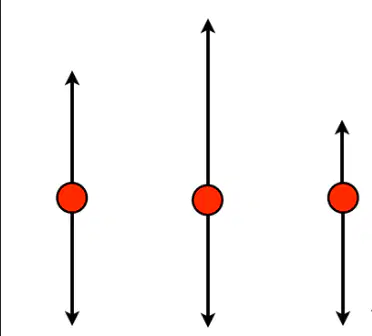
Here are 3 FBD diagrams for an elevator. Consider them to be A, B and C. Which one shows an elevator accelerating upward?
A
B
C
None of these

Is it possible for the object in the diagram to be moving to the right and have this FBD?
Yes. It's possible that the x forces were just left off the diagram.
No. The FBD shows that the system is in equilibrium.
Yes. It could be moving at a constant velocity.
No. A FBD shows all F.
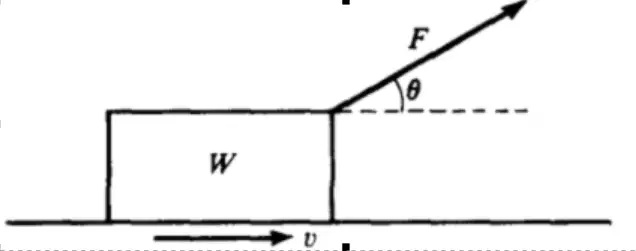
A block of weight W is pulled along a horizontal surface at a constant speed v by a force F, which acts at an angle Θ with the horizontal, as shown. The normal force exerted on the block by the surface has magnitude
greater than W
greater than 0 but less than W
equal to W
0
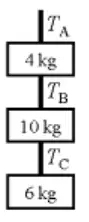
Rank the tensions experienced by the strings.
TA>TB>TC
TB>TC>TA
TB>TA=TC
Cannot be determined
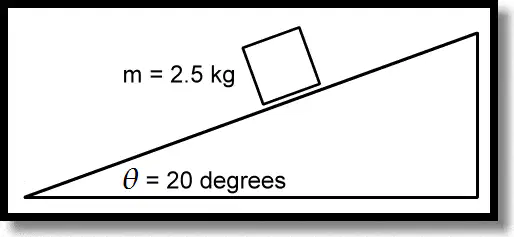
If there is no friction, then the acceleration would be equal to
mg
g
sin(Θ)mg
sin(Θ)g
A man standing on a scale in an elevator notices that the scale reads 40 newtons greater than his normal weight. Which type of movement of the elevator could cause this greater-than-normal reading?
Upward acceleration of the elevator
Downward acceleration of the elevator
Constant speed of the elevator
A man weighing 800 Newtons is standing in an elevator. If the elevator rises with an acceleration of 0.5 meters per second2, the force exerted by the elevator on the man will be
840 N
How is Newton's second law important for a rocket launch?
The rocket burns fuel to become lighter and require less force.
The burning fuel exerts a force downward, which causes an upward reaction force.
The object will remain in motion once it leaves the pull of Earth's gravity.
The sum of the forces will be in equilibrium as the rocket launches.
A 3 kg mass is attached by a string to a 5 kg mass. The 5 kg mass is pulled upwards with an acceleration of 2.2 m/s/s. What is the tension on the string between the two masses?
36 N
0 N
29 N
23 N
A 3 kg mass is attached by a string to a 5 kg mass. The 5 kg mass is connected to the ceiling and the masses are not moving. What is the tension on the string between the two masses?
0 N
29.4 N
49 N
0.3 N
A box is attached to a frictionless pulley. The box has a mass of 21 kg and the rope can withstand a force of up to 65 N. How much can the box accelerate before the rope breaks?
3.10 m/s/s
9.8 m/s/s
21 m/s/s
0.05 m/s/s
An elevator carrying a person of mass m is moving downward and slowing down. How does the magnitude F of the force exerted on the person by the elevator floor compare with the magnitude mg of the gravitational force?
F is greater than mg
F is equal to mg
F is less than mg
F can be greater or less depending on the speed of the elevator
A person is riding in an elevator going down and increasing in speed. Which of the following is correct about the force F(P) that is exerted by the floor of the elevator on the person?
F(P) is equal to the normal force, where F(P) is larger as the person moves down.
F(P) is equal to the normal force, which decreases as the person accelerates down.
F(P) is equal to the force of gravity, which does not change as the person moves.
F(P) is equal to the force of gravity, which decreases as the person accelerates down.
A spring is stretched 0.75 m by an external force of 30 N. What is the spring constant?
Which experiment would measure inertial mass?
A block is pushed with a known force to a specific acceleration.
A block is placed on an electronic scale and the result is multiplied by 9.8.
A block is hung vertically from a spring to determine the displacement.
None fo these
An astronaut is floating away from his space station. How can they get back?
Not possible. All is lost.
Throw their tools in the direction they want to go.
Move their feet in opposite directions to each other while pointed away from the station.
Expel some of the air supply in the opposite direction that they want to go.
Which is an example of friction acting in the direction of motion?
A person walking across the floor.
A ball coming to rest after rolling across the floor.
Brakes being applied to stop a car.
Rubbing your hands together to get warm.
What is the algebraic relationship between acceleration and mass?
Directly linear
Inverse
Exponential
Square root
What is the algebraic relationship between acceleration and force?
Directly linear
Inverse
Exponential
Square root
A box is sliding down a 20 degree ramp at a constant speed. What is the coefficient of friction?
0.36
0.31
0.93
0.05
If it takes 25 N of force to move a box across the floor at a constant speed, and the coefficient of friction is 0.65, how much does the box weigh?
17 N
38 N
How is static friction different than kinetic friction?
Static friction prevents motion, while kinetic friction occurs during motion.
An object is moving to the south at a constant speed. Three forces are exerted on the object. One force is 10 N south and one force is 5 N east. What is a possible third force?
11 N northwest
15 N southwest
5 N northwest
10 N northeast
A bulldozer is pushing on a 100 kg object with 150 N of force. Another bulldozer (with a distracted driver), pushes on the opposite side of the object with 200 N. What is the acceleration of the object?
0.5 m/s/s
2 m/s/s
1.5 m/s/s
2.5 m/s/s
A box is on an inclined plane. Which formula is equal to the normal force on the box?
A box is moving at a constant speed on an inclined plane. Which formula is equal to the force of friction between the box and the inclined plane?
mgcos(theta)
mgtan(theta)
mg*coefficient of friction
mgsin(theta)

