wayground logo

Free Printable Worksheets

Font size

S
M
L
XL
Worksheets

Test #2

Total questions: 105

Worksheet time: 2hrs 55mins

Name
Class
Date
1.
What does it mean to reflect?
a)
bounce off
b)
bend
c)
refract
d)
energy
2.
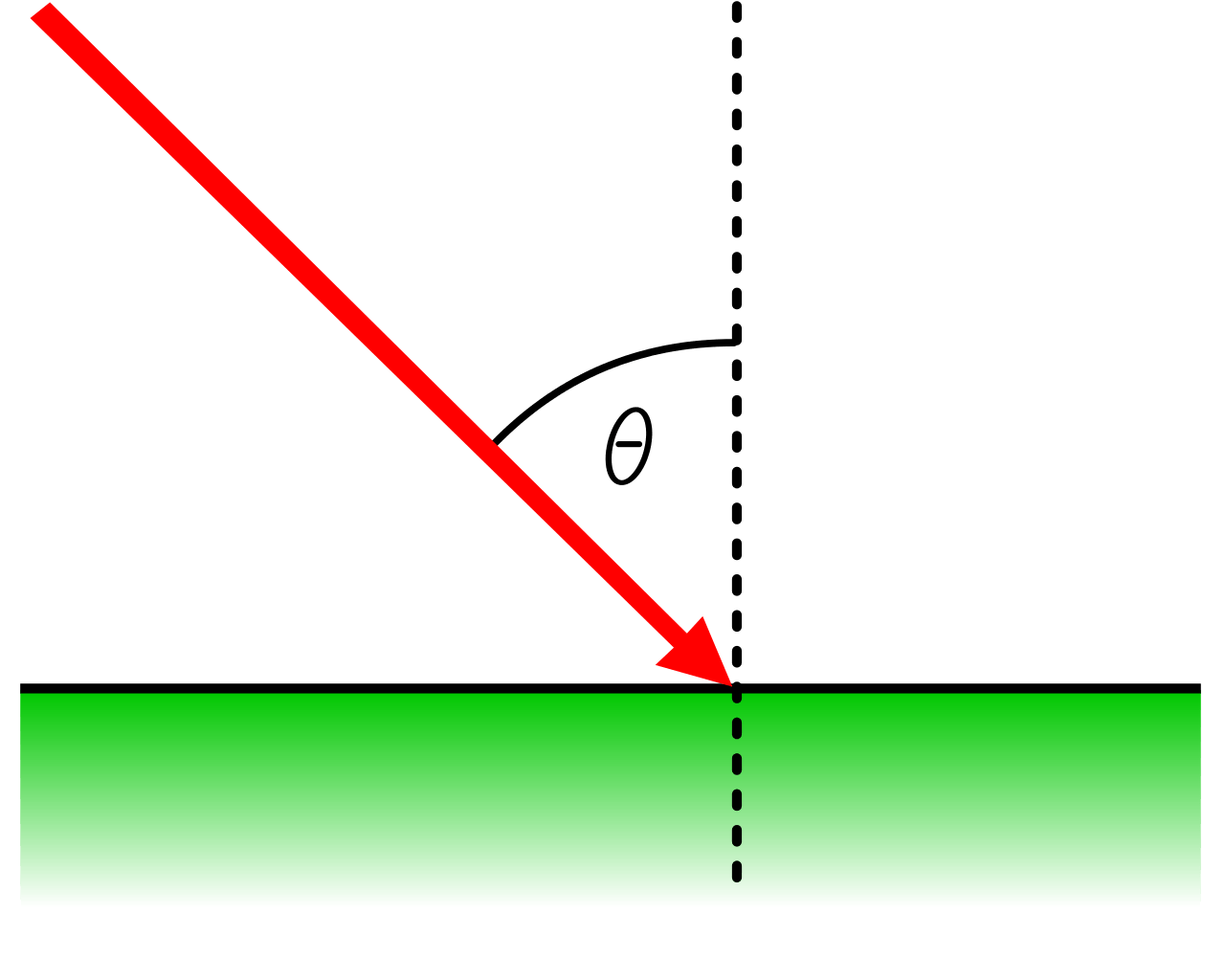
According to the Law of reflection, a light ray striking a mirror
a)
continues moving through the mirror in the same direction
b)
moves into the mirror at a slightly different angle
c)
bounces off the mirror toward the direction it came from
d)
bounces off the mirror at the same angle it hits.
3.
An image that you can see when you look into a mirror, but does not really exist is called which of the following?
a)
Real Image
b)
Fake Image
c)
Virtual Image
d)
Digital Image
4.

A real image...

a)

is produced by virtual rays and can be projected on a screen

b)

is produced by real rays and cannot be projected on a screen

c)

is produced by virtual images and cannot be projected on a screen

d)

is produced by real rays and can be projected on a screen

5.

What is an image called that forms when light rays actually meet

a)

virtual image

b)

real image

c)

diffuse reflection

d)

regular reflection

6.
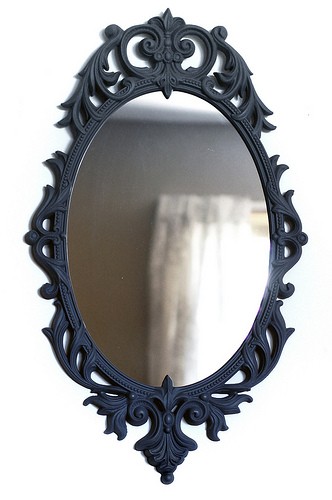
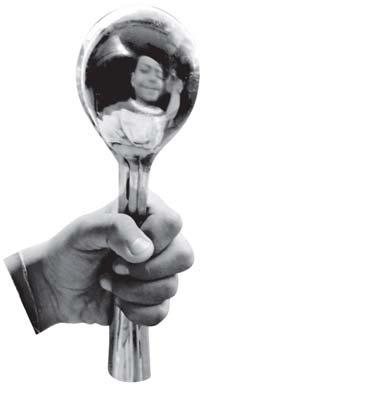
What kind of mirror is shown here?
a)
plane
b)
concave
c)
convex
d)
diffuse
7.
Convex mirrors can create virtual and real images.
a)
True
b)
False
8.
Concave mirrors can create virtual and real images.
a)
True
b)
False
9.
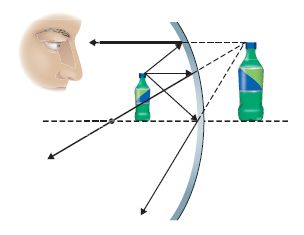
An incident ray that is parallel to the principal axis of a curved mirror...
a)
will reflect parallel to the principal axis
b)
will reflect through the focal point
c)
will reflect through the center of curvature
d)
will continue along the same path through the lens
10.
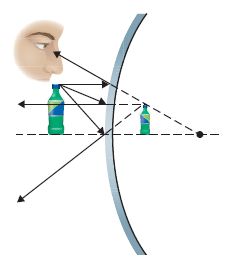
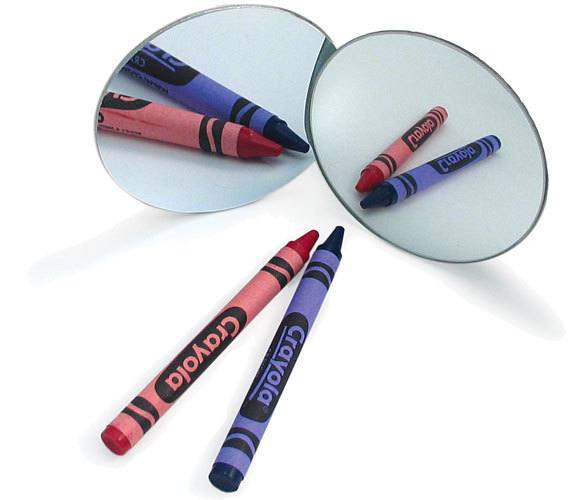
Which terms describe the reflection seen in this image?
a)
behind mirror, erect, magnified, virtual
b)
behind mirror, erect, reduced, virtual, inverted
c)
d < f, erect, reduced, real
d)
d < f, erect, reduced, virtual
11.
Convex mirrors cause light to spread out.
a)
True
b)
False
12.
a)
Real, larger image
b)
virtual, larger image
c)
Real, smaller image
d)
Real, larger image
13.
The distance between the focal point and the mirror is
a)
raduis
b)
diameter
c)
focal point
d)
focal length
14.

The focal length of a mirror is equal to the:

a)

radius of curvature

b)

diameter of curvature

c)

half radius of curvature

d)

half diameter of curvature

15.
If an incident ray passes through C and hits a concave mirror then it will reflects
a)
Parallel
b)
Towards F
c)
Towards C
d)
Away from the mirror
16.
An object located on 2F of a concave mirror will always appear...
a)
upright
b)
smaller
c)
same size
d)
larger
17.
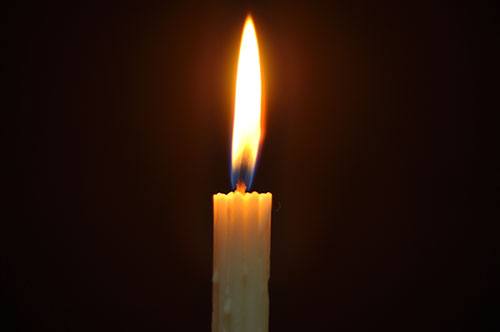
If a candle is placed at f in front of a converging mirror, the image
a)
will appear at f behind the mirror
b)
the image will appear at C in fromt of the mirror
c)
the image will appear between C and f on the same side 
d)
the image will not appear
18.
If a candle is placed at C in front of a converging mirror, the image
a)
will appear at f behind the mirror
b)
the image will appear at C in fromt of the mirror
c)
the image will appear between C and f on the same side 
d)
the image will not appear
19.
Convex mirrors can produce...
a)
Real, erect images
b)
Virtual, erect images
c)
Real, inverted images
d)
no images form
20.
Occurs when a beam of light strikes a smooth surface
a)
regular reflection
b)
regular refraction
c)
diffuse reflection
d)
diffuse refraction
21.
Occurs when a beam of light strikes a rough surface, reflecting in many directions
a)
regular reflection
b)
regular refraction
c)
diffuse reflection
d)
diffuse refraction
22.
A lens that is thicker in the center and thinner at the edges and bends light inwards is a ____________________
a)
concave lens
b)
convex lens
23.
Al lens that is thinner in the center and thicker at the edges and bends light outward is a _______________________
a)
concave lens
b)
convex lens
24.
What is refraction?
a)
Where light changes direction
b)
When light bounces off a surface
c)
When light is absorbed
25.
What is reflection?
a)
Where light changes direction
b)
When light bounces off a surface
c)
When light is absorbed
26.
What is 'the normal'?
a)
A line at a right angle from the incident ray
b)
Where the mirror is located
c)
The angle of which light changes direction
27.
What is the angle of refraction?
a)
The angle which light bounces of an object?
b)
The angle which light changes direction
c)
The angle of which light enters an object
28.
What is the angle of incidence
a)
The angle which light bounces of an object?
b)
The angle which light changes
c)
The angle of which light enters an object
29.
what is the difference between convergent and divergent lens?
a)
convergent - focus light together, divergent - refracts light into different directions
b)
convergent - focus light into different directions, divergent - refracts light together
c)
no difference
30.
A magnifying glass is an example of what type of lens?
a)
convex
b)
concave
c)
mirror
d)
prism
31.
The incident angle that causes the refracted ray to lie along the boundary of the surface is called the _____.
a)
normal
b)
critical angle
c)
absolute angle
32.
When an object is placed on the focal point in front of a convex lens, the image produced is ___.
a)
real, reduced, and inverted
b)
real, enlarged, and inverted
c)
real, true, and inverted
d)
There is no image
33.
When an object is placed between the focal point and the convex lens, the image produced is ___.
a)
real, reduced, and inverted
b)
real, enlarged, and inverted
c)
virtual, enlarged, and upright
d)
virtual, reduced, and upright
34.
What does the word "diverging" mean?
a)
to spread apart
b)
to come together
c)
parallel
d)
perpendicular
35.
Images produced by a diverging lens are always _____.
a)
real, reduced, and inverted
b)
virtual, reduced, and upright
c)
real, enlarged, and inverted
d)
virtual, enlarged, and upright
36.
In the formulat 1/f= 1/do + 1/di, the variable "f" refers to the _____.
a)
object distance from the lens
b)
image distance from the lens
c)
magnification
d)
focal point 
37.
In the formula 1/f = 1/do + 1/di, the variable "di" refers to _____.
a)
the object distance from the lens
b)
the image distance from the lens
c)
the object height
d)
the image height
38.
In the formula m = hi/ho, the variable "m" refers to ___.
a)
the height of the image
b)
the height of the object
c)
the focal point
d)
how reduced or enlarged the image is compared to the object
39.
In the formula m = hi/ho, if the variable "hi" is negative, that implies that the image is ___.
a)
true
b)
upright
c)
inverted
d)
reduced
40.
If the focal point is a negative number, the lens is _____.
a)
convex
b)
concave
c)
virtual
d)
real
41.
When the variable "di" is a negative number, the image is ____.
a)
upright
b)
inverted
c)
virtual
d)
real
42.
When an object is placed at 2f in front of a convex lens, the image will be ___.
a)
real, reduced, and inverted
b)
real, true, and inverted
c)
real, enlarged, and inverted
d)
virtual, enlarged, and upright
43.
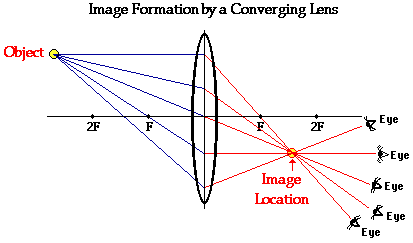
This image is.....
a)
inverted and smaller
b)
inverted and larger
c)
not inverted and smaller
d)
not inverted and larger
44.
A convex lens has a focal length f.  If an object is placed at 2f at what distance will the image appear?
a)
2f
b)
f
c)
between f and 2f
d)
infinity
45.
What is in the middle of a lunar eclipse?
a)
moon
b)
sun
c)
earth
46.
Where must you be to see a total solar eclipse?
a)
a corona
b)
an orbit
c)
the moon's shadow
d)
the earth's shadow
47.

This model is showing us a...

a)

lunar eclipse

b)

solar eclipse

c)

phases of the moon

d)

earth eclipse

48.

This image is showing us a.....

a)

solar eclipse

b)

lunar eclipse

c)

phases of the moon

d)

earth eclipse

49.

When the moon passes between the earth and the sun, this results in a.....

a)

Waxing moon

b)

lunar eclipse

c)

solar eclipse

d)

sun rise

50.
What is the darkest inner part of the shadow cone called, where a total eclipse can be viewed.
a)
Total
b)
Umbra
c)
Penumbra
51.
What is the order during a lunar eclipse
a)
sun, moon, earth
b)
sun, earth, moon
52.
the lighter outer portion of the shadow or partial shadow of the earth.
a)
Umbra
b)
Penumbra
c)
Solar Eclipse
d)
Lunar Eclipse
53.
When light travels through water it ______.
a)
speeds up
b)
gets wet
c)
slows down
d)
makes it boil
54.
How does light travel?
a)
longitudinal wave
b)
transverse wave
55.
Electromagnetic waves are transverse waves that transfer
a)
sound energy.
b)
photons.
c)
electrical and magnetic energy.
d)
the particles of a medium.
56.
What is the energy of an EM wave related to?
a)
frequency
b)
speed
c)
absorption rate
d)
transmission rate
57.
As the wavelength of an EM wave increases, 
a)
frequency and energy decrease
b)
frequency and energy increase
c)
frequency increases, but energy decreases
d)
frequency decreases, but energy increases
58.
The speed of light in a vacuum is---
a)
3 x 10(-1) m/s
b)
300 m/s
c)
300,000,000 m/s
d)
Infinite
59.
Which of the following has the highest frequency?
a)
Visible light
b)
Microwaves
c)
Infrared
d)
Radio waves
60.
Which of the following has the shortest wavelength?
a)
Gamma rays
b)
Visible light
c)
Ultraviolet
d)
Radio waves
61.
Which of the following has the lowest frequency?
a)
Ultraviolet
b)
Microwaves
c)
Radio waves
d)
X-rays
62.
Electromagnetic waves can travel through a vacuum.
a)
True
b)
False
63.
Sound waves are part of the electromagnetic spectrum.
a)
True
b)
False
64.
Objects that are opaque (create a shadow) __________ light
a)
Reflect
b)
Transmit
c)
Absorb
65.

Objects that are transparent _____________ light

a)

Reflect

b)

Transmit

c)

Absorb

66.
What is a prism?
a)
a transparent object that separates white light
b)
an opaque object that appears black
c)
a translucent object
67.
Transparent
a)
A material that allows some light to pass through it
b)
a material that allows light to pass through it
68.
When light waves strike a(n) ______ object, a shadow forms
a)
transparent
b)
translucent
c)
opaque
d)
clear
69.
Which material is transparent?
a)
clear glass
b)
frosted glass
c)
white plastic
d)
mirror
70.
Which of these BEST describes an opaque material?
a)
bends the light when it passes through
b)
blocks all the light from passing through
c)
changes the color of light as it passes through
d)
allows light to pass through
71.
What happens to blue light when it hits a shirt that appears blue?
a)
The light is reflected.
b)
The light is absorbed.
c)
The light is refracted.
d)
The light is blocked.
72.
Which is true of a green grape?
a)
It absorbs green light.
b)
It absorbs white light.
c)
It reflects green light.
d)
It reflects white light.
73.
What is the absence of color?
a)
black
b)
white
c)
yellow
d)
blue
74.
Absorb or Reflect all colors?
a)
Absorb
b)
Reflect
75.
Absorb or Reflect all colors?
a)
Absorb
b)
Reflect
76.
Which of the following is not a secondary color of light?
a)
blue
b)
cyan
c)
yellow
d)
magenta
77.
Which color has the longest wavelength?
a)
Blue
b)
Green
c)
Red
d)
Yellow
78.
Magenta light is really a mixture of 
a)
red and yellow light.
b)
red and cyan light.
c)
yellow and green light
d)
red and blue light.
79.
The color of an opaque object is determined by the light that is 
a)
absorbed
b)
reflected
c)
transmitted
d)
all 
80.
Magenta light is really a mixture of 
a)
red and yellow light.
b)
red and cyan light.
c)
yellow and green light
d)
red and blue light.
81.
Complementary colors are two colors that 
a)
are next to each other on the color chart.
b)
produce white light when added together.
c)
look good together.
d)
are primary colors.
82.
Different colors of light correspond to different light 
a)
frequencies
b)
polarities
c)
intensities
d)
velocities
83.
Colors seen on a photograph result from color 
a)
subtraction
b)
addition
84.
Humans are most sensitive to light that is 
a)
red
b)
white
c)
yellow-green
d)
green-blue
85.
Sunlight contains all colors of light, but much of it is 
a)
orange
b)
red
c)
violet 
d)
yellow
86.
Light sometimes acts as a wave and sometimes as a particle.
a)
True
b)
False
87.
Energy emitted by vibrating electric charges is carried by electromagnetic waves.
a)
True
b)
False
88.
The sky is blue because air molecules absorb blue light.
a)
True
b)
False
89.
Which two pigments would you add to get Donald's blue shirt?
a)
Cyan and Yellow
b)
Cyan and Magenta
c)
Magenta and Yellow
d)
Cyan, Yellow, and Magenta
90.
Which two pigments would you have to mix to print Mickey's red shirt?
a)
Cyan and Yellow
b)
Cyan and Magenta
c)
Yellow and Magenta
d)
Cyan, Yellow, and Magenta
91.
What are the three secondary colors of light (primary pigments)?
a)
Cyan, Yellow, Magenta
b)
Red, Blue, Green
c)
Violet, Orange, Turquiose
d)
White, Black, Grey
92.
What are the three primary colors of light?
a)
Red, Blue, Yellow
b)
Green, Blue, Yellow
c)
Red, Blue, Green
d)
Cyan, Yellow, Magenta
93.
Which color has the longest wavelength?
a)
Blue
b)
Green
c)
Red
d)
Yellow
94.
As a light ray travels away from an object, the light ray travels
a)
in a straight line.
b)
on a curved path.
c)
up and down.
d)
in a circle.
95.
What are the actual colors of the rainbow?
a)
ROYGBIV
b)
ROYGBV
c)
ROYGCB
d)
ROYGCV
96.
Amplitude means 
a)
the length of the wave 
b)
the distance between waves
c)
the height of the wave 
d)
the energy in the wave 
97.
Waves with shorter wavelengths have 
a)
higher frequency 
b)
lower frequency 
c)
higher amplitude 
d)
lower amplitude 
98.
Colors we can see are called
a)
radio waves 
b)
ultraviolet light 
c)
infrared light 
d)
visible light 
99.
Waves with longer wavelengths have 
a)
higher frequency 
b)
lower frequency 
c)
higher amplitude 
d)
lower amplitude 
100.
Which section of the spectrum is the ONLY one we can see?
a)
X-rays
b)
Visible Light
c)
Gamma Rays
d)
Ultraviolet Rays
101.
How are electromagnetic waves different from other waves? 
a)
They have very short wavelengths 
b)
They transmit energy instead of matter 
c)
They can travel through a vacuum 
d)
They can change direction by reflection 
102.
Which of the following electromagnetic waves is given off as heat? 
a)
Radio Waves
b)
Infrared Rays
c)
Visible Light
d)
Gamma Rays
103.
The distance between two crests or two troughs of a wave is called:
a)
frequency
b)
amplitud
c)
wavelength
d)
hertz
104.
Which color has the least amount of energy?
a)
red
b)
orange
c)
green
d)
blue
105.
Emission of light from an atom occurs when an electron
a)
drops from a higher to a lower energy level.
b)
   jumps from a lower to a higher energy level.   
c)
   moves within its atomic orbital.
d)
falls into the nucleus.