wayground logo

Free Printable Worksheets

Font size

S
M
L
XL
Worksheets

Waves Review

Total questions: 100

Worksheet time: 2hrs 40mins

Name
Class
Date
1.

What is transferred from place to place by waves? (a)  

Choose from the below words
matter
energy
particles
light
2.

Waves that require a medium to travel are: (a)  

Choose from the below words
mechanical waves
transverse waves
electromagnetic waves
light waves
3.

What kind of wave is pictured below? (a)  
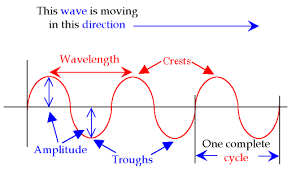
Choose from the below words
compressional wave
transverse wave
longitudinal wave
mechanical wave
4.

One hertz is equal to:

a)

1 cycle or wave per second

b)

the distance from crest to crest or trough to trough

c)

the distance from one rarefaction to the next rarefaction.

d)

the maximum displacement of the wave

5.

Longitudinal waves move __________ to the energy of the wave (select all that apply).

a)

Parallel

b)

Perpendicular

c)

At a 90 degree angle

d)

In the same direction

6.

The area of a longitudinal wave where particles are pushed close together are called: (a)  
Choose from the below words
rarefactions
compressions
amplitude
wavelength
7.

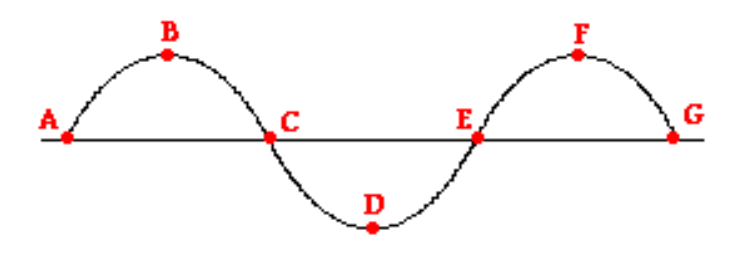
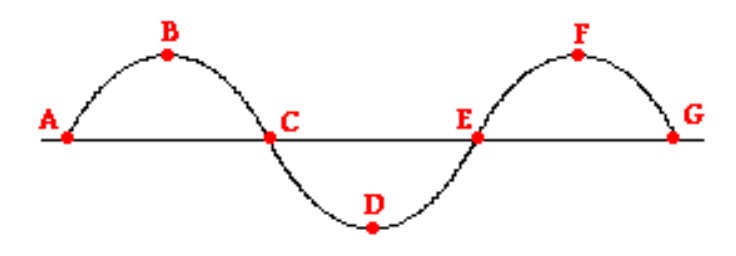
Which letter(s) represent the rest position of the wave (select all that apply)?

a)

A & C

b)

B & F

c)

E & G

d)

D

8.

What is represented by the blue lines? (a)  

Choose from the below words
Trough
Crest
Wavelength
Amplitude
9.

Which type of wave does sound travel in? (a)  

Choose from the below words
Transverse
Longitudinal
10.

What type of wave move in a back and forth motion? (a)  

Choose from the below words
Compression wave
Light wave
Transverse wave
Hicks-Riddick Wave
11.

What is the wavelength of this wave?

12.

Which of the following properties makes a light wave different from all mechanical waves?

a)

A light wave slows down in a vacuum.

b)

A light wave is able to transmit energy.

c)

A light wave exists as a transverse wave.

d)

A light wave can travel without a medium.

13.

What is the visible light spectrum in order?

a)

red, orange, yellow, green, blue, indigo, violet

b)

orange, blue, green, yellow, red, violet, indigo

c)

red, green blue, orange, violet, yellow, indigo

d)

McDonald's is gross

14.

What causes the refraction of a wave?

a)

the density of the medium changes the speed

b)

the amount of the medium changes the direction

c)

the color of the medium changes the speed

d)

the type of wave changes the direction

15.

The electromagnetic waves with the highest frequencies are called?

a)

radio waves

b)

gamma rays

c)

x-rays

d)

visible light

16.

The electromagnetic waves with the longest wavelengths are called?

a)

radio waves

b)

microwaves

c)

gamma rays

d)

x-rays

17.

When the frequency of a wave decreases, the ____________________________________ of the wave increases.

a)

wave speed

b)

amplitude

c)

wavelength

d)

Doc McStuffins

18.

How does a cell phone work?

a)

cell phones transmit and receive signals using high-frequency microwaves

b)

cell phones only receive signals from a cellular system

c)

cell phones use frequency modulation

d)

cell phones will use pulse modulation

19.
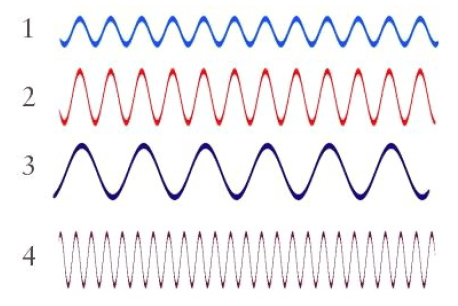
Which wave in the diagram has the greatest frequency?
a)
1
b)
2
c)
3
d)
4
20.

A _____ is sound waves that reflect off of a hard surface.

a)

echo

b)

amplitude

c)

opaque

d)

frequency

21.

What type of wave behavior is shown in the picture causing the pencil to appear to be bent?

a)

Reflection

b)

Absorption

c)

Bentrotation

d)

Refraction

22.

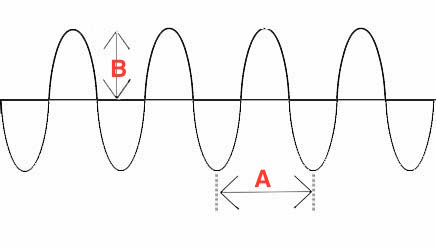
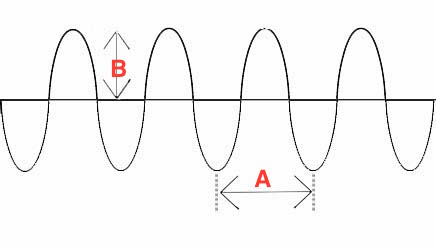
What property of this wave is represented by the letter "A"

a)

amplitude

b)

crest

c)

trough

d)

wavelength

23.
What property of the wave is represented by the letter "B"?
a)
amplitude
b)
crest
c)
trough
d)
wavelength
24.
The number of wavelengths that pass a point each per second is:
a)
frequency
b)
period
c)
longitudinal 
d)
transverse wave 
25.
Which vocabulary term is used to identify the distance between points C & G?
a)
Amplitude
b)
Crest
c)
Frequency
d)
Wavelength
26.
When the frequency of a wave increases, what happens to the wavelength?
a)
The wavelength is not directly affected by the frequency of a wave.
b)
The wavelength increases.
c)
The wavelength decreases.
d)
More specific information is needed to form a conclusion about the wavelength.
27.
Which letter(s) represent the trough of the wave?
a)
A
b)
B & D
c)
D
d)
C & G
28.
Which letter(s) represent the crest of the wave?
a)
A
b)
B & D
c)
B & F
d)
F
29.
This is a __________wave
a)
transverse
b)
longitudinal
c)
surface
d)
all of the above
30.
Which is an example of a longitudinal wave?
a)
light wave
b)
sound wave
c)
visible wave
d)
radio wave
31.
This is what you get when sound waves are reflected, or bounce back, off of a hard surface.
a)
Amplitude
b)
Pitch
c)
Volume
d)
Echo
32.
Destructive interference is 
a)
When the two waves affect  each other in a negative way 
b)
The two waves add together and produce a single wave of greater amplitude
c)
Are in phase 
33.
What is interference?  
a)
occurs when two or more waves overlap and combine 
b)
occurs when two or more waves combine and neutralize each other 
c)
when one waves travels alone
34.
Which wave behavior do noise cancelling headphones use?
a)
diffraction
b)
refraction
c)
constructive interference
d)
destructive interference
35.
When sound or light waves approach a corner, what is it most likely to do?
a)
go in a straight line
b)
bend around the corner
c)
turn around around and go back
d)
none of the above
36.
A change in the direction of a wave when the wave finds an obstacle or an edge.
a)
A. refraction
b)
B. reflection
c)
C. standing wave
d)
D. diffraction
37.
This is an example of which type of wave behavior?
a)
Reflection
b)
Refraction
c)
Diffraction
d)
Interference
38.
What is refraction?
a)
The bending of light as it passes through one material to another
b)
On the Electromagnetic spectrum, these have the shortest wavelengths and highest frequency
c)
Type of wave in which sound travels
d)
Highest point on a wave
39.
When two waves combine to form a new wave with a smaller amplitude, it is called 
a)
Refraction
b)
Constructive Interference
c)
Resonance
d)
Destructive Interference
40.
Which term best represents what happens when two wave pulses meet as they approach each other on a string?
a)
constructive interference
b)
destructive interference
c)
absorbed interference
d)
static interference
41.
A wave carries...?
a)
energy only
b)
matter only
c)
the matter carries the energy
d)
neither
42.
White light is the entire range of
a)
colors of visible light combined.
b)
ultraviolet light.
c)
gamma rays and X rays.
d)
EM waves.
43.
EM waves used in security scanning devices in airports
a)
ultraviolet
b)
x rays
c)
radio waves
d)
infrared
44.
Ultraviolet light is associated with
a)
human vision
b)
communication
c)
lung cancer
d)
producing vitamin D
45.
Which color of light has the longest wavelength?
a)
orange
b)
red
c)
blue
d)
green
46.
The higher the frequency the ______ the energy. 
a)
higher
b)
lower
c)
neither, stays the same
47.

Which electromagnetic waves are used in ovens and cell phone communications?

a)

Infrared rays

b)

ultraviolet rays

c)

microwaves

48.
Which type of waves are used in broadcasting?
a)
radio waves
b)
infrared rays
c)
x-rays
49.

How much of the electromagnetic spectrum is made up of visible light?

a)

only a small portion

b)

a very l;arge portion

c)

about half

50.

Which electromagnetic waves allow us to diagnose & treat cancer?

a)

Gamma rays

b)

X-rays

c)

Ultraviolet rays

51.

Which of the following is not an application of microwaves?

a)

cellphone

b)

radio

c)

radar

d)

microwave oven

52.

A wave that needs a medium to travel is called a(n)

a)

electromagnetic wave

b)

mechanical wave

c)

ocean wave

d)

any way can do this

53.

A wave that can travel with or without a medium is called a(n)

a)

electromagnetic wave

b)

mechanical wave

c)

surface wave

d)

all waves can travel in any way

54.

True or False: Amplitude can increase or decrease wavelength

a)

True, amplitude can increase or decrease wavelength

b)

False, frequency can increase or decrease wavelength

c)

False, crests can increase or decrease wavelength

55.
Waves that move the particles of the medium parallel to the direction in which the waves are traveling are called
a)
Surface Waves
b)
Combination Waves
c)
Longitudinal Waves
d)
Transverse Waves
56.
You and your father inspect an empty house with the hopes of buying it. You walk through the rooms talking to one another, and you notice that your voices and footsteps are echoing in the big, empty house. What causes the echo?
a)
sound waves reflecting off smooth, flat surfaces throughout the house
b)
sound waves moving around the large rooms
c)
sound waves moving slowly through air
d)
sound waves refracting around corners in the empty rooms
57.

What is the speed of light in kilometers per second?

a)

1,000,000 km/s

b)

300,000 km/hour

c)

300,000 km/minute

d)

300,000 km/s

58.

The distance light can travel in one year is ______________

a)

15,000 kilometers

b)

1 light-year

c)

15 Astronomical Units

d)

6,000 miles

59.

What type of interference is represented in this diagram?

a)

Constructive

b)

Destructive

60.

What type of interference is represented in the diagram?

a)

Constructive

b)

Destructive

61.

Review: What is it called when a wave bounces off an object?

a)

Reflection

b)

Refraction

c)

Diffraction

62.

What is a general definition of wave interference?

a)

When a wave bounces off an object

b)

When more than on wave meet and interact in the same medium

c)

When a wave bends around a corner

d)

When a wave creates static

63.

What type of interference is being shown in the picture?

a)

Constructive

b)

Destructive

64.

If waves overlap and are in phase, how will that affect the resultant wave?

a)

Decrease the amplitude

b)

Increase the amplitude

c)

Decrease the frequency

d)

Increase the frequency

65.

Constructive interference happens when two waves are:

a)

out of phase.

b)

zero amplitude.

c)

in phase.

66.

What do we call it when the energy of a wave is transferred to the matter it is passing through?

a)

reflection

b)

refraction

c)

diffraction

d)

absorption

67.
Two transverse waves overlap.  Crests overlap with crests.  Troughs overlap with troughs.  The waves are
a)
In-phase
b)
Out-of-phase
c)
In-synchronicity
d)
Out-of-synchronicity
68.
If two overlapping waves are in-phase, the resultant wave will have ______ compared to the two waves.
a)
Greater amplitude
b)
Greater frequency
c)
Greater wavelength
d)
Greater wave speed
69.
High frequency waves have _________ wavelength.
a)
varying
b)
high
c)
the same
d)
low
70.

Which would result in no network connection?

a)

cinder block walls around the phone

b)

water around the phone

c)

a phone in a microwave oven

d)

a plastic case around the phone

71.
All electromagnetic waves have the same...
a)
frequency
b)
speed
c)
wavelength
d)
energy
72.
Look at the diagram.  At which positions will the overlapping waves have the most destructive interference?
a)
Positions #1 & #2
b)
Positions #2 & #3
c)
Positions #3 & #4
d)
Positions #4 & #5
73.
a)
Diffraction
b)
Interference
74.
One end of the rope is vibrated to produce a wave with a wavelength of .25 m.  The Frequency of the wave is 3.0 Hz.  What is the speed of the wave?
a)
3.00 m/s
b)
2.50 m/s
c)
.75 m/s
d)
1.25 m/s
75.

What is the wavelength of a wave traveling at 1600m/s and a frequency of 400Hz?

a)

400m

b)

4m

c)

640,000m

d)

64m

76.

A wave moving at 2600m/s with a wavelength of 400m has what frequency?

a)

6.5 Hz

b)

1040000Hz

c)

.15Hz

d)

6Hz

77.

Amy sees a lightning flash.

She hears the thunder from the flash 5 seconds later.

The sound travels at 340 m/s.

How far away was the lightning?

a)

68 m

b)

850 m

c)

1700 m

d)

3400 m

78.

Which of these shows a longitudinal wave?

a)
b)
c)
d)
79.

What of the following equations can be used to calculate wave speed?

a)

Wave speed = frequency x wavelength

b)

Wave speed = amplitude x frequency

c)

Wave speed = frequency / wavelength

d)

Wave speed = wavelength / frequency

80.
What is the frequency of a wave traveling at 300 m/s with a 4 m wavelength?
a)
0.013 Hz
b)
75 Hz
c)
300 Hz
d)
1200 Hz
81.

If a mechanical wave is traveling through medium A and into medium B and it speeds up. Which statement is true?

a)

The wavelength of the wave will get shorter

b)

The wavelength of the wave will get longer

c)

The frequency of the wave will increase

d)

The frequency of the wave will decrease

82.

What is the speed of a wave with 0.15m wavelength and a frequency of 60 meters?

a)

90 m/s

b)

900 m/s

c)

9 m/s

83.

A wave has a frequency of 4 hz and a wave length of 3 m. What is the wave speed (velocity)?

a)

25 m/s

b)

1 m/s

c)

7 m/s

d)

12 m/s

84.

A wave has a frequency of 2 hz and a wave length of 8 m. What is the wave speed (velocity)?

a)

27 m/s

b)

36 m/s

c)

24 m/s

d)

16 m/s

85.
Which type of wave is the first to arrive after an earthquake occurs?
a)
P- Wave
b)
Rayleigh Wave
c)
S- Wave
d)
Shear Wave
86.
Which body waves cause particles of rock material to move at right angles to the direction in which the waves are traveling?
a)
Body Waves
b)
P- Waves
c)
S- Waves
d)
Surface Waves
87.
P Waves can move through which of the following?
a)
Gas
b)
Liquid
c)
Solid
d)
All of these
88.
S Waves can move through which of the following?
a)
Gas
b)
Liquid
c)
Solid
d)
All of these
89.
If the distance represented by the letter A were increased, how would it change the way the sound was heard?
a)
The sound would be higher. 
b)
The sound would be lower. 
c)
The sound would be softer. 
d)
The sound would be louder. 
90.

Kate's teacher gives her a tuning fork like the one shown. Kate knows that the following four things must happen so that she can hear the tuning fork. However, she does not know what order they must happen in. W-Her eardrum vibrates. X-She hits the tuning fork. Y-The air around tuning fork vibrates. Z-The tuning fork vibrates. Which of these shows the steps above in the order that they must occur for someone to be able to hear the tuning fork?

a)

W X Y Z

b)

Y Z X W

c)

W Z Y X

d)

X Z Y W

91.
What is the measure of how many waves pass a point in a certain amount of time?
a)
frequency
b)
wavelength
c)
midpoint
d)
crest and trough
92.
A _____________________ is the distance between a point on one wave and the identical point of the next wave.
a)
amplitude
b)
wavelength
c)
frequency
d)
compression
93.
If you walk into an empty gym and yell, why would you hear an echo?
a)
The gym walls are soft and uneven. 
b)
The sound waves are being absorbed by the hard smooth walls.
c)
The sound waves are bouncing off the hard smooth gym walls.
d)
The gym walls are really clean.
94.

This image best depicts which of the following wave behaviors?

a)

Reflection

b)

Refraction

c)

Diffraction

d)

Resonance

95.

Which color corresponds to wavelength A?

a)

Red

b)

Orange

c)

Yellow

d)

Green

e)

Blue

96.

What is the shortest wavelength on the electromagnetic spectrum?

a)

Red

b)

Ultra violet

c)

gamma rays

d)

Blue

97.
What can you tell about the motion of this object?
a)
Moving left.
b)
Moving right quickly.
c)
Standing still. 
d)
Moving up slowly. 
98.
A wave that moves the medium parallel to the direction of the energy is a:
a)
electromagnetic
b)
standing
c)
transverse
d)
longitudinal
99.
Sound is an example of which type of wave?
a)
Transverse
b)
Longitudinal
c)
Both
d)
Neither
100.
The image above shows a student using a Slinky to create a wave. The slinky is stretched at one end and the resulting wave travels back and forth. This is an example of a...
a)
Superposition Wave
b)
Refracted Wave
c)
Longitudinal Wave
d)
Transverse Wave