wayground logo

Free Printable Worksheets

Font size

S
M
L
XL
Worksheets

IIT-JEE & NEET FOUNDATION LEVEL-19 (9-O)

Total questions: 100

Worksheet time: 2hrs 40mins

Name
Class
Date
1.
Which type of bond has an unequal sharing of electrons?
a)
Polar Covalent 
b)
Non Polar Covalent
c)
Ionic
d)
Metallic
2.

Which of the following is NOT matter?

a)

a chair

b)

air

c)

light

d)

water

3.

Which of the following may be heterogeneous?

a)

elements only

b)

compounds only

c)

mixtures only

d)

elements and compounds

4.

Which of the following is pure?

a)

elements only

b)

compounds only

c)

mixtures only

d)

elements and compounds

5.

What is matter made up of?

a)

particles that are too large to be seen

b)

tiny butter particles

c)

particles that are too small to be seen

d)

tiny water particles

6.

Which among the following are natural materials?

a)

Air

b)

Water

c)

Sand

d)

Clothes

7.

Solids have ___________ and ____________.

(a)  

8.

The particles in a liquid are free to move.

a)

True

b)

False

9.

in which of the following diffusion is faster?

a)

solid in liquid

b)

liquid in liquid

c)

gas in gas

d)

none of the above

10.

Gases dissolve in water.

a)

True

b)

False

11.

When temperature increases solubility of a solid substance___________

a)

decreases

b)

remains unchanged

c)

increases

12.

Most of the materials that we see around us are mixtures

a)

False

b)

True

13.

Which among the following materials float?

a)

rubber cork

b)

steel cup

c)

stone

d)

plastic spoon

14.

Which among the following are natural materials?

a)

Air

b)

Water

c)

Sand

d)

Clothes

15.

The particles in a liquid are free to move.

a)

True

b)

False

16.

in which of the following diffusion is faster?

a)

solid in liquid

b)

liquid in liquid

c)

gas in gas

d)

none of the above

17.

Gases dissolve in water.

a)

True

b)

False

18.

Which among the following is synthetic materials?

a)

wood

b)

water

c)

clothes

d)

air

19.

Which among the following materials floats?

a)

plastic spoon

b)

rubber cork

c)

steel cup

d)

stone

20.

Sugar, salt and honney are ______ in water.

a)

soluble

b)

insoluble

21.
The ray of light that strikes a reflecting surface is called ________.
a)
incident ray
b)
reflected ray
c)
normal ray
d)
none of the above
22.
The imaginary line perpendicular to a reflecting surface is called _____.
a)
crooked line
b)
parallel line
c)
angular line
d)
normal line
23.
The angle produced as a source of light bounces off a reflecting surface is called ______.
a)
angle of crookedness
b)
angle of reflection
c)
angle of incidence
d)
angle of bounce
24.
Why can you see most objects? 
a)
they emit light
b)
light refracts through them
c)
light reflects off them
d)
They absorb light
25.
straight lines that represent light waves 
a)
Rays
b)
image
c)
lines
d)
visible light
26.
What is the line MN called in the given diagram
                               
a)
incident ray
b)
reflected ray
c)
reflecting surface
d)
normal
27.
what is the angle between the incident ray and the normal called as
a)
angle of incidence
b)
angle of reflection
c)
angle of convergent
d)
angle of divergent
28.
what is the angle between the reflected ray and the normal called as
a)
angle of incidence
b)
angle of reflection
c)
angle of convergent
d)
angle of divergent
29.
If the angle of incidence is 45 degree, what is the angle between the incident ray and reflecting surface
a)
45
b)
90
c)
180
d)
none of the above
30.
What does incidence angle equal?
a)
reflection angle
b)
∠C
c)
∠D
d)
all of these
31.
straight lines that represent light waves
a)
rays
b)
image
c)
reflection
d)
visible light
32.
a copy of an object formed by reflected or refracted rays of light
a)
image
b)
reflection
c)
regular reflection
d)
diffuse reflection
33.
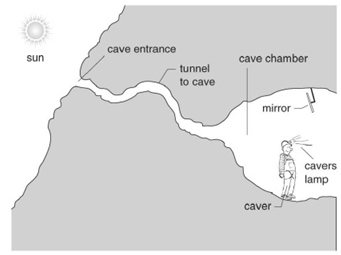
Which of the following is not a source of light? 
a)
A. candle
b)
B. caver’s lamp
c)
C. mirror
d)
D. sun
34.
If his lamp stopped working, what would the caver be able to see? 
a)
A. the tunnel to the cave
b)
B. a mirror
c)
C. nothing
d)
D. the walls of the cave
35.
What is A?
a)
Angle of incidence
b)
Angle of reflection
c)
Incident ray
d)
Reflected ray
36.
Law of reflection state that - The angle of incidence is .................. to the angle of reflection.
a)
equal
b)
double
c)
half
37.
........... – the angle between the normal and the reflected ray.
a)
Angle of incidence
b)
Angle of reflection
c)
Angle of coincidence
d)
Angle of direction
38.
........... – the angle between the normal and the incident ray.
a)
Angle of incidence
b)
Angle of reflection
c)
Angle of coincidence
d)
Angle of direction
39.
What is reflection?
a)
Reflection is the bouncing  of light off the surface that it strikes on.
b)
Reflection is the absorbing of light off the surface that it strikes on.
c)
Reflection is the bending of light off the surface that it strikes on.
d)
Reflection is the scattering of light off the surface that it strikes on.
40.
Which of these statements is true?
a)
Light travels in straight lines.
b)
Light is stopped when it meets a solid object.
c)
Light does not travel in straight lines.
d)
Light will only travel for about 2000km before it stops.
41.

WHAT IS CROP?

a)

WHEN DIFFERENT PLANTS ARE CULTIVATED ON SAME PATCH OF LAND ON LARGE SCALE

b)

WHEN SAME TYPE OF PLANTS ARE CULTIVATED IN SAME PATCH OF LAND ON LARGE SCALE

c)

WHEN SAME TYPE OF PLANTS ARE CULTIVATED IN DIFFERENT LANDS IN LESS NUMBER

d)

NONE OF THE ABOVE

42.

FOOD

a)

HELPS IN GROWTH

b)

PROTECTS US FROM DIFFERENT DISEASES

c)

GIVES ENERGY TO TO PERFORM DIFFERENT ACTIVITIES

d)

ALL OF THE ABOVE

43.

WHICH OF THE FOLLOWING CAN FEED A GROWING POPULATION?

a)

TRADITIONAL METHOD OF CROP PRODUCTION

b)

MODERN METHOD OF IMPROVED CROP PRODUCTION AND MANAGEMENT

c)

INDUSTRIAL EVOLUTION

d)

NONE OF THE ABOVE

44.

IDENTIFY THE PLOUGH FROM THE FOLLOWING FIGURES

a)
b)
c)
d)
45.

WHICH OF THE FOLLOWING CROP GROWS IN WINTER?

a)

PEA

b)

PADDY

c)

MAIZE

d)

SOYABEAN

46.

WHICH OF THE FOLLOWING IS NEITHER KHARIF CROP NOR RABI CROP?

a)

PADDY

b)

WHEAT

c)

MAIZE

d)

WATERMELON

47.

DURATION OF RABI CROP IS

a)

JUNE TO SEPTEMBER

b)

JUNE TO DECEMBER

c)

OCTOBER TO MARCH

d)

MARCH TO JUNE

48.

WHICH AGRICULTURAL PRACTICE HELPS IN TURNING AND LOOSENING OF SOIL?

a)

SELECTION AND SHOWING OF SEEDS

b)

IRRIGATION

c)

WEEDING AND CROP ROTATION

d)

SOIL PREPARATION

49.

VERMICOMPOST IS A

a)

FERTILISER

b)

PESTICIDE

c)

MANURE

d)

NONE OF THESE

50.

WHEN YOU WILL PUT SEEDS IN WATER ,WHAT IS TRUE ABOUT DAMAGED SEEDS?

a)

THEY WILL SINK

b)

THEY WILL FLOAT

c)

THEY ARE HEAVIER

d)

ALL OF THESE

51.

WHILE SOWING OF SEEDS PROPER DISTANCE MUST BE MAINTAINED BETWEEN EVERY SEED .WHY?

a)

TO PREVENT FROM OVERCROWDING

b)

TO PREVENT FROM COMPETITION FOR NUTRIENTS,WATER, SHELTER, SUNLIGHT ETC.

c)

TO PROTECT FROM DISEASE

d)

TO PROTECT FROM WEEDS

52.

WHICH OF THE FOLLOWING IS NOT ECO FRIENDLY?

a)

VERMICOMPOST

b)

GREEN MANURE

c)

BIO FERTILIZER LIKE Rhizobium

d)

AMMONIUM SULPHATE

53.

Transplantation is done in the case of

a)

Wheat

b)

Paddy

c)

Maize

d)

Barley

54.

Weeds can be defined as

a)

Useful plants present in the field

b)

Undesirable plants present in the field

c)

Plants that cannot be used at all

d)

Undesirable insects present in the field.

55.

Manures are

a)

Organic in nature

b)

Inorganic in nature

c)

Organic as well as inorganic in nature

d)

None of above

56.

To improve the varieties of crop the technique employed is

a)

Transplantation

b)

Broadcasting

c)

Hybridisation

d)

Cultivation.

57.

The plant roots contain nitrogen fixing bacteria _________________.

a)

Orange

b)

Pea

c)

Mango

d)

Tomato

58.
What does NPK stand for?
a)
Nutrients, Pancakes, Kittens
b)
Nitrogen, Phosphorus, Potassium
c)
Nitrogen, Potassium, Phosphorus
59.

The process of supplying water to crops in the field is called

a)

Irrigation

b)

Winnowing

c)

Fallowing

d)

Broadcasting

60.

_______________ is growing of crops, plants and livestock.

a)

Fishing

b)

Constructing

c)

Agriculture

d)

Industrialisation

61.
Fill in the blanks:
Point (0 , -7) lies______
a)
on the x-axis
b)
in the second quadrant
c)
on the y-axis
d)
in the fourth quadrant
62.

x-coordinate of a point is also known as _____

a)

Ordinate

b)

Origin

c)

Abscissa

d)

Ordered pair

63.
The point at which the two coordinate axes meet is called ______
a)
abscissa
b)
ordinate
c)
origin
d)
quadrant
64.
If y-coordinate of a point is zero, then this point always lies:
a)
in I quadrant
b)
in II quadrant
c)
on x - axis
d)
on y - axis
65.
The point whose ordinate is 4 and which lies on y-axis is _____
a)
(4 , 0)
b)
(0 , 4)
c)
(1 , 4)
d)
(2, 4)
66.
Say 'TRUE' or 'FALSE'
Point (1 , -1) and (-1 , 1) lies in the same quadrant
a)
TRUE
b)
FALSE
67.

What is the mirror image of (3 , 9) considering x-axis as mirror?

a)

(3 , -9)

b)

(9 , 3)

c)

(-9 , -3)

d)

(-3 , -9)

68.
Name the quadrant in which the point (-5 , -4) lie
a)
I QUDRANT
b)
II QUADRANT
c)
III QUADRANT
d)
IV QUADRANT
69.
The sign of x-coordinate of a point lying in the IV quadrant is 
a)
+
b)
-
c)
±
d)
None of the above
70.
The figure obtained by plotting the points (2 ,3), (-2, 3), (-2, -3) and (2, -3) is _________
a)
Trapezium
b)
Rectangle
c)
Square
d)
Rhombus
71.
How do you write an ordered pair?
a)
(X,X)
b)
(Y,X)
c)
(X,Y)
d)
(Y,Y)
72.
In the ordered pair (4,9), which number is the y-coordinate?
a)
4
b)
9
c)
neither
d)
both
73.
Find the distance.
a)
√95
b)
√115
c)
√136
d)
√162
74.
What is the distance between the two points?
a)
√40 ≈ 6.32
b)
√32 ≈ 5.66
c)
√20 ≈ 4.47
d)
none of these
75.
Find the midpoint of the segment with the endpoints:
(6, 7) and (6, -5) 
a)
(0, -1)
b)
(6, 1)
c)
(1, 6)
d)
(0, 1)
76.

What is the formula for midpoint?

a)
b)
c)
d)

a2+b2=c2

77.

What formula would you use to show two line bisect each other?

a)
b)
c)
78.

What formula is shown?

a)

slope

b)

distance

c)

midpoint

d)

Pythagorean Theorm

79.
Find the distance between the points:
(5,3) (2,3)
a)
3
b)
7
c)
10
80.
What's the distance between (0,0) and (3,4)
a)
7
b)
49
c)
5
d)
25
81.
x + 12 = 20
a)
x = 32
b)
x = -32
c)
x = 8
d)
x = -8
82.
Solve the equation
3x = 27. 
a)
x = 24
b)
x = 81
c)
x = 9
d)
x = 3
83.
Which equation has x = 5 as the solution?
a)
x + 15 = 10
b)
2x = 5
c)
2x = 10
84.

Which is a linear equation?

a)

y=4x+2y=4x+2

b)

55

c)

mxmx

d)

4s4s

85.
Which of these is a solution to the equation
y = 5x?
a)
(1,5)
b)
(1, -5)
86.
Points that are___________ the line are solutions to a linear equation.
a)
On
b)
Off
87.
Which of the following is a solution to the equation
2x + 3y = 12
a)
(0, 3)
b)
(3, 2)
c)
(2, 0)
d)
(-1, -4)
88.
When x = 6 in the equation
3x = 18
3(6) = 18
18= 18
TRUE OR FALSE?
a)
TRUE
b)
FALSE
89.
When x = 5 in the equation
x + 7 = 15
(5) + 7 = 15
12 = 15
TRUE OR FALSE?
a)
TRUE
b)
FALSE
90.
Which part of the equation is a variable?
81  ÷  n = 9
a)
9
b)
n
c)
81
d)
=
91.

If a system of equations has no solution, what does the graph look like?

a)

intersecting lines

b)

parallel lines

c)

coincident lines

92.
If a system of linear equations has one solution, what does this mean about the two lines? 
a)
Parallel lines
b)
the same line 
c)
Intersecting lines
93.
If a pair of linear equations is consistent, then the lines will be 
a)
 parallel
b)
always coincident
c)
intersecting or coincident
d)
 always intersecting
94.
The equations 4x + 3y – 1 = 5 and 12x + 9y = 15 represent 
a)
No  solution
b)
Infinite many solution
c)
Unique solution
95.

What is the solution to a system of equations?

a)

The point that the equations have in common.

b)

The point where the two lines intersect.

c)

All of the above.

96.

The ordered pair that satisfies (makes them true) all equations in the system is a called a ________________.

a)

system of equations

b)

graph

c)

solution of a system

97.

 7x3=7x+57x-3=7x+5  

a)

No Solution

b)

Infinite Solutions

c)

 x=2x=2  

d)

 x=8x=8  

98.

Is (1, 2) a solution to the linear equation 2x + 5y = 12?

a)

Yes

b)

No

99.

Is (3, 1) a solution to the linear equation 4x + 3y = 12?

a)

Yes

b)

No

100.

Given the equation 3x + y = 5 and x =1, what is the value of y?

a)

1

b)

2

c)

3

d)

4