wayground logo

Free Printable Worksheets

Font size

S
M
L
XL
Worksheets

Transformations, Key Features, & Comparing Functions

Total questions: 100

Worksheet time: 5hrs 51mins

Name
Class
Date
1.
What is the equation of the graph below?
a)
f(x ) = I x + 4 I + 2
b)
f(x ) = -I x - 4 I + 2
c)
f(x ) = I x - 4 I + 2
d)
f(x ) = -I x + 4 I + 2
2.
What is the domain of the graph above?
a)

all real numbers

b)

y > 2

c)

y < 2

3.
What is the range of the graph above?
a)

all real numbers

b)

y2y\le2

c)

y > 2

d)

y2y\ge2

4.
What is the equation of the graph below?
a)
f(x) = I x + 2 I 
b)
f(x) = I x + 2 I +2
c)
f(x) = I x - 2 I +2
d)
f(x) = I x - 2 I 
5.

Select all the true statements of about the graph.

a)

The domain is all real numbers.

b)

The vertex is at (2, 0)

c)

The range is y0y\ge0

d)

This function is always increasing.

e)

This graph is decreasing when

x < 2.

6.
Describe the transformation of the equation below from the parent function of y = I x I
y = I x - 2 I + 4
a)
Left 2 up 4
b)
Right 2 up 4
c)
Left 2 down 4
d)
Right 2 down 4
7.

What is the transformation for:

y=3x+13y=-3|x+1|-3

a)

Reflected, vertically stretched by 3, left 1, and down 3

b)

Reflected, vertically compressed by 3, right 1, and down 3

c)

Certically compressed by 3, right 3, and down 1

d)

Reflected, left 1, and up 3

8.

Write an absolute value function given the following transformations:
Reflection across the x-axis
Horizontal shift right 2 units
Vertical shift down 7 units

a)

y = - |x + 2| - 7 

b)
y = |x - 2| - 7 
c)

y = - |x - 2| - 7

d)

y = - |x - 2| + 7

9.
Write an absolute value function given the following transformations:
Vertical Stretch of 2
Horizontal shift left 1 unit
Vertical shift down 9 units
a)

f(x) = 9|x + 1| - 2

b)

f(x) = -|x - 2| - 9

c)
f(x) = 2|x + 1| - 9 
d)
f(x) = 2|x - 1| - 9
10.
What shifts have occurred?
a)
left 1, up 5
b)
left 1, down 5
c)
right 1, down 5
d)
right 1, up 5
11.
Which of the following describes the horizontal and vertical translations of the following functions:
f(x) = |x + 4| - 9
a)
Left 4
up 9
b)
Left 4
Down 9
c)
Right 4
up 9
d)
Right 4
Down 9
12.
Describe the transformation from the Absolute Value Parent Function.
a)

vertical stretch by 1/5, shifts up 4 units

b)

Vertical stretch by 1/5, shifts down 4 units

c)

Vertical compression by 1/5, shifts up 4 units

d)

Vertical compression by 1/5, shifts down 4 units

13.
Describe the transformations of the absolute value equation.
a)

Reflection over the x-axis, Vertical compression by 3, shifts right 1 unit

b)

Reflection over the x-axis, Vertical compression by 3, shifts up 1 unit

c)

Reflection over the x-axis, Vertical stretch by 3, shifts right 1 unit

d)

Reflection over the x-axis, Vertical stretch by 3, shifts up 1 unit

14.
Describe the transformation of the equation below from the parent function of y = I x I
y = I x - 4 I 
a)
Left 4
b)
Right 4
c)
Up 4
d)
Down 4
15.

Where is the vertex of the absolute value function?


y = I x + 3 I

a)

(-3, 0)

b)

(3, 0)

c)

(0, 3)

d)

(0, -3)

16.

Which graph represents the parent function of an Absolute Value?

a)

Black

b)

Blue

c)

Orange

d)

Red

17.
Describe the transformation of the equation below from the parent function of y = I x I
y = -2 I x - 3 I + 3
a)

reflected over x axis, vertically stretched by 2, right 3, up 3

b)

reflected over x axis, vertically stretched by 2, left 3 up 3.

c)

reflected over x axis, vertically compressed by 2, right 3, up 3

d)

reflected over the x axis, vertically compressed by 2, left 3, up 3

18.
Determine the transformation
a)

right 2, down 1

b)

reflection over the x-axis, down 2

c)

reflection over the x-axis, right 2

d)

right 2

19.

Select all the true statements about the graph of this function.

a)

The vertex is at (3, 0)

b)

The range is y > 0.

c)

The domain is all real numbers.

d)

Transformations form parent: vertical stretch by factor of 2, right 3

e)

Transformations form parent: up 2, right 3

20.
Which transformation maps the graph of
f(x) = x2 to the graph of g(x) = (x + 4)2?
a)

a translation shifting f(x) 4 units up

b)
a translation shifting f(x) 4 units down
c)
a translation shifting f(x) 4 units to the left
d)
a translation shifting f(x) 4 units to the right
21.
Which transformation will occur if f(x) = x2 is replaced with 2⋅f(x)?
a)

Wider (more compressed)

b)

Narrower (more stretched)

c)
Vertical translation up by 2 units.
d)
Reflection across the x-axis.
22.
Which transformation will occur if f(x) = x2 is replaced with f(x) + 2?
a)

Translation left 2 units

b)

Narrower (more stretched)

c)
Vertical translation up by 2 units.
d)
Reflection across the x-axis.
e)

Vertical translation down by 2 units.

23.
Which transformation will occur if f(x) = x2 is replaced with -f(x)?
a)
Nothing happens, it stays the same.
b)

Narrower (more stretched)

c)
Vertical translation up by 2 units.
d)
Reflection across the x-axis.
e)

Wider (more compressed)

24.
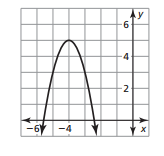
The vertex of the quadratic function f(x) in the picture is (-4, 5). If g(x) = f(x + 2) , what is the vertex of g(x)?
a)
(-2, 5)
b)
(-6, 5)
c)
(-4, 3)
d)
(-4, 7)
25.
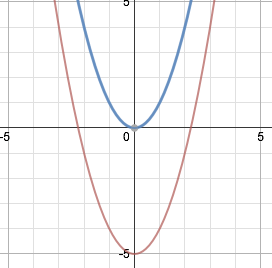
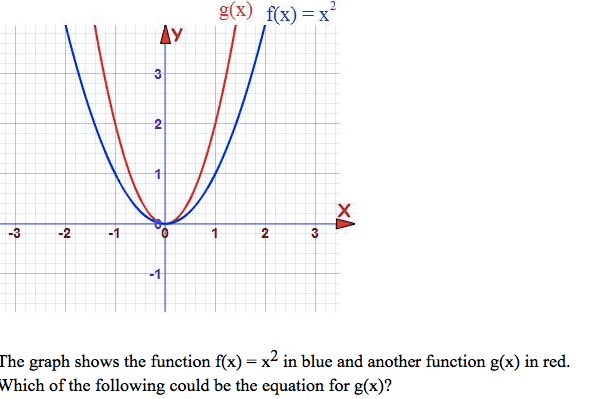
If the blue is f(x)=x2, then the red must be
a)
g(x)=x2-5
b)
g(x)=x2+5
c)
g(x)=(x-5)2
d)
g(x)=(x+5)2
26.
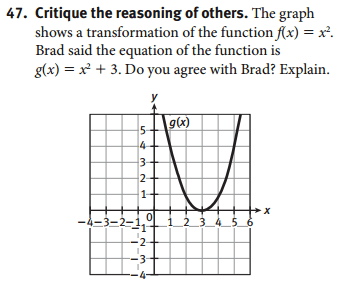
a)
Yes, "+3" on the end of the function moves the function to the right 3 units
b)
No, "+3" on the end of the function moves the function to the left 3 units
c)
No, "+3" on the end of the function moves the function to the down 3 units
d)
No, "+3" on the end of the function moves the function to the up 3 units
27.
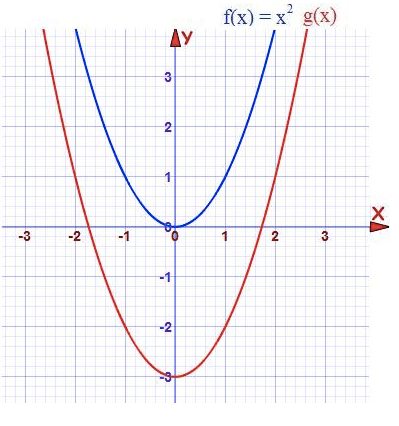
f(x) is transformed so that it maps onto g(x). Which equation would correctly represent g(x)
a)
g(x)=f(x - 3)
b)
g(x)=f(x) - 3
c)
g(x)=f(x) + 3
d)
g(x)=3f(x)
28.
 f(x) is transformed so that it maps onto g(x). Which equation would correctly represent g(x)
a)
g(x)=2f(x)
b)
g(x)=0.5f(x)
c)
g(x)=f(x) + 2
d)
g(x)=f(x + 2)
29.
f(x) is transformed so that it maps onto g(x). Which equation would correctly represent g(x)
a)
g(x)=f(x + 3)
b)
g(x)=f(x - 3)
c)
g(x)=f(x) + 3
d)
g(x)=f(x) - 2
30.
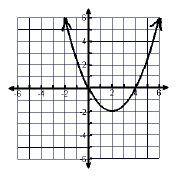
The vertex of the quadratic function f(x) in the picture (2, -2). If g(x) = f(x) - 4, what is the vertex of g(x)?
a)

(2, -6)

b)

(2, 2)

c)

(-2, -2)

d)

(6, -2)

31.

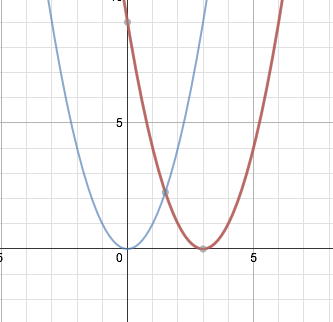
What is the vertex?

a)

(-3, 0)

b)

(3, 0)

c)

(0, 18)

d)

(18, 0)

32.

What is the equation of the axis of symmetry?

a)

y = 0

b)

x = 0

c)

x = 3

d)

x = -3

33.

Which of the statements about the graph is FALSE?

a)

The vertex is a maximum

b)

There are two zeros at x = -3 and x = 3

c)

The y-intercept is (0, 18)

d)

The range is y ≥ 18

34.

What is the significance of the ordered pair (0, -2) to the graph?

a)

It is the vertex

b)

It is an x-intercept

c)

It is the y-intercept

d)

It is the axis of symmetry

35.

What is the significance of the ordered pair (2, -4) to the graph?

a)

It is the vertex

b)

It is an x-intercept

c)

It is the y-intercept

d)

It is the axis of symmetry

36.

Determine the domain and range of the function

a)

Domain: All real numbers, Range: All real numbers

b)

Domain: x ≥ -4, Range: All real numbers

c)

Domain: All real numbers, Range: y ≥ -4

d)

Domain: -1 ≤ x ≤ 5, Range: y ≥ -4

37.

What are the zeros of the function? Choose all that apply.

a)

x = 0

b)

x = -3

c)

x = -6

d)

x = -2

38.

Which statement about the graph is FALSE?

a)

The vertex is (-3, 18)

b)

The vertex is a maximum

c)

The y-intercept is y = 0

d)

The axis of symmetry is y = -3

39.

Which statement about the graph is FALSE?

a)

The vertex is also a zero of the function

b)

The y-intercept is (0, -2)

c)

The axis of symmetry is x = 2

d)

The range is y ≥ 0

40.

What is the significance of the ordered pair (1, -2) to the graph?

a)

It is the maximum point

b)

It is the vertex

c)

It is the y-intercept

d)

It is an x-intercept

41.

What is the significance of the ordered pair (0, -1.5) to the graph?

a)

It is the maximum point

b)

It is the vertex

c)

It is the y-intercept

d)

It is an x-intercept

42.

Which point is the vertex?

a)

(-8, 0)

b)

(-5, -9)

c)

(-2, 0)

d)

(-9, -5)

43.

State the domain and range.

a)

Domain: All real numbers, Range: y ≥ -9

b)

Domain: All real numbers, Range: All real numbers

c)

Domain: x ≥ -8, Range: y ≥ -9

d)

Domain: x ≥ -8, Range: All real numbers

44.

Which function has an axis of symmetry of x = 0?

a)
b)
c)
d)

None of the above

45.

Which function has a range y ≥ -4?

a)
b)
c)
d)

None of the above

46.

Which function has a maximum at (2, 0)?

a)
b)
c)
d)
47.

What is the vertex of the function?

f(x)=(x+4)210f\left(x\right)=\left(x+4\right)^2-10

a)

(-4, -10)

b)

(-4, 10)

c)

(10, -4)

d)

(-10, -4)

e)

(0, -10)

48.

When is this function decreasing?

a)

x > -1

b)

x < -1

c)

y > 4

d)

y < 4

49.

What is the equation that represents the function?

a)

f(x)=x34f\left(x\right)=\left|x-3\right|-4

b)

f(x)=x+34f\left(x\right)=\left|x+3\right|-4

c)

f(x)=x+43f\left(x\right)=\left|x+4\right|-3

d)

f(x)=(x3)24f\left(x\right)=\left(x-3\right)^2-4

e)

f(x)=(x+3)2+4f\left(x\right)=\left(x+3\right)^2+4

50.
What type of function is shown?
a)
linear
b)
quadratic
c)

exponential

d)
absolute value
51.
Determine the transformation 
a)
left 3, up 2
b)
right 3, up 2
c)
left 3, down 2
d)
right 3, down 2
52.
Choose the correct translated function.
a)
f(x)= |x|+2
b)
f(x)= |x|-2
c)
f(x)= -|x|
d)
f(x)= -|x|+2
53.
What is the equation of the absolute value function?
a)
f(x)= 4|x+3|
b)
f(x)= 1/4 |x+3|
c)
f(x)= 1/4 |x - 3|
d)
f(x)= 4|x - 3|
54.

Which of the following graphs appropriately marks the axis of symmetry?

a)
b)
c)
d)
55.

Which function has a translation of 3 units to the left, and 1 unit up?

a)
f(x) = 3x2+1
b)
f(x) = (x + 3)2 + 1
c)
f(x) = (x - 3)+ 1
d)
f(x) = (x + 1)2- 3
56.
Which function has a translation of 2 units right and a vertical stretch by a factor of 5?
a)
f(x)= 5(x - 2)2
b)
f(x) = 5(x + 2)2
c)
f(x) = (x - 2)2 - 5
d)
f(x) = (x + 2)2 + 5
57.
How is the graph of y = 2x2+ 3 different from the graph of y = 2x2?
a)
It is shifted 3 units left.
b)
It is shifted 3 units right.
c)
It is shifted 3 units down.
d)
It is shifted 3 units up.
58.
Which quadratic is the narrowest graph?
a)
y = 3x2
b)
y = 4x2
c)
y = 2x2
59.

What are the transformations?

y=(x-2)2+4 (Choose ALL that apply.)

a)

shift right 2

b)

shift left 2

c)

shift up 4

d)

shift down 4

60.

Describe the transformation of

y=f(x+4)3y=f\left(x+4\right)-3  .

a)

Right 4, Down 3

b)

Left 4, Down 3

c)

Left 3, Down 4

d)

Right 3, Up 4

61.

Does the function have a maximum or minimum point?

y=(x+5)2y=\left(x+5\right)^2  

a)

Maximum

b)

Minimum

62.

Does the function have a maximum or minimum point?

y=2x2+5y=-2x^2+5  

a)

Maximum

b)

Minimum

63.

Does the function have a maximum or minimum point?

y=3(x+5)2+1y=3\left(x+5\right)^2+1  

a)

Maximum

b)

Minimum

64.

Where is the vertex of the graph:

y=(x1)26y=-\left(x-1\right)^2-6  

a)

(6, 1)

b)

(-1, -6)

c)

(6, -1)

d)

(1, -6)

65.

Where is the vertex of the graph:

y=(x5)2+3y=\left(x-5\right)^2+3  

a)

(3, 5)

b)

(5, 3)

c)

(-5, -3)

d)

(3, -5)

66.

Which statement below is TRUE regarding the two functions?

a)

Both functions are linear

b)

Both functions are increasing

c)

Both functions have a y-intercept of 1

d)

Both functions are exponential growth

67.

Put these functions in order from least to greatest based on their Y-INTERCEPT.

a)

B C A

b)

B A C

c)

C A B

d)

C B A

68.
Is the equation linear, exponential, or quadratic?
y = 2x+ 4
a)
Linear
b)
Exponential
c)
Quadratic
d)
None of the above
69.
Is the table linear, exponential or neither?
a)
Linear
b)
Exponential
c)
Neither
70.
Is this table linear, quadratic, exponential, or none of the above?
a)
linear
b)
quadratic
c)
exponential
d)
none of the above
71.

How many zeros does this function have?

f(x) = (x+4)2 - 7?

a)

two zeros

b)

one zero

c)

no zeros

72.
What type of function best models the situation: A zombie virus has infected the population and the number of infected people triples every day.
a)
linear
b)
quadratic
c)
exponential growth
d)
exponential decay
73.
Which function is linear?
a)
f(x)
b)
h(x)
c)
g(x)
74.

A bank account balance earning an annual interest rate.

a)

Linear

b)

Quadratic

c)

Exponential

75.

Which function best models the height and speed of throwing a ball in the air?

a)

Linear

b)

Quadratic

c)

Exponential

76.

Which function is exponential?

a)

A

b)

B

c)

C

77.

Write the function that best models the table?

a)

y = (1/4)x

b)

y = 4x

c)

y = 4x

d)

y = (1/4)x

78.
What type of function is f(x)=2(1/7)x ?
a)
Exponential Growth
b)
Linear
c)
Exponential Decay
d)
None of the Abovee
79.
Classify the model as Exponential GROWTH or DECAY.
A=1200(.85)6
a)
Growth
b)
Decay
80.
In an exponential function, what does the 'a' represent? 
a)
SLOPE
b)
RATE OF CHANGE
c)
Y-INTERCEPT
d)
COMMON RATIO
81.

What function is represented in this table?

a)

Exponential

b)

Linear

c)

Quadratic

82.

What function is represented by the table?

a)

Exponential

b)

Linear

c)

Quadratic

83.

What type of function does this table represent?

a)

Linear Function

b)

Exponential Function

c)

Quadratic Function

d)

Not a Function

84.

Write an equation to represent the below situation “A library has 8000 books, and is adding 500 more books each year.”

a)

y=8000-500x

b)

y=8000*50x

c)

y=500x+8000

d)

y=8000(1.5)x

85.

“A bank account starts with $10. Every month, the amount of money in the account is tripled.” Write an equation to represent this situation

a)

y=3(10)x

b)

y=10(3)x

c)

y=10(1.3)x

d)

y=3x+10

86.

Describe the function's end behavior.

a)

As x, yAs\ x\rightarrow-\infty,\ y\rightarrow-\infty
As x, yAs\ x\rightarrow\infty,\ y\rightarrow-\infty

b)

As x, yAs\ x\rightarrow-\infty,\ y\rightarrow-\infty
As x, yAs\ x\rightarrow\infty,\ y\rightarrow\infty

c)

As x, yAs\ x\rightarrow-\infty,\ y\rightarrow\infty
As x, yAs\ x\rightarrow\infty,\ y\rightarrow-\infty

d)

As x, yAs\ x\rightarrow-\infty,\ y\rightarrow\infty
As x, yAs\ x\rightarrow\infty,\ y\rightarrow\infty

87.

Describe the function's end behavior.

a)

As x, yAs\ x\rightarrow-\infty,\ y\rightarrow-\infty
As x, yAs\ x\rightarrow\infty,\ y\rightarrow-\infty

b)

As x, yAs\ x\rightarrow-\infty,\ y\rightarrow-\infty
As x, yAs\ x\rightarrow\infty,\ y\rightarrow\infty

c)

As x, yAs\ x\rightarrow-\infty,\ y\rightarrow\infty
As x, yAs\ x\rightarrow\infty,\ y\rightarrow-\infty

d)

As x, yAs\ x\rightarrow-\infty,\ y\rightarrow\infty
As x, yAs\ x\rightarrow\infty,\ y\rightarrow\infty

88.
What is the vertex of the following function?
y= -4|x+2|+5
a)
(-4,2)
b)
(-2,5)
c)
(-4,-2)
d)
(2,5)
89.

What is the equation of this graph?

a)

y=2|x-3|+1

b)

y=2|x-1|+3

c)

y=-2|x+1|+3

d)

y=-2|x-1|+3

90.
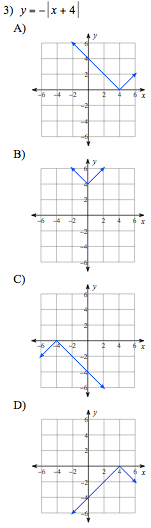
f(x) = −|x+4|
a)
A
b)
B
c)
C
d)
D
91.
Which function is graphed?
a)
f(x) = -3|-x - 1| + 4
b)
f(x) = -|x - 1| + 4
c)
f(x) = 5|x - 1| + 4
d)
f(x) = -3|x - 4| + 1
92.
Which equation represents this graph.
a)
f(x)=(x - 4)2 - 3
b)
f(x)=-(x - 4)2 + 3
c)
f(x)=(x - 4)2 + 3
d)
f(x)=-(x + 4)2 + 3
93.
Which of the following functions shows an initial amount of $15 and an increase of 35% each year?
a)
y = 15(35)x
b)
y = 15(1.35)x
c)
y = 15(0.35)x
d)
y = 35(1.15)x
94.
The value of a car is $15,000 and depreciates at a rate of 8% per year. What is the exponential equation?
a)
y=8(15,000)x
b)
y=15,000(1.08)x
c)
y=15,000(0.92)x
d)
y=15,000(0.08)x
95.

Select all the TRUE statements about the function.

y=x+10y=|x|+10  

a)

The vertex is at (0, -10).

b)

The range is y10y\ge10

c)

It is shifted up 10 units from the parent function.

d)

It is shifted left 10 units from the parent function.

e)

This function touches the x-axis twice.

96.

What is the range of the function?

f(x)=2x+4+8f\left(x\right)=-2\left|x+4\right|+8  

a)

y8y\le8

b)

y8y\ge8

c)

y4y\le4

d)

y4y\ge-4

e)

y8y\ge-8

97.

What is the range of the function

y=x+2y=\left|x\right|+2  

a)

y2y\ge2  

b)

All Real Numbers

c)

y>0y>0  

d)

y2y\le-2  

98.

What is the range of the function?

y=x+1611y=\left|x+16\right|-11  

a)

y11y\ge11

b)

y11y\ge-11

c)

y16y\ge16

d)

y16y\le-16

e)

none of these

99.

Which way does the following equation open? f(x)=12(x5)2+6f\left(x\right)=-\frac{1}{2}\left(x-5\right)^2+6  

a)

upward

b)

downward

100.
Identify the vertex and whether the graph opens up or down.
a)
(5, 2); opens up
b)
(5, 2); opens down
c)
(-5, 2); opens up
d)
(-5, 2); opens down