wayground logo

Free Printable Worksheets

Font size

S
M
L
XL
Worksheets

Tectonic Plates

Total questions: 97

Worksheet time: 3hrs 57mins

Name
Class
Date
1.
What causes the tectonic plates to move?
a)
convection of magma
b)
the earth's magnetic field
c)
the earth spinning
d)
earth's gravitational pull
2.
What causes the tectonic plates to move?
a)
convection of magma
b)
the earth's magnetic field
c)
the earth spinning
d)
earth's gravitational pull
3.
Scientists think that the movement of Earth's tectonic plates are caused by convection currents, that are located in the _________?
a)
outer core
b)
inner core
c)
mantle
4.

Which set of events is most common along tectonic plate boundaries?

a)

Earthquakes and volcanoes

b)

Erosion and earthquakes

c)

Tidal waves and volcanoes

d)

Hurricanes and tsunamis

5.

How are faults that occur in the middle of tectonic plates different from plate boundaries?

a)

Plate boundaries are sites for earthquakes but faults are not.

b)

Plate boundaries occur between tectonic plates while faults can occur anywhere.

c)

Faults cover larger areas than the intersections between plates.

d)

Faults are the sites of volcanoes while the intersections between plates are not.

6.

One student of a class studying where earthquakes and volcanoes occur says that geologists cannot predict earthquakes. Which of the below statements contradicts the student’s conclusion?

a)

Earthquakes are caused by changing weather conditions.

b)

Earthquakes can occur in every state in the United States.

c)

Earthquakes are statistically more common around fault lines.

d)

Earthquakes are caused by landslides occurring at Earth’s surface.

7.
Earth's crust is broken up into several large rocky pieces called ...
a)
plates
b)
faults
c)
fossils
d)
puzzle pieces
8.

Convection currents happen in the mantle. The outer core heats magma around it and causes it to become less dense. Because the magma is less dense than the material around it, it starts to rise toward the crust. Since the crust is not hot, the magma starts to cool as it gets close to the crust. Since it is cooling, it gets denser and starts to sink back down toward the outer core.


Use the information above to answer the following question: Which of the following TWO things happen to magma causing it to rise?

a)

It gets cooler.

b)

It gets warmer.

c)

It gets denser.

d)

It gets less dense.

9.

What is the thinnest and outer most layer of the Earth, that we live on?

a)

Outer Core

b)

Crust

c)

Mantle

d)

Inner core

10.

Which layer of the Earth is solid iron and nickel?

a)

Mantle

b)

Crust

c)

Inner Core

d)

Outer core

11.

Describe the most likely relationship between these mountains and nearby tectonic plates.

a)

The mountains are probably formed by earthquakes

b)

The mountains are probably formed by the movement of glaciers

c)

The mountains are probably located near the edge of 2 tectonic plates.

d)

The mountains are probably formed by running water.

12.

What was the name given to all the continents when they were joined as one super continent?

a)

Supreme Continent

b)

Eurasia

c)

Plate tectonics

d)

Pangaea

13.
Earth's plates are....
a)
Constantly moving and changing the face of the Earth
b)
Never moved
c)
Move seldom and very fast
d)
move when they feel like it
14.
Which of these is a key piece of evidence of contiental drift?
a)
Continent shapes
b)
Fossil record
c)
Rock layers
d)
All of the above
15.
This scientist built most of the evidence for continental drift.
a)
Alfred Wegener
b)
Sean Carroll
c)
Fred Calfred
d)
John Williams
16.
This is when two plates converge but one slides under the other due to density.
a)
Uplift
b)
Subduction
c)
Trench
d)
None of the above
17.
This type of plate boundary is when two plates move apart.
a)
Convergent
b)
Transform
c)
Divergent
d)
Subductive
18.
This type of plate boundary is when two plates crash into each other.
a)
Convergent
b)
Transform
c)
Divergent
d)
Subductive
19.
This type of plate boundary is when two plates slide past each other.
a)
Convergent
b)
Transform
c)
Divergent
d)
Subductive
20.
The ______ is the layer of the Earth under the crust.
a)
core
b)
mantle
c)
magma
d)
none of the above
21.

What is true about the layer (lower mantle) below the Earth's plates?

a)

It is solid rock.

b)

It is slightly softened rock like clay.

22.

What is true about the Earth's plates?

a)

The are made of solid rock that can never be seen.

b)

They are made of solid rock that can be seen if not covered by soil, rock, or water.

23.

Ancient fossils have been placed on the map indicating where they were found.


The strongest evidence exists for which two continents to have been connected when Pangaea was present?

a)

South America and Africa

b)

North America and Africa

c)

Africa and Australia

d)

South America and Australia

24.

A student prepared a list of changes that can occur to landforms through volcanic eruptions.


Which changes in the student’s list are correct?

a)

1 and 2

b)

1 and 3

c)

2 and 3

d)

3 and 4

25.
Earth's plates are....
a)
Constantly moving and changing the face of the Earth
b)
Never moved
c)
Move seldom and very fast
d)
move when they feel like it
26.

Tectonic plates float on top of the ________

a)

Crust

b)

Mantle

c)

Inner Core

d)

Outer Core

27.

Which layer of the Earth is solid iron and nickel?

a)

Mantle

b)

Crust

c)

Inner Core

d)

Outer core

28.

What is the thinnest and outer most layer of the Earth, that we live on?

a)

Outer Core

b)

Crust

c)

Mantle

d)

Inner core

29.

Which layer of the Earth is the thickest and is made of molten rock?

a)

Outer Core

b)

Inner Core

c)

Crust

d)

Mantle

30.

Put these layers in order from the center of Earth outward

a)

Mantle, crust, inner core, outer core

b)

outer core, inner core, mantle, crust

c)

Crust, mantle, outer core, inner core

d)

Inner core, outer core, mantle, crust
31.
Scientists recently discovered that rocks collected from the Franklin Mountains in West Texas and rocks collected from mountains in eastern Antarctica were exactly the same age. Further research showed that the rocks were chemically and geologically the same and came from the same magma source. This discovery provides evidence of —
a)
coastal erosion.
b)
plate tectonics.
c)
ocean currents.
d)
glacial melting.
32.
Earth's crust is broken up into several large rocky pieces called ...
a)
plates
b)
faults
c)
fossils
d)
puzzle pieces
33.
True/False: Igneous rocks can only turn into metamorphic rocks.
a)
True
b)
False
34.
A metamorphic rock changes into an igneous rock by what two processes?
a)
Melting and cooling
b)
Extreme heat and pressure
c)
Compaction and cementation
d)
Weathering and erosion
35.
Which type of rock results from melting and cooling of magma?
a)
Igneous
b)
Metamorphic
c)
Sedimentary
d)
Extrusive
36.
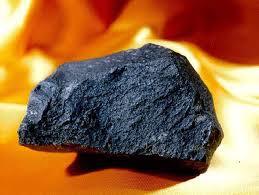
This rock was found near the mouth of a volcano. What type of rock is this?
a)
Sedimentary
b)
Igneous
c)
Metamorphic
37.
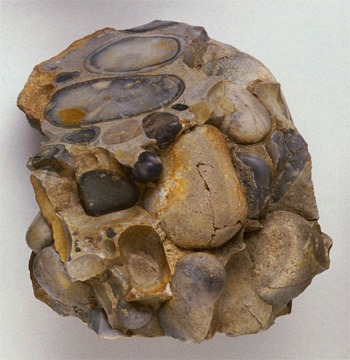
This rock was formed by smaller pieces of rock that settled at the bottom of a lake millions of years ago. What type of rock is this?
a)
Sedimentary
b)
Igneous
c)
Metamorphic
38.
What are the 3 major types of rocks?
a)
Igneous, Metamorphic, Sedimentary
b)
Metamorphic, Igneous, Cementation
c)
Brown, Red, Gray
d)
Streak, Hardness, Breakage
39.
This rock started as lava that cooled and then was heated and put under pressure over time. What type of rock is this?
a)
Sedimentar
b)
Igneous
c)
Metamorphic
40.
This rock cooled on the outside of a volcano and contained air bubbles when it was forming. What type of rock is this?
a)
Sedimentary
b)
Igneous
c)
Metamorphic
41.
Mountains form from....
a)
Plates sliding past one another
b)
collision of plates
c)
plates moving away from each other
d)
none of these
42.
Name this boundary
a)
Convergent
b)
Divergent
c)
Transform
d)
Sergent
43.
Name the boundary
a)
divergent
b)
convergent
c)
transform
d)
sergent
44.
Name the boundary
a)
convergent
b)
transform
c)
divergent
d)
sergent
45.
Mountains form from....
a)
Plates sliding past one another
b)
collision of plates
c)
plates moving away from each other
d)
none of these
46.
Which of the following is associated with transform boundary?
a)
volcanoes
b)
mountains
c)
trenches
d)
earthquakes and fault line
47.
This is the driving force behind the movement of tectonic plates.
a)
Mantle convection currents
b)
Oceanic convection currents
c)
Atmospheric convection currents
d)
Solar convection currents
48.
 A land feature that is produced at a convergent boundary is
a)
a valley
b)
an ocean
c)
a canyon
d)
a volcano
49.
Which best describes the mantle?
a)
molten metal
b)
dense, solid metal ball
c)
hot but not solid rock
d)
dry land and ocean floor
50.
In which layer of the Earth is the athenosphere located?
a)
inner core
b)
mantle
c)
outer core
d)
crust
51.
Oceanic crust is.....
a)
Younger and less dense than continental crust
b)
Thinner, younger, and more dense than continental crust
c)
older, thicker, and less dense than continental crust
d)
Bigger and younger than continental crust
52.
Earth's plates are....
a)
Constantly moving and changing the face of the Earth
b)
Never moved
c)
Move seldom and very fast
d)
move when they feel like it
53.
What was the name given to all the continents when they were joined as one super continent?
a)
Supreme Continent
b)
Eurasia
c)
Plate tectonics
d)
Pangea
54.

Describe the most likely relationship between these mountains and nearby tectonic plates.

a)

The mountains are probably formed by earthquakes

b)

The mountains are probably formed by the movement of glaciers

c)

The mountains are probably located near the edge of 2 tectonic plates.

d)

The mountains are probably formed by running water.

55.

Tectonic plates float on top of the ________

a)

Crust

b)

Mantle

c)

Inner Core

d)

Outer Core

56.
This is the theory that states that all the continents started as a single massive continent and have been MOVING apart for over 200 million years and the man that proposed it.
a)
The Big Bang Theory, Einstein
b)
The Pangea Theory, Hutton
c)
The Tectonic Plate Theory, Darwin
d)
The Continental Drift Theory, Wegner
57.
Which is older oceanic or continental crust?
a)
Oceanic
b)
Continental
58.

Which layer of the Earth is solid iron and nickel?

a)

Mantle

b)

Crust

c)

Inner Core

d)

Outer core

59.

What is the thinnest and outer most layer of the Earth, that we live on?

a)

Outer Core

b)

Crust

c)

Mantle

d)

Inner core

60.

Which layer of the Earth is the thickest and is made of molten rock?

a)

Outer Core

b)

Inner Core

c)

Crust

d)

Mantle

61.

Put these layers in order from the center of Earth outward

a)

Mantle, crust, inner core, outer core

b)

outer core, inner core, mantle, crust

c)

Crust, mantle, outer core, inner core

d)

Inner core, outer core, mantle, crust

62.

Alfred Wegener used __________ to prove that Pangea once existed ?

a)

graham crackers and frosting

b)

math

c)

a metal detector

d)

fossils

63.
What does the theory of continental drift state?
a)
The continents were once joined in a super-continent and have moved over time
b)
Continents are stationary and do not move
c)
The Earth is broken into lithospheric plates that move due to convection currents
d)
none of the above
64.
Scientists recently discovered that rocks collected from the Franklin Mountains in West Texas and rocks collected from mountains in eastern Antarctica were exactly the same age. Further research showed that the rocks were chemically and geologically the same and came from the same magma source. This discovery provides evidence of —
a)
coastal erosion.
b)
plate tectonics.
c)
ocean currents.
d)
glacial melting.
65.
The layer that makes up most of the earth's mass and volume is the
a)
crust
b)
mantle
c)
core
d)
asthenosphere
66.
Earth's crust is broken up into several large rocky pieces called ...
a)
plates
b)
faults
c)
fossils
d)
puzzle pieces
67.

Most Earthquakes and Volcanoes can be found....

a)

around the Pacific Ring of Fire

b)

along the coast of Asia

c)

along plate boundaries

d)

in the Southern Hemisphere

68.
The cracks in Earth's crust are called ___________.
a)
tectonic plates
b)
faults
c)
magma
d)
lava
69.
What are the puzzle pieces of the Earth's surface called?
a)
Tectonic plates
b)
Puzzles
c)
Earthquakes
70.
What is the shaking of the Earth’s crust caused by a release of energy?
a)
Earthquake
b)
Epicenter
c)
Fault
d)
Plate
71.

What type of boundary is shown in the diagram?

a)

Divergent

b)

Convergent

c)

Transform

d)

Prodigent

72.

The idea that Earth's crust is made up of separate plates that float on the upper mantle is the theory of what?

a)

Plate Tectonics

b)

Continental Drift

c)

Pangaea

d)

Transubstantiation

73.

What type of boundary is shown in the diagram?

a)

Divergent

b)

Convergent

c)

Transform

74.

What type of boundary is shown in the diagram?

a)

Divergent

b)

Convergent

c)

Transform

75.

What is the definition of dormant?

a)

sleeping and could erupt again

b)

extinct and won't erupt

c)

active and dangerous

76.

These are volcanoes formed from an area of the Earth's mantle from which hot plumes rise upward on the overlying crust.

a)

Subduction Zone Volcanoes

b)

Hot spot volcanoes

c)

Divergent Zone Volcanoes

77.

Which of the following is NOT an Evidence that Tectonic plates move

a)

presence of volcanoes and mountain ranges

b)

Occurrence of Earthquake and Fault lines

c)

Increased BIODIVERSITY

d)

Paleomagnetic Record

78.

Describe the most likely relationship between these mountains and nearby tectonic plates.

a)

The mountains are probably formed by earthquakes

b)

The mountains are probably formed by the movement of glaciers

c)

The mountains are probably located near the edge of 2 tectonic plates.

d)

The mountains are probably formed by running water.

79.

Is there a pattern to the locations of earthquakes and volcanoes around the globe?

a)

No, earthquakes and volcanoes are random.

b)

Yes, earthquakes and volcanoes usually occur near the boundaries of tectonic plates.

c)

yes, earthquakes and volcanoes usually occur in the middle of tectonic plates.

d)

No, earthquakes and volcanoes usually occur under water.

80.

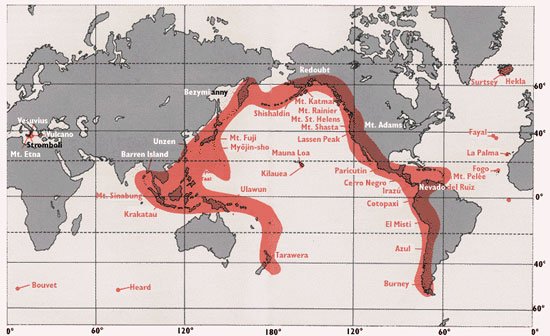
The Ring of Fire is an area where a large number of earthquakes and volcanic eruptions occur. What claim can be made about the Ring of Fire from this information?

a)

It is the only place on Earth where earthquakes can happen.

b)

The edges of the tectonic plates are moving in this area.

c)

It represents the areas where tectonic plates are the thickest.

d)

It has been getting larger since Earth first formed.

81.
The ______ is the layer of the Earth under the crust.
a)
core
b)
mantle
c)
magma
d)
none of the above
82.
Which of these is NOT a type of plate boundary?
a)
Convergent
b)
Divergent
c)
Bivergent
d)
Transform
83.
This type of plate boundary is when two plates slide past each other.
a)
Convergent
b)
Transform
c)
Divergent
d)
Subductive
84.
This type of plate boundary is when two plates crash into each other.
a)
Convergent
b)
Transform
c)
Divergent
d)
Subductive
85.
This type of plate boundary is when two plates move apart.
a)
Convergent
b)
Transform
c)
Divergent
d)
Subductive
86.
This is when two plates converge but one slides under the other due to density.
a)
Uplift
b)
Subduction
c)
Trench
d)
None of the above
87.
Which of these is a key piece of evidence of contiental drift?
a)
Continent shapes
b)
Fossil record
c)
Rock layers
d)
All of the above
88.

The San Andreas Fault in California is known as an active earthquake area. What type of boundary is it?

a)

Converging

b)

Transform

c)

Diverging

89.
What was Pangea?
a)
An ancient Mountain Range that divided Africa
b)
A large valley where civilization began.
c)
A supercontinent where all Earth's land masses were joined.
d)
A large meteor that hit Earth and destroyed all of the dinosaurs
90.
The Theory of Continental Drift states that Pangaea broke apart and the continents "drifted" away from each other
a)
True
b)
False
91.

What type of boundary is this?

a)

Converging

b)

Transform

c)

Diverging

92.

What type of boundary is this?

a)

Converging

b)

Transform

c)

Diverging

93.

What type of boundary is this?

a)

Converging

b)

Transform

c)

Diverging

94.

The song does to the melody of The Addams Family.

a)

True

b)

False

95.

When two continental plates converge (collide) what type of crustal feature is formed?

a)

Mid Ocean Ridge

b)

Subduction Zone

c)

Rift Valley

d)

Folded Mountains

96.

Tsunamis are formed from what two types of convergent boundaries?

a)

Continental-Continental

b)

Oceanic-Continental

c)

Oceanic-Oceanic

97.
What geologic feature/event you be most likely to find at a transform boundary?
a)
Earthquakes
b)
Volcanoes
c)
Mountains
d)
Rift Valleys