wayground logo

Free Printable Worksheets

NEW

Font size

S
M
L
XL
Worksheets

Animals and Organisms Mixed Review

Total questions: 80

Worksheet time: 46mins

Name
Class
Date
1.

A ______ is a response to a change in the environment.

a)

action

b)

trait

c)

communication

d)

behavior

2.

Inherited traits in an organism comes______

a)

from their siblings

b)

from their grandparents

c)

from their aunts

d)

from their parents

3.

Animals are born with certain behaviors that allow them to survive which are called ___________

a)

physical characteristics

b)

learned traits

c)

instincts

d)

acquired traits

4.

Which of these is an inherited trait?

a)

language spoken

b)

fingernail length

c)

hair style

d)

color of flowers

5.
What is an adaptation?
a)
An adaptation is a plant.
b)
An adaptation is an animal.
c)
An adaptation is anything that hurts an animal or a plant.
d)
An adaptation is anything that helps plants or animals survive in their environment.
6.
What is the purpose of adaptations?
a)
Adaptation is having a backbone.
b)
Adaptations help animals find food or water, protect them from danger, or help them survive.
c)
Adaptations allow animals to easily be spotted by their predator.
d)
Adaptation does not help animals in any way.
7.
Why do animals need to move?
a)
So they won't gain any weight.
b)
So they can travel the world and see nature
c)
Animals don't need to move.
d)
So they can find food, shelter  or space.
8.
All animals move the same way.
a)
True
b)
False
9.
What is camouflage?
a)
Camouflage is a tree.
b)
Camouflage is invisible.
c)
Camouflage is all colors
d)
Camouflage is a color or pattern that allows an animal to blend into its environment.
10.
Which animal uses camouflage?
a)
Dog
b)
poison dart frog
c)
Chameleon
d)
goldfish
11.
All animals have the same sensory organs.
a)
True
b)
False
12.
Which sense allows animals to recognize  objects or others. .
a)
Sight
b)
Hearing
c)
Smelling
d)
Touching
13.
Which sense allows us to hear danger to escape enemies.
a)
Sight
b)
Hearing
c)
Smelling
d)
Touching
14.

Sensory organs help animals ___________

a)

find food and shelter

b)

hibernate

c)

change

d)

fly

15.

Animals have ______________ that allow them to detect changes in their environments.

a)

sensory organs

b)

behaviors

c)

detection

d)

selective hearing

16.

When an animal detects changes, they can respond with certain __________________________.

a)

organs

b)

answers

c)

behaviors

d)

detection

17.

A behavior is a ___________________ to a change in the environment.

a)

sensory organ

b)

detection

c)

condition

d)

response

18.

Senses tell animals what they need to know about their __________________________

a)

offspring

b)

health

c)

environment

d)

parents

19.

Which sensory organ is used to detect sight?

a)

eyes

b)

ears

c)

legs

d)

mouth

20.

Which of the following is not a sensory organ?

a)

ears

b)

eyes

c)

tongue

d)

teeth

21.

Animals have ________ senses.

a)

4

b)

5

c)

3

d)

7

22.

Which group includes all of the senses?

a)

seeing, hearing, listening, eating, feeling

b)

hearing, seeing, tasting, touching, smelling

c)

seeing, smiling, chewing, eating, feeling

d)

hearing, seeing, listening, smelling

23.
What group(s) CANNOT make their own food?
a)
Plants
b)
Animals
c)
Plants and Animals
24.
Animals are classified into 2 main groups. Those groups are 
a)
WIth fur and without
b)
Cold-blooded and warm-blooded
c)
Vertebrate and invertebrate
d)
Insects and mammals
25.
What are some of examples of amphibians?
a)
Toad, salamander and frog
b)
Hawks, robins, and chickens
c)
Lizards, alligators, and turtles
d)
Dogs, whales, and squirrels
26.
Hawks, ducks, robins and chickens are examples of what animal?
a)
Reptiles
b)
Mammals
c)
Amphibians
d)
Birds
27.
Which group of animals are warm-blooded?
a)
Mammals and Reptiles
b)
Amphibians and Fish
c)
Fish, Amphibians, and reptiles
d)
Mammals and birds
28.
What is an invertebrate?
a)
An animal that lays eggs.
b)
An animal that has a live birth.
c)
An animal without a backbone.
d)
An animal with a backbone. 
29.
Where do you find a seed in a pine tree?
a)
Stem
b)
Fruit
c)
Flower
d)
Cone
30.
What is the part of a flower from which a new plant grows?
a)
Seed
b)
Fruit
c)
Flower
d)
Cone
31.
All living things have a life cycle.
a)
True
b)
False
32.
What would be a good title for the diagram above?
a)
A Fish's Life Cycle
b)
A Reptile's Life Cycle
c)
An Amphibians Life Cycle
d)
A Bird's Life Cycle
33.
What animal's life cycle is represented in the diagram?
a)
Fish
b)
Amphibian
c)
Reptile
d)
Mammal
34.
Which two animal's life cycles does this image illustrate?
a)
Mammal and Reptile
b)
Mammal and Bird
c)
Bird and Reptile
d)
Fish and Amphibians 
35.
The diagram below shows the life cycle of a frog. Four stages of development are labeled A,B, C and D. Which letter shows the adult stage of development?
a)
A
b)
B
c)
C
d)
D
36.
Select the correct order for a butterfly's life cycle.
a)
eggs, butterfly, chrysalis, caterpillar
b)
butterfly, eggs, chrysalis, caterpillar
c)
eggs, caterpillar, chrysalis, butterfly
37.
What is the beginning stage of a butterfly's life cycle?
a)
larva
b)
nymph
c)
pupa
d)
egg
38.
What animal lives part of its life on land and part of its life in water?
a)
birds
b)
mammals
c)
reptile
d)
amphibian
39.
What is it called when an animal cannot control its own body temperature?
a)
cold blooded
b)
blood
c)
warm blooded
d)
mammal 
40.
How are young mammals different from their parents?
a)
They do not need food.
b)
They can swim.
c)
They cannot feed or protect themselves.
d)
They move more quickly
41.
Which two animals go through metamorphosis during its life cycle?
a)
Frog and bird
b)
butterfly and horse
c)
fish and frog
d)
butterfly and frog
42.
butterflies, lady bugs, and beetles are all examples of which animal?
a)
amphibian
b)
insect
c)
mammal
d)
bird
43.
What is a life cycle?
a)
process of changing from one form to another
b)
changes an animal goes through during its life
c)
larva spins this covering out of silk or grows hard shells
44.
The diagram below shows the growth of a tree. The diagram represents a 
a)
food chain
b)
food supply
c)
life span
d)
life cycle
45.
Do all animals follow the same life cycle?
a)
No, but certain types of animals have similar life cycles.
b)
Yes
46.
An organism that is fully grown is called a/an_.
a)
nymph
b)
embryo
c)
egg
d)
adult
47.
After a frog hatches from an egg it looks just like an adult frog.
a)
True
b)
False
48.
Each part of a life cycle is called
a)
a stage
b)
a section
c)
a step
d)
a run
49.
Which set of animals contain only mammals?
a)
centipede, earthworm, snake
b)
cat, bat, deer
c)
turtle, seagull, frog
d)
butterfly, bird, bat
50.
Mammals are animals that require what to breathe?
a)
gills
b)
skin
c)
lungs
d)
warm blood
51.
Animals that began their life in water, but live most of it on land are
a)
mammals
b)
amphibians
c)
reptiles
d)
birds
52.
What are gills?
a)
structures that fish use to take in oxygen
b)
structures that fish use to swim
c)
structures that birds use to take in oxygen
d)
structures that birds use to fly
53.
Most of the animals on Earth are
a)
vertebrates
b)
invertebrates
c)
arthropods
d)
mollusks
54.
Which animal group spends part of their lives in the water and part on land?
a)
fish
b)
reptiles
c)
amphibians
d)
mammals
55.
What does it mean to classify animals?
a)
to capture it for scientific research 
b)
to put into a group with other animals that are similar
c)
to release it into the wild
d)
to study it in its natural environment
56.

Which is not an amphibian?

a)

snake

b)

toad

c)

salamander

d)

frog

57.

The five classes of vertebrates are

a)

reptiles, amphibians, crustaceans, fish, birds

b)

amphibians, arachnids, reptiles, mammals, fish

c)

birds, mammals, reptiles, arachnids, fish

d)

birds, mammals, fish, reptiles, amphibians

58.

Animals that cannot keep a constant body temperature are called

a)

vertebrates

b)

invertebrates

c)

warm blooded

d)

cold blooded

59.

Which group of living things is the largest?

a)

birds

b)

vertebrates

c)

insects

d)

crustaceans

60.

Animals without backbones are called

a)

warm blooded

b)

mammals

c)

invertebrates

d)

vertebrates

61.
What  anchor plants to the ground and absorb water and nutrients?
a)
Roots
b)
Stem
c)
Xylem
d)
Leaves
62.
Which part of the plant makes the food?
a)
roots
b)
stem
c)
leaf
d)
flower
63.
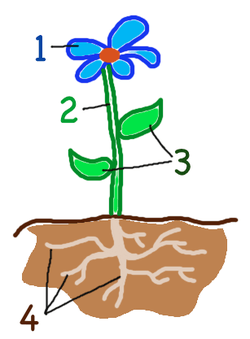
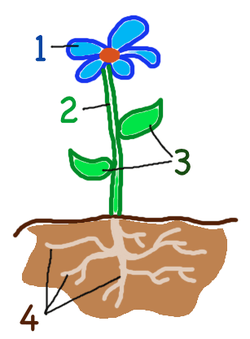
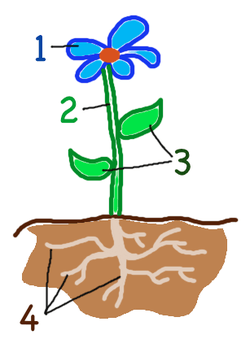
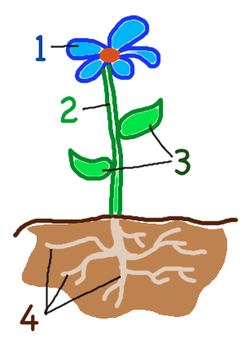
What part of the plant is #1?
a)
flower
b)
stem
c)
root
d)
leaf
64.
What part of the plant is #2?
a)
leaf
b)
flower
c)
stem
d)
root
65.
What part of the plant is #3?
a)
leaf
b)
root
c)
flower
d)
stem
66.
What part of the plant is #4?
a)
leaf
b)
flower
c)
stem
d)
root
67.
This part of the plant acts like an "elevator" carrying nutrients to the plant.
a)
roots
b)
stem
c)
leaves
d)
flower
68.
The roots absorb what for the plant? 
a)
Water and Nutrients
b)
Soil and Sun
c)
Warmth and Water
d)
Sun and Photosynthesis
69.
What part of a plant produces a new plant?
a)
root
b)
stem
c)
leaf
d)
seed
70.
What is an animal with a backbone and an internal skeleton?
a)
vertebrate
b)
invertebrate
c)
endothermic
d)
ectothermic
71.
What is an animal without a backbone and an internal skeleton?
a)
vertebrate
b)
invertebrate
c)
ectothermic
d)
endothermic
72.
Fish, amphibians, reptiles, birds, and mammals are all types of
a)
vertebrates
b)
invertebrates
c)
ectothermic animals
d)
endothermic animals
73.
Organs that obtain information from the environment are called
a)
ectothermic organs
b)
sensory organs
c)
digestive organs
d)
respiratory organs
74.
What is another word for warm-blooded that means that an animal's body temperature stays the same no matter what the temperature of its environment?
a)
endothermic
b)
ectothermic
c)
invertebrate
d)
echinoderm
75.
What is another word for cold-blooded that means the animal's body temperature is the same as its environment?
a)
endothermic
b)
ectothermic
c)
echinoderms
d)
invertebrates
76.
What are ectothermic vertebrates with lungs, covered in scales or plates?
a)
fish
b)
amphibians
c)
reptiles
d)
birds
77.
What are ectothermic vertebrates that breathe with gills when young, but go through metamorphosis and breathe with lungs as adults?
a)
reptiles
b)
fish
c)
amphibians
d)
birds
78.
What are endothermic vertebrates with wings and feathers who lay eggs?
a)
birds
b)
mammals
c)
reptiles
d)
amphibians
79.
What are endothermic vertebrates with fur and which produce milk to feed their young?
a)
birds
b)
mammals
c)
fish
d)
reptiles
80.
What is an organ for an animal that gets oxygen from the water?
a)
lungs
b)
gills
c)
heart
d)
liver