wayground logo

Free Printable Worksheets

Font size

S
M
L
XL
Worksheets

Minerals, Rocks, History of the Earth TEST review

Total questions: 57

Worksheet time: 37mins

Name
Class
Date
1.

Based on scientific evidence, how old is the earth?

a)

15 billion years old

b)

4.6 million years old

c)

50 million years old

d)

4.6 billion years old

2.

The Law of Superposition helps scientists to determine what?

a)

The absolute age of rock layers

b)

How fossils became embedded in the rock layers

c)

The relative age of rock layers

d)

All of the above

3.
According to the law of superposition, the oldest fossils are found 
a)
At the top of the rock layers
b)
Near the bottom of the rock layers
c)
In the middle of the rock layers
d)
Somewhat near the surface
4.
Which rock layer in the diagram seems to be the oldest?
a)
F
b)
E
c)
B
d)
A
5.
According to the law of superposition, which layer is the youngest?
a)
A
b)
B
c)
C
6.

Limestone forms away from water and sandstone forms near water. If limestone is the oldest layer in this rock formation, what likely happened to the water line as time progressed?

a)

The water level dropped (receded)

b)

The water level rose

c)

The water level dropped and rose, then dropped again

d)

All of the above

7.

Which of the following orders the rock layers accurately from youngest to oldest?

a)

1, 2, 3, 4, 5

b)

5, 4, 3, 2, 1

c)

2, 3, 4, 5, 1

d)

1, 2, 3, 5, 4

8.

Which fossil is relatively the oldest?

a)

Trilobite

b)

Ammonite

c)

Crinoid

d)

Gastropod

9.
Name the boundary
a)
convergent boundary
b)
divergent boundary
c)
transform boundary
d)
sergent boundary
10.

In a transform-fault boundary, plates...

a)

slide past each other

b)

collide together

c)

move away from each other

d)

none of the above

11.

What is one geological activity that happens at transform-fault boundary?

a)

folded mountains

b)

trenches

c)

major earthquakes

d)

hurricanes

12.

What type of plate boundary would you expect to see: Mid-ocean ridge (mountain range), smaller earthquakes, creation of sea-floor and widening of the ocean basin.

a)

Convergent

b)

Divergent

c)

Transform-fault

d)

All of the above

13.

Which boundary produces new land and oceanfloor?

a)

Convergent

b)

Divergent

c)

Transform-fault

d)

All of the above

14.

Name this boundary

a)

Convergent

b)

Divergent

c)

Transform-fault

d)

All of the above

15.
Mid-ocean ridge – huge underwater mountain chain where plates move APART, molten rock moves upward and fills the space between the plates – in the ocean.
a)
convergent boundary
b)
divergent boundary
c)
transform boundary
16.

All new mineral and rock material to create new crust on Earth will be formed by

a)

Convection currents in the mantle

b)

Earth's mantle

c)

Oceans

d)

Volcanoes

17.

Name this boundary

a)

Convergent

b)

Divergent

c)

Transform fault

d)

All of the above

18.
What does the theory of continental drift state?
a)
The continents were once joined in a super-continent and have moved over time
b)
Continents are stationary and do not move
c)
The Earth is broken into lithospheric plates that move due to convection currents
d)
none of the above
19.

One piece of evidence that Wegener used to support his theory of continental drift was

a)

Tectonic plates are moving apart

b)

There are similar fossils on continents that are separated by oceans

c)

Animals and plants have evolved or changed over time to survive

d)

All of the above

20.

If the layer F was formed when a volcano erupted, is it older or younger than layer A?

a)

Older

b)

Younger

c)

There is no way to know

21.
How light reflects off of a mineral is called the mineral's 
a)
luster
b)
streak
c)
cleavage
d)
fracture
22.
Why is coal not a mineral?
a)
It's not a solid
b)
It is man-made
c)
It is not inorganic
d)
It is made of carbon
23.

This mineral

a)

Cleaves

b)

Fractures

c)

Both

d)

Neither

24.

Dull, non-metallic, waxy, metallic, and earthy are terms that best describe which property of minerals?

a)

luster

b)

color

c)

streak

d)

hardness

25.
By definition, a mineral has which of the following characteristic(s)?
a)
definite chemical composition
b)
crystal structure
c)
naturally occurring
d)
all of the above
26.
A naturally occurring, inorganic solid with a crystal structure and a definite chemical composition is referring to
a)
density
b)
streak
c)
mineral
d)
non silicate mineral
27.
A mineral's resistance to being scratched is called
a)
streak
b)
luster
c)
hardness
d)
heft
28.
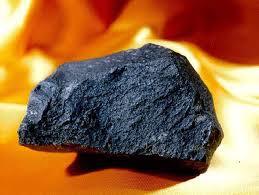
How would you describe this mineral's luster?
a)
Glassy
b)
Metallic
c)
Dull (non-metallic)
d)
Earthy
29.
Which mineral can be scratched with a nail?
a)
Apatite
b)
Corundum
c)
Gypsum
d)
Topaz
30.
What is Missouri's state mineral?
a)
Quartz
b)
Limestone
c)
Galena
d)
Ozarkite
31.
Many of the properties we use to classify minerals are
a)
Physical properties
b)
Chemical properties
32.
Which property is not the most reliable characteristic to use when classifying minerals?
a)
Luster
b)
Color
c)
Hardness
d)
Density
33.
Does this mineral cleave or fracture?
a)
Cleave
b)
Fracture
34.
How would you describe this mineral's luster?
a)
Earthy 
b)
Dull (non-metallic)
c)
Glassy
d)
Metallic
35.

The mineral's streak and color will always be the same.

a)

True

b)

False

36.
Using this scale, which mineral can scratch fluorite but not quartz?
a)
Talc 
b)
Gypsum 
c)
Apatite 
d)
Calcite 
37.
Which term does not describe a mineral?
a)
Solid
b)
Organic
c)
Has crystalline structure
d)
Natural
38.
What term means that a mineral will break along a curved and/or jagged line?
a)
Luster
b)
Cleaving
c)
Fracturing
d)
Hardness
39.
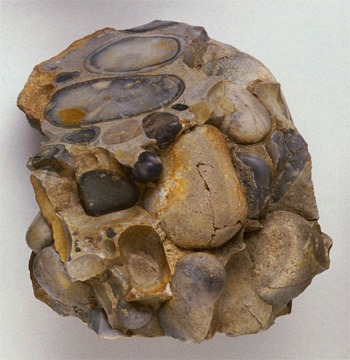
This rock formed when bits of other rocks became pressed into a solid. What type of rock is it?
a)
Sedimentary Rock
b)
Metamorphic Rock
c)
Igneous Rock
40.
This rock was formed when magma cooled very slowly inside the Earth. What specific type of rock is it?
a)
Intrusive Igneous Rock
b)
Extrusive Igneous Rock
c)
Foliated Metamorphic Rock
d)
Clastic Sedimentary Rock
41.
This rock formed when lava cooled very quickly on Earth's surface. What specific type of rock is it?
a)
Extrusive Igneous Rock
b)
Intrusive Igneous Rock
c)
Non-Foliated Metamorphic Rock
d)
Biochemical Sedimentary Rock
42.
What are the 3 major types of rocks?
a)
Igneous, Metamorphic, Sedimentary
b)
Metamorphic, Igneous, Cementation
c)
Brown, Red, Gray
d)
Streak, Hardness, Breakage
43.
This rock was formed by smaller pieces of rock that settled at the bottom of a lake millions of years ago. What type of rock is this?
a)
Sedimentary
b)
Igneous
c)
Metamorphic
44.
This rock was found near the mouth of a volcano. What type of rock is this?
a)
Sedimentary
b)
Igneous
c)
Metamorphic
45.
How is sedimentary rock formed?
a)
Formed by heat and pressure
b)
Formed by heat and cooling
c)
Bits of sediment that are compressed, cemented, and compaction
d)
All of the above
46.
When sediments are pressed together tightly, this is called ____________.
a)
Compaction
b)
Cementation
c)
Weathering
d)
Erosion
47.
The process in which dissolved minerals crystallize and glue sediment together.
a)
compaction
b)
deposition
c)
organic rock
d)
cementation
48.
The process when rocks break into smaller pieces due to exposure to natural elements is called
a)
erosion
b)
weathering
c)
sediments
49.
Which rocks are formed on Earth's surface?
a)
Intrusive igneous and sedimentary
b)
Extrusive igneous and sedimentary
c)
Metamorphic and extrusive igneous
d)
Sedimentary and metamorphic
50.
Heat and pressure below the Earth's surface will form ____ rocks.
a)
Igneous
b)
Sedimentary
c)
Metamorphic
d)
All 
51.

Rocks with large crystals are classified as

a)

Intrusive igneous rock

b)

Extrusive igneous rock

c)

Sedimentary rock

d)

Metamorphic rock

52.

Rocks with small or no crystals are

a)

Metamorphic rocks

b)

Sedimentary rocks

c)

Extrusive igneous rocks

d)

Intrusive igneous rocks

53.
Pressure is used to make
a)
Igneous rocks
b)
Sedimentary rocks
c)
Metamorphic rocks
d)
Both sedimentary and metamorphic rocks
54.
Mafic and felsic are characteristics of 
a)
Sedimentary rocks
b)
Metamorphic rocks
c)
Igneous rocks
d)
All of the above
55.

Foliation or banding is a characteristic of

a)

Metamorphic rocks

b)

Sedimentary rocks

c)

Intrusive igneous rocks

d)

Extrusive igneous rocks

56.
Fossils will be found in ___ rocks only.
a)
Intrusive igneous 
b)
Extrusive igneous
c)
Sedimentary
d)
Metamorphic
57.
Weathering, erosion, and compaction will form which type of rock? 
a)
Intrusive igneous
b)
Extrusive igneous
c)
Sedimentary
d)
Metamorphic