
 Worksheets
Unit 5 Plate Tectonics Test LIFT
Total questions: 60
Worksheet time: 33mins
Name
Class
Date
1.
The part of the earth that includes the crust and the upper mantle and is split into tectonic plates is the
a)
lithosphere
b)
crust
c)
asthenosphere
d)
mantle
2.
The hottest layer
a)
crust
b)
inner core
c)
mantle
d)
outer core
3.
The thinest layer
a)
crust
b)
inner core
c)
mantle
d)
outer core
4.
The thickest layer
a)
crust
b)
inner core
c)
mantle
d)
outer core
5.
This layer is completely liquid
a)
crust
b)
inner core
c)
mantle
d)
outer core
6.
This layer is completely solid due to the intense pressure it is under
a)
crust
b)
inner core
c)
mantle
d)
outer core
7.
This layer is solid
a)
crust
b)
asthenosphere
c)
mantle
d)
outer core
8.
The theory stating the continents were once joined in a large mass that broke apart.
a)
Continental Drift
b)
Seafloor Spreading
c)
Plate Tectonics
d)
Pangaea
9.
The process for new oceanic lithosphere forming at mid ocean ridges
a)
Continental Drift
b)
Seafloor Spreading
c)
Plate Tectonics
d)
Pangaea
10.
The theory that states that the Earth is divided into plates that float and move in slow, constant motion.
a)
Continental Drift
b)
Seafloor Spreading
c)
Plate Tectonics
d)
Tectonic Plates
11.
Ocean trenches always form at subduction zones where dense oceanic crust subducts.
a)
True
b)
False
12.
Volcanoes never form along subduction zones.
a)
True
b)
False
13.
The circular pattern of heating, rising, cooling, sinking of magma in the mantle causing tectonic plates to move.
a)
Plate Tectonics
b)
Convection Currents
c)
Pangaea
d)
Subduction
14.
Volcanoes are most often formed at this boundary.
a)
Divergent
b)
Convergent
c)
Normal
d)
Transform
15.
The Mid-Atlantic Ridge is formed at this boundary.
a)
Divergent
b)
Convergent
c)
Normal
d)
Transform
16.
The tectonic plates float on the
a)
lithosphere
b)
lower mantle
c)
outer core
d)
asthenosphere
17.
Faults can occur at plate boundaries, near boundaries, and at other weakened areas of crust.
a)
True
b)
False
18.
There are 3 types of crust.
a)
True
b)
False
19.
Continental crust is more dense than oceanic crust.
a)
True
b)
False
20.
Hot spots are volcanically active areas that are not near tectonic plate boundaries.
a)
True
b)
False
21.
What would you be most likely to find at a transform boundary?
a)
Earthquakes
b)
Volcanoes
c)
Mountains
d)
Rift
22.
What would you be most likely to find at a convergent boundary between two pieces of continental crust?
a)
Volcano
b)
Mountain
c)
Rift
d)
Island Arc
23.
A subduction zone is formed...
a)
when one tectonic plate sinks below another
b)
at every type of convergent plate boundary
c)
at every type of divergent plate boundary
d)
at transform boundaries
24.
Hypothesis proposed by Alfred Wegener
a)
Continental Drift
b)
Seafloor Spreading
c)
Pangaea
d)
Magnetic Reversal
25.
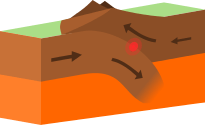
What type of plate boundary is this?
a)
Plate
b)
Divergent
c)
Convergent
d)
Transform
26.
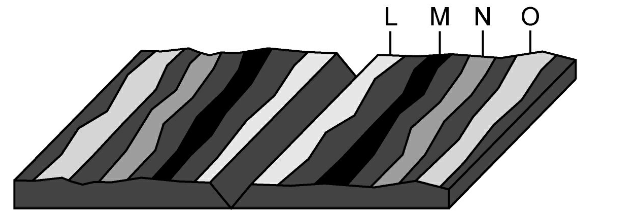
Where would the oldest rock be found?
a)
L
b)
M
c)
N
d)
O
27.

Name this Boundary type
a)
Convergent boundary
b)
Divergent Boundary
c)
Transform
d)
Equal Arm Balance
28.

Name this type of boundary
a)
Convergent boundary
b)
Divergent Boundary
c)
Transform
d)
Volcanoes
29.

Name this type of boundary
a)
Convergent boundary
b)
Divergent Boundary
c)
Transform boundary
d)
Dot boundary
30.
Which two continents can fit like a puzzle?
a)
North America and Asia
b)
Nothing
c)
South America and Australia
d)
South America and Africa
31.
The fastest type of seismic wave
a)
P-Wave
b)
S-wave
c)
Surface wave
32.
Second seismic wave to arrive
a)
P wave
b)
S wave
c)
Surface wave
33.
Most destructive seismic wave
a)
P wave
b)
S wave
c)
Surface wave
34.
Force that pulls rocks apart
a)
compression
b)
shearing
c)
tension
35.
fault type where hanging wall falls
a)
reverse
b)
strike-slip
c)
normal
36.
fault where hanging wall rises
a)
reverse
b)
strike-slip
c)
normal
37.
fault where blocks of rock slide past each other side by side
a)
reverse
b)
strike-slip
c)
normal
38.
An upward fold in rock in the shape of an arch
a)
anticline
b)
syncline
c)
focus
d)
hanging wall
39.
An downward fold in rock in the shape of a "U"
a)
anticline
b)
syncline
c)
focus
d)
hanging wall
40.

Which is the hanging wall?
a)
left side
b)
right side
41.
What type of fault is shown?
a)
reverse fault
b)
normal fault
c)
strike-slip fault
42.
What type of stress caused the fault?
a)
shearing
b)
tension
c)
compression
43.

What type of fault is shown?
a)
reverse fault
b)
normal fault
c)
strike-slip fault
44.

What type of stress caused the fault?
a)
shearing
b)
tension
c)
compression
45.

Which letter represents the arrival of the P wave?
a)
A
b)
B
c)
C
d)
D
46.
Which letter represents the arrival of the S wave?
a)
A
b)
B
c)
C
d)
D
47.
Which do we have to measure to determine distance to the epicenter?
a)
A
b)
B
c)
C
d)
D
48.

When we map the seismograph data, where is the epicenter?
a)
in the middle of each circle
b)
on the edges of the circles
c)
where all three circles circumferences cross
49.
Which station is closest to the epicenter?
a)
the station with the largest circle
b)
the medium circle
c)
the station with the smallest circle
50.
Where is the point at which the first movement occurs during an earthquake?
a)
Epicenter
b)
Focus
c)
Fault
d)
Plate
51.
Where is the point on the Earth’s surface directly above the focus of an earthquake?
a)
Epicenter
b)
Fault
c)
Hypocenter
d)
Tremor
52.
Which body wave squeezes and stretches rock materials as they pass through the Earth?
a)
Body Waves
b)
P Waves
c)
S Waves
d)
Surface Waves
53.
What is another term for P Wave?
a)
Compression Wave
b)
Principal Wave
c)
Shear Wave
d)
Secondary Wave
54.
What is an instrument that detects and records waves produced by earthquakes? (This piece of equipment can measure the magnitude of an earthquake.)
a)
Epicenter
b)
Fault
c)
Seismogram
d)
Seismograph
55.
What is the measure of the amount of energy released in an earthquake?
a)
Earthquake
b)
Epicenter
c)
Magnitude
d)
Seismogram
56.
Which scale rates earthquakes based on the amount of damage done?
a)
Mercalli Scale
b)
Richter Scale
c)
Seismogram Scale
d)
Bernoulli Scale
57.
Which scale measures the intensity of the ground movement?
a)
Mercalli Scale
b)
Richter Scale
c)
Seismogram Scale
d)
Bernoulli Scale
58.
What is the shaking of the Earth’s crust caused by a release of energy?
a)
Earthquake
b)
Epicenter
c)
Fault
d)
Plate
59.

The huge pieces of the earth's crust are called ____________________________.
a)
crust
b)
plates
c)
directions
d)
seismos
60.

This famous transform fault is located in the western United States creates significant earthquake activity for California
a)
New Madrid
b)
Denali Fault
c)
Ramapo Seismic Zone
d)
San Andreas
100 %

