
 Worksheets
3B: Sucession & Human Impact
Total questions: 36
Worksheet time: 22mins
Name
Class
Date
1.
Starts with BARE ROCK followed by lichen
a)
primary succession
b)
secondary succession
c)
both types of succession
2.

What is the order of succession shown in this figure?
a)
A, B, C, D
b)
B, A, D, C
c)
C, D, A, B
d)
D, A, B, C
3.

What type of succession is shown going from figure A to figure B?
a)
primary succession
b)
eutrophication
c)
secondary succession
d)
intermediate
4.
The first organisms that appear in an ecological community
a)
ecological succession
b)
primary succession
c)
secondary succession
d)
pioneer species
5.
What is the difference between a primary vs. secondary succession?
a)
secondary occurs where there was no previous community
b)
they are the same
c)
secondary occurs in an area that was only partially destroyed
d)
primary ocurs in an area that was only partially destroyed
6.
How do lichens contribute to primary succession?
a)
Lichens decompose organic matter from animals and plants
b)
Lichens begin to break down rock to form soil
c)
Lichens are nitrogen fixing bacteria
7.
Succession that occurs in an area with NO SOIL
a)
ecological succession
b)
primary succession
c)
secondary succession
d)
pioneer speciles
8.

Final illustration (#8) shows
a)
pioneer species
b)
climax community
c)
only biotic factors
d)
only abiotic factors
9.

Succession type?
a)
primary succession
b)
secondary succession
c)
tertiary succession
d)
variable succession
10.

Succession type?
a)
primary succession
b)
secondary succession
c)
tertiary succession
d)
variable succession
11.

What does biodiversity mean?
a)
Only one species in an area.
b)
The different amount of species in an area
c)
All abiotic life
d)
Nitrogen fixation
12.
The illegal capture or killing of an organism, often for money, is called...
a)
poaching
b)
harvesting
c)
fragementation
d)
extinction
13.

Many different types of organisms.
a)
Pioneer species
b)
Community
c)
Biodiversity
d)
Population
14.

__________ is an energy resource that WILL NOT run out in the next several hundred years.
a)
Renewable Energy Resource
b)
Nonrenewable Energy Resource
c)
Fossil Fuel
d)
Forever Fuel
15.

__________ is an energy resource that WILL run out in the next several hundred years.
a)
Renewable Energy Resource
b)
Nonrenewable Energy Resource
c)
Fossil Fuels
d)
Forever Fuels
16.

Coal is a __________ energy resource.
a)
Renewable
b)
Nonrenewable
17.

Solar Power is a __________ energy resource.
a)
Renewable
b)
Nonrenewable
18.

Natural Gas is a __________ energy resource.
a)
Renewable
b)
Nonrenewable
19.
Non-renewable or Renewable: Wood
a)
Non-renewable
b)
Renewable
20.

The largest number of individuals in a species that an environment can support long term
a)
carrying capacity
b)
emigration
c)
immigration
d)
population density
21.
Populations with high diversity have _________.
a)
very few traits
b)
high number of different traits
c)
difficulty surviving
d)
very few living individuals
22.
Populations with low genetic diversity are more likely to ______________.
a)
go extinct
b)
adapt to their environment
c)
posses a wide variety in traits
d)
have an advantage over living things with high genetic diversity
23.
A population whose members all look very similar would have _____________.
a)
high genetic diversity
b)
low genetic diversity
c)
high biological diversity
d)
low species diversity
24.
An ecosystem that contains many different species would have a ____________.
a)
high genetic diversity
b)
low genetic diversity
c)
high biological diversity
d)
high species diversity
25.
Species that have ____________ are more able to adapt to their environment.
a)
high species diversity
b)
high biological diversity
c)
high genetic diversity
d)
low genetic diversity
26.

The greenhouse gas having the greatest role in human-caused global warming is
a)
methane
b)
carbon dioxide
c)
CFCs (chlorofluorocarbons)
d)
ozone
27.
The main human activity that releases greenhouse gases is
a)
using bottled water
b)
burning fossil fuels
c)
texting on cellphones
d)
eating meat
28.
Deforestation contributes to greenhouse gases by
a)
loss of trees that would otherwise remove carbon dioxide from the air
b)
burning wood releases carbon dioxide
c)
Both are correct
29.
Worldwide, temperatures have been increasing for more than 100 years. Is this evidence of global warming?
a)
yes
b)
no
30.
Melting of glaciers and polar ice caps....
a)
will result in cooler temperatures in the Arctic
b)
will result in sea-levels rising
c)
Will have no effect on ecosystems
d)
None of the above
31.
Human activity is adding additional greenhouse gases to the amount that are in the atmosphere naturally
a)
True
b)
False
32.
The warming of the atmosphere by the trapping of heat being radiated to space is called
a)
evaporation
b)
condensation
c)
the greenhouse effect
d)
radiation
33.
Without the "greenhouse effect"
a)
Overnight temperatures would plunge downward
b)
the earth would catch on fire
c)
the earthe would heat up drastically
d)
the atmosphere would leave
34.
Which of these sets of three items produce CFCs
a)
cars, factories, and cardboard
b)
spray cans, cardboard, insulation
c)
spray cans, refrigerant, cardboard
d)
spray cans, refrigerant, insulation
35.
What absorbs ultraviolet rays in the atmosphere?
a)
troposphere
b)
stratosphere
c)
ozone layer
d)
greenhouse gases
36.
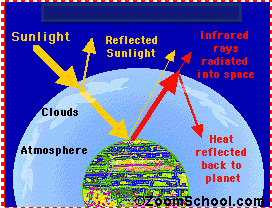
What does this diagram illustrate?
a)
Ozone Layer
b)
The Greenhouse Effect
c)
Ultraviolet Radiation
d)
Layers of the atmosphere
100 %

