
 Worksheets
Ecology Test Review
Total questions: 33
Worksheet time: 1hrs 6mins
Name
Class
Date
1.
True/False, The arrows in a food web point in the direction of energy flow.
a)
True
b)
False
2.

The clown fish & sea anemone exhibit which type of symbiotic relationship?
a)
Mutualism
b)
Commensalism
c)
Predator/Prey
d)
Parasite/Host
3.
This word means living or once living.
a)
Abiotic
b)
Biotic
4.
Which is NOT a human impact on the ocean?
a)
Hurricanes
b)
Garbage Patches
c)
Artificial Reefs
d)
Whaling
5.
Which of the following is a long term effect on the environment?
a)
Flooding
b)
Drought
c)
Fire
d)
Climate Change
6.
Which of the following is a short term effect on the environment?
a)
Large Scale Habitat Loss
b)
Climate Change
c)
Large Volcanic Eruption
d)
Hurricane
7.
Which of the following is autotrophic?
a)
producer
b)
omnivore
c)
detritovore
d)
carnivore
8.
Which symbiotic relationship do a dog and flea represent?
a)
commensalism
b)
parasite/host
c)
predator/prey
d)
producer/consumer
9.

How many organisms only eat autotrophs?
a)
2
b)
3
c)
1
d)
4
10.
What is the primary source of energy on the Earth?
a)
Moon
b)
Sun
c)
Fossil Fuels
d)
Water
11.

Is this ecosystem freshwater, terrestrial, or marine?
a)
freshwater
b)
terrestrial
c)
marine
12.
the non living things in an ecosystem are called...
a)
abiotic factors
b)
biotic factors
13.
Leeches are organisms that live in ponds. They feed on the blood of fish and other vertebrates and produce enzymes, which cause the animal on which it feeds to continue bleeding even after the leech is done feeding. This relationship would be classified as which of the following?
a)
Freshwater producer/consumer
b)
Marine predator/prey
c)
Freshwater parasite/host
d)
Terrestrial parasite/host
14.
Which of the following describes a predator/prey relationship in a marine environment?
a)
Phytoplankton in the sea make food from sunlight.
b)
Sharks consume smaller fish they catch in the ocean.
c)
Frogs in a pond catch and eat flying insects.
d)
Fish of the same species compete for plants to eat.
15.

The marine food web is provided. Which pair of organisms represents a predator/prey relationship?
a)
Tuna & squid
b)
Shrimp & copepods
c)
Diatoms & shrimp
d)
Sunfish & lanternfish
16.

The aggressive South American cane toad was introduced to Australia by humans. Information about the cane toad is provided in the table. Based on the table, native organisms will be negatively affected by competition with cane toads if they -
a)
eat reptiles.
b)
hunt from the air.
c)
live in the water.
d)
are longer than 15 cm.
17.
Trees in a temperate deciduous forest compete for all of the following EXCEPT -
a)
sunlight.
b)
shelter.
c)
soil.
d)
water.
18.
Fish in a small pond will most likely depend on which of the following biotic factors to meet their needs?
a)
Plants that exchange gasses with the pond water.
b)
Insects that feed on other insects in the pond.
c)
Water birds that prey on amphibians and small fish.
d)
Large predators that consume aquatic vertebrates.
19.
Run-off is the water that -
a)
soaks into the ground
b)
contains living organisms
c)
always ends up in the oceans
d)
flows over land into a body of water
20.

Which of the following is a herbivore?
a)
cricket
b)
frog
c)
hawk
d)
shrew
21.
A consumer that hunts is called:
a)
a producer.
b)
an omnivore.
c)
a predator.
d)
a herbivore.
22.
Humans are considered...
a)
consumers
b)
decomposers
c)
producers
23.
Example of a decomposer
a)
fungus
b)
mouse
c)
plants
d)
frogs
24.

What is a producer?
a)
an organism that gets energy from eating other organisms
b)
an organisms that uses sunlight to make its own food
c)
an organism that gets energy from eating dead organisms, non-living material or waste
d)
an organism that uses chemical energy to make its own food
25.

Which is NOT an abiotic factor:
a)
Soil
b)
Air
c)
Bacteria
d)
Water
26.

The fox in this food web would be considered a:
a)
Tertiary Consumer
b)
Producer
c)
Secondary Consumer
d)
Primary Consumer
27.

The mouse in this food web would be considered a:
a)
Primary Consumer
b)
Producer
c)
Tertiary Consumer
d)
Secondary Consumer
28.
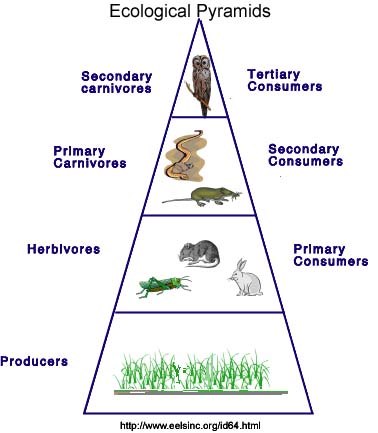
The largest group of organisms found in a food web would be:
a)
Primary Consumers
b)
Producers
c)
Decomposers
d)
Tertiary Consumers
29.
What are phytoplankton?
a)
tiny sea animals
b)
microscopic sea plants and algae
c)
consumers in a marine ecosystem
d)
bacteria and fungi
30.
What type of relationship is positive for one organism and has no impact on the other?
a)
Commensalism
b)
Mutualism
c)
Survival of the Fittest
d)
Parasitism
31.

This image shows a tree covered in soot from pollution. The bark used to be white. What impact would this environmental change have on the white moth shown?
a)
It would cause the population to increase, as it is camouflaged with the tree
b)
It would cause the population to decrease, as it is now easier for predators to see it
c)
It would have no impact on the population of moths, as moths do not eat trees
32.
Which of the following human activities would be most helpful to an ocean ecosystem?
a)
Adding chemicals to farmlands
b)
Overharvesting coastal waters
c)
Pouring motor oil down the drain
d)
Building an artificial reef
33.

Which organisms are primary consumers competing for the same food?
a)
Rabbits and snakes
b)
Mice and crickets
c)
Owls and snakes
d)
Frogs and crickets
100 %

