wayground logo

Free Printable Worksheets

Font size

S
M
L
XL
Worksheets

Year 10 Physics

Total questions: 73

Worksheet time: 2hrs 41mins

Name
Class
Date
1.
What type of energy is in this picture?
a)
Kinetic
b)
Potential
c)
Chemical
d)
Sound
2.
When plants convert the sun's energy into food, which type of energy is it?
a)
kinetic
b)
chemical
c)
thermal
d)
radiant
3.
What kind of energy is represented in this picture?
a)
Thermal
b)
Potential
c)
Nuclear
d)
Mechanical
4.
What kind of energy is represented in the picture?
a)
Thermal
b)
Chemical
c)
Sound
d)
Nuclear
5.
What kind of energy does this device use?
a)
Chemical
b)
Electrical
c)
Thermal
d)
Chemical
6.
A battery converts what type of energy to another?
a)
sound to kinetic
b)
light to heat
c)
mechanical to electrical
d)
chemical to electrical
7.
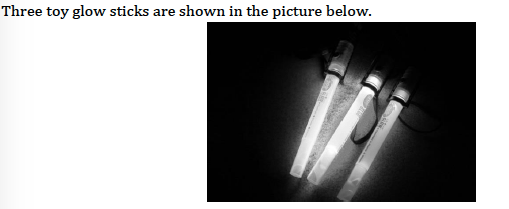
The glow sticks produce light for a short amount of time. The light from the glow stick is a conversion from what to what?
a)
thermal to light
b)
gravitational to potential
c)
radiant to electrical
d)
chemical to light
8.
Work is:
a)
A transfer of energy by a force to move and object
b)
Something you get paid for
c)
Something you take home
d)
Makes you sweat
9.
What machine changes electrical energy into light and sound energy?
a)
battery
b)
lightbulb
c)
alarm clock
d)
apple
10.
According to which law of energy, energy can't be created or destroyed?
a)
First law of motion
b)
The law of tacos
c)
Laws of Energy
d)
law of conservation of energy
11.
The purpose of the panels is to change solar energy into ____________.
a)
light energy
b)
electrical energy
c)
chemical energy
d)
mechanical energy
12.
What machine changes chemical energy into heat, light and sound energy
a)
blender
b)
firecracker
c)
lightbulb
d)
apple
13.
Energy causes ___________ to occur.
a)
change
b)
motion
c)
age
14.
All of the different forms of energy can be stored energies.
a)
True
b)
False
15.
Lightning during a thunderstorm is an example of what form of energy?
a)
Radiant (potential) energy
b)
Radiant (kinetic) energy
c)
Electrical (potential) energy
d)
Electrical (kinetic) energy
16.
At what position does the rock have the greatest kinetic energy?
a)
A
b)
B
c)
D
d)
E
17.
Energy due to motion is ____________ energy. 
a)
Potential 
b)
Energy
c)
Kinetic
d)
Friction
18.
Gravitational potential energy depends on the ________ and ________ of the object. 
a)
Height and mass
b)
Friction and movement
c)
Mass and Movement
d)
Height and Friction 
19.
which point has the most potential energy
a)
G
b)
f
c)
b
d)
a
20.
Energy can be _____________ or changed from one type to another.
a)
destroyed
b)
transferred
c)
created
d)
ignored
21.
An explosion of gas from a Hawaiian volcano blows a rock into the sky. the rock has 2000J of kinetic energy. What was its mass if the rock had a velocity of 20m/s
a)
200Kg
b)
20,000Kg
c)
10Kg
d)
200Kg
22.
The faster an object moves, the ________ kinetic energy it has. 
a)
more
b)
less
c)
none of the above
d)
all of the above 
23.
Roller coasters slow down because their energy disappears.  
a)
True 
b)
False
24.
What kind of energy is in flowerpot sitting on a windowsill?
a)
Gravitational
b)
Kinetic
25.
The unit used to measure work is the 
a)
Watt
b)
Newton
c)
Joule
d)
meter
26.
What kind of energy is in a rock at the edge of a cliff?
a)
Potential
b)
Kinetic
27.
The ability to do work is....
a)
work
b)
power
c)
acceleration
d)
energy
28.
In which of the following is no work done
a)
climbing stairs
b)
lifting a book
c)
pushing a shopping car
d)
none of the above
29.

What is gravitational potential energy (GPE)?

a)

Stored energy due to an object's shape

b)

Stored energy due to an object's position

c)

Energy due to the motion of an object

d)

Stored energy due to the condition of the object

30.

What is kinetic energy?

a)

Energy an object has due to its height

b)

Stored energy due to an object's position

c)

Energy an object has due to its motion

d)

Stored energy due to an object's condition

31.

An object is as rest. What types of energy are possible for it to have?

a)

GPE and KE

b)

GPE

c)

KE

d)

It has no GPE or KE

32.

A baseball is thrown straight up into the air. At which point is the potential energy of the baseball the least?

a)

At the apex

b)

Halfway up

c)

Right before it is caught

d)

Halfway down

33.

Which one is not a type of energy?

a)

Gravitational potential

b)

Chemical

c)

Biochemistry

d)

Kinetic

34.
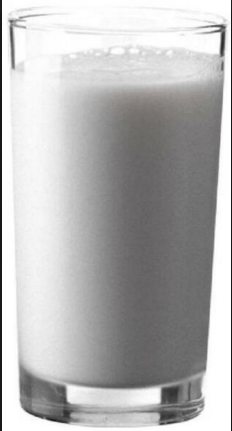
A glass of milk.
a)
Potential
b)
Kinetic
35.
How far will an object move in 12 seconds if it is traveling at a velocity of 8 m/s?
a)
96 m
b)
0.7 m
c)
20 m
d)
4 m
36.
How long will it take a moving object traveling at a velocity of 6 m/s to move 30 meters?
a)
5 s
b)
180 s
c)
36 s
d)
24 s
37.

What is the formula for kinetic energy?

a)

K.E. = 1/2 mv

b)

K.E. = 1/2 mv2

c)

K.E. = mv2

d)

K.E. = mv 1/22

38.
A laptop sitting on a table has potential energy because of the gravitational pull of the Earth. Which of the following would change the energy to kinetic energy?
a)
Looking at the screen
b)
Putting a cute sticker on it
c)
Yelling at it
d)
Sliding it across the table
39.

What is the formula for Gravitational Potential Energy?

a)

G.P.E. = mass x gravity x height

b)

G.P.E. = Force x gravity x height

c)

G.P.E. = mass x speed x height

d)

G.P.E. = mass x gravity x height2

40.

If a soccer ball weighing 4kg is sitting on a desk at 1.5m high, what would be it's Gravitational potential energy?

a)

57J

b)

54J

c)

58.8J

d)

105J

41.

If a soccer ball weighing 2kg is sitting on a desk at 4m high, what would be it's Gravitational potential energy?

a)

78.4J

b)

77J

c)

78J

d)

110J

42.

What are you having the most trouble with?

a)

Calculations

b)

Gravitational Potential Energy

c)

Kinetic Energy

d)

I understand most things

e)

I understand everything

43.

65 km per hour North is an example of an objects what?

a)

Speed

b)

Velocity

c)

Average Speed

d)

Constant Speed

44.

10 km per hour is an example of an objects what?

a)

Velocity

b)

Speed

c)

Acceleration

d)

Inertia

45.
Velocity is 
a)
speed
b)
direction
c)
speed with a direction
46.
On a distance vs. time graph, the steeper the slope _____
a)
the slower the speed
b)
the faster the speed
c)
less acceleration
d)
greater acceleration
47.
According to Newton’s First Law of Motion, a moving object that is not acted on by an unbalanced force will
a)
Remain in motion.
b)
Eventually come to a stop.
c)
Change its momentum.
d)
Accelerate.
48.
Newton's Third Law of Motion states that any action will have a(n) _______ and ______ reaction
a)
Equal and similar
b)
Equal and opposite
c)
Equal and different
d)
Greater and opposite
49.
What is the speed of an object that travels 20 meters in 4 seconds?  (Hint: Speed = Distance / Time)
a)
80 m/s
b)
0.2 m/s
c)
5 m/s
d)
24 m/s
50.
A roller coasters accelerates from an initial velocity of 6.0 m/s to a final velocity of 70 m/s over 4 seconds.  What's the acceleration?
a)
24 m/s2
b)
18 m/s2
c)
16 m/s2
d)
16 m/s
51.
A race car goes from 100 m/s to rest in 25 seconds. What is its acceleration?
a)
-4 m
b)
4 m/s
c)
4 m/s2
d)
-4 m/s2
52.
Peanut ran 50 meters in 10 seconds.  What was Peanut's average speed?
a)
2 m/s
b)
5 km/h
c)
5 m/s
d)
5 m/s North
53.
A distance vs. time graph shows an object's
a)
frame of reference
b)
speed
c)
acceleration
d)
favorite food
54.
Velocity is both ____ and _____. 
a)
speed , direction 
b)
direction, mass
c)
volume, density 
d)
direction, magnitude 
55.
A change in velocity over time is known as:
a)
acceleration
b)
constant speed
c)
average speed
d)
displacement
56.
What is happening to the velocity?
a)
Constant
b)
Decreasing
c)
Increasing
d)
Zero
57.
Which graph shows a car that is moving at a constant velocity?
a)
A
b)
B
c)
C
d)
none of them
58.
Which graph shows a car that is speeding up?
a)
A
b)
B
c)
C
d)
none of them
59.
How will this object move? 
a)
It won't move. 
b)
It will move to the right. 
c)
It will move to the left. 
d)
It will move in both directions. 
60.
What are balanced forces?
a)
Forces in the same direction
b)
Forces of the same size
c)
forces of the same size in opposite directions
61.
How could you make an object increase its speed?
a)
use less force
b)
use more force
c)
use no force
62.
Since Force = Mass * Acceleration, how would you manipulate the equation to solve for mass?
a)
mass divided by acceleration
b)
Mass times acceleration
c)
Force divided by acceleration
d)
Equations cannot be manipulated
63.
If a 10 kilogram object accelerates suddenly at 15 m/s^2, how much force was applied to the object?
a)
150 Newtons
b)
15 Newtons
c)
150 kilograms
d)
100 kilograms
64.
A push or pull exerted on an object
a)
Force
b)
Net force
c)
Momentum
d)
Speed
65.
What is the force that pulls us towards the Earth?
a)
gravity
b)
weight
c)
friction
d)
mass
66.
What is 'drag' another name for?
a)
dressing up
b)
air resistance
c)
friction
d)
weight
67.
What are balanced forces?
a)
Forces in the same direction
b)
Forces of the same size
c)
forces of the same size in opposite directions
68.

What topic are you having the most trouble with?

a)

Velocity and acceleration

b)

Energy

c)

Graphing and calculating gradient

d)

Equations of motion

e)

Forces and Newton's Laws

69.
Total distance divided by total time is
a)
average speed
b)
constant speed
c)
instantaneous speed
d)
acceleration
70.
How fast is the car traveling at 30 seconds?
a)
5m/s
b)
10m/s
c)
20m/s
d)
30m/s
71.
The picture of the position vs. time graph shows an object that is...
a)
accelerating/speeding up
b)
moving at a constant speed 
c)
not moving 
d)
accelerating/slowing down. 
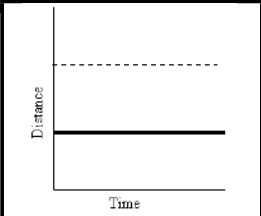
72.
What does this graph represent?
a)
Constant speed
b)
Acceleration
c)
Not moving
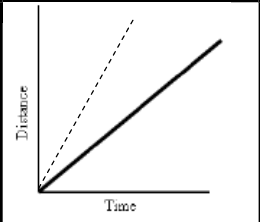
73.
What does this graph represent?
a)
Constant Speed
b)
Acceleration
c)
Not moving