
 Worksheets
CW Qz Autosomal Dominant, April 17
Total questions: 250
Worksheet time: 5hrs 20mins
Name
Class
Date
1.

In the second generation-how many people are carriers of the trait?
a)
2
b)
3
c)
5
d)
6
2.

How many individuals are there in the 3rd generation?
a)
2
b)
3
c)
4
d)
6
3.

a)
Not affected Female
b)
Not affected Male
c)
Affected Male
d)
Affected Female
4.

a)
Not Affected Male
b)
Not Affected Female
c)
Affected Male
d)
Affected Female
5.
What do we use pedigrees for?
a)
To look at families
b)
To make determinations about the offspring
c)
To track traits in families
d)
Nothing
6.

How are individuals III-2 and II-4 related?
a)
Cousins
b)
Dad and Daughter
c)
Uncle and Niece
d)
Grandpa and Granddaughter
7.

Why do all the daughters in Generation II carry the colorblind gene?
a)
Because mom passed on the gene.
b)
Because dad passed on the X chromosome.
c)
Because their brother has it.
d)
Because their brother gave it to them.
8.

Why does individual IV-7 have colorblindness?
a)
Because his mom is a carrier.
b)
Because his dad has it.
c)
Because his siblings have it.
d)
Because his uncle has it.
9.

Give the genotype for person III-3
a)
GG
b)
Gg
c)
gg
10.

Give the genotype for person II-1
a)
GG
b)
Gg
c)
gg
11.

Which individual in the first generation is a carrier?
a)
The male
b)
The female
c)
individual 1
d)
None of the above
12.

If this pedigree shows a recessive disorder, what MUST the genotype of individual II-3 be?
a)
HH
b)
Hh
c)
hh
d)
None of the above
13.

What is the mode of inheritance shown here?
a)
Recessive
b)
Sex Linked
c)
Dominant
14.
What does a filled in square represent?
a)
Not affected Female
b)
Not affected Male
c)
Affected Male
d)
Affected Female
15.

How many generations are shown in this pedigree?
a)
1
b)
2
c)
3
d)
4
16.

How many kids did the mother and father from the first generation have?
a)
2
b)
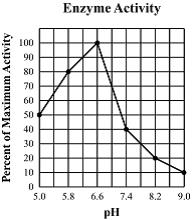
4
c)
5
d)
6
17.
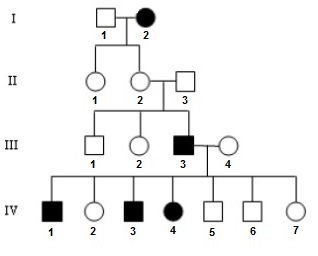
This pedigree represents the inheritance of hemophilia in this family. How many of the females have the hemophilia trait?
a)
8
b)
5
c)
2
d)
3
18.

What do half colored symbols represent?
a)
The individual is a carrier (heterozygous).
b)
The individual expresses the trait.
c)
The individual has both recessive alleles.
d)
The individual has both dominant alleles.
19.
What does an open circle represent?
a)
Not Affected Male
b)
Not Affected Female
c)
Affected Male
d)
Affected Female
20.

Lisa has two grandmothers in this picture.
a)
Mona and Jackie
b)
Marge and Mona
c)
Selma and Jackie
d)
Patty and Selma
21.

How many females are in this pedigree?
a)
3
b)
4
c)
6
d)
7
22.
Photograph of chromosomes grouped in ordered pairs
a)
pedigree
b)
Punnett Square
c)
Venn Diagram
d)
Karyotype
23.
Chart that shows the relationships within a family
a)
Pedigree
b)
Karyotype
c)
T chart
d)
Key
24.

What is this?
a)
karyotype
b)
pedigree
c)
Venn diagram
d)
Punnett Square
25.

What is this?
a)
Pedigree
b)
Karyotype
c)
Venn diagram
d)
Punnett Square
26.
What does a filled in square represent?
a)
Not affected Female
b)
Not affected Male
c)
Affected Male
d)
Affected Female
27.

What does this shape represent in a pedigree?
a)
Not Affected Male (doesn't have the trait)
b)
Not Affected Female (doesn't have the trait)
c)
Affected Male (has the trait)
d)
Affected Female (has the trait)
28.

What does this shape represent in a pedigree?
a)
Not affected Female (doesn't have the trait)
b)
Not affected Male (doesn't have the trait)
c)
Affected Male (has the trait)
d)
Affected Female (has the trait)
29.

How many girls did II-1 and II-2 have?
a)
1
b)
2
c)
3
d)
4
30.

How are individuals I-2 and III-5 related?
a)
Grandpa and grandson
b)
Mom and son
c)
Uncle and nephew
d)
Grandma and grandson
31.

How are individuals II-4 and III-5 related?
a)
Grandpa and grandson
b)
Mom and son
c)
Uncle and nephew
d)
Father and son
32.
This pedigree represents the inheritance of hemophilia in this family. How many of the males have the hemophilia trait?
a)
8
b)
5
c)
2
d)
3
33.
If hemophilia is a sex-linked recessive trait, what genotype would individual I-2 have?
a)
XBXb
b)
XbXb
c)
XBY
d)
XbY
34.
If hemophilia is a sex-linked recessive trait, what genotype would individual IV-2 have?
a)
XBXb
b)
XbXb
c)
XBY
d)
XbY
35.

a)
Not affected male
b)
Not affected female
c)
Affected male
d)
Affected female
36.

a)
Not affected male
b)
Not affected female
c)
Affected male
d)
Affected female
37.
What does a vertical line coming down from a square and circle that are connected by horizontal line indicate?
a)
They are cousins
b)
The children
c)
Aunts and Uncles
38.
What do we use pedigrees for?
a)
To look at families
b)
To make determinations about the offspring
c)
To track traits in families
d)
Nothing
39.

The genotype of the affected son and daughter at the bottom of this pedigree...
a)
homozygous dominant
b)
homozygous recessive
c)
heterozygous
d)
Can't tell
40.
Which individual in the first generation is a carrier?
a)
The male
b)
The female
c)
individual 1
d)
None of the above
41.

Name 2 IV generation colorblind males.
a)
IV-1 and IV-2
b)
IV-1 and IV-6
c)
IV-5 and IV-8
d)
IV-1 and IV-5
42.
What do half colored symbols represent?
a)
The individual is a carrier.
b)
The individual expresses the trait.
c)
The individual has both recessive alleles.
d)
The individual has both dominant alleles.
43.

How many kids did the mother and father from the first generation have?
a)
2
b)
4
c)
5
d)
6
44.

Looking at this pedigree, how many family members have the disease?
a)
4
b)
7
c)
All
d)
None
45.
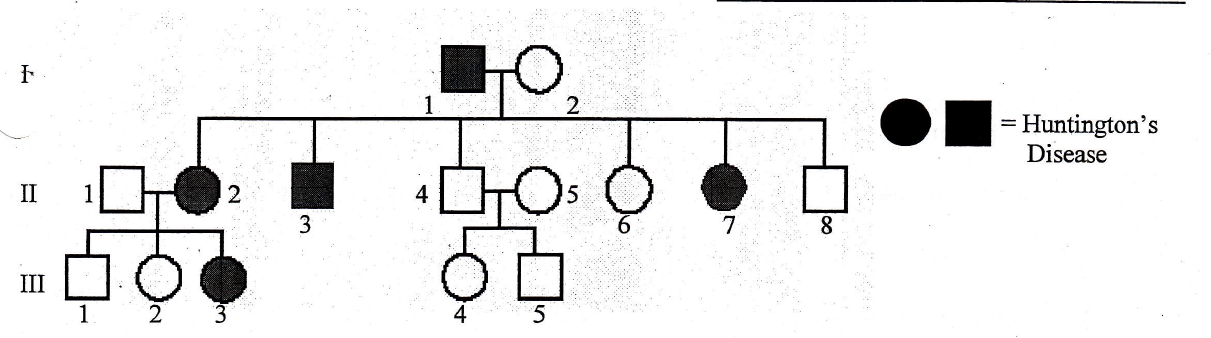
There are no carriers for Huntington's Disease- you either have it or you don't. Is Huntington's disease caused by a dominant or recessive trait?
a)
Dominant
b)
Recessive
46.
Aa, DD, bB, yy are all examples of
a)
genotypes
b)
phenotypes
47.
AA and Aa always show up as
a)
dominant
b)
recessive
48.
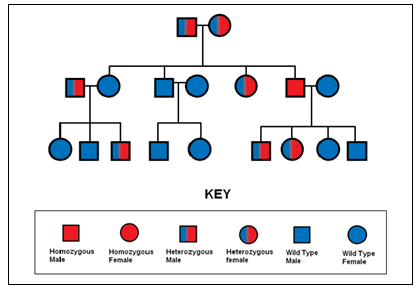
In a pedigree, what shape represents a male?
a)
circle
b)
square
c)
triangle
d)
diamond
49.

Huntington's Disease is a dominant trait.
What is the correct genotype for individual I-2?
What is the correct genotype for individual I-2?
a)
HH
b)
Hh
c)
hh
d)
H_
50.

How many individuals are there in the 3rd generation?
a)
2
b)
3
c)
4
d)
6
51.

In the second generation-how many people have the disease or display the physical trait?
a)
2
b)
4
c)
5
d)
6
52.

How many generations are shown in this pedigree?
a)
1
b)
2
c)
3
d)
4
53.

What is the gender of the individual whose karyotype is seen in the image?
a)
Male
b)
Female
54.

How many girls did the mother and father from the first generation have?
a)
2
b)
4
c)
5
d)
6
55.

In the second generation-how many people are carriers of the trait?
a)
2
b)
3
c)
5
d)
6
56.
How many alleles (letters) do each person carry for a trait?
a)
1
b)
2
c)
3
d)
4
57.
Aa is
a)
homozygous
b)
heterozygous
58.

The genotype of the affected son and daughter at the bottom of this pedigree...
a)
could be homozygous dominant
b)
could be homozygous recessive
c)
could be heterozygous
d)
Can't tell
59.
Heredity is the passing of traits from _____________________ to _____________________
a)
predators to prey
b)
water to rain
c)
parents to offspring
d)
fungi to protists
60.
___________________________ is the study of how traits are passed on, or inherited.
a)
dominant traits
b)
ratio
c)
phenotype
d)
genetics
61.
W=white hair
w= non-white hair
If you cross a horse with WW and a horse with ww what fraction of the offspring would be expected to have white hair?
w= non-white hair
If you cross a horse with WW and a horse with ww what fraction of the offspring would be expected to have white hair?
a)
none
b)
3/4
c)
1/2
d)
all
62.
Proteins are made of monomers called ___________
a)
Nucleotides
b)
Monosaccharides
c)
Amino Acids
d)
Glycerol and fatty acids
63.
The element _______is found in all of the organic compounds.
a)
Iron
b)
Nitrogen
c)
Carbon
d)
Oxygen
64.
_________ are composed out of carbon (C), hydrogen (H), oxygen (O), nitrogen (N), and phosphorus (P)
a)
Carbohydrates
b)
Lipids
c)
Proteins
d)
Nucleic Acids
65.
DNA and RNA are examples of
a)
Carbohydrates
b)
Lipids
c)
Proteins
d)
Nucleic Acids
66.
Nucleotides are monomers of
a)
Carbohydrates
b)
Lipids
c)
Proteins
d)
Nucleic Acids
67.
Monosaccharides are monomers of
a)
Carbohydrates
b)
Lipids
c)
Proteins
d)
Nucleic Acids
68.
Waxes, oils and fats are examples of
a)
Carbohydrates
b)
Lipids
c)
Proteins
d)
Nucleic Acids
69.
Glycerol and fatty acids are the monomers of
a)
Carbohydrates
b)
Lipids
c)
Proteins
d)
Nucleic Acids
70.
The organic compounds that have many structural purposes and are used in many processes within the
cell are called ____________________.
cell are called ____________________.
a)
Carbohydrates
b)
Lipids
c)
Proteins
d)
Nucleic Acids
71.

Which macromolecule is shown?
View Figure 1 (if not visible)
View Figure 1 (if not visible)
a)
lipid
b)
protein
c)
nucleic acid
d)
carbohydrate
72.
What is the function of nucleic acids?
a)
store genetic information
b)
store energy (long-term)
c)
store energy (short-term)
d)
build skin, hair, nails, muscles
73.

Which macromolecule is shown?
View Figure 2 (if not visible)
View Figure 2 (if not visible)
a)
lipid
b)
protein
c)
nucleic acid
d)
carbohydrate
74.

Which macromolecule is shown?
View Figure 3 (if not visible)
View Figure 3 (if not visible)
a)
lipid
b)
protein
c)
nucleic acid
d)
carbohydrate
75.

Which macromolecule is shown?
View Figure 4 (if not visible)
View Figure 4 (if not visible)
a)
lipid
b)
protein
c)
nucleic acid
d)
carbohydrate
76.
What type of macromolecule are enzymes?
a)
Protein
b)
Carbohydrate
c)
Lipid
d)
Nucleic Acid
77.
Which of the following organic compounds is the main source of energy for living things?
a)
carbohydrates
b)
lipids
c)
nucleic acids
d)
proteins
78.
Carbohydrates are made of...
a)
C H O
b)
C H O N
c)
C H O N P
d)
C H O N S
79.
Lipids are made of...
a)
C H O
b)
C H O N
c)
C H O N P
d)
C H O N S
80.
Proteins are made of...
a)
C H O
b)
C H O N
c)
C H O N P
d)
C H O N S
81.
Which macromolecule stores energy, insulates us, and makes up the cell membrane?
a)
lipids
b)
proteins
c)
carbohydrates
d)
nucleic acids
82.
This is one job proteins do NOT have in the body
a)
insulation
b)
structure for tissues and organs
c)
speed up chemical reactions
d)
transport things through cell membrane
83.
Which macromolecule is made of simple and complex sugars?
a)
lipids
b)
proteins
c)
carbohydrates
d)
nucleic acids
84.
What are the four macromolecules?
a)
proteins, nucleic acids, carbohydrates, and lipids
b)
monosaccharides, lipids, polysaccaharides, and proteins
c)
RNA, DNA, proteins, and carbohydrates
d)
proteins, DNA, RNA, and steroids
85.
All of the following are examples of lipids except:
a)
oil
b)
wax
c)
fatty acid
d)
cellulose
86.
What suffix (word ending) is used in the names of most carbohydrates?
a)
-ase
b)
-nic
c)
-ose
d)
-yme
87.
Subunit is to Macrocolecule like ___ is to ____
a)
Building is to Bricks.
b)
Brick is to Building.
c)
Carpenter is to Building.
d)
Building is to Carpenter.
88.

What type of macromolecule is being represented in this image?
a)
carbohydrate
b)
lipid
c)
protein
d)
nucleic acid
89.

What is the building block of a lipid?
a)
monosaccharide
b)
nucleic acid
c)
fatty acid
d)
amino acid
90.

Which macromolecule is this?
a)
carbohydrates
b)
lipids
c)
proteins
d)
nucleic acids
91.

Photosynthesis involves the production of sugar and oxygen. Select the drawing that shows a carbohydrate that is formed in photosynthesis.
a)
A
b)
B
c)
C
d)
D
92.

What is the correct name of the macromolecule in the diagram below and what is its correct function?
a)
Nucleic acid/ Storage of energy
b)
Protein/ Formation of enzymes
c)
Nucleic acid/ Contains genetic information
d)
Lipid/ Water soluble membranes
93.

The following is a diagram of the product of protein synthesis. This protein is a chain of a certain molecule. The molecule labeled Z is most likely classified as
a)
Amino acid
b)
Polypeptide
c)
Glycerol
d)
Sugar
94.

Which major macromolecule is being represented in this image?
a)
carbohydrate
b)
lipid
c)
protein
d)
nucleic acid
95.
Which of the following contains the genetic code for protein synthesis?
a)
carbohydrate
b)
lipid
c)
protein
d)
nucleic acid
96.

What type of macromolecule is being represented in this image?
a)
carbohydrate
b)
lipid
c)
protein
d)
nucleic acid
97.
Which of the following decreases the activation energy necessary to initiate the chemical change within the body?
a)
nucleotides
b)
enzymes
c)
amino acids
d)
fatty acids
98.
What are the building blocks of proteins?
a)
amino acid
b)
fatty acid
c)
nucleotide
d)
lipid
99.
What are the single sugars that are the building blocks of carbohydrates?
a)
monosaccharides
b)
disaccharides
c)
polysaccharides
d)
amino acid
100.
Why are lipids insoluble in water?
a)
lipids are polar
b)
lipids are non-polar
c)
lipids have a negative charge
d)
lipids are building blocks of protiens
101.
REVIEW: Which of the following represents a formula for a chemical compound?
a)
H2O
b)
P2
c)
C6
d)
H
102.
REVIEW: Why will salt form a solution with water but sand will not?
a)
Salt is polar, while sand is non-polar
b)
Salt is non-polar, while sand is polar
c)
Salt and sand are polar
d)
Sand is more coarse than salt
103.
Which of the four major biological macromolecules can be easily identified by the nitrogen base and phosphate found in its structure?
a)
carbohydrate
b)
lipid
c)
protein
d)
nucleic acid
104.

Which of the following would most improve the design of the experiment? (STRAND I)
a)
replace the nail with a wood pencil
b)
increase the length of the wire as the number of loops is increased
c)
keep the umber of paper clips lifted constant in the experiment
d)
increase the number of wire beyond fifteen
105.
Researchers have discovered a biopolymer made from orange peels and carbon dioxide. According to the researchers, using CO2 to make polymers could reduce the amount of greenhouse gas emitted into the atmosphere. What question would an environmentalist most likely want answered before accepting this statement as credible?
(STRAND II)
(STRAND II)
a)
How long will it take the biopolymer to decompose?
b)
Is the biopolymer as strong as hydrocarbon polymers?
c)
Can other types of citrus be used to produce biopolymers?
d)
What happens to the CO2 when the biopolymer decomposes?
106.
Petroleum-based Polymers vs. Plant-based Polymers A petroleum-based (inorganic) polymer is commonly used for grocery bags. Recently there has been a push by environmentalists to make grocery bags out of plant-based (organic) polymers.
Students in a science class decided to investigate the strength of the two types of polymers. They obtained one petroleum-based (inorganic) polymer bag and one plant- based (organic) polymer bag of the same size and thickness. They added 100-gram weights to each bag until it broke.
The students found that the plant-based polymer grocery bag held 500 grams before breaking and the petroleum-based polymer grocery bag held 600 grams before breaking. In order to increase confidence in their results, the students should repeat the investigation using _____________.
(STRAND II)
Students in a science class decided to investigate the strength of the two types of polymers. They obtained one petroleum-based (inorganic) polymer bag and one plant- based (organic) polymer bag of the same size and thickness. They added 100-gram weights to each bag until it broke.
The students found that the plant-based polymer grocery bag held 500 grams before breaking and the petroleum-based polymer grocery bag held 600 grams before breaking. In order to increase confidence in their results, the students should repeat the investigation using _____________.
(STRAND II)
a)
only plant based polymer bags`
b)
two other types of polymer bags
c)
a double thickness of each polymer bag
d)
both the plant and petroleum polymer bag
107.

The graph below shows the correlation between pollutants and human deaths during the London smog disaster of 1952. Which conclusion is best supported by the data? (STRAND IV)
a)
Acid rain fell from December 4 to December 10
b)
Smoke caused more deaths than sulfur dioxide
c)
Sulfur dioxide remains in the air longer than smoke.
d)
Air pollution peaked between December 7 and December 8.
108.

After reviewing her data, the student decides to perform an additional trial at 35OC. She observes that the balloon inflates faster than during the trial in which the 30oC water was used. This additional trial supports which of the following hypotheses? (STRAND IV)
a)
Warmer temperatures are more favorable for yeast fermentation
b)
Yeast require less sugar when maintained at lower temperatures
c)
The optimum temperature for yeast fermentation is less than 35OC
d)
The time required for fermentation increases with increasing temperature.
109.

Which of the following is the independent variable in the students’ experiment? (STRAND IV)
a)
the amount of time in the solution
b)
the shape of the slices
c)
the mass of the potatoes
d)
the concentration of the solutions
110.

What can be concluded about the enzyme? (STRAND IV)
a)
The enzyme works best at a pH of 8 and a temperature of 25oC
b)
The enzyme only works at a pH of 8 and a temperature of 25oC
c)
The enzyme only works at a pH of 8 and a temperature of 25oC
d)
The enzyme works better at a pH of 8 than a temperature of 25oC
111.
Students placed a sample of red blood cells (RBC) and a sample of skin cells in 2 test tubes that contained the same glucose solution. After 24 hours, the students observed the cells under the microscope and found that the cells in both samples increased in size. What conclusion might be drawn from this observation? (STRAND V)
a)
The cytoplasm of the red blood cells is more concentrated than that of the skincells.
b)
Skin cells absorb water faster than the red blood cells.
c)
Both cells absorb water when placed in the glucose solution.
d)
Both cells absorb water when placed in any solution.
112.

When did a major extinction event most likely occur? (STRAND V)
a)
at the end of the Cenozoic
b)
at the end of the Permian
c)
at the beginning of the Silurian
d)
at the beginning of the Cambrian
113.

According to the records of fossil species V and W, which statement is most likely true? (STRAND V)
a)
Fossil species W appeared before fossil species V, allowing fossil species W tosurvive longer.
b)
Fossil species W was ancestral to fossil species V because it appeared beforefossil species V
c)
Fossil species W had greater genetic variability than fossil species V, allowing fossil species W to adapt and survive longer.
d)
Fossil species W had lower reproductive success than fossil species V, allowing smaller populations to adapt and survive.
114.

The yeast were placed on a nutrient dish and allowed to grow. On which day was additional nutrient most likely added to the yeast culture? (STRAND V)
a)
3
b)
4
c)
6
d)
7
115.

A possible conclusion from the data is that Echinacea _____________. (STRAND V)
a)
is a safe remedy for the common cold
b)
is effective only for children
c)
has side effects
d)
reduces the length of colds
116.
Data in the table show that the use of Echinacea can _____________. (STRAND V)
a)
reduce the length of cold infection from 10 to 7 days
b)
. increase the incidence of colds in children from 52% to 64%
c)
increase the percent of children with skin rash from 2.7% to 7.1%
d)
educe the numbers of children having colds from 370 to 337 cases
117.
Which of these could be observed using the sense of sight?
a)
temperature of the air
b)
change in the height of plants
c)
sweetness of a new chemical
d)
sound made by an engine
118.
During an investigation, which of the following should only a teacher do?
a)
be careful around heated objects
b)
clean up broken glass
c)
handle plants
d)
use caution when mixing solutions
119.
Which is safe to taste during an investigation?
a)
any material from a clean beaker
b)
anything that smells good
c)
any clear liquid
d)
only what your teacher tells you to taste
120.
What is the purpose of wearing a lab apron?
a)
to protect your eyes and nose
b)
to protect your shoes and socks
c)
to protect your hands and feet
d)
to protect your clothes and skin
121.
Curtis wants to measure the volume of a rock he found on the beach. Which of the following is the BEST way to do this?
a)
Measure the rock on a scale, then measure another rock about the same size, and compare the findings.
b)
Compare the measurements in a graduated cylinder filled with water, before and after the rock is placed in it
c)
Measure the rock with a tape measure
d)
Place the rock on one side of a balance, with another rock on the other side of the balance.
122.
Recently, Betty heard sirens roaring on a nearby street. The next day when she went to school she saw a house covered with wide black spots and smoke. Which is the most reasonable inference she could make about the house?
a)
it was destroyed by a tornado
b)
it was destroyed by a wild animal
c)
it was destroyed by a fire
d)
it was destroyed by a hurricane
123.
Christine wants to see if different types of salt—rock salt, table salt, and kosher salt—have an effect on the time is takes for ice to melt. She places the same amount of ice, and a different type of salt, in each of three cups. She then starts the stopwatch. MANIPULATED VARIABLE?
a)
time it took for the ice to melt
b)
amount of ice in each cup
c)
types of salt
d)
the stopwatch
124.
Christine wants to see if different types of salt—rock salt, table salt, and kosher salt—have an effect on the time is takes for ice to melt. She places the same amount of ice, and a different type of salt, in each of three cups. She then starts the stopwatch. RESPONDING VARIABLE?
a)
time it took for the ice to melt
b)
amount of ice in each cup
c)
types of salt
d)
the stopwatch
125.
Christine wants to see if different types of salt—rock salt, table salt, and kosher salt—have an effect on the time is takes for ice to melt. She places the same amount of ice, and a different type of salt, in each of three cups. She then starts the stopwatch. CONTROLLED VARIABLE?
a)
time it took for the ice to melt
b)
amount of ice in each cup
c)
types of salt
d)
inference
126.
How do enzymes speed up chemical reaction?
a)
Increasing activation energy
b)
Decreasing activation energy
c)
Increasing deactivation energy
d)
Decreasing deactivation energy
127.
What is a substance called if it speeds up a chemical reaction?
a)
reusable
b)
catalyst
c)
specific
d)
fragile
128.
With what 3 letters do enzymes typically end?
a)
-ose
b)
-ase
c)
-ese
d)
-tic
129.
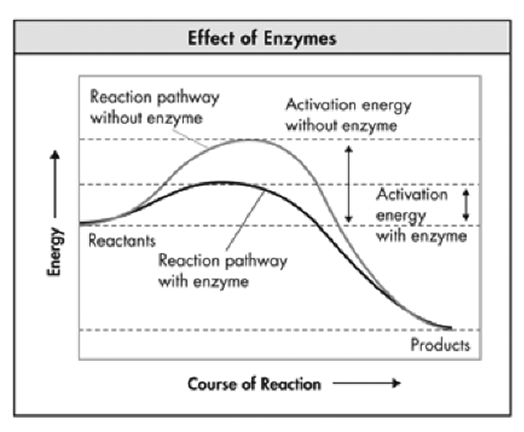
The graph shows how enzymes affect reactions in cells. Which statement best summarizes the information shown in the graph?
a)
Enzymes increase the energy of the reactants.
b)
Enzymes decrease the energy level of the products.
c)
Enzyme decrease the activation energy of the reaction.
d)
Enzymes reverse the direction of the reaction.
130.
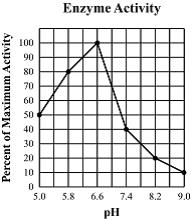
Which of the following conclusions can be drawn from this graph?
a)
The optimum pH of the enzyme is 6.6.
b)
The optimum pH of the enzyme is 5.8
c)
The enzyme’s activity increases as pH increases 5.0 to 9.0
d)
The enzyme’s activity is greater around pH of 8.0 .
131.
Any substance that is acted upon by an enzyme is called a(n)?
a)
Coenzyme
b)
Substrate
c)
Vitamin
d)
Polypeptide
132.
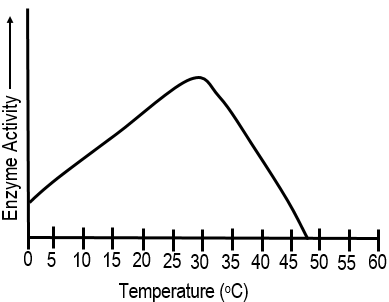
Based on the graph, what is the optimal temperature for this enzyme?
a)
15oC
b)
40oC
c)
30oC
d)
35oC
133.
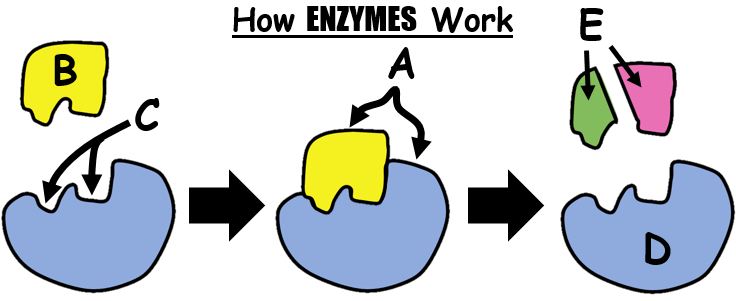
In the diagram, what is letter A?
a)
product
b)
substrate
c)
enzyme-substrate complex
d)
active site
134.
Enzymes are...
a)
nucleic acids
b)
proteins
c)
lipids
d)
carbohydrates
135.
What is the function of an enzyme?
a)
enzymes break themselves into small pieces
b)
enzymes slow down chemical reactions
c)
enzymes speed up chemical reactions
d)
enzymes combine products to form reactants
136.
What happens when enzymes are heated to a high temperature?
a)
The enzymes die.
b)
The shapes of the enzyme are altered denature
c)
The enzymes' amino acid sequence changes.
d)
The enzymes remain the same
137.
Which of these is most likely an enzyme?
a)
Sucrose
b)
Galactose
c)
Fructose
d)
Amylase
138.
Which is NOT true?
a)
Enzymes speed up chemical reactions.
b)
Enzymes react best at a specific temperature.
c)
Enzymes only control ONE type of reaction.
d)
Enzymes are made of fatty acids.
139.
What is another name for enzymes?
a)
chemical catalysts
b)
microorganisms
c)
biological catalysts
d)
inorganic catalysts
140.
Babies do not have well developed digestive systems for breaking down proteins; therefore baby food is prepared after treatment with which enzyme?
a)
protease
b)
lipase
c)
carbohydrase
d)
synthase
141.
The pH at which an enzyme is most efficient is called the _________ pH of an enzyme.
a)
neutral
b)
optimum
c)
minimum
d)
experimental
142.

The current model of enzyme action is referred to as the...
a)
Induced Fit Model
b)
Lock & Key Model
c)
Singer-Nicolson Model
d)
Davson-Danielli Model
143.
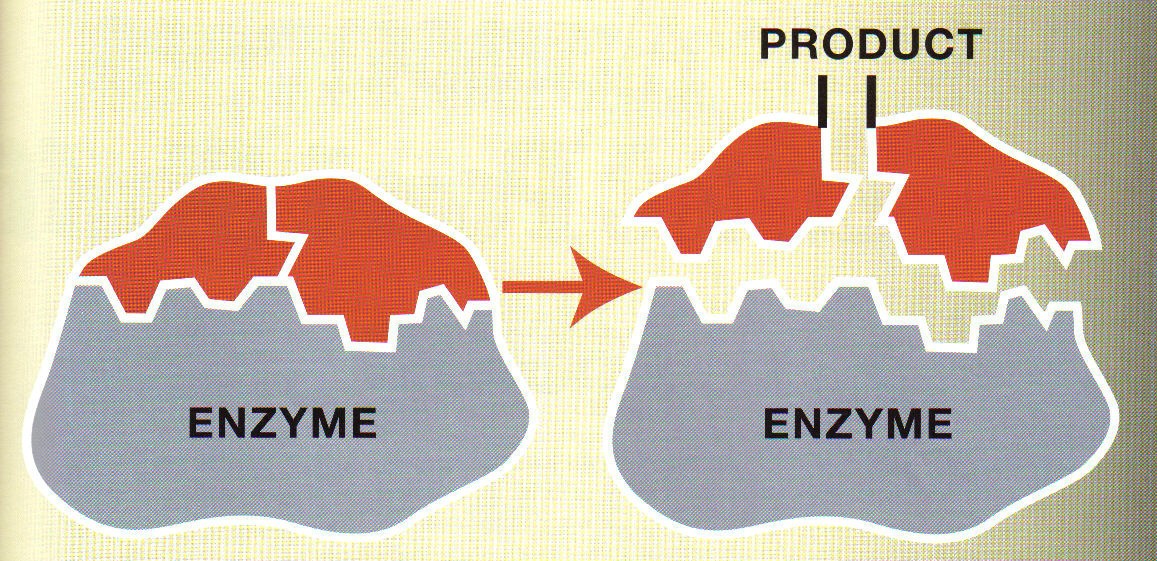
Enzymes speed up reaction rates by changing...
a)
Activation Energy
b)
pH
c)
Hydrogen Bonds
d)
Kinetic Energy
144.
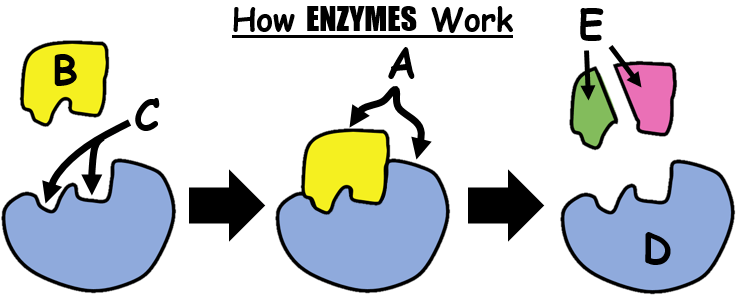
Letter D...
a)
active site
b)
enzyme
c)
substrate
d)
products
145.
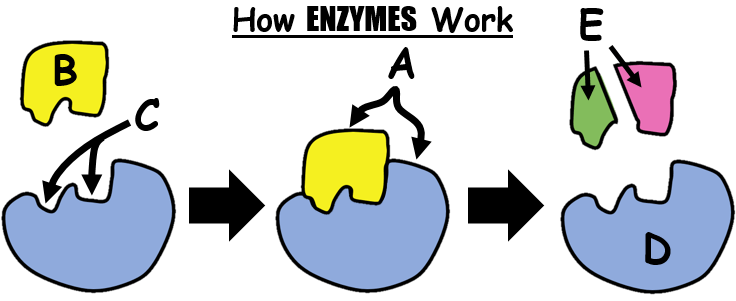
Letter B...
a)
active site
b)
enzyme
c)
substrate
d)
products
146.
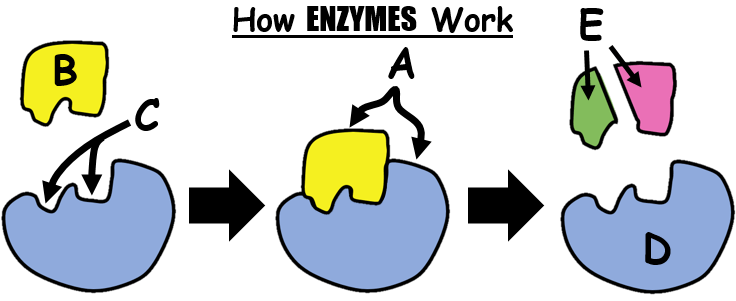
Letter C...
a)
active site
b)
enzymes
c)
substrate
d)
products
147.
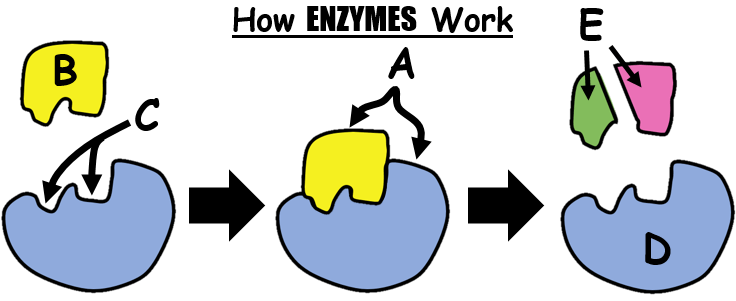
Letter E...
a)
active site
b)
enzyme
c)
substrate
d)
products
148.
Enzymes are considered to be
a)
Lipids
b)
Carbohydrate
c)
Protein
d)
Nucleic Acid
149.
What is the purpose of an enzyme?
a)
give permission for the reaction
b)
raise activation energy
c)
speed up reactions
d)
control how many reactions occur
150.
Where do substrates bind on an enzyme?
a)
voltage-gated channels
b)
surface receptor
c)
calcium channels
d)
active site
151.

What is structure A?
a)
Substrate
b)
Active site
c)
Enzyme
d)
Products
152.
What is the name for the mechanism of enzyme activity?
a)
Lock and key
b)
jigsaw puzzle
c)
hammer and nail
d)
two hands pattern
153.
At 40 degrees Celsius, your biological enzymes will...
a)
Functional optimally
b)
Denature
c)
Wait until the temp. increases
d)
Wait until the temp. decreases
154.
Which of the following conclusions can be drawn from this graph?
a)
The optimum pH of the enzyme is 6.6.
b)
The optimum pH of the enzyme is 5.8
c)
The enzyme’s activity increases as pH increases 5.0 to 9.0
d)
The enzyme’s activity is greater around pH of 8.0 .
155.
What makes an enzyme substrate specific?
a)
Size
b)
Shape
c)
Name
d)
Location it is found in
156.
Enzymes are considered to be
a)
Lipids
b)
Carbohydrate
c)
Protein
d)
Nucleic Acid
157.

What is structure A?
a)
Substrate
b)
Active site
c)
Enzyme
d)
Products
158.

What is structure D?
a)
Substrate
b)
Active site
c)
Enzyme
d)
Products
159.

What is structure E, F, G?
a)
Substrate
b)
Active site
c)
Enzyme
d)
Products
160.
Which of the following is not a function of proteins?
a)
Catalyze biochemical reactions a enzymes
b)
Serve as supportive structures such as keratin
c)
Provide energy for cells
d)
Communicating between cells such as insulin
161.
Which of the following is responsible for long term energy storage and the makeup of cell membranes?
a)
Lipids
b)
Carbohydrates
c)
Proteins
d)
Nucleic Acids
162.
What are carbohydrates used for?
a)
Long term energy storage
b)
Chemical bonds are used to create energy for the cell
c)
Communicate to other cells
d)
Give directions for protein synthesis
163.
What do nucleic acids do?
a)
Solely transmit information
b)
Solely store genetic information
c)
Give instructions for protein synthesis
d)
Insulate organisms
164.
Enzymes...
a)
lower activation energy of a biochemical reaction
b)
Speed up all reactions
c)
Slow down all reactions
165.
When enzymes are denatured, which crucial part of the enzyme loses its shape and thus, decreases functionality?
a)
Any part
b)
Substrate
c)
Body
d)
Active Site
166.
Enzymes can function in any temperature or any pH.
a)
True
b)
False; low temperature and pHs
c)
False; high temperature and pHs
d)
False; narrow ranges of temperature and pH
167.
The area on an enzyme where substrates bind is called...
a)
Binding Site
b)
Active Site
c)
Enzyme-Substrate Complex
d)
Products
168.
At the end of a biochemical reaction, an enzyme should...
a)
Be identical to its starting shape
b)
Be a very different shape
c)
Be a slightly different shape
d)
Be a product
169.

The orange piece in the image above is the...
a)
Substrate
b)
Enzyme-Substrate Complex
c)
Enzyme
d)
Products
170.
Amino Acids are:
a)
containers used for bioprocessing
b)
the building blocks of protein molecules
c)
the smallest units of living organisms
d)
proteins that accelerate chemical reaction rates
171.
Bioinformatics is:
a)
using computers and technology to better understand biological processes
b)
using biological fermentation to produce food and drinks which can be preserved safely
c)
artificially changing the genetic makeup of an organism
d)
using biological processes to develop mathematical algorithms
172.
An enzyme is:
a)
a protein that accelerates the rate of biochemical reactions such as converting sugars into simpler molecules
b)
the complete genetic material of an organism
c)
a collection of cells containing the same genetic material
d)
a small section of a chromosome with limited amounts of DNA in it
173.
Genetic Engineering is:
a)
using computers and technology to better understand biological processes
b)
selectively breeding specific animals for the best traits
c)
artificially changing the genetic makeup of an organism
d)
growing bacterial cultures in artificial environments
174.
A carbohydrate is an organic compound that is composed of carbon, hydrogen, and oxygen. The unique structure of carbohydrates makes them useful material for building cell walls in plants. Which of the following is a function of carbohydrates in animals?
a)
digesting food
b)
fighting disease
c)
short term energy
d)
transporting DNA
175.

Which of the following conclusions can be drawn from this graph?
a)
The optimum pH of the enzyme is 6.6.
b)
The optimum pH of the enzyme is 5.8
c)
The enzyme’s activity increases as pH increases 5.0 to 9.0
d)
The enzyme’s activity is greater around pH of 8.0 .
176.

A scientist analyzing an unknown substance has determined that it consists of carbon, hydrogen and oxygen. During experimentation, she determines that the substance is soluble in oil but not in water. Which of the following macromolecules is the unknown substance most likely to be?
a)
Carbohydrate
b)
Lipid
c)
Nucleic Acid
d)
Protein
177.
A group of scientists is performing an experiment focusing on how environmental factors impact enzyme activity in bacteria that is frequently found in hot springs. They are examining an enzyme that breaks down nutrients for the bacteria into usable monomers. At set intervals they measure the parts per million [ppm] of the monomers available within the bacteria. The results of their experiment are shown.
Which of the following conclusions is best supported by the data from the experiment?
Which of the following conclusions is best supported by the data from the experiment?
a)
These bacteria are found in hot springs with a temperature close to 70°C.
b)
These enzymes are responsible for breaking down nutrients in every species of bacteria.
Proteins contain nitrogen as well as carbon, hydrogen, and oxygen
Proteins contain nitrogen as well as carbon, hydrogen, and oxygen
c)
These bacteria will be able to acquire more nutrients in hot springs over 90°C.
d)
Protein monomers have a carboxyl group on one end and an amino acid on the other.
178.

Metabolism is generally referred to as the chemical processes that allow the body to function. How do enzymes allow metabolic chemical reactions to proceed more quickly?
a)
They lower the activation energy of biochemical reactions.
b)
They cause products of biochemical reaction to break down.
c)
They convert carbohydrates into proteins during biochemical reactions.
d)
They decrease the amount of reactants needed for biochemical reactions.
179.

Specialized proteins, called enzymes, are required for many biological reactions to take place. However, they can be affected by certain changes. These non-favored changes will cause the protein to denature. Which of the following will cause a protein to denature.
a)
Extreme light and heat
b)
Extreme water currents
c)
Extreme temperature and pH
d)
Extreme wind and water
180.
If a large amount of acid were added to a enzyme-catalyzed reaction, which of the following would be the most accurate reason the enzyme will stop working?
a)
Acids burn enzymes.
b)
The acid concentration will change the shape of the enzyme.
c)
The acid will change the temperature of the solution.
d)
none of the above
181.

Lipids arent soluble in water which can be beneficial for organisms. Phospholipids are used in what biological structure
a)
RNA
b)
DNA
c)
Cell membrane
d)
Cell wall
182.

Which macromolecule is shown?
a)
lipid
b)
protein
c)
nucleic acid
d)
carbohydrate
183.

If enzyme C is functioning at 25°C and a pH of 7, under which conditions would the rate of enzyme action probably increase? Use the chart below and your knowledge of enzymes to answer the question.
a)
The temperature is decreased to 22 C and the pH is kept the same
b)
The temperature is kept the same and the pH is decreased to 6
c)
The temperature is increased to 44 C and the pH is kept the same
d)
The temperature is increased to 30 C and the pH is increased to 8
184.

What kind of organic compound is this molecule?
a)
Carbohydrate
b)
amino acid
c)
lipid
d)
nucleic acid
185.

The process/reaction used to link compounds/monomers together. Releases water.
a)
Dehydration
b)
Hydrolysis
c)
Enzomatic
d)
Tetratonic
186.

Combines with 3 fatty acid chains to make up a triglyceride; part of the monomer of lipids
a)
Amino Acid
b)
Fatty Acid
c)
Glycerol
d)
Nucleotide
187.

The monomer, building block, of proteins
a)
Amino Acid
b)
Fatty Acid
c)
Nucleotide
d)
monosaccharide
188.

The monomer, building block, of carbohydrates; simple sugar
a)
Amino acid
b)
Fatty Acid
c)
Nucleotide
d)
Monosaccharide
189.
What type of bond connects carbons to each other and other elements? (The sharing of electrons)
a)
Ionic Bonding
b)
Covalent Bonding
c)
Monomer Bonding
d)
Nucleotide Bonding
190.

The process used to split polymers; this is done by adding water
a)
Dehydration
b)
Hydrolysis
c)
Enzomatic
d)
Tetratonic
191.

The above diagram represents
a)
A monosaccharide
b)
A monomer of a carbohydrate
c)
A sugar
d)
All of the above
192.
Which of the following is not a job of a protein
a)
Act as hormones and enzymes
b)
Do much of the work in cells and transport materials
c)
Build tissues and muscles
d)
store and transmit genetic information
193.

Which macromolecule is shown?
a)
lipid
b)
protein
c)
nucleic acid
d)
carbohydrate
194.

What do disaccharides, such as sucrose, and polysaccharides, such as starch, have in common?
a)
They are lipids made of fatty acids.
b)
They are proteins made of amino acids.
c)
They are nucleic acids made of nucleotides.
d)
They are carbohydrates made of simple sugars.
195.

Which macromolecule is this?
a)
carbohydrates
b)
lipids
c)
proteins
d)
nucleic acids
196.

Which macromolecule is this?
a)
carbohydrate
b)
lipid
c)
protein
d)
nucleic acid
197.

Which formula represents an amino acid?
a)
a.
b)
b.
c)
c.
d)
d.
198.

Which of the following conclusions can be drawn from this graph?
a)
The optimum pH of the enzyme is 6.6.
b)
The optimum pH of the enzyme is 5.8
c)
The enzyme’s activity increases as pH increases 5.0 to 9.0
d)
The enzyme’s activity is greater around pH of 8.0 .
199.
Which organelle is only found in a plant cell?
a)
nucleus
b)
chloroplast
c)
mitochondria
d)
cell membrane
200.

Directs all cell activities through the DNA located there.
a)
Lysosomes
b)
Nucleus
c)
ribosomes
d)
Mitochondria
201.
Which of the following is directly involved in the transportation of materials inside/within the cell?
a)
Endoplasmic Reticulum
b)
Vacuole
c)
Lysosome
d)
Mitochondria
202.
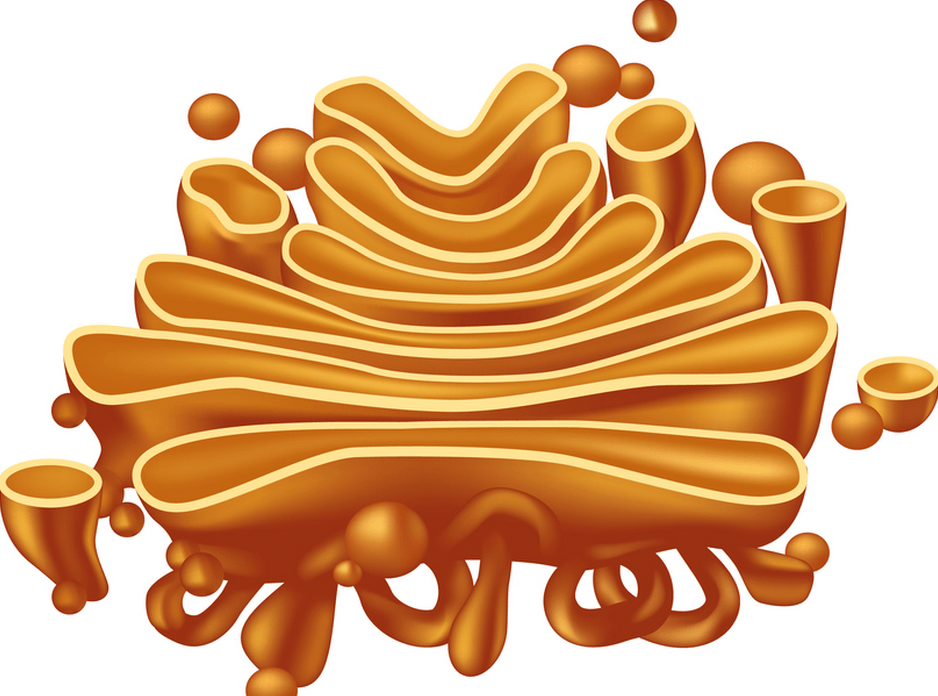
I am a protein packaging and shipping machine! Who am I?
a)
vacuole
b)
ribosome
c)
mitochondrion
d)
golgi apparatus
203.
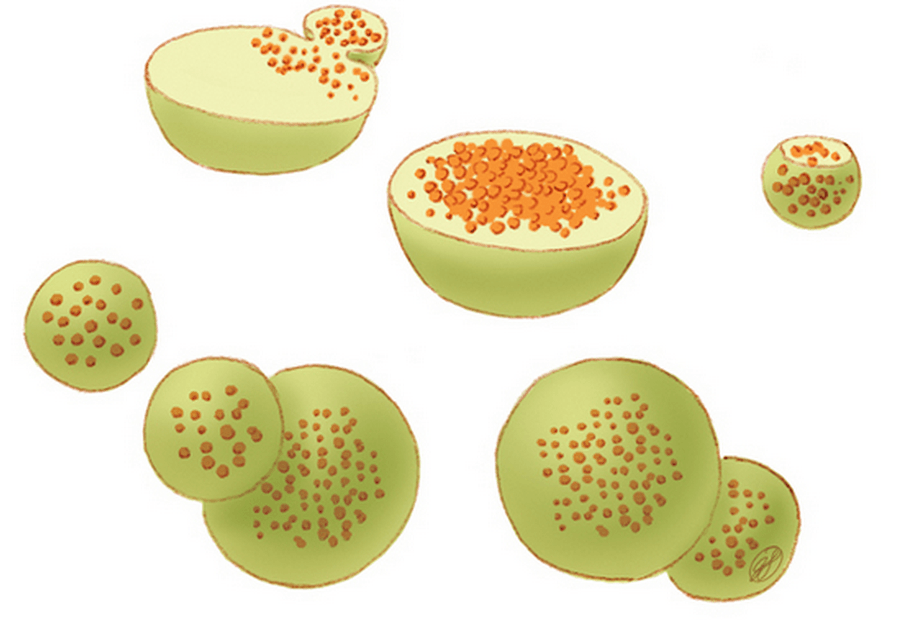
You might think of me as the trash collector, but recycler is maybe more accurate. What am I?
a)
mitochondria
b)
lysosome
c)
vacuole
d)
ribosome
204.
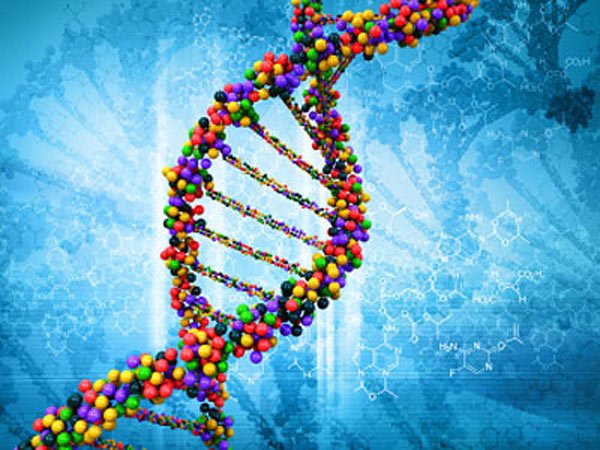
What is the name of the genetic material that is inside the nucleus?
a)
ER
b)
ATP
c)
YOLO
d)
DNA
205.

Which part of the cell is often called "the brain of the cell"?
a)
nuclear membrane
b)
endoplasmic reticulum
c)
nucleus
d)
mitochondria
206.
What is found in both plant and animal cells but is much larger in plant cells?
a)
Nucleus
b)
Mitochondria
c)
Chloroplast
d)
Vacuole
207.
Where are proteins made?
a)
Golgi body
b)
Mitoichondria
c)
Chromosomes
d)
Ribosomes
208.
This organelle takes food and turns it into ENERGY for plant and animal cells.
a)
Chloroplast
b)
Mitochondria
c)
Lysosome
d)
Ribosome
209.
The site of photosynthesis
a)
ribosome
b)
mitochondria
c)
chloroplast
d)
nucleus
210.

I am the outer most layer of an animal cell. What am I?
a)
cell wall
b)
nucleus
c)
cell membrane
d)
cell skin
211.
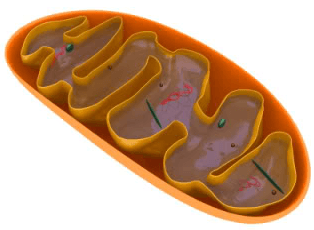
What are tiny organelles that convert glucose into ATP?
a)
Ribosomes
b)
Vesicles
c)
Cytoskeleton
d)
Mitochondria
212.
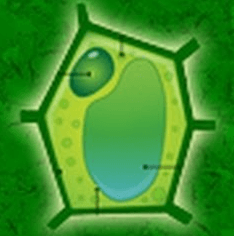
A rigid layer that lies outside the cell's membrane is...
a)
Cytoskeleton
b)
Cilia
c)
Cell Wall
d)
Flagella
213.
What organelle is called the "powerhouse" of a cell?
a)
Endoplasmic Reticulum
b)
Nucleus
c)
Mitochondria
d)
Nucleolus
214.
What organelle helps with cell digestion?
a)
Lysosomes
b)
Ribosomes
c)
Golgi Complex
d)
ER
215.
What is the gel-like substance inside of cells called?
a)
photoplasm
b)
photosynthesis
c)
cytoskeleton
d)
cytoplasm
216.
Main producer of ATP in all eukaryotes
a)
chloroplast
b)
mitochondria
c)
lysosome
d)
smooth er
217.

The ___________ is the basic unit of life
a)
organ
b)
cell
c)
atom
d)
tissue
218.
A group of tissues that work together to perform a similar function is called_____. (Examples include the heart, lungs or stomach)
a)
cells
b)
tissues
c)
organs
d)
organ system
219.
A group of cells that have similar functions? Examples are nervous, epithelial, muscle and connective
a)
cells
b)
tissues
c)
organs
d)
atoms
220.
Organs that work together to perform a related function is called _____________?
a)
cells
b)
tissues
c)
organ system
d)
organs
221.
When many organ systems work together it can form...
a)
organ
b)
cells
c)
organ system
d)
organism
222.

This is a example of........
a)
organ system
b)
cells
c)
organ
d)
tissue
223.

This is a example of ........
a)
cell
b)
organ system
c)
organ
d)
tissue
224.
The brain is a part of which organ system?
a)
nervous
b)
skeletal
c)
muscular
d)
digestive
225.
The lungs and the kidneys are examples of
a)
cells
b)
organs
c)
tissues
d)
organ systmes
226.
In what organelle is the genetic material found inside?
a)
Endoplasmic Reticulum
b)
Golgi Complex
c)
Nucleolus
d)
Nucleus
227.
What organelle is called the "powerhouse" of a cell?
a)
Endoplasmic Reticulum
b)
Nucleus
c)
Mitochondria
d)
Nucleolus
228.

Using this image, what organelle is C?
a)
Cell Wall
b)
Mitochondria
c)
Large Cell Vacuole
d)
Chloroplast
229.
What is the function of the mitochondria?
a)
Structure that manufactures ribosomes
b)
Structures that converts nutrients to energy
c)
Stack of membranes that packages chemicals
d)
Structure that contains DNA and directs the cell
230.
What is the function of the vacuole?
a)
Sac that stores water, nutrients, and waste products
b)
Sac filled with digestive chemicals
c)
Jelly-like substance within the plasma membrane
d)
stack of membranes that packages chemicals
231.
What is the function of nucleus?
a)
Structure that organizes motion of chromosomes.
b)
Structure that contains DNA and directs the cell
c)
Membrane that surrounds and protects the cell
d)
Stack of membranes that packages chemicals
232.
Where does photosynthesis occur?
a)
mitochondria
b)
stomata
c)
xylem
d)
chloroplast
233.

I store water in both plant and animal cells. What am I?
a)
cytoplasm
b)
ribosomes
c)
vacuole
d)
lysosomes
234.

I make proteins for the cell. What am I?
a)
ribosome
b)
mitochondria
c)
chloroplast
d)
lysosome
235.
What can only be found in plant cells?
a)
Cell membrane
b)
Vacuole
c)
Chloroplast
d)
Mitochondrion
236.
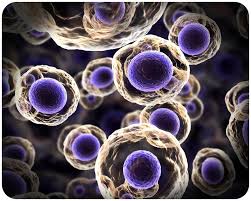
The two kinds of cells are Prokaryotes and Eukaryotes. How are they different?
a)
Prokaryotes have a nucleus.
b)
Eukaryotes have a nucleus.
c)
Prokaryotes are plant cells.
d)
There is no difference.
237.

What cell part is NOT found in all cells?
a)
Cell Wall
b)
Cell Membrane
c)
Cytoplasm
d)
Genetic Material
238.

Complex cell. Can be plant or animal. Contains membrane bound organelles.
a)
Eukaryotic Cell
b)
Prokaryotic Cell
c)
Bacteria
d)
Blood cell
239.
Which part of the cell is often called "the brain of the cell"?
a)
nuclear membrane
b)
endoplasmic reticulum
c)
nucleus
d)
mitochondria
240.
Where are proteins made?
a)
Golgi body
b)
Mitoichondria
c)
Chromosomes
d)
Ribosomes
241.
A rigid layer that lies outside the cell's membrane is...
a)
Cytoskeleton
b)
Cilia
c)
Cell Wall
d)
Flagella
242.
What organelle is called the "powerhouse" of a cell?
a)
Endoplasmic Reticulum
b)
Nucleus
c)
Mitochondria
d)
Nucleolus
243.
Main producer of ATP in all eukaryotes
a)
chloroplast
b)
mitochondria
c)
lysosome
d)
smooth er
244.
What is the function of the vacuole?
a)
Sac that stores water, nutrients, and waste products
b)
Sac filled with digestive chemicals
c)
Jelly-like substance within the plasma membrane
d)
stack of membranes that packages chemicals
245.

I store water in both plant and animal cells. What am I?
a)
cytoplasm
b)
ribosomes
c)
vacuole
d)
lysosomes
246.
What can only be found in plant cells?
a)
Cell membrane
b)
Vacuole
c)
Chloroplast
d)
Mitochondrion
247.
Only eukaryotic cells have....
a)
membrane-bound organelles
b)
DNA
c)
ribosomes
d)
cell membranes
248.

What does this organism use for movement?
a)
Pseudopod
b)
Cilia
c)
Flagella
d)
legs
249.

What does this organism use for movement?
a)
Pseudopod
b)
Cilia
c)
Flagella
d)
legs
250.
A nucleus is found in what type of cell?
a)
Prokaryotic
b)
Eukaryotic
c)
Both prokaryotic and eukaryotic
d)
Neither prokaryotic or eukaryotic
100 %

