wayground logo

Free Printable Worksheets

Font size

S
M
L
XL
Worksheets

Cellular Energy - Respiration and Photosynthesis

Total questions: 246

Worksheet time: 3hrs 27mins

Name
Class
Date
1.
What is the source of energy for photosynthesis?
a)
carbohydrates-chemical
b)
sunlight-radiant
c)
heat-thermal
d)
television-electrical
2.
What gas is released by plants during photosynthesis?
a)
sulfur
b)
carbon dioxide
c)
oxygen
d)
hydrogen
3.
What is the purpose of photosynthesis?
a)
make glucose
b)
make ATP
c)
make light
d)
release carbon dioxide
4.
What type of organism uses photosynthesis?
a)
plants
b)
bacteria
c)
animals
d)
both plants and bacteria
5.
What is the energy conversion during photosynthesis?
a)
chemical --> chemical
b)
thermal --> electrical
c)
chemical --> electrical 
d)
radiant --> chemical
6.
How can photosynthesis be related to cellular respiration?
a)
What's produced (made) by one is needed (the reactants) for the other
b)
They both produce the same products
c)
They both have the same reactants (need the same things)
d)
These 2 processes have nothing in common
7.
Which of the following is the correct equation for PHOTOSYNTHESIS?
a)
CO+ light + H2O --> O+ Sugar
b)
CO+ sugar + H2O --> O+ light
c)
O2 + light + H2O --> CO+ Sugar
d)
CO+ O2 + H2O --> Light+ Sugar
8.
What are the products of photosynthesis?
a)
water and carbon dioxide
b)
oxygen and glucose
c)
oxygen and carbon dioxide
d)
oxygen and water
9.
What is the pigment in chloroplasts that performs photosynthesis?
a)
Chlorosynthesis
b)
Chlorophyll
c)
ADP
d)
Electron Transport
10.
Most plants appear green because chlorophyll
a)
absorbs green light.
b)
absorbs violet light.
c)
does not absorb green light.
d)
does not absorb violet light.
11.
Plants need carbon dioxide from their environment to produce glucose during which stage of photosynthesis? 
a)
The light-dependent stage
b)
The light-independent stage (The Calvin Cycle)
c)
The electron transport chain
d)
ATP formation
12.
Does the Calvin Cycle require light?
a)
yes
b)
no
c)
depends on the amount of carbon dioxide
13.
__________ is a stack of thylakoids
a)
Granum
b)
Stomata
c)
Stroma
d)
Chloroplast
14.
The light reactions occur in the ________ and the dark reactions take place in the ________.
a)
Chloroplast / thylakoid membrane
b)
stroma / thylakoid
c)
mesophyl / stomata
d)
thylakoid membrane / stroma
15.
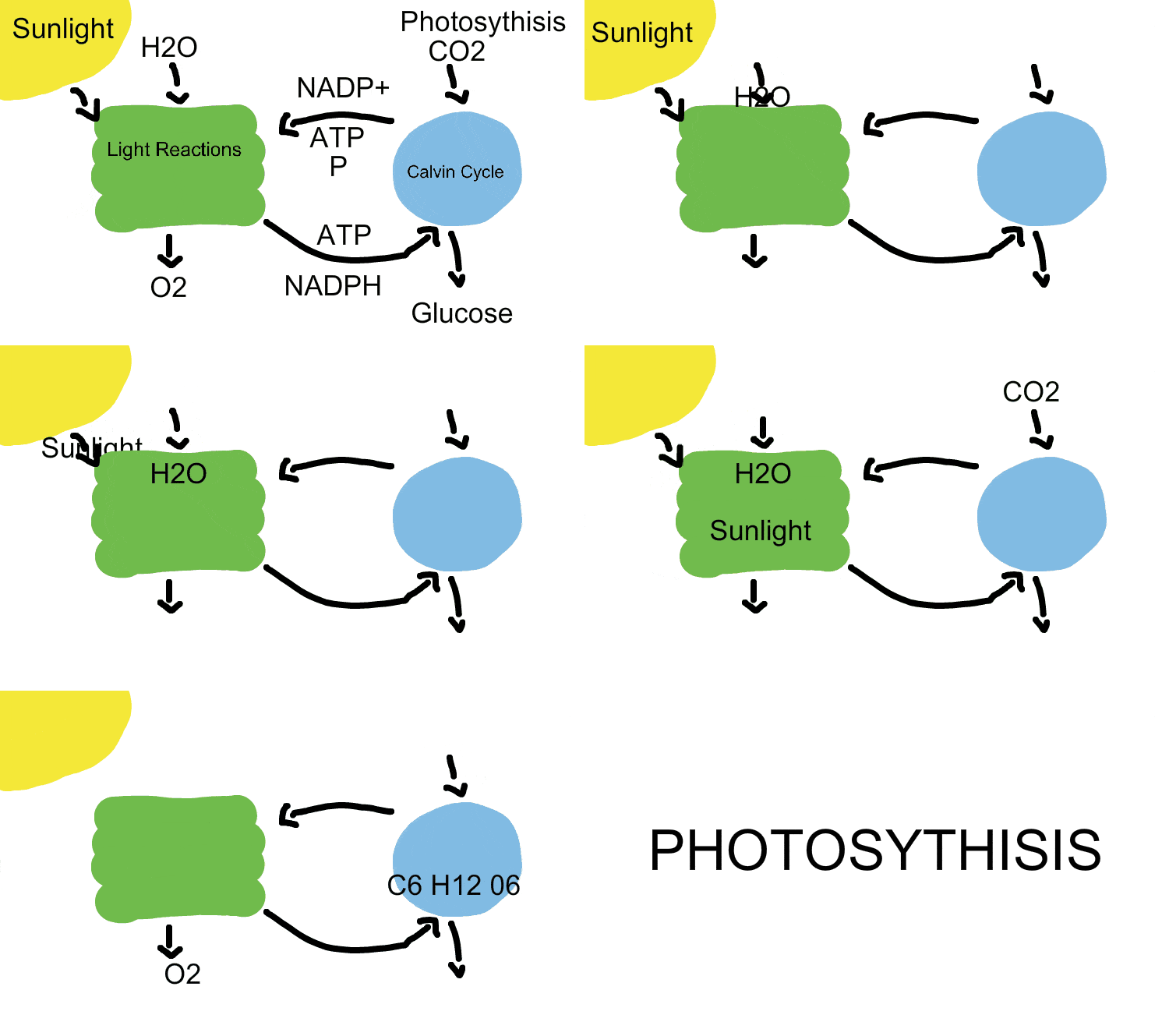
This image shows the process of _____.
a)
Respiration
b)
Photosystem I
c)
Dark Reactions
d)
Photosynthesis
16.
What is represented by "E" in this image?
a)
ATP
b)
NADPH
c)
Light Energy
d)
Glucose
17.
Where is glucose synthesized
a)
Photosystem II
b)
Photosystem I
c)
Calvin Cycle
d)
Glycolysis
18.
Since we're building a carbohydrate in the Calvin Cycle, is the process endergonic or exergonic and why?
a)
Endergonic because carbohydrate production is catabolic
b)
Exergonic because carbohydrate production is anabolic
c)
Endergonic because carbohydrate production is anabolic.
d)
Exergonic because carbohydrate production is catabolic
19.
Which of the following best describes photosynthesis?
a)
Photosynthesis converts radiant energy into chemical energy.
b)
Photosynthesis produces carbohydrates.
c)
Plants need sunlight, carbon dioxide, water, nutrients, and chlorophyll to complete photosynthesis.
d)
Plants use chlorophyll, water, and carbon dioxide to make sugar.
20.
Which of the following is the correct equation for PHOTOSYNTHESIS?
a)
6CO2 + 6H2O --> 6O+ C6H12O6
b)
6CO+ C6H12O6 + 6H2O --> O
c)
6O2 + 6H2O --> 6CO+ C6H12O6
d)
C6H12O6 + 6O2 ---> 6H2O + 6CO2 
21.
6CO2 + 6H20 + light energy    -> C6H12O6 + 6O2
In this chemcial equation, the highlight red is called the ______. 
a)
product
b)
reactant
c)
yields
d)
production
22.
The main source of energy for all life comes from ____.
a)
the Earth
b)
the moon
c)
the sun
d)
the food we eat/make
23.
Which of the following is the correct equation for PHOTOSYNTHESIS?
a)
CO+ light + H2O --> O+ glucose
b)
CO+ glucose + H2O --> O+ light
c)
O2 + light + H2O --> CO+ glucose
d)
CO+ O2 + H2O --> Light+ glucose
24.
Chlorophyll absorbs _____ and _______ light from the light.
a)
purple and green
b)
red and blue
c)
black and orange
d)
yellow and green
25.
A student is collecting the gas given off from a plant in bright sunlight at a temperature of 27°C. The gas being collected is probably ________.
a)
oxygen
b)
carbon dioxide
c)
ATP
d)
glucose
26.
If carbon dioxide is completely removed from a plant’s environment, what would you expect to happen to the plant’s production of high-energy sugars (rate of photosynthesis)?
a)
Sugar production will likely increase.
b)
Sugars will not be produced.
c)
The rate of sugar production will decrease .
d)
Fewer sugars will be produced at first, but then the plant will recover.
27.
The raw materials or reactants of photosynthesis are
a)
sugar and water.
b)
sugar and oxygen.
c)
carbon dioxide and water.
d)
carbon dioxide and oxygen.
28.
During photosynthesis in plants, what is the source of carbon in the sugar molecule? (C6H12O6) 
a)
Carbon dioxide in the air
b)
Carbon monoxide in the air
c)
Carbon particles in the soil
d)
Carbon particles in the air
29.
Which of the following processes allows the cells of an organism to use carbon from the environment?
a)
Mitosis
b)
Fertelization
c)
Transpiration
d)
Photosynthesis 
30.
Which factor does not affect photosynthesis?
a)
Water
b)
Sun
c)
Oxygen
d)
Temperature
31.
Which gas is forming in the test tube shown here?
a)
Carbon Dioxide
b)
Hydrogen
c)
Oxygen
d)
Nitrogen
32.
Which is the most likely function of a group of cells that contains a high number of chloroplasts?
a)
Respiration
b)
Fermintation
c)
Transpiration
d)
Photosynthesis
33.
What does the following equation represent?
a)
Kreb's Cycle
b)
Cellular Respiration
c)
Glycolosis
d)
Photosynthesis
34.
Where does the carbon come from that is used to form glucose?
a)
The soil
b)
CO2 in the air
c)
From other carbohydrates
d)
Calvin Cycle
35.
Where is glucose synthesized
a)
Photosystem II
b)
Photosystem I
c)
Calvin Cycle
d)
Glycolysis
36.
Which molecule is regenerated in the Calvin Cycle?
a)
NADPH
b)
ATP
c)
RuBP
d)
G3P
37.
What does photo mean? 
a)
light
b)
make
c)
self
38.
What does synthesis mean? 
a)
light
b)
make
c)
self
39.
What is the name of the 1st stage of photosynthesis
a)
light reactions
b)
Calvin cycle
c)
dark reactions
40.
where does the 1st stage of photosynthesis occur in the cell? 
a)
thylakoid of chloroplast
b)
stroma of chloroplast
c)
mitochondria
41.
which part of the plant absorbs the energy from the sun
a)
water
b)
roots
c)
chlorophyll
42.
the chlorophyll transfers energy to what
a)
water
b)
electrons
c)
ATP
43.
as electrons are passed down the electron transport chain, small amounts of energy are released, what is the energy used to do? 
a)
form ATP
b)
form water
c)
form NADPH
44.
When the electrons were passed away, there is nothing for the chlorophyll to pass the energy to until the electrons get replaced.  The electrons get replaced when what gets split apart?
a)
NADPH
b)
chlorophyll
c)
water
45.
during photolysis, what busts the water apart?
a)
ATP
b)
NADPH
c)
enzyme
46.
In addition to electrons, what 2 things are released when water is busted apart?
a)
oxygen & carbon dioxide
b)
carbon dioxide & H+
c)
oxygen & H+
47.
when water gets busted apart to replace the electrons is called 
a)
photolysis
b)
electron transport chain
c)
Calvin cycle
48.
where does the oxygen that is released from the breakdown of water  go?
a)
electron transport chain
b)
concentration gradient
c)
atmosphere
49.
where does the H+ that is released from the breakdown of water go?
a)
atmosphere
b)
chlorophyll
c)
concentration gradient
50.
stage 2 of photosynthesis is called?
a)
Calvin cycle
b)
light reactions
c)
electron transport chain
51.
where in the cell does stage 2 of photosynthesis occur?
a)
thylakoid of chloroplast
b)
stroma of chloroplast
c)
mitochondria
52.
The 6 carbon molecule that is formed during stage 2 of photosynthesis is unstable and is split into 2 what?
a)
PGA
b)
PGAL
c)
RuB
RuBP
53.
Many glucose are combined to make ____ or ____, depending if the plant needs to make cell wall material or store energy for later. 
a)
cellulose, glycogen
b)
starch, glycogen
c)
starch, cellulose
54.
Which of the following is the correct equation for PHOTOSYNTHESIS?
a)
CO+ light + H2O --> O+ glucose
b)
CO+ glucose + H2O --> O+ light
c)
O2 + light + H2O --> CO+ glucose
d)
CO+ O2 + H2O --> light+ glucose
55.
What do photosynthetic organisms all have in common?
a)
They are all green.
b)
The are all small.
c)
They can all perform photosynthesis.
d)
They can all give off carbon dioxide.
56.
When we left a leaf in water and bubbles formed on it, what part of the photosynthesis equation was that evidence for? Select a color.
6CO2 + 6H2O --> C6H12O6 + O2
a)
WHITE
b)
RED
c)
BLUE
d)
GREEN
57.
I blew bubbles to add CO2 to two test tubes. After 24 hours, the one with the plant had less CO2. Which part of the equation does that provide evidence for? Select a color.
6CO2 + 6H2O --> C6H12O6 + O2
a)
WHITE
b)
RED
c)
BLUE
d)
GREEN
58.
Chlorophyll absorbs a higher percentage of _____ and _______ light.
a)
green and purple
b)
red and blue
c)
black and orange
d)
yellow and green
59.
A student is collecting the gas given off from a plant in bright sunlight at a temperature of 27°C. The gas being collected is probably ________.
a)
oxygen
b)
carbon dioxide
c)
ATP
d)
glucose
60.
If carbon dioxide is completely removed from a plant’s environment, what would you expect to happen to the plant’s production of high-energy sugars (rate of photosynthesis)?
a)
Sugar production will likely increase.
b)
Sugars will not be produced.
c)
The rate of sugar production will decrease .
d)
Fewer sugars will be produced at first, but then the plant will recover.
61.
Which statement about photosynthesis is correct?
a)
Plants get the energy they need for photosynthesis from water.
b)
Plants get the energy they need for photosynthesis from soil.
c)
Plants get the energy they need for photosynthesis from sunlight.
d)
Plants do not require energy to perform photosynthesis.
62.
What are the products of photosynthesis?
a)
Carbon dioxide and water
b)
Carbon dioxide and oxygen
c)
Glucose and oxygen
d)
Glucose and water
63.
The rate of photosynthesis is affected by all of the following except
a)
the amount of salt.
b)
the availability of water.
c)
light intensity.
d)
temperature (enzymes).
64.
Which conclusion best matches the trends shown on the graph?
a)
Bean plants produce more ATP than corn plants.
b)
Corn plants require more oxygen than bean plants.
c)
Corn plants release more carbon dioxide than bean plants.
d)
Corn plants produce sugars at a faster rate than bean plants.
65.
Which of the following carry out photosynthesis?
a)
bees
b)
red algae
c)
humans
d)
mushrooms
66.
Autotroph or heterotroph?
a)
Autotroph
b)
Heterotroph
67.
Autotroph or Heterotroph?
a)
Autotroph
b)
Heterotroph
68.
Autotroph or heterotroph?
a)
Autotroph
b)
Heterotroph
69.
Autotroph or heterotroph?
a)
Autotroph
b)
Heterotroph
70.
Which of the following is an example of a HETEROTROPH?
a)
Grasses
b)
Algae
c)
Lemon Tree
d)
Bush Mouse
71.
Which gas is removed from the atmosphere during photosynthesis?
a)
hydrogen
b)
oxygen
c)
nitrogen
d)
carbon dioxide
72.
What are the products of photosynthesis?
a)
water and carbon dioxide
b)
oxygen and glucose
c)
oxygen and carbon dioxide
d)
oxygen and water
73.
Plants need ________ for photosynthesis
a)
oxygen
b)
soil
c)
carbon dioxide
d)
sugar
74.
What are the bubbles rising in the test tube?
a)
nitrogen gas
b)
carbon dioxide gas
c)
glucose
d)
oxygen gas
75.
Which organisms perform Photosynthesis?
a)
Only Autotrophs
b)
Only Heterotrophs
c)
Autotrophs and Heterotrophs
76.
Chloroplasts are...
a)
Structures of animal cells to produce ATP
b)
Organelles where lipids are elaborated
c)
Specialized structures of plants where food is made
d)
Waste organelle of plants
77.
Leaves look green because.....
a)
they eat their vegetables
b)
to blend into their environment
c)
they contain a molecule named chlorophyll
d)
they are sick
78.
What is produced as a result of photosynthesis?
a)
Glucose and Chlorophyll
b)
Glucose and Oxygen
c)
Water and Light energy
d)
Carbon dioxide and Water
79.
If all four plants were watered daily but placed in a closet, receiving no sunlight, what process would NOT occur?
a)
Ingestion of carbon dioxide
b)
Filtration of water through the soil
c)
Photosynthesis
d)
Water absorbtion
80.
Look at the image
What substances and organelle work together to absorb sunlight to perform photosynthesis in this example?
a)
cell wall and chloroplast
b)
mitochondria and water
c)
vacuole and carbon dioxide
d)
chloroplast and chlorophyll
81.
According to this absorption spectrum, what color is not used by the chlorophyll pigments?
a)
green
b)
blue
c)
yellow
d)
red
82.
What supplies the electron that is lost in Photosystem II?
a)
oxygen
b)
water
c)
glucose
d)
rubisco
83.
What are the reactants (what's needed) for photosynthesis?
a)
glucose and oxygen
b)
light, water, and carbon dioxide
84.
What gas is released by plants during photosynthesis?
a)
sulfur
b)
carbon dioxide
c)
oxygen
d)
hydrogen
85.
What is the purpose of photosynthesis?
a)
make glucose
b)
make ATP
c)
make light
d)
release carbon dioxide
86.
What is the gas we breath out that plants use for photosynthesis?
a)
sulfur
b)
carbon dioxide
c)
oxygen
d)
hydrogen
87.
Which of the following is the correct equation for PHOTOSYNTHESIS?
a)
6CO2 + 6H2O --> 6O+ C6H12O6
b)
6CO+ C6H12O6 + 6H2O --> O
c)
6O2 + 6H2O --> 6CO+ C6H12O6
d)
C6H12O6 + 6O2 ---> 6H2O + 6CO2 
88.
6CO2 + 6H20 + light energy    -> C6H12O6 + 6O2
In this chemcial equation, the highlight red is called the ______. 
a)
product
b)
reactant
c)
yields
d)
production
89.
What is this molecule..? 
a)
ADP
b)
ATP
c)
AMP
d)
Carbohydrate 
90.
Letter C represents? 
a)
Adenine 
b)
Glucose 
c)
Sugar Ribose 
d)
Phosphates 
91.
Letter B represents? 
a)
sugar Ribose 
b)
phosphates 
c)
sugar dextrose 
d)
adenine 
92.
Organisms that make energy from the sun are called..
a)
hetertrophs 
b)
autotrophs 
c)
carbohydrates 
d)
consumer 
93.
Organisms that obtain energy from other organisms..
a)
autotroph
b)
ATP
c)
photosynthesis
d)
heterotroph
94.
What are the major differences between ATP and ADP?
a)
ADP is high energy and has 3 phosphate groups, while ATP is low energy and has 2 phosphate groups
b)
ATP is high energy and has 2 phosphate groups, while ADP is low energy and has 3 phosphate groups
c)
ATP is high energy and has 3 phosphate groups, while ADP is low energy and has 2 phosphate groups
95.
The figure labeled A is..? 
a)
Thylakoid 
b)
Stroma 
c)
Chloroplast 
d)
Grana 
96.
The figure labeled B is...? 
a)
Stroma 
b)
Thylakoid 
c)
Chloroplast 
d)
Grana 
97.
The figure labeled C is..? 
a)
Grana 
b)
Thylakoid 
c)
Stroma 
d)
Chloroplast 
98.
How are ADP and ATP related to each other?
a)
ADP is a high energy molecule and when it loses a phosphate it released energy becoming low energy ATP.
b)
ATP loses energy when it gains a phosphate group, becoming low energy ADP.
c)
ATP is a high energy molecule and when it loses a phosphate it released energy becoming low energy ADP.
99.
What is the main light absorbing pigment in chloroplasts? 
a)
dark reactions 
b)
chlorophyll 
c)
lipids 
d)
mitochondria 
100.
__________ and _____________ are high energy molecules that are made during the light dependent reactions and are used in the dark reaction.
a)
NAD and ADP
b)
ATP and NADPH
c)
ATP and ADP
101.
All organisms get the ENERGY they need to regenerate ATP from
a)
breaking phosphates 
b)
adenosine 
c)
organelles 
d)
proteins 
102.
Energy is required for which of the following cellular functions?
a)
exocytosis
b)
movement 
c)
growth 
d)
all of these require energy 
103.
Why is photosynthesis important?
a)
creates oxygen for animals to breath
b)
becomes a food source for animals and humans
c)
creates food for plants to use
d)
all of these are correct
104.
Where does carbon dioxide enter plants?
a)
The leaves (in the holes called Stomata)
b)
Flowers
c)
Roots
d)
Stem
105.

Where does photosynthesis happen?

a)

cells in the leaf act like nature's solar panels to collect light

b)

chloroplasts are structures (aka organelles) inside the leaf cells where photosynthesis occurs

c)

cholorphyll pigment inside the chloroplast absorbs light

d)

all of these answers are correct descriptions of where photosynthesis occurs

106.
How can photosynthesis be related to cellular respiration?
a)
What's produced (made) by one is needed (the reactants) for the other
b)
They both produce the same products
c)
They both have the same reactants (need the same things)
d)
These 2 processes have nothing in common
107.
What is another name for glucose?
a)
Chlorophyll
b)
Chloroplasts
c)
Stomata
d)
Sugar
108.
Why do plants go through photosynthesis?
a)
To make food for us
b)
To make food for themselves
c)
They're bored and have nothing else to do
109.
Which organelle does cellular respiration take place? 
a)
Mitochondria
b)
Choloroplasts
c)
Vacuole
d)
Nucleus 
110.
Which of the following are products of respiration? 
a)
Glucose and water
b)
Water and Oxygen 
c)
Water, Carbon Dioxide, and Energy 
d)
Oxygen and Energy 
111.
What is the name of the simple sugar that is produced in photosynthesis?
a)
Sucrose
b)
Dextrose
c)
Glucose
d)
Lactose
112.
What does the arrow in a chemical equation mean?
a)
equals
b)
produces
c)
yields
d)
means
113.
Which of the following is the correct equation for PHOTOSYNTHESIS?
a)
CO+ light + H2O --> O+ glucose
b)
CO+ glucose + H2O --> O+ light
c)
O2 + light + H2O --> CO+ glucose
d)
CO+ O2 + H2O --> Light+ glucose
114.
Which plant structure is extremely necessary for photosynthesis to take place?
a)
leaves
b)
flower petals
c)
anthers
d)
pistils
115.
What kind of plants go through photosynthesis?
a)
All plants
b)
Plants with purple leaves
c)
Plants with green leaves
d)
Plants with red leaves
116.

What would happen to us if plants stopped producing oxygen?

a)

We would die since we can't breathe carbon dioxide

b)

We would keep living since we can't breathe carbon dioxide

c)

Nothing

117.
Chlorophyll absorbs a higher percentage of _____ and _______ light.
a)
purple and green
b)
red and blue
c)
black and orange
d)
yellow and green
118.
If H is combined with CO2 glucose can be made.
a)
TRUE
b)
FALSE
119.
Light energy is used to 
a)
split water into H and O
b)
weld C, H and O together
c)
make water
120.
Which of the following is considered a waste product of photosynthesis?
a)
glucose
b)
oxygen
c)
carbon dioxide
d)
sunlight
121.
Which of the following is considered a waste product of photosynthesis?
a)
glucose
b)
oxygen
c)
carbon dioxide
d)
sunlight
122.
Which product is produced during the light-dependent reactions?
a)
water
b)
oxygen
c)
glucose
d)
carbon dioxide
123.
From which molecule does a plant get most of its mass?
a)
carbon dioxide
b)
water
c)
sunlight
d)
soil
124.
Which product is produced during the light-dependent reactions?
a)
water
b)
oxygen
c)
glucose
d)
carbon dioxide
125.
Is ADP or ATP more like a fully charged battery, and why?
a)
ADP, because it has three phosphate groups; breaking and reforming the bonds among them releases energy.
b)
ATP, because it has three phosphate groups; breaking and reforming the bonds among them releases energy.
c)
ADP, because it has two phosphate groups; breaking and reforming the bonds among them releases energy.
d)
ATP, because it has two phosphate groups; breaking and reforming the bonds among them releases energy.
126.
Which of the following best describes photosynthesis?
a)
Photosynthesis converts radiant energy into chemical energy.
b)
Photosynthesis produces carbohydrates.
c)
Plants need sunlight, carbon dioxide, water, nutrients, and chlorophyll to complete photosynthesis.
d)
Plants use chlorophyll, water, and carbon dioxide to make sugar.
127.
Use the diagram to answer the question. Between which parts of the molecule must the bonds be broken to form an ADP molecule?
a)
A and B
b)
A and C
c)
B and C
d)
C and D
128.
Plants need carbon dioxide from their environment to produce glucose during which stage of photosynthesis? 
a)
The light-dependent stage
b)
The light-independent stage (The Calvin Cycle)
c)
The electron transport chain
d)
ATP formation
129.
Where does the Calvin Cycle occur?
a)
thylakoid
b)
stroma
c)
lumen
d)
mitochondria
130.
Where do the light-dependent reactions occur? 
a)
thylakoid membrane
b)
stroma
c)
mesophyll
d)
mitochondria
131.
True or False.   The calvin cycle can happen at night.
a)
true
b)
false
132.
TRUE or FALSE.  The calvin cycle can happen during the day.
a)
True
b)
false
133.
Which term is the part of photosynthesis when light energy is captured and transferred to a molecule, such as ATP?
a)
light- independent reactions
b)
cellular respiration
c)
light- dependent reactions
d)
 photosynthesis
134.
What supplies the electron that is lost in PS II?
a)
oxygen
b)
water
c)
glucose
d)
rubisco
135.
This molecule helps add a phosphate do a depleted energy molecule.
a)
PS 2
b)
PS 1
c)
Electron Transport Chain
d)
ATP Synthase
136.
After the electron leave PS II, where does it go next?
a)
Electron Transport Chain
b)
NADPH Reductase
c)
PS I
d)
Stroma
137.

You and your best friend went into Botanical Garden over the weekend. You discovered some of the plants were starting to wilt and turning into gray. Which of the following is the best assumptions of this issue.

a)

The gardener did not give enough oxygen to plants.

b)

The gardener did not give enough water to plants.

c)

The gardener let the plants get too much oxygen.

d)

The gardener gave too much of carbon dioxide.

138.
Which of the following is NOT a product of the light-dependent reactions?
a)
ATP
b)
NADPH
c)
Oxygen
d)
Glucose
139.

How does the Calvin cycle differ from the light-dependent reactions?

a)

It takes place in the stroma.

b)

It takes place in the thylakoid.

c)

It requires light.

d)

It takes place in chloroplasts.

140.

If carbon dioxide is removed from a plant’s environment, what would you expect to happen to the plant’s production of high-energy sugars?

a)

The same number of sugars will be produced but without carbon dioxide.

b)

More sugars will be produced.

c)

Fewer sugars will be produced.

d)

Carbon dioxide does not affect the production of high-energy sugars in plants.

141.
Which conclusion best matches the trends shown on the graph?
a)
Bean plants produce more ATP than corn plants.
b)
Corn plants require more oxygen than bean plants.
c)
Corn plants release more carbon dioxide than bean plants.
d)
Corn plants produce sugars at a faster rate than bean plants.
142.

Based on the graph, what pigment is NOT absorbed by Chlorophyll A or B?

a)

blue

b)

red

c)

violet

d)

green

143.
What is the main chemical compound that stores and releases energy?
a)
ATP
b)
Cytoplasm
c)
PTP
d)
Oxygen
144.
What is the main chemical compound that stores and releases energy?
a)
ATP
b)
Cytoplasm
c)
PTP
d)
Oxygen
145.
What are the two products of the light reactions that are needed for the calvin cycle?
a)
NAD and NADPH
b)
NADP + and Glucose
c)
NADPH and ATP
d)
Oxygen and NADPH
146.
What do plants need for the photosynthesis process?
a)
a camera and tripod
b)
light, carbon dioxide, and water
c)
roots, flowers, and bees
d)
soil, air, and oxygen
147.
What is the main purpose of the light reactions?
a)
To provide the energy and electrons for the calvin cycle
b)
To capture energy and make sugar
c)
To reflect green light
d)
To make sugars
148.
The stacks of disks in the chloroplast are called:
a)
Lamellae
b)
Grana
c)
Stroma
d)
Thylakoid
149.
The interior space of the chloroplast is called:
a)
Lamellae
b)
Grana
c)
Stroma
d)
Thylakoids
150.
What is the main purpose of the light dependent reactions?
a)
To provide the energy for the calvin cycle
b)
To capture energy and make sugar
c)
To reflect green light
d)
To make sugars
151.
Which of the following is an example of an AUTOTROPH?
a)
Appletree
b)
Dog
c)
Mushroom
d)
Human
152.
Which of the following is an example of a HETEROTROPH?
a)
Grass
b)
Algae
c)
Lemon Tree
d)
Bear
153.
If all four plants were watered daily but placed in a closet, receiving no sunlight, what process would NOT occur?
a)
Ingestion of carbon dioxide
b)
Filtration of water through the soil
c)
Photosynthesis
d)
Water absorbtion
154.
What is another term to describe a consumer?
a)
Autotroph
b)
Heterotroph
155.
What is another term to describe a producer?
a)
Autotroph
b)
Heterotroph
156.
How can animals and fungi best be classified?
a)
Autotroph
b)
Heterotroph
157.
From where do autotrophs obtain their energy?
a)
The sun
b)
Other organisms
158.
What is the function of NADPH and ATP?
a)
They absorb light
b)
They power the light-dependent reactions
c)
They are light-reflecting pigments
d)
They are short term energy carriers
159.
Which substance from the light-dependent reactions of photosynthesis is a source of energy for the light-independent reactions?
a)
ADP
b)
H2O
c)
NADPH
d)
pyruvic acid
160.
Use the diagram to answer the question. Between which parts of the molecule must the bonds be broken to form an ADP molecule?
a)
A and B
b)
A and C
c)
B and C
d)
C and D
161.
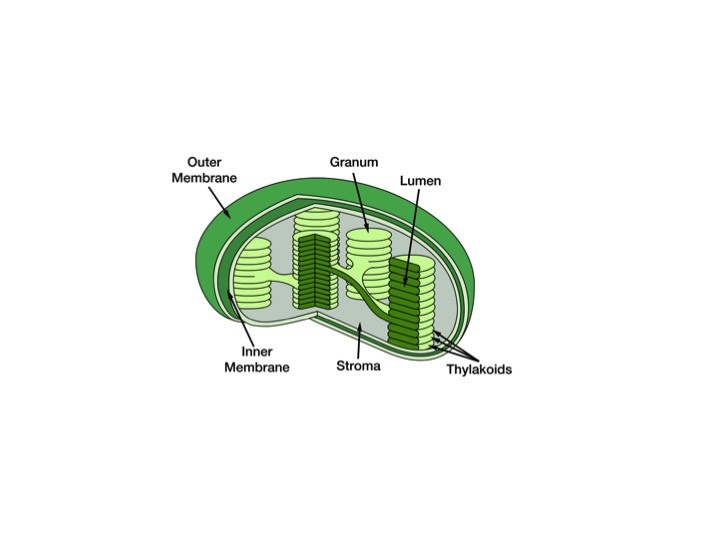
What is 3 pointing to?
a)
Thylakoid space
b)
Thylakoid
c)
Stroma
d)
Stomata
162.
What is 4 pointing to?
a)
Stroma
b)
Thylakoid
c)
Granum
d)
Stomata
163.
The correct formula for glucose is:
a)
CH12O6
b)
C12H6O12
c)
C6H12O6
d)
C6H6O12
164.

Some water containing red dye was poured into the soil of a potted plant. After a few hours, some parts of the flowers and leaves turned red.


Which of the following statements are correct for the potted plant?


A: Water is taken in by the roots.

B: Water is transported to the leaves.

C: Water is transported to the flowers.

D: Water is carried through the stem.

a)

A and D only

b)

B and C only

c)

A, B and C only

d)

A, B, C and D

165.

The diagram below shows three glass tanks, P, Q and R, each containing different organisms and with the same amount of carbon dioxide in each.


The three glass tanks were sealed and kept in a well-lit room for six hours.


In which of the tanks would there be an increase in carbon dioxide after six hours?

a)

Q only

b)

R only

c)

P and Q only

d)

P and R only

166.

Rita set up an experiment in a dark room as shown.


She placed a table lamp at a distance of 20 cm from the glass jar. After one hour, she observed that the syringe had collected 5 cm3 of gas. She repeated the experiment by placing the lamp at different distances from the glass jar.


Which one of the following shows the most likely result of this experiment?

a)

10 cm from lamp - less than 5cm3 of gas collected

b)

10 cm from lamp - 5cm3 of gas collected

c)

30 cm from lamp - less than 5cm3 of gas collected

d)

30 cm from lamp - more than 5cm3 of gas collected

167.

When do photosynthesis and respiration normally occur in green plants?

a)

Photosynthesis - day

Respiration - night

b)

Photosynthesis - day and night

Respiration - night

c)

Photosynthesis - day

Respiration - day and night

d)

Photosynthesis - day and night

Respiration - day and night

168.

Dinah wanted to find out whether water plants affect the amount of carbon dioxide in water at different times of the day. She used the set-up as shown.


She placed the set-up near the window and added a few drops of liquid X to the water. Liquid X changes colour as shown in the table.


What colour would the water with liquid X be at midday and midnight?

a)

At midday - red

At midnight - yellow

b)

At midday - purple

At midnight - yellow

c)

At midday - yellow

At midnight - purple

d)

At midday - purple

At midnight - red

169.

Lilian set up an experi,ent to find out whether carbon dioxide is needed for photosynthesis. She used a plant which had leaves with green areas in the middle and white areas around the edges as shown.


The set-up was placed in sunlight.


Which of the following two areas should Lilian compare to show that carbon dioxide is needed for photosynthesis?

a)

P and Q

b)

S and Q

c)

P and R

d)

S and R

170.

Study the set-up as shown below.


After some time, the rate of photosynthesis of the plant slowed down. This was most likely caused by the lack of _________________.

a)

water

b)

oxygen

c)

chlorophyll

d)

carbon dioxide

171.

Sally conducted an experiment to find out whether carbon dioxide is needed for photosynthesis. She used the set-up shown in the diagram.


Which one of the following should Sally use as a control for her experiment?

a)
b)
c)
d)
172.

Kumar conducted an experiment using the following set-ups.


What would be the likely change in the amount of carbon dioxide after a few hours?

a)

amount of carbon dioxide in

A - increase

B - increase

C - no change

b)

amount of carbon dioxide in

A - decrease

B - no change

C - no change

c)

amount of carbon dioxide in

A - increase

B - no change

C - increase

d)

amount of carbon dioxide in

A - decrease

B - increase

C - increase

173.

Liwen set up an experiment. She wrapped three similar leaves in different types of plastic bags. The plastic bags were of the same size. She left the plant under bright light for some time.


Which graph correctly represents the amount of carbon dioxide after several hours?

a)
b)
c)
d)
174.

Which of the following about photosynthesis is correct?

a)

Gas taken in - carbon dioxide

Gas given out - oxygen

light needed - no

b)

Gas taken in - carbon dioxide

Gas given out - oxygen

light needed - yes

c)

Gas taken in - oxygen

Gas given out - carbon dioxide

light needed - no

d)

Gas taken in - oxygen

Gas given out - carbon dioxide

light needed - yes

175.

Plant P climbs up another plant Q to get more sunlight. Q provides support for P.


The stem of P was cut at X. The part of P above X died after some time. Why?

a)

There was a lack of sunlight.

b)

The part above X had no water.

c)

There was a lack of chloroplasts.

d)

The part above X had no support from Q.

176.

Study the three set-ups X, Y and Z. At the start, the colour of substance P in each set-up was red. If the amount of carbon dioxide increases, substance P will change from red to yellow.


What is the colour of substance P in each set-up after 3 hours?

a)

Set-up X - yellow

Set-up Y - yellow

Set-up Z - red

b)

Set-up X - yellow

Set-up Y - red

Set-up Z - red

c)

Set-up X - red

Set-up Y - yellow

Set-up Z - yellow

d)

Set-up X - red

Set-up Y - red

Set-up Z - yellow

177.

Which one of the following statetments about green plants are correct?


A - They can make their own food.

B - They need energy to carry out life processes.

C - They are made up of cells that have cell walls.

D - They do not move freely from one place to another by themselves.

a)

B and C only

b)

B and D only

c)

A, C and D only

d)

A, B, C and D

178.

Peishi plucked a leaf from a plant and placed it in a beaker of hot water.


Peishi observed that bubbles formed only on the upper surface of the leaf.


Which one of the following conclusions is correct?

a)

Air escapes through the openings found on both surfaces of the leaf.

b)

Bubbles form in the water and land on the upper surface of the leaf.

c)

The leaf has openings on the upper surface but not on the lower surface.

d)

Air enters the lower surface of the leaf and escapes through the upper surface.

179.

In the presence of oxygen, glycolysis is followed by ___.

a)

alcoholic fermentation

b)

lactic acid fermentation

c)

the Kreb's cycle

d)

photosynthesis

180.

In eukaryotes, electron transport occurs in the ___.

a)

cytoplasm.

b)

cell membrane.

c)

mitochondria.

d)

chloroplasts.

181.

Glycolysis provides a cell with a net gain of____ molecules.

a)

2 ATP

b)

36 ATP

c)

4 ATP

d)

18 ATP

182.

Which of these processes takes place in the cytoplasm of a cell?

a)

glycolysis

b)

Kreb's cycle

c)

electron transport chain

d)

all of these

183.

Lactic acid fermentation occurs in____.

a)

yeast cells

b)

muscle cells and some bacteria

c)

mitochondria

d)

any environment containing oxygen

184.

Which of the following is released during cellular respiration?

a)

air

b)

oxygen

c)

lactic acid

d)

energy

185.

Which of the following is the correct sequence of events in cellular respiration?

a)

Krebs cycle → electron transport → glycolysis

b)

glycolysis → Krebs cycle → electron transport

c)

Krebs cycle → glycolysis → electron transport

d)

glycolysis → fermentation → Krebs cycle

186.

One cause of muscle soreness is _____.

a)

glycolysis.

b)

alcoholic fermentation.

c)

lactic acid fermentation.

d)

the Krebs cycle.

187.

The energy of the electrons passing along the electron transport chain is used to make____.

a)

citric acid

b)

ATP

c)

lactic acid

d)

alcohol

188.

What is the correct equation for cellular respiration?

a)

6O2 + C6H12O6 + Energy → 6CO2 + 6H2O

b)

6O2 + C6H12O6 → 6CO2 + 6H2O + Energy

c)

6CO2 + 6H2O + Energy → 6O2 + C6H12O6

d)

6CO2 + 6H2O → 6O2 + C6H12O6 + Energy

189.

Cellular respiration is called an aerobic process because it requires_____

a)

exercise

b)

light

c)

glucose

d)

oxygen

190.

Which process is used to produce beer and wine?

a)

lactic acid fermentation

b)

glycolysis

c)

the Krebs cycle

d)

alcoholic fermentation

191.

The starting molecule for glycolysis is ____.

a)

glucose.

b)

pyruvic acid

c)

ADP + P

d)

citric acid

192.

The Krebs cycle and the electron transport chain do not occur if ____.

a)

oxygen is not present.

b)

glycolysis occurs.

c)

fermentation occurs.

d)

carbon dioxide is present.

193.

Which of the following passes high-energy electrons into the electron transport chain?

a)

acetyl – CoA

b)

ATP and ADP

c)

citric acid

d)

NADH and FADH2

194.

How are cellular respiration and photosynthesis almost opposite processes?

a)

Photosynthesis removes oxygen from the atmosphere, and cellular respiration puts it back.

b)

Photosynthesis releases energy, and cellular respiration stores energy.

c)

Photosynthesis removes carbon dioxide from the atmosphere, and cellular respiration puts it back.

d)

all of the above

195.

Bromothymol blue (BTB) is a pH indicator that is also used to detect carbon dioxide (CO2). BTB is blue when pH is basic and CO2 is low. BTB is yellow when pH is acidic and CO2 is high. BTB is green when pH is neutral. A group of students are planning to perform an investigation in which they will place either a stalk of the aquatic plant elodea or a snail in a test tube that contains water with a neutral pH of 7 and BTB. The students will also include a test tube that contains elodea and a snail. Observing color change once the tubes have been placed under a growth light for several hours will allow the students to answer which TWO of the following questions? (Choose 2 answers!)

A) Do both elodea and snails require oxygen to survive?

B) Does elodea produce oxygen during photosynthesis?

C) Do snails respire faster when placed in a tube with elodea?

D) Do snails use the CO2 produced by elodea to produce oxygen?

E) Does photosynthesis performed by elodea remove CO2 from the water?

F) Does cellular respiration occur at a higher rate than photosynthesis in the tube with only elodea?

a)

A & B

b)

C & D

c)

E & F

d)

A & E

196.

What reaction does ATP synthase catalyze when an H+ ion passes through its channel in Figure 9-3?

a)

It converts ADP into ATP.

b)

It converts H+ and O2 into H2O.

c)

It converts ATP into ADP.

d)

It converts NADH to NAD+.

197.

In Figure 9-1, how many ATP molecules are formed by fermentation?

a)

6

b)

36

c)

2

d)

40

198.

In Figure 9-1, how many ATP molecules are formed by fermentation?

a)

6

b)

36

c)

2

d)

40

199.

In Figure 9-1, only the pathway labeled _?_ requires oxygen.

a)

A

b)

B

c)

C

200.

The breakdown of food (carbohydrates, lipids and in starvation conditions, proteins) to produce ATP.

Example: The breakdown of glucose

in the presence of oxygen,

occurring in autotrophs and heterotrophs.

C6H12O6 + 6O2 →6CO2+ 6H20 + ATP

a)

Osmosis

b)

Carbohydrates

c)

Photosynthesis

d)

Cell Respiration

201.

An organelle that is the site of cellular respiration.

The powerhouse of the cell:

most cellular energy (ATP) is produced here.

Found in the cells of

autotrophs and heterotrophs

a)

Chlorplasts

b)

Mitochondria

c)

Nucleous

d)

Lysosome

202.

The conversion of light energy (solar energy) to chemical energy (glucose) when autotrophs use sunlight, carbon dioxide and water to produce food and oxygen.

Occurs in chloroplast organelles which are green due to chlorophyll.

a)

Osmosis

b)

Metabolism

c)

Respiration

d)

Photosynthesis

203.

A green organelle found in autotrophs (mostly plants and algae) that converts light energy into chemical energy (photosynthesis).

a)

Lysosomes

b)

Cilia

c)

Chloroplasts

d)

Mitochondria

204.

Cell respiration with oxygen.


Provides the most ATP- up to 36 ATP/molecule of glucose

Endurance activities for humans.

ie. Long distance running.

a)

Anaerobic Cellular Respiration

b)

Aerobic Cellular Respiration

c)

Mitochondria

d)

Photosynthesis

205.

Cell respiration with no oxygen.


Inefficient production of ATP. 2-4 ATP per Molecule of Glucose

Intense activities for humans.

ie. Sprinting 100 meters.

a)

Chloroplasts

b)

Aerobic Respiration

c)

Photosynthesis

d)

Anaerobic Cellular Respiration

206.

The molecule used directly by cells for energy

in cellular processes.

a)

Protein

b)

Glucose

c)

ATP

d)

Lipids

207.

The transformation of solar energy to chemical energy (carbohydrates) and then to chemical energy that cells can use directly (ATP).

a)

Myocardial Infarcton

b)

Diffusion

c)

Osmosis

d)

Energy Conversion

208.

The production of cellular energy without light using chemical energy sources.


Example: Deep sea archaea bacteria/Extremophiles

a)

Osmosis

b)

Photosynthesis

c)

Chemosysthesis

d)

Cellular Respiration

209.

Essentially the same reactions in reverse.


The products of photosynthesis are the reactants of cellular respiration and the products of cellular respiration are the reactants of photosynthesis.

a)

Photosynthesis vs. Respiration

b)

Photosynthesis vs. Osmosis

c)

Aerobic vs Anaerobic

d)

Solar vs. Lunar

210.
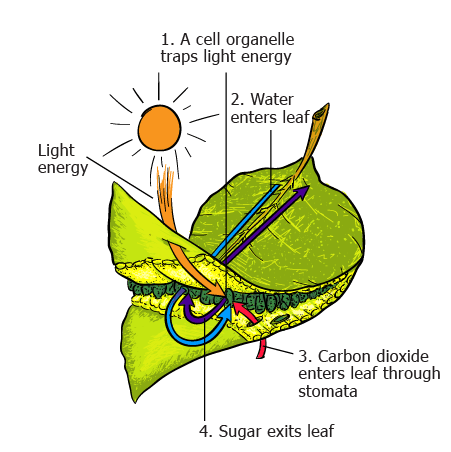
Both photosynthesis and cellular respiration take place in the leaves of plants. The diagram below shows a plant undergoing photosynthesis. WHAT PRODUCTS FROM PHOTOSYNTHESIS ARE USED IN CELLULAR RESPIRATION?
a)
water and glucose
b)
glucose and oxygen
c)
water and carbon dioxide
d)
glucose and carbon dioxide
211.
Cellular respiration is almost the reverse of photosynthesis. Which compounds are produced in the chloroplast and used by the mitochondria?
a)
glucose, oxygen
b)
water, carbon dioxide, ATP
c)
carbon dioxide, ADP, glucose
d)
glucose, oxygen, carbon dioxide
212.
In the contained ecosystem below, the organisms will need to get food and any other requirements within the system. How do the plants get enough carbon dioxide to go through photosynthesis?
a)
carbon dioxide is stored in the glass container
b)
water plants do not need carbon dioxide to undergo photosynthesis
c)
water will slowing dissolve the sand and dirt, releasing carbon dioxide
d)
living things within the system will produce carbondioxide as products of cellular respiration
213.
A diagram representing the relationship between photosynthesis and cellular respiration is shown below. The numbered boxes in the diagram represent which of the following?
a)
1 - water; 2 - nitrogen
b)
1- nitrogen; 2- oxygen
c)
1 - oxygen; 2- carbon dioxide
d)
1- carbon dioxide; 2- water
214.
How are cellular respiration and photosynthesis related, in terms of energy?
a)
energy captured in photosynthesis is used to power cellular respiration
b)
energy transformed in cellular respiration is used to power photosynthesis
c)
photosynthesis and cellular respiration perform the same task in terms of energy transformation
d)
energy is not involved in either photosynthesis or cellular respiration
215.
During photosynthesis, plant cells take in water (H2O) and carbon dioxide (CO2) and release oxygen (O2). How is this different from what takes place during aerobic respiration?
a)
during aerobic respiration, cells release O2 and take in CO2, H2O, and ATP
b)
during aerobic respiration, 
O2 is inhaled and CO2 and H2O are exhaled
c)
during aerobic respiration, cells use ATP to cinvert insulin to glucose and CO2
d)
during aerobic respiration, the mitochondria form CO2 during the process of fermentation
216.
During cellular respiration the cells within a white-tailed rabbit break down glucose that is absorbed through digestion of plant materials. What product of this process is then released into the atmosphere as waste and used by other plants to create more glucose?
a)
oxygen
b)
methane
c)
carbon dioxide
d)
carbon monoxide
217.
Which type of molecule is used by cells throughout the body as the primary energy source?
a)
proteins
b)
nucleic acids
c)
carbohydrates
d)
lipids
218.
Which type of organic molecule is made up of fatty acids and glycerol?
a)
lipids
b)
proteins
c)
carbohydrates
d)
nucleic acids
219.
During cellular respiration in eukaryotic cells, glucose is broken down into carbon dioxide and water molecules. What energy source is produced during this process of breaking down the glucose molecules?
a)
ATP
b)
ADP
c)
Oxygen
d)
Carbon Dioxide
220.
The burning or breaking down of glucose is known as...
a)
photosynthesis
b)
transpiration
c)
respiration
d)
transport
221.
This organelle is the _____________.
a)
chloroplast
b)
Golgi bodies
c)
nucleus
d)
mitochondria
222.
The folding of membranes 
a)
increases photosynthesis
b)
increases respiration
c)
increases diffusion
d)
increases digestion
223.
An giraffe exhales ...
a)
carbon dioxide & water
b)
ATP and carbon dioxide
c)
carbon dioxide & glucose
d)
glucose & oxygen
224.
What organic molecule is necessary for cellular respiration to occur?
a)
lipids
b)
fats
c)
carbon dioxide
d)
glucose
225.
What process is the opposite of aerobic respiration?
a)
anaerobic respiration
b)
cellular respiration
c)
photosynthesis
d)
lactic acid fermentation
226.
A yeast is producing bubbles when it is placed in sugar water. What are the bubbles?
a)
acid
b)
carbon dioxide
c)
oxygen
d)
alcohol
227.
"Feeling the burn" during extreme exercise is associated with...
a)
alcoholic fermentation
b)
lactic acid fermentation
c)
photosynthesis
d)
aerobic respiration
228.
Oxygen and glucose will yield _______________________
a)
glucose and oxygen
b)
lactic acid & 2 ATP
c)
alcohol & carbon dioxide 
d)
ATP carbon dioxide & water
229.
which kind of cells would have the most mitochondria?
a)
brain cells
b)
bone cells
c)
plant cells
d)
muscle cells
230.
What gas or gases will a turtle release?
a)
carbon dioxide & water vapor
b)
oxygen & water vapor
c)
water vapor and alcohol
d)
ethyl alcohol
231.
potted plant is placed inside a clear, sealed vacuum container that has water pumped into it on a regular basis. The container is placed in the sun and the plant’s growth is monitored. Which statement best describes what will most likely happen to the plant over time?
a)
The plant will grow faster because it is sheltered from the wind.
b)
The plant will die because it does not have oxygen for photosynthesis.
c)
The plant will die because it does not have carbon dioxide for photosynthesis
d)
The plant will grow at a slower rate because it requires more water.
232.
Two different species of bacteria are examined. Scientists find that species X always produces CO2 and H2O during cellular respiration. Species Y always produces ethyl alcohol and CO2. Which conclusion can be made from these observations?
a)
Only species Y is aerobic.
b)
Only species Y is anaerobic
c)
Both species X and Y are aerobic.
d)
Both species X and Y are anaerobic.
233.

A weightlifter is using heavy weights in short bursts for a competition. Because his muscle cells are not able to take in enough oxygen to make very much ATP the weightlifter begins to get fatigue in his muscles. Which of the following processes is most likely going on in the muscles of the weightlifter as he competes in his event?

a)

As the cells run out of oxygen they switch to anaerobic respiration (fermentation), which allows the cell to make small amounts of ATP in the absence of oxygen.

b)

As the cells run out of oxygen, they die off gradually and the weightlifter's muscles have fewer contracting muscle cells.

c)

The cells will never run out of oxygen if the weightlifter is breathing.

d)

As the cells run out of oxygen, they will continue to make the same amount of ATP, since oxygen is not required to make ATP.

234.
In which way are photosynthesis and cellular respiration different?
a)
Cellular respiration stores ATP, while photosynthesis releases ATP.
b)
Cellular respiration produces oxygen, while photosynthesis uses oxygen.
c)
Photosynthesis releases energy, while cellular respiration stores energy.
d)
Photosynthesis used carbon dioxide, while cellular respiration produces carbon dioxide.
235.
The diagram shows the relationship between photosynthesis and cellular respiration and the organelles in which they occur.
Which statement describes how photosynthesis and cellular respiration are interrelated?
a)
Oxygen is produced during cellular respiration and stored during photosynthesis.
b)
Carbon dioxide and water released by cellular respiration are used in photosynthesis.
c)
Photosynthesis releases the energy that is stored during the process of cellular respiration.
d)
Glucose is used during cellular respiration to produce food that is broken down during photosynthesis.
236.
Which of the following equations best represents photosynthesis?
a)
C + O2 + H2O = CO2 +HOH
b)
6CO2 + 6H2O = C6H12O6 + 6O2
c)
6C + 6 H2O = C6H12O6
d)
C6H12O6 = 6CO2 + 6H2O
237.
What is the correct equation for cellular respiration?
a)
6O2 + C6H12O6 -> 6CO2 + 6H2O + Energy
b)
6O2 + C6H12O6 + Energy -> 6CO2 + 6H2O
c)
6CO2 + 6H2O -> 6O2 + C6H12O6 + Energy
d)
6CO2 + 6H2O + Energy -> 6O2 + C6H12O6
238.

A potted plant is placed inside a clear, sealed vacuum container that has water pumped into it on a regular basis. The container is placed in the sun and the plant’s growth is monitored. Which statement best describes what will most likely happen to the plant over time?

a)

The plant will grow faster because it is sheltered from the wind.

b)

The plant will die because it does not have oxygen for photosynthesis.

c)

The plant will die because it does not have carbon dioxide for photosynthesis

d)

The plant will grow at a slower rate because it requires more water.

239.
How are cellular respiration and photosynthesis related, in terms of energy?
a)
The energy captured in photosynthesis is used to power cellular respiration.
b)
The energy transformed in cellular respiration is used to power photosynthesis.
c)
Photosynthesis and respiration perform the same task in terms of energy transformation
d)
Energy is not involved in either photosynthesis or cellular respiration.
240.
Two test tubes were filled with a solution of bromthymol blue. A student exhaled through a straw into each tube, and the bromthymol blue turned yellow. An aquatic green plant was placed into each tube, and the tubes were corked. One tube was placed in the dark, and one was placed in direct sunlight. The yellow solution in the tube in sunlight turned blue, while the one in the dark remained yellow. Which statement best explains why the solution in the tube placed in sunlight returned to a blue color?
a)
Oxygen was produced by photosynthesis.
b)
Carbon dioxide was removed by photosynthesis.
c)
Carbon dioxide was produced by respiration.
d)
Oxygen was removed by respiration.
241.
All living things do which of the following?
a)
Chemosynthesis
b)
Respiration
c)
photosynthesis
d)
all of the answers
242.
______________ produces the most ATP.
a)
photosnthesis
b)
aerobic respiration
c)
anaerobic respiration
d)
glycolysis
243.
What is the molecule called that mitochondria produce when they respire glucose?
a)
ATP
b)
ADP
c)
DNA
d)
80p
244.
During cellular respiration, what do animal cells use to produce energy from food?
a)
sunlight
b)
meat
c)
water
d)
oxygen
245.
A diagram representing the relationship between photosynthesis and cellular respiration is shown.
The numbered boxes in the diagram represent which of the following?
a)
1 - water; 2 - nitrogen
b)
1 - nitrogen; 2 - oxygen
c)
1 - oxygen; 2 - carbon dioxide
d)
1 - carbon dioxide; 2 – water
246.

From where do heterotrophs obtain their energy?

a)

The sun

b)

Other organisms