wayground logo

Free Printable Worksheets

Font size

S
M
L
XL
Worksheets

Biology GMA Review

Total questions: 245

Worksheet time: 3hrs 33mins

Name
Class
Date
1.
This organelle is in all eukaryotic cells. It is the control center of the cell because it holds the DNA.
a)
Mitochondria
b)
Nucleus
c)
Chloroplasts
d)
Ribosomes
2.
This organelle is like a recycling center for the cell. It breaks down old materials. It is like a vacuum cleaner that cleans up the waste in cells.
a)
Ribosomes
b)
Lysosomes
c)
Mitochondria
d)
Chloroplasts
3.
Tiny cell structures that carry out specific functions within the cell.
a)
membranes
b)
nucleus
c)
organelles
d)
animalicules
4.
How are eukaryotes different from prokaryotes?
a)
They aren't different, except the spelling.
b)
I have no clue!
c)
Eukaryotes have a NUCLEUS, prokaryotes do NOT!
d)
Prokaryotes have a NUCLEUS, eukaryotes do NOT!
5.
I am a protein packaging and shipping machine! Who am I?
a)
vacuole
b)
ribosome
c)
endoplasmic reticulum
d)
golgi apparatus
6.
The powerhouse of the cell is the...It converts energy from food into energy the cell can use
a)
Mitochondrion
b)
Golgi body
c)
Nucleus
d)
Ribosomes
7.
Where are proteins made? These are small, grain-like or rod shaped organelles.
a)
Golgi body
b)
Mitoichondrion
c)
Chromosomes
d)
Ribosomes
8.
Using this image, what organelle is C?
a)
Cell Wall
b)
Mitochondria
c)
Large Cell Vacuole
d)
Chloroplast
9.
I store water in both plant and animal cells. What am I?
a)
cytoplasm
b)
ribosomes
c)
vacuole
d)
lysosomes
10.
Which part of the cell is often called "the brain of the cell"?
a)
nuclear membrane
b)
endoplasmic reticulum
c)
nucleus
d)
mitochondria
11.
A rigid layer that lies outside the cell's  membrane is...
a)
Cytoskeleton
b)
Cilia
c)
Cell Wall
d)
Flagella
12.

How does a cell membrane keep harmful stuff out of the cell?

a)

Regulates what enters and leaves the cell

b)

Flexibility

c)

Protective barrier

d)

Structure and support

13.
What is found in both plant and animal cells but is much larger in plant cells?
a)
Nucleus
b)
Mitochondria
c)
Chloroplast
d)
Vacuole
14.
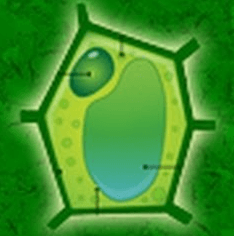
The following cell is a _______ cell.
a)
Animal
b)
Plant
15.
In which organism can a cell wall be found?
a)
An ant
b)
A hawk
c)
A leaf
d)
A tiger
16.
What cell part is NOT found in all cells?
a)
Cell Wall
b)
Cell Membrane
c)
Cytoplasm
d)
Genetic Material
17.
Ridged outer layer of a plant cell.
a)
Cell Membrane
b)
Cell Wall
c)
ER
d)
Ribosomes
18.
Sexual reproduction requires _____ parents and asexual reproduction requires ___ parents
a)
1,1
b)
2,2
c)
2,1
d)
1,2 
19.
What is an advantage of sexual reproduction?
a)
Allows genetic variation
b)
Only needs one parent
c)
Happens very quickly
d)
Offspring are exact copies of parent
20.
Bacteria reproduce asexually by a process called 
a)
replication
b)
meiosis
c)
splitting in two
d)
binary fission
21.
In which type of cells will mitosis occur?
a)
egg cells
b)
germ cells
c)
jail cells
d)
Somatic cells
22.
What is an advantage of sexual reproduction over asexual reproduction?
a)
It increases diversity in the population, making it more adaptable to changing environments. 
b)
It is better for all organisms to be the same.
c)
It happens faster.
d)
It helps skin cells divide faster to heal wounds.
23.
The process on the left is:
The process on the right is:
a)
Left: meiosis
Right: meiosis
b)
Left: meiosis
Right: cloning
c)
Left: mitosis
Right: meiosis
d)
Left: mitosis
Right: mitosis
24.
What are spindle fibers?
a)
One half of a chromosome
b)
Condensed chromatin
c)
Kinetechores
d)
Protein structures that separate chromosomes
25.
What happens during Interphase?
a)
Mitosis and Meiosis
b)
Growth and DNA synthesis
c)
DNA synthesis and mitosis
d)
Growth and mitosis
26.
In which phase of mitosis does this occur:
Chromatids move to opposite sides of the cell.
a)
Interphase
b)
Prophase 
c)
Metaphase 
d)
Anaphase
27.
In which phase of the cell cycle does this occur:
The cytoplasm divides.
a)
Interphase
b)
Anaphase
c)
Cytokinesis
d)
Telophase
28.
In which phase of the cell cycle does this occur:
A cell spends 90% of the cycle in this phase.
a)
Metaphase
b)
Prometaphase
c)
Prophase
d)
Interphase
29.
In which phase of the cell cycle does this occur:
The chromosomes line - up along the middle of the cell.
a)
Cytokinesis
b)
Telophase
c)
Metaphase
d)
Anaphase
30.
If a parent cell has 12 chromosomes, how many chromosomes will each gamete have after meiosis?
a)
4
b)
6
c)
12
d)
24
31.

The result of meiosis is

a)

2 identical daughter cells

b)

2 different daughter cells

c)

4 identical daughter cells

d)

4 different daughter cells

32.

the 4 phases of mitosis in order are

a)

prophase, anaphase, metaphase, telophase

b)

telophase, metphase, metaphase, anaphase

c)

prophase, metaphase, anaphase, telophase

d)

telophase, metaphase, anaphase, prophase

33.

The male and female sex cells are also called

a)

body cells

b)

skin cells

c)

somatic cells

d)

gametes

34.
What causes genetic variation in meiosis?
a)
chromosomes lining up
b)
crossing over of chromosomes
c)
separation of chromosomes
d)
chromosomes pulling apart
35.
This type of RNA moves amino acids to the ribosomes.
a)
mRNA
b)
tRNA
c)
rRNA
36.

Is this karyotype for a male or female?

a)

MALE

b)

FEMALE

37.
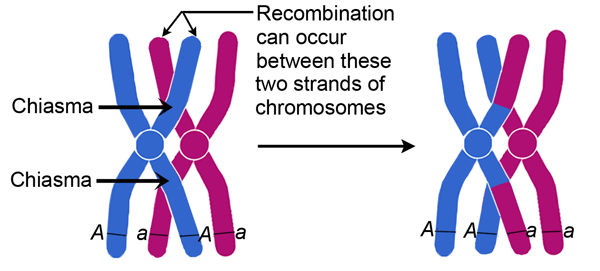
This image shows chromosomes during Prophase 1. Which of the following correctly describes the process shown?
a)
segregation of sister chromatids
b)
condensation and segregation of alleles
c)
mutationin which the DNA content of the gene is altered
d)
crossing - over in which alleles are exchanged
38.
Which macromolecule stores energy, insulates us, and makes up the cell membrane?
a)
lipids
b)
proteins
c)
carbohydrates
d)
nucleic acids
39.
What are the four macromolecules?
a)
proteins, nucleic acids, carbohydrates, and lipids
b)
monosaccharides, lipids, polysaccaharides, and proteins
c)
RNA, DNA, proteins, and carbohydrates
d)
proteins, DNA, RNA, and steroids
40.
What suffix (word ending) is used in the names of most carbohydrates?
a)
-ase
b)
-nic
c)
-ose
d)
-yme
41.
DNA and RNA are examples of 
a)
Carbohydrates
b)
Lipids
c)
Proteins
d)
Nucleic Acids
42.
Nucleotides are monomers of
a)
Carbohydrates
b)
Lipids
c)
Proteins
d)
Nucleic Acids
43.
Waxes, oils and fats are examples of
a)
Carbohydrates
b)
Lipids
c)
Proteins
d)
Nucleic Acids
44.
What is the function of nucleic acids?
a)
store genetic information
b)
store energy (long-term)
c)
store energy (short-term)
d)
build skin, hair, nails, muscles
45.
Building blocks of the body, hair , muscles etc.
a)
protein
b)
nucleic acid
c)
lipids
d)
carbohydrates
46.
Is found in the cell membrane as a bilayer. 
a)
lipids
b)
protein
c)
nucleic acid
d)
carbohydrate
47.
Enzymes are..
a)
nucleic acids 
b)
carbohydrates 
c)
lipids 
d)
proteins 
48.
Where does the energy from our food originally come from?
a)
the Sun
b)
chemical reactions
c)
carbohydrates
d)
mitochondria
49.
What is the diffusion of water through a selectively permeable membrane?
a)
active transport
b)
osmotic pressure
c)
facilitated diffusion
d)
osmosis
50.
Diffusion is the movement of particles
a)
from low to high concentration
b)
from  high to low concentration
c)
from equilibrium to areas of high concentration
d)
all of the above
51.
The current model of the plasma membrane is called the
a)
hydrophobic layer
b)
transport bilayer
c)
phosphoproteins
d)
fluid mosaic model
52.
Placing a cell containing 10% salt  into a solution containing 15% salt will cause the cell to
a)
shrink
b)
 swell
c)
stay the same
53.
Placing a cell containing 10% salt into a solution containing 7% salt will cause the cell to 
a)
shrink
b)
swell
c)
stay the same
54.
This picture represents which type of cellular transport?
a)
passive transport
b)
endocytosis
c)
exocytosis
d)
osmosis
55.
The cell below is in a _________ solution.
a)
Hypotonic
b)
Hypertonic
c)
Isotonic
56.
The cell below is in a _____________ solution.
a)
Hypertonic
b)
Hypotonic
c)
Isotonic
57.
This picture represents what type of cell transport?
a)
endocytosis
b)
exocytosis
c)
osmosis
d)
passive transport
58.
What does it mean that a cell membrane is semi-permeable?
a)
It allows all substances in
b)
It allows some substances in
c)
It allows nothing in
59.
This type of endocytosis is used by the cell to take in large molecules or food. 
a)
Pinocytosis 
b)
Protein pumps
c)
Phagocytosis
d)
Exocytosis
60.
This solution has the equal concentrations of water molecules and particles.
a)
hypertonic
b)
hypotonic
c)
isotonic
61.

which way would the water molecules move through the semi permeable membrane?

a)

From the A side to the B side

b)

From the B side to the A side

c)

There would be no net movement of water

d)

In both directions

62.
What type of transport is this?
a)
facilitated diffusion
b)
active transport
c)
diffusion
d)
osmosis
63.
Hydrophobic region of the cell membrane?
a)
E
b)
B
c)
C
d)
64.
The products of photosynthesis are
a)
water and carbon dioxide
b)
oxygen and water
c)
sugar and cabon dioxide
d)
oxygen and sugar (glucose)
65.
Which gas is removed from the atmosphere during photosynthesis?
a)
hydrogen
b)
oxygen
c)
nitrogen
d)
carbon dioxide
66.
The main source of energy for all life comes from ____.
a)
the Earth
b)
the moon
c)
the sun
d)
the food we eat/make
67.
In what part of the cell does photosynthesis occur?
a)
Nucleus
b)
Chloroplast
c)
Epidermis
d)
Vacuole
68.
After photosynthesis, plants store their energy as _________ .
a)
chlorophyll
b)
pigment
c)
glucose (sugar)
d)
Oxygen
69.
What is the correct equation for cellular respiration?
a)
6O2 + C6H12O6 -> 6CO2 + 6H2O + Energy
b)
6O2 + C6H12O6 + Energy -> 6CO2 + 6H2O
c)
6CO2 + 6H2O -> 6O2 + C6H12O6 + Energy
d)
6CO2 + 6H2O + Energy -> 6O2 + C6H12O6
70.
What is the purpose of cellular respiration?
a)
to break down food
b)
to create energy in the body
c)
to release energy from food
d)
there is none; it's a waste of time
71.
Which of the following happens in glycolysis?
a)
Glucose is split into pyruvate molecules
b)
Glucose is split into water and carbon dioxide
c)
Glucose is made by joining oxygen and water
d)
Glucose is made by joining carbon dioxide and water
72.
How is energy released from ATP?
a)
By adding a phosphate group
b)
By removing a phosphate group
c)
By adding three phosphate groups
d)
By removing three phosphate groups
73.
Which anaerobic process results in muscle soreness?
a)
Ethyl alcohol fermentation
b)
Glycolysis 
c)
Electron transport chain
d)
Lactic acid fermentation
74.
By what process does glycolysis continue in the absence of oxygen?
a)
Transpiration
b)
Fermentation
c)
Phosphorylation
d)
Pigmentation
75.
Which of the following correctly sequences the events of aerobic respiration?
a)
Glycolysis, Fermentation, Krebs Cycle
b)
Krebs Cycle, Electron transport, Glycolysis
c)
Glycolysis, Krebs Cycle, Electron Transport
d)
Krebs Cycle, Glycolysis, Electron Transport
76.
The carbon cycle circulates carbon dioxide and oxygen throughout an ecosystem. Which statement below best explains the role of photosynthesis and cellular respiration in the carbon cycle?
a)
 Animals take CO2 out of the atmosphere through the process of photosynthesis and plants release CO2 back into the atmosphere through the process of cellular respiration.
b)
Animals take O2 out of the atmosphere through the process of cellular respiration and release O2 back into the atmosphere through the process of cellular respiration.
c)
Plants take O2 out of the atmosphere through the process of photosynthesis and animals release CO2 into the atmosphere through the process of cellular respiration.
d)
Plants take CO2 out of the atmosphere through the process of photosynthesis and animals release CO2 back into the atmosphere through the process of cellular respiration.
77.
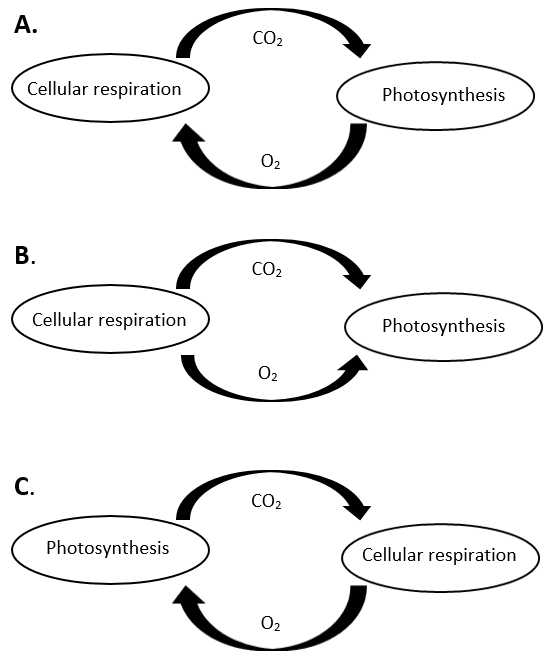
Which diagram accurately represents the use of the gases from both cellular respiration and photosynthesis?
a)
C.
b)
B.
c)
A.
78.
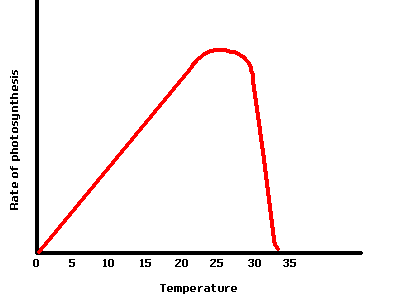
The diagram represents the effects of temperature on the rate of photosynthesis of the Elodea plant. Which statement best explains the results of the study?
a)
As temperature increases, the rate of photosynthesis constantly increases.
b)
As temperature increases, the rate of carbon dioxide bubbles constantly increases.
c)
The rate of photosynthesis increases as temperature increases up to around 25⁰ C and then decreases.
d)
The rate of carbon dioxide bubbles increases as temperature increases up to around 25⁰ C and then decreases.
79.
What does the term anaerobic respiration refer to?
a)
A process that takes place with no oxygen present
b)
A process that takes place with oxygen present
c)
A process that takes place with no carbon dioxide present
d)
A process that takes place only in yeast cells
80.
Two brown eyed parents (Bb) have a baby. What is the chance the baby is blue eyed?
a)
0 %
b)
25%
c)
50%
d)
75%
81.
Which of the following genotypes is a purebred?
a)
Bb
b)
Gg
c)
bb
d)
Dd
82.
If green is dominant over purple, then what is the genotype for this individual?
a)
Purple
b)
Green
c)
GG
d)
gg
83.
Brown fur color is dominant over black fur color. Which of the following is the actual genotype of ALL of the offspring in the next generation of this cross for fur color?
AA x aa
a)
AA
b)
Aa
c)
aa
d)
brown fur
84.
Tt is-
a)
homozygous dominant
b)
homozygous recessive
c)
heterozygous
d)
none of these
85.
What would the ratio for genotypes be for this Punnett Square?
a)
2Bb:2bb
b)
2BB:2Bb
c)
1BB:2Bb:1bb
d)
4Bb
86.
He is known as the father of modern day genetics.
a)
Gregory Mendel
b)
Greg Mendel
c)
Gregor Mendel
d)
Grace Mendel
87.
Y for yellow body is dominant over y for blue body.  What alleles would produce yellow bodies?
a)
YY,yy
b)
Yy,yy
c)
YY only
d)
YY,Yy
88.
Females-XX; MalesXY.  A couple has 4 girls.  What is the chance the next child will be a boy?
a)
75%
b)
100%
c)
25%
d)
50%
89.
What would the genotypes be?
a)
TT, TT, Tt, Tt
b)
TT, Tt, Tt, tt
c)
Tt, Tt, tt, tt
d)
None of the above
90.

A calico cat shows both the traits for orange fur and black fur. What kind of inheritance pattern is this?

a)

Incomplete Dominance

b)

Co Dominance

c)

Sex-Linked

d)

Polygenic

91.

A red flowered plant (RR) breeds with a White flowered plant (WW). The gene for petal color in these plants expresses incomplete dominance. What percentage of the offspring will have pink (RW) flowers?

a)

0%

b)

25%

c)

50%

d)

100%

92.

This type of inheritance pattern is a Blend of both traits.

a)

incomplete dominance

b)

co-dominance

c)

complete dominance

d)

recessive pattern

93.
This type of inheritance pattern shows BOTH traits in possible offspring
a)
complete dominance
b)
incomplete dominance
c)
co-dominance
d)
dominant pattern
94.

This is an example of ___________?

a)

Incomplete dominance

b)

Co-Dominance

c)

Sex-linked inheritance

d)

Autosomal recessive inheritance

95.
Which of the following genotypes belongs in the red box in the Punnett square?
a)
XBXB
b)
XbXb
c)
XbY
d)
XBY
96.

If a gene is found only on the X chromosome and not the Y chromosome, it is said to be what?

a)

sex-linked trait

b)

polygenic trait

c)

codominant trait

d)

incomplete dominance trait

97.
The visual representation of an individual's chromosomes is a 
a)
phenotype
b)
genotype
c)
karyotype
d)
stereotype
98.

If this pedigree shows a recessive disorder, what MUST the genotype of individual 4 be?

a)

HH

b)

Hh

c)

hh

99.

In a pedigree, horizontal lines represent:

a)

females

b)

males

c)

offspring

d)

marriage

100.

In this pedigree, individual 6 is a ____ who _____ the trait.

a)

girl, does not have

b)

girl, has

c)

boy, does not have

d)

boy, has

101.

In a pedigree, circles represent:

a)

females

b)

males

c)

offspring

d)

marriage

102.
A father that has blood type O is crossed with a blood type O mother. What will be the genotype of the offspring?
a)
50% AB; 50% OO
b)
25% AB,  25% AO, 25% BO, 25% OO
c)
25% AA, 25% BB, 25% AB, 25% OO
d)
100% OO
103.
Having two of the SAME alleles for a trait (example HH or hh):
a)
homozygous
b)
heterozygous
c)
recessive
d)
whack, dawg.
104.
I am single stranded.
a)
DNA
b)
RNA
c)
Both DNA and RNA
105.
I am arranged as a double helix or "twisted ladder."
a)
Both DNA and RNA
b)
DNA
c)
RNA
106.
Adenine bonds with ______________.
a)
Guanine
b)
Thymine
c)
Cytosine
d)
Adenine
107.
Guanine bonds with ______________.
a)
Adenine
b)
Guanine
c)
Cytosine
d)
Thymine
108.
Why is DNA important?
a)
it is very small and very complicated
b)
it's in everything
c)
it serves as the blueprint for traits of all living things
d)
because we eat it every day for energy
109.
Which 2 molecules forms the sides (backbone) of the DNA ladder?
a)
deoxyribose and adenine
b)
deoxyribose and a hydrogen bond
c)
sugar and the nucleus
d)
deoxyribose (sugar) and phosphate
110.
Which sequence of DNA bases would pair with this partial strand
ATG TGA CAG
a)
ATG TGA CAG
b)
TAC ACT GTC
c)
GTA AGT GAC
d)
CAT TCA CTG
111.
RNA contains the sugar
a)
ribose
b)
deoxyribose
c)
glucose
d)
lactose
112.
What is the difference between DNA and RNA in terms of bases?
a)
RNA contains uracil in place of thymine
b)
RNA contains uracil in place of adenine
c)
RNA contains uracil in place of guanine
d)
RNA contains uracil in place of  cytosine
113.
I include the bases Guanine, Cytosine, Adenine and Thymine.
a)
DNA
b)
RNA
114.
I include the bases Guanine, Cytosine, Adenine and Uracil .
a)
DNA
b)
RNA
115.
I travel outside of the nucleus.
a)
DNA
b)
RNA
116.
What is the correct amino acid sequence for the mRNA code AUGCCAGUAUGA?
a)
 Met-Pro-Val-Stop
b)
Met-Pro-Arg-Stop
c)
 Tyr-Gly-His
d)
Tyr-Gly-Arg-His
117.
Other than mRNA, what is this image showing?
a)
tRNA
b)
rRNA
c)
DNA
d)
RNA polymerase
118.
Translation happens at the - 
a)
Nucleus
b)
Ribosome
c)
Chloroplast
d)
Mitochondria
119.
What is the term for making an RNA copy of DNA?
a)
Transcription
b)
Translation
c)
Folding
d)
Coding
120.
If the percentage of DNA is made of 30% Thymine, what is the correct percentage of Guanine?
a)
30
b)
15
c)
20
d)
60
121.

The diagram below shows a normal portion of a gene sequence and three mutated sequences of DNA.

What type of mutation is shown in sequence c?

a)

Insertion

b)

Deletion

c)

Substitution

d)

Frame Shift

122.

Which cell will most likely pass on a heritable change to offspring if a mutation occurs in the DNA?

a)

Skin cell

b)

Brain cell

c)

Sperm cell

d)

Muscle cell

123.

Which most closely matches the goal of protein synthesis?

a)

Making a protein

b)

Decoding a protein

c)

Copying DNA to make a protein

d)

Making ribosomes where proteins are made

124.
The diagram shows the process of
a)
Transcription
b)
Translation
c)
Replication
d)
Mitosis
125.
ATTTGAGCC- Original
ATTGAGCC - Mutated
The example above is an example of a 
a)
Insertion- Frameshift
b)
Deletion- Substitution
c)
Deletion -Frameshift
d)
All of the above
126.
This type of substitution codes for a stop codon
a)
Missense
b)
Nonsense
c)
Silent
d)
Deletion
127.
A type of substitution in which no  amino acids change is called 
a)
Missense
b)
Nonsense
c)
Silent
d)
Deletion
128.
A frameshift mutation would result from...
a)
a base deletion only
b)
a base substitution only
c)
either an insertion or deletion of a base
d)
a base insertion only
129.
Normal-
GAG-CTC-GAC-AGA
Mutant
GAG CTC-CAC-AGA
a)
no mutation
b)
substitution
c)
insertion
d)
deletion
130.

Two llamas are produced with the exact same DNA in a science lab. What is this known as?

a)

Stem Cell Therapy

b)

Genetically Modified Organisms

c)

Cloning

d)

Gene Therapy

131.

If scientists engineer the DNA of tomatoes to make them survive in cold temperatures, what do type of technology do those tomatoes become?

a)

Human Genome Project

b)

Genetically Modified Organisms

c)

Punnett Squares

d)

Gene Therapy

132.

Which type of cell can become any type of cells? (also known as a "blank" cell)

a)

Adult stem cells

b)

Ovum cell

c)

Embryonic stem cells

d)

Heart cell

133.
Whose blood was found at the crime scene?
a)
John
b)
Lisa
c)
Bob
d)
Sure
134.
Which man is the father of this baby?
a)
Father 1
b)
Father 2
c)
Father 3
d)
None of them
135.
Which domain is capable of living in extreme environments like hot springs, geysers, or very salty waters?
a)
Bacteria
b)
Archaea
c)
Eukarya
136.
Which domain includes all animals and plants?
a)
Archaea
b)
Eukarya
c)
Bacteria
137.
Which two kingdoms are entirely multicellular?
a)
Animalia and Plantae
b)
Animalia and Protista
c)
Protista and Plantae
138.
To say that an organism is heterotrophic means...
a)
it cannot reproduce asexually
b)
it cannot make its own food
c)
it cannot breathe oxygen gas
139.
Which kingdoms have some organisms that can make their own food (autotrophic)?
a)
Plantae and Animalia
b)
Fungi and Plantae
c)
Protista and Plantae
140.
Organisms whose cells have NO nucleus are classified as...
a)
Eukaryotic
b)
Prokaryotic
c)
Dead
141.
True or False: All cells have DNA.
a)
True
b)
False
142.
True or False: All living things are made of one or more cells.
a)
True
b)
False
143.
Moss belongs in the kingdom...
a)
Fungi
b)
Plantae
144.
Fungi are a type of...
a)
decomposer
b)
producer
145.
What is the genus name here:
Canis lupus
a)
Canis
b)
lupus
146.
The scientific name for water bear is Hypsibius dujardini.  What is its genus?
a)
Hypsibius 
b)
dujardini
c)
water 
d)
tardigrade
147.
Who organized living things by creating binomial nomenclature?
a)
Carolus Linnaeus
b)
Robert Hooke
c)
Anton van Leeuwenhoek
d)
James Watson
148.
What are the 8 levels of classification of living things from most general to most specific?
a)
domain, kingdom, phylum, class, order, family, genus, species
b)
domain, kingdom, phylum, class, order, family, genius, species
c)
domain, kingdom, phamily, class, order, family, genus, species
d)
domain, king, phillip, class, order, family, genus, species
149.
Who is the closest relative to the birds?
a)
crocodiles
b)
sharks
c)
fish
d)
amphibians
150.
Who is the closest relative to the sharks?
a)
crocodiles
b)
sharks
c)
ray-finned fish
d)
amphibians
151.
Which characteristics best describes the Plant Kingdom?
a)
unicellular; eukaryote; autotroph
b)
multicellular, prokaryote, autotroph
c)
multicellular, eukaryote, autotroph
d)
unicellular, prokaryote, heterotroph
152.
Which characteristics best describes the Animal Kingdom?
a)
unicellular, eukaryote, autotroph
b)
multicellular, prokaryote, heterotroph
c)
multicellular, eukaryote, autotroph
d)
multicellular, eukaryote, heterotroph
153.
Which characteristics best describe the Kingdom Protista?
a)
multicellular, eukaryote, heterotroph and autotroph
b)
multicellular and unicellular, heterotoph and autotroph, eukaryote
c)
unicellular, autotroph, prokaryote
d)
multicellular and unicellular, prokaryote, heterotroph
154.
Which characteristics best describe the Kingdom Fungi?
a)
multicellular and unicellular, eukaryote, autotroph
b)
multicellular and unicellular, prokaryote, heterotroph
c)
multicellular, eukaryote, heterotoph
d)
multicellular and unicellular, eukaryote, heterotroph
155.
Which characteristics best describes the Kingdoms Eubacteria and Archaebacteria?
a)
unicellular, prokaryote, heterotroph
b)
unicellular, prokaryote, heterotroph and autotroph
c)
multicellular, eukaryote, autotroph
d)
multicellular, prokaryote, heterotroph and autotroph
156.
Why do scientists classify viruses as non-living?
a)
They DO respond to a stimulus
b)
They need a host's energy because they do not have their own energy 
c)
They produce wastes
d)
They are really small 
157.
What is the first step of the virus reproduction cycle?
a)
The viruses genetic material (DNA) starts to take over the functions of the cell
b)
The host cell bursts open, releasing the new viruses
c)
The virus injects its genetic material into the cell
d)
A virus attaches to the surface of a host cell
158.
Antibiotics kill viruses
a)
True
b)
False
159.
What part of the phage is the DNA?
a)
A
b)
B
c)
C
d)
D
160.
Which viral life cycle allows viral genetic material to lay dormant while the host cell reproduces?
a)
lytic
b)
mitosis
c)
lysogenic
d)
S phase
161.
What is the main function of the projections on the surface of a virus?
a)
They aid in respiration
b)
They help the virus grow
c)
They help the virus invade its host by attaching to specific sites on the host
d)
They help the virus digest food molecules
162.
virus attaches
a)
a
b)
b
c)
c
d)
d
163.
new viruses assembled
a)
b
b)
c
c)
d
d)
e
164.
Injection
a)
b
b)
c
c)
d
d)
e
165.
host cell breaks open
a)
a
b)
c
c)
d
d)
e
166.
viral genes copied
a)
a
b)
b
c)
c
d)
e
167.
The shrew provides energy for the _______?
a)
cricket
b)
grasshopper
c)
frog
d)
snake
168.
Which of the following is a herbivore?
a)
cricket
b)
frog
c)
hawk
d)
shrew
169.
Which best describes what a food chain shows you?
a)
Energy flow through an ecosystem
b)
Food flowing through an ecosystem
c)
Consumers going into other consumers
d)
Who eats who
170.
What may happen if the snowshoe hare was removed from the food web pictured?
a)
The insects in the habitat would increase.
b)
The shrew population would decrease due to being only hawk food source.
c)
The willow tree population would decrease.
d)
Foxes would dies due to no food source. 
171.
In the energy pyramid here, how much of the energy in the producers gets passed to the herbivores?
a)
10%
b)
20%
c)
80%
d)
90%
172.
In the food web shown, the snail would be considered...
a)
primary consumer
b)
secondary consumer
c)
tertiary consumer
d)
producer
173.
Which biome, because of its climate and amount of rainfall, has the largest number of species of plants and animals?
a)
Tundra
b)
Rainforest
c)
Desert
d)
Pineforest
174.
The diagram below shows the cycling of nutrients in an ecosystem.
The removal of which of the following groups would cause an immediate decrease in the amount of energy flowing through the system?
a)
Producers
b)
Consumers
c)
Decomposers
d)
Inorganic nutrients
175.
symbiotic relationship in which both organisms benefit
a)
competition
b)
Mutualism
c)
nitrogen fixation
d)
energy pyramid
176.
What does a food web represent?
a)
All connections of energy flow throughout all organisms in a habitat.
b)
The specific ways that mutualism is carried out.
c)
A single pathway or energy flow between organisms. 
d)
How carnivores get their food. 
177.
a relationship between two in which one species, the predator, feeds on the other species, the prey
a)
chemosynthesis
b)
predation
c)
cellular respiration 
d)
commensalism
178.
symbiotic relationship in which one organisms benefits and the other organism is not affected
a)
invasive (non-native) species
b)
mutualism 
c)
nitrogen fixation
d)
commensalism
179.
Members of a species in a defined area
a)
Ecosystem
b)
community
c)
biodiversity
d)
population
180.
A pond ecosystem is shown in the diagram below. Which statement describes an interaction that helps maintain the dynamic equilibrium of this ecosystem?
Which statement describes an interaction that helps maintain the dynamic equilibrium of this ecosystem?
a)
The frogs make energy available to this ecosystem through the process of photosynthesis.
b)
The algae directly provide food for both the rotifers and the catfish.
c)
The green-backed heron provides energy for the mosquito larvae.
d)
The catfish population helps control the populations of water boatman and waterfleas.
181.
What are the Abiotic factors in this image? 
a)
water, sunlight, dirt, air
b)
birds and plants
c)
birds, water, dirt
d)
plants, water
182.

In the graph to the right, what is the population of deer at the carrying capacity of the environment?

a)

3

b)

7

c)

70

d)

40

183.

Something in the environment that keeps a population from steadily increasing is known as

a)

a limiting factor

b)

population density

c)

the carrying capacity

d)

reproduction

184.

One species of Galapagos finches, the cactus finch, eats insects off cactus plants. A disease kills off most of the cacti in the Galapagos Islands.


Which of these most likely would happen to the carrying capacity of the island?

a)

It would increase a small amount since the insect population would decrease.

b)

It would remain about the same since the finches would change to a different diet.

c)

It would decrease a lot because there is less to eat.

185.
When a specific population grows past the ecosystem's carrying capacity, what happens to the population?
a)
Density Independent limiting factors start to occur resulting in the population going farther above carrying capacity.
b)
Density Dependent limiting factors start to occur resulting in the population going back below carrying capacity.
c)
The population will go extinct due to lack of resources
d)
The population grows then finds a new carrying capacity
186.
Limiting factors which impact the size of a population no matter how large that population is.
a)
Density Independent Limiting Factors
b)
Density Dependent Limiting Factors
c)
Carrying Capacity
d)
Exponential Growth
187.
Which feature of a rose helps it grow without being eaten by large animals?
a)
flowers with bright colors
b)
sharp thorns
c)
small seeds
d)
deep roots
188.
Which feature helps an animal hide from other animals?
a)
looking like a dangerous animal
b)
being the same color as the place it lives (camoflauge)
c)
having sharp claws or a strong shel
d)
having only a few young and caring for them
189.
 A giraffe has a long neck.  Why would the giraffe need this adaptation?
a)
to keep warm
b)
to reach food high above the ground
c)
to have room to eat more
d)
to catch birds
190.
A Porcupine has sharp quills.  Why would a porcupine need this adaptation?
a)
to protect itself
b)
to keep warm
c)
to kill its prey
d)
to cover its skin
191.

Evolution of a new species from an existing species

a)

Adaptation

b)

Natural Selection

c)

Speciation

d)

Artificial Selection

192.

Organisms better suited to their environment survive easier and longer than those who aren't

a)

Natural Selection

b)

Adaption

c)

Artificial Selection

d)

Speciation

193.

Scientist who proposed the theory of natural selection

a)

Robert Hooke

b)

Charles Darwin

c)

Alfred Wegener

d)

Albert Einstein

194.
The role an organism plays in its ecosystem
a)
niche
b)
behavior
c)
structure
d)
function
195.
When an organism slows its life functions for a period of time to better its chances for survival during harsh conditions
a)
camouflage
b)
migration
c)
mimicry
d)
hibernation
196.
The seasonal movement of an organism from one place to another
a)
camouflage
b)
migration
c)
hibernation
d)
function
197.
The place or environment where an organism naturally lives
a)
function
b)
habitat
c)
community
d)
ecosystem
198.
What adaptation does this squirrel have that allows it to glide through the air?
a)
Extra skin under the arms and legs to capture air as it falls.
b)
Big ears to capture are as it falls
c)
Small eyes to see where it will land
d)
A short thin tail
199.
Polar bears have an adaptation that allows them to swim. What is most likely this adaptation?
a)
White coat
b)
Fat belly
c)
Small eyes
d)
Webbed Feet
200.
Cactus have a thick, hard surface (cuticle) that prevent ______________ from evaporating.
a)
Water
b)
Air
c)
Sugar
d)
light
201.
What is the function (job) of fish gills?
a)
To absorb water from the water
b)
To make the fish faster
c)
To make the fish lighter
d)
To absorb oxygen from the water
202.
Why do hollow bones help birds during flight?
a)
Hollow bones make the birds weigh less
b)
Hollow bones are full of heavy blood
c)
Hollow bones store water
d)
Hollow bones are made of feathers 
203.
Xylem is a plant adaptation that allows plants to transport ______________ up the stem.
a)
Salt 
b)
Sugar
c)
Water
d)
Coffee
204.
Define Adaptation.
a)
How an organism has NOT changed and continues to live in an environment 
b)
All animals can live in any environment 
c)
How an organism grows over time
d)
Special features or behaviors that allow an animal to survive in an environment.
205.
A particular golf course is using large amounts of nitrogen fertilizer. What process could move this nitrogen into a local stream?
a)
volatilization
b)
nitrogen fixation
c)
runoff
d)
ammonification
206.
Which of the following describes the role of nitrogen-fixing bacteria in the nitrogen cycle? Nitrogen-fixing bacteria convert
a)
nitrates intro nitrogen gas
b)
ammonia into proteins
c)
nitrogen gas into ammonia
d)
proteins into nitrates
207.
When nitrogen gas is turned in to a form that plants and animals can use is called 
a)
Combustion
b)
Photosynthesis
c)
Decomposition
d)
Nitrogen Fixation
208.
Organisms that break down dead plants & animals and release nitrogen back into atmosphere...
a)
bacteria
b)
plants
c)
animals
d)
producers
209.
The process of plants losing water through their leaves is called ____.
a)
condensation
b)
evaporation
c)
transpiration
d)
exhaling
210.
How does carbon in a grass plant get into a lion?
a)
The lion eats the grass
b)
Carbon from grass doesn't end up in a lion. 
c)
The carbon ends up in the food the lion eats. 
d)
The lion breathes in carbon given out by the plant
211.
Which one of these does not add CO2 to the atmosphere?
a)
cooking with gas
b)
planting trees
c)
burning wood
d)
riding in a bus
212.

What is a greenhouse gas?

a)

A gas that helps plants grow

b)

Any gas in the atmosphere

c)

A gas that absorbs solar radiation allowing the Earth to stay at a livable temperature

d)

A gas that can only be harmful and poisonous

213.

Photosynthesis is an important part of the ______ cycle

a)

Carbon

b)

Water

c)

Phosphorus

d)

Nitrogen

214.
Nitrogen fixing bacteria, lives in nodules on the root of a plant called
a)
Broccoli
b)
Legumes
c)
Beats
d)
Carrots
215.
Identify the cycle pictured.
a)
The Water cycle
b)
The Carbon cycle
c)
The Nitrogen cycle
d)
The Phosphorus cycle.
216.
Identify the cycle pictured.
a)
The Water cycle
b)
The Carbon cycle
c)
The Nitrogen cycle
d)
The Phosphorus cycle
217.
Which of the following is NOT an example of natural selection? 
a)
People selectively breeding hamsters.
b)
Insect populations developing resistance to certain pesticides.
c)
Bacteria becoming resistant to antibiotics.
d)
Male birds of certain species developing colorful feathers to attract female mates.
218.
Which term refers to the process by which individuals that are better suited to the environment survive and reproduce therefore passing down their genes to their offspring? 
a)
Evolution 
b)
Variation 
c)
Adaptation
d)
Natural Selection 
219.
Which species’ DNA is most similar to the DNA of the toothed whale? 
a)
Hippopotamus 
b)
Baleen Whale
c)
Grazing Mammals
d)
Camels
220.
The environment around Manchester, England, changed during the Industrial Revolution.  How did this change affect peppered moths living in the area?
a)
Natural selection favored moths with dark wings because predators could not see them on the soot-colored trees.
b)
Natural selection favored moths with white wings that were easy for predators to see.
c)
Natural selection favored moths with white wings because predators could not see them on the soot-colored trees.
d)
Natural selection caused moths with white wings to become extinct.
221.
When an organism completely dies out, it is called.....
a)
Adaption
b)
Extinction
c)
Fossilization
d)
Mutation
222.
Two organisms that are closely related would have
a)
very similar DNA sequence
b)
exactly the same DNA sequences
c)
no proteins in common
d)
completely different DNA sequence
223.
A structure that is inherited from ancestors but has long lost much or all of its original use.
a)
vestigial structure
b)
miniscule structure
c)
analogous structure
224.
Which of the following is a term for a group of similar organisms that can reproduce fertile offspring?
a)
individual
b)
population
c)
species
d)
fossil
225.

The solidified remain or imprint of a once living thing are called:

a)

Fossils

b)

Homologous Structures

c)

Vestigial Structures

d)

DNA

226.

What type of evidence is represented in the picture above:

a)

Fossils

b)

Vestigial Structures

c)

DNA

d)

Homologous Structures

227.

What type of evidence is shown in the image above?

a)

Fossils

b)

Vestigial structures

c)

Homologous Structures

d)

DNA

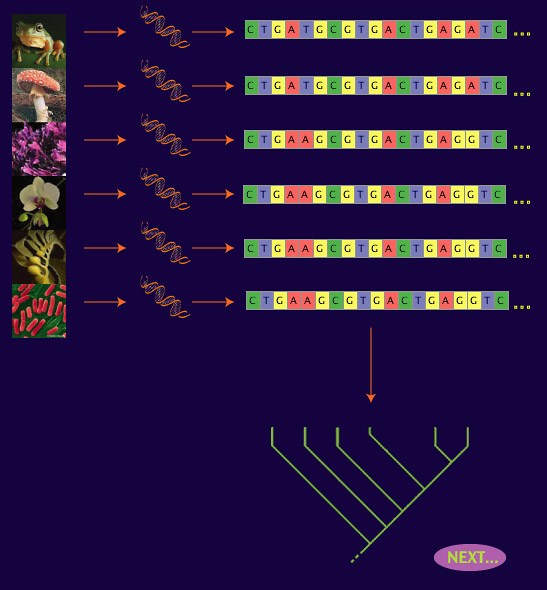
228.

What type of evidence are shown in the picture above?

a)

Fossils

b)

Embryology

c)

Homologous Structures

d)

Vestigial Structures

229.

Adaptations are:

a)

physical or behavioral tendencies.

b)

physical or behavioral characteristics that help an organisms survive and reproduce.

c)

physical or behavioral characteristics that do not help the organism in any way.

d)

genetic mutations that have gone wrong.

230.
The similarities of the bones in the diagram provide evidence that---
a)
The organisms shown lived in the same natural envionrment
b)
The organisms shown may have developed from a common ancestor
c)
The organisms shown have the same genetic diseases
d)
All vertebrate species have identical forelimbs
231.
The diagram shows fossils in different rock layers. Which of these statements about the age of these fossils is most likely correct?
a)
Fossil A and C are the same age
b)
Fossil B is older than fossil C
c)
Fossils A is older than fossil B
d)
Fossil D is older than fossil C
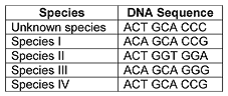
232.
According to this data, the unknown bacterial species is most closely related to: 
a)
Species I
b)
Species II
c)
Species III
d)
Species IV
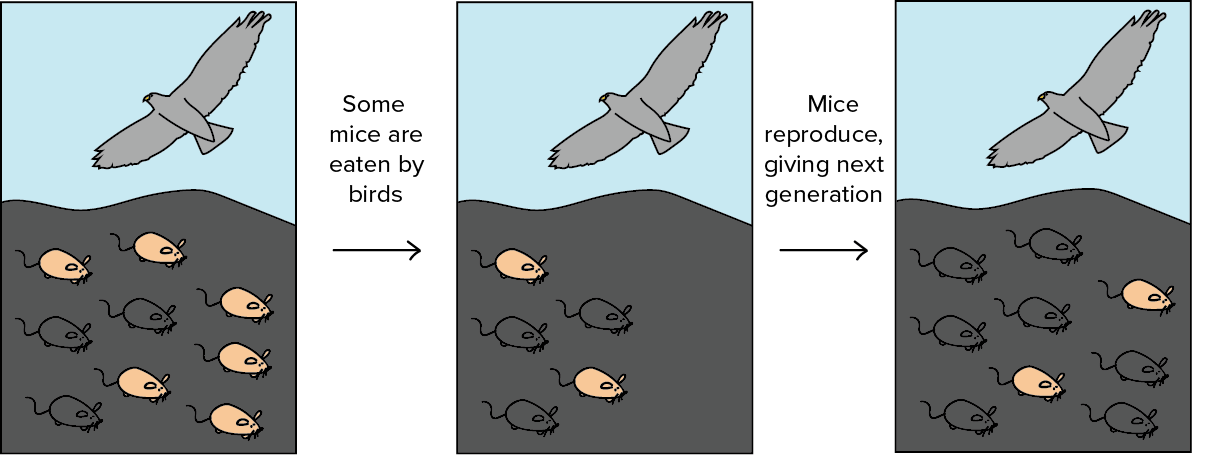
233.
Why is the mouse population changing over time?
a)
The light mice can reproduce more successfully than the dark mice
b)
The hawks eat more dark mice than light mice because the dark mice taste better
c)
The hawks eat more light mice than dark mice because they can see the light mice more easily
d)
The hawks eat more dark mice than light mice because they can see the dark mice more easily
234.

Which scientist is known for his work that he did on the Galapagos Islands to develop his theory of natural selection?

a)

Gregor Mendel

b)

Charles Darwin

c)

Anton Van Leewenhoek

d)

Robert Brown

235.

The process by which two populations of the same species become so different that they can no longer interbreed.

a)

natural selection

b)

artificial selection

c)

speciation

d)

fossilization

236.

Which of the following is true regarding the evidence of evolution

a)

Vestigial structures are not real evidence of evolution.

b)

Homologous structures and fossils are the most dependable forms of evidence.

c)

Comparing DNA is the most definitive and accurate method to show evolutionary relationships.

d)

Embryology and Homologous structures do not support the theory of evolution.

237.
The type of genetic drift that follows the colonization of a new habitat by a small group of individuals is called
a)
the Hardy-Weinberg principle
b)
the founder effect
c)
directional selection
d)
the bottleneck effect
238.
Which of the following is an example of the founder effect?
a)
Bald Eagles are hunted until near extinction, population recovers.
b)
Small group of iguanas floats to an island, starts a new population.
c)
Red fox pups are more likely to survive in a snowy environment if they are born white.
d)
Farmer chooses seeds from largest apples to plant next year.  This results in larger apples from year to year.
239.

What is another name for natural selection?

a)

survival of the smartest

b)

survival of the fastest

c)

survival of the biggest

d)

survival of the fittest

240.
Which of the following is an example of the bottle neck effect?
a)
Bald Eagles are hunted until near extinction, population recovers.
b)
Small group of iguanas floats to an island, starts a new population.
c)
Red fox pups are more likely to survive in a snowy environment if they are born white.
d)
Farmer chooses seeds from largest apples to plant next year.  This results in larger apples from year to year.
241.
Poison Ivy growing on a tree by touch.
a)
Gravitropism 
b)
Phototropism
c)
Thigmotropism
d)
Hydrotropism
242.
A plant growing in response to the sunlight. 
a)
Gravitropism 
b)
Phototropism
c)
Thigmotropism
d)
Hydrotropism
243.
Roots of a tree growing towards the water line of a house. 
a)
Gravitropism 
b)
Phototropism
c)
Thigmotropism
d)
Hydrotropism
244.
Pollen tubes forming in the Style of the Carpel during fertilization.  The pollen grows towards glucose. 
a)
Gravitropism 
b)
Phototropism
c)
Thigmotropism
d)
Chemotropism 
245.
The shoot of a plant growing up. 
a)
Positive Gravitropism 
b)
Negative Gravitropism 
c)
Thigmotropism
d)
Hydrotropism