
 Worksheets
Genetics & Heredity Study Sesh!
Total questions: 38
Worksheet time: 40mins
Name
Class
Date
1.
The passing of traits from parent to offspring
a)
Heredity
b)
Genetics
c)
Hybrid
d)
Probability
2.
Who was the father of genetics
a)
Sagan
b)
Issac Newton
c)
Gregor Mendel
d)
C.jenkins
3.
The STUDY OF heredity and the variation of inherited characteristics
a)
gene
b)
genetics
c)
meiosis
d)
hybrid
4.
which is heterozygous ?
a)
Tt
b)
TT
5.
Which is homozygous ?
a)
Zz
b)
SS
6.
the genetic makeup of an organism; it's allele combination
a)
heterozygous
b)
punnet square
c)
genotype
7.

Genotype refers to the ...
a)
physical expression of the genes
b)
the possible combination of alleles in a gene
c)
whether an allele is dominant or recessive
d)
how an organism will appear
8.

Squidward has light blue skin, and his genotype for this trait is Bb. Would Squidward be considered a purebred or hybrid for light blue skin?
a)
Purebred
b)
Hybrid
9.
having two of the same genes for the trait (sometimes called purebred).
a)
homozygous
b)
hetrozygous
c)
protein
d)
chromosome
10.
having two different genes for a trait (sometimes called hybrid).
a)
protein
b)
homozygous
c)
heterozygous
d)
genotype
11.
Magda is a tall, 11 year old drummer. She has a scar on her right cheek. She is good at swimming. Which of her traits did Magda most likely inherit?
a)
height
b)
the scar
c)
ability to swim
d)
ability to play drums
12.
Two brown eyed parents (Bb) have a baby. What is the chance the baby is blue eyed?
a)
0 %
b)
25%
c)
50%
d)
75%
13.
G = green, g = yellow
The genotype for a yellow plant is...
The genotype for a yellow plant is...
a)
GG
b)
Gg
c)
gg
d)
all of the choices result in yellow
14.
An allele whose trait only shows up when no dominant allele is present.
a)
hidden allele
b)
dominant allele
c)
recessive allele
d)
present allele
15.
Two heterozygous (Tt) tall pea plants are crossed. Which describes their offspring?
a)
50% tall and 50% short
b)
75%tall and 25% short
c)
100%short
16.

This is an example of what?
a)
Complete dominance
b)
Incomplete dominance
c)
Codominance
d)
None of the above
17.

A corn plant heterozygous for tall sprouts mates with a corn plant with short sprouts. If tall sprouts are dominant, how many different phenotypes are possible in the offspring?
a)
1
b)
2
c)
3
d)
4
18.

Which process and type of resulting cells are represented?
a)
mitosis, gametes
b)
mitosis, body cells
c)
meiosis, gametes
d)
meiosis, body cells
19.
Which of the following cell types is formed by meiosis?
a)
muscle cells
b)
skin cells
c)
sperm cells
d)
blood cells
20.

Which best describes the process shown?
a)
mutation in which the DNA content of the gene is ltered
b)
segregation of sister chromatids
c)
condensation and segregation of the alleles
d)
crossing-over which alleles are exchanged
21.
What is one advantage of sexual reproduction?
a)
offspring are identical to parents
b)
offspring are resistant to viruses
c)
offspring are born live, rather thna from eggs
d)
offspring inherit a wider variety of genetic information
22.
How many times in meiosis does the cell divided?
a)
2
b)
4
c)
3
d)
1
23.

What phase is shown in the picture?
a)
anaphase 1
b)
anaphase 2
c)
metaphase 1
d)
telophase 1
24.

The sex of an offspring is determined by ______________________.
a)
the mother
b)
the father
c)
the mother and the father
d)
by the environment
25.

Term for homozygous organisms that display two dominant phenotypes at the same time
a)
codominance
b)
incomplete dominance
c)
multiple alleles
d)
linked genes
26.
W=white hair
w= non-white hair
If you cross a horse with WW and a horse with ww what fraction of the offspring would be expected to have white hair?
w= non-white hair
If you cross a horse with WW and a horse with ww what fraction of the offspring would be expected to have white hair?
a)
none
b)
3/4
c)
1/2
d)
all
27.
What is a phenotype?
a)
The expression of a trait; what you see.
b)
refers to the genetic makeup of an individual
c)
An organism that has the same genes for a trait (ex. TT or tt)
d)
the passing of traits from parent to offspring
28.
Sex cells are produced through the process of
a)
mitosis
b)
cytokinesis
c)
binary fission
d)
meiosis
29.
One form of a gene is called_______________
a)
a DNA
b)
a Phenotype
c)
a trait
d)
an allele
30.

What is the percentage of offspring that have green pods?
a)
100%
b)
75%
c)
50%
d)
25%
31.

In the second generation-how many people are carriers of the trait?
a)
2
b)
3
c)
5
d)
6
32.

How many individuals are there in the 3rd generation?
a)
2
b)
3
c)
4
d)
6
33.

a)
Not affected Female
b)
Not affected Male
c)
Affected Male
d)
Affected Female
34.

a)
Not Affected Male
b)
Not Affected Female
c)
Affected Male
d)
Affected Female
35.
What do we use pedigrees for?
a)
To look at families
b)
To make determinations about the offspring
c)
To track traits in families
d)
Nothing
36.

What is the mode of inheritance shown here?
a)
Recessive
b)
Sex Linked
c)
Dominant
37.
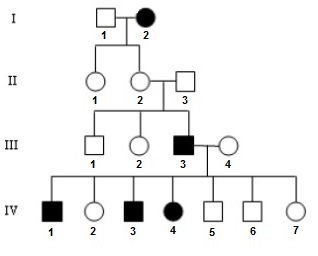
This pedigree represents the inheritance of hemophilia in this family. How many of the females have the hemophilia trait?
a)
8
b)
5
c)
2
d)
3
38.

What is this?
a)
Pedigree
b)
Karyotype
c)
Venn diagram
d)
Punnett Square
100 %

