
 Worksheets
Atmosphere and Weather Test
Total questions: 102
Worksheet time: 1hrs 23mins
Name
Class
Date
1.
Which gas in our atmosphere is most abundant?
a)
Argon
b)
Oxygen
c)
Nitrogen
d)
Carbon Dioxide
2.
The air in the troposphere has a greater density than the air in any other layer of the atmosphere,
a)
True
b)
False
3.
Temperature in the stratosphere warms as altitude increases.
a)
True
b)
False
4.
Temperature decreases as altitude increases in the Thermosphere.
a)
True
b)
False
5.
What is the percentage of oxygen in Earth's atmosphere?
a)
1%
b)
21%
c)
78%
d)
90%
6.
Which layer of the atmosphere contains the greatest amount of water vapor?
a)
Thermosphere
b)
Troposphere
c)
Mesosphere
d)
Stratosphere
7.
In which layer of the atmosphere does weather occur?
a)
Mesosphere
b)
Thermosphere
c)
Stratosphere
d)
Troposphere
8.
What decreases as you go up in the atmosphere?
a)
Altitude
b)
Atmosphere
c)
Meteors
d)
Air Pressure
9.
What is the lowest main layer of Earth's atmosphere?
a)
Thermosphere
b)
Troposphere
c)
Stratosphere
d)
Mesosphere
10.
What is the outer most main layer of Earth's atmosphere?
a)
Thermosphere
b)
Troposphere
c)
Stratosphere
d)
Mesosphere
11.
What is the second lowest main layer of Earth's atmosphere?
a)
Thermosphere
b)
Troposphere
c)
Stratosphere
d)
Mesosphere
12.

Where is the temperature the highest?
a)
1
b)
2
c)
3
d)
4
13.

Where is the air pressure the greatest?
a)
1
b)
2
c)
3
d)
4
14.

Where is the altitude the greatest?
a)
1
b)
2
c)
3
d)
4
15.
The layers of the atmosphere are classified according to changes in _________.
a)
altitude
b)
density
c)
composition
d)
temperature
16.
What are the 2 most abundant gases in Earth's atmosphere?
a)
carbon dioxide and oxygen
b)
carbon dioxide and nitrogen
c)
nitrogen and oxygen
d)
nitrogen and hydrogen
17.
James plans to climb to the top of Mount Everest. Which of the following statements about his climb will be the most accurate?
a)
Air pressure will rise and the temperature on a thermometer will increase.
b)
Air pressure will fall and the temperature on a thermometer will decrease.
c)
Air pressure will rise and the temperature on a thermometer will decrease.
d)
Air pressure and thermometer will not change.
18.
Which of the following is NOT a reason why the atmosphere is important?
a)
It is made of many layers.
b)
It provides gases living things need.
c)
It provides warm temperatures.
d)
It protects us from UV rays and meteors.
19.
Which of the following is the correct order of the atmosphere layers from Earth to space?
a)
troposphere, stratosphere, mesosphere, thermosphere, exosphere
b)
troposphere, mesosphere, thermosphere, exosphere, stratosphere
c)
thermosphere, stratosphere, mesosphere, troposphere, exosphere
d)
troposphere, stratosphere, mesosphere, exosphere, thermosphere
20.
The density of our atmosphere _____________ with an increase in altitude.
a)
Increases
b)
Gets greater
c)
Decreases
d)
Gets heavier
21.
Which layer protects the earth from meteors?
a)
Troposphere
b)
Stratosphere
c)
Mesosphere
d)
Thermosphere
22.
Which layer is the coldest?
a)
Troposphere
b)
Stratosphere
c)
Mesosphere
d)
Thermosphere
23.
Describe how the ozone layer protects the earth.
a)
Absorbs solar radiation, Protects Earth from UV Rays, and emits heat
b)
Ozone in the lower atmosphere is a pollutant
24.
Airplanes fly in which layers of the atmosphere?
a)
Troposphere, Stratosphere, and Mesosphere
b)
Stratosphere and Mesosphere
c)
Troposphere and Stratosphere
d)
Troposphere Stratosphere, Mesosphere, and Thermosphere
25.
As altitude increase, the air pressure
a)
does not change
b)
increases
c)
decreases
26.
The force that air exerts on all objects is called-
a)
density
b)
altitude
c)
infrared radiation
d)
air pressure
27.
Which layer of the atmosphere contains the ozone layer?
a)
Mesosphere
b)
Stratosphere
c)
Ionosphere
d)
Exosphere
28.
Which layer has the hottest molecules?
a)
Thermosphere
b)
Mesosphere
c)
Exosphere
d)
Stratosphere
29.
Which layer contains the ionosphere, a layer of charged particles, that interact with solar winds to cause the auroras?
a)
Exosphere
b)
Stratosphere
c)
Thermosphere
d)
Mesosphere
30.
Which layer protects humans from most of the harmful UV radiation received from the sun?
a)
Clouds
b)
Exosphere
c)
Ionosphere
d)
Ozone Layer
31.
The layers of the atmosphere are calssified according to changes in
a)
temperature and air pressure
b)
altitude and air quality
c)
humidity and temperature
d)
air pressure and oxygen
32.
A mixture of gases and particles that surround a planet, held by gravity is called the-
a)
greenhouse effect
b)
atmosphere
c)
jet stream
d)
blanket
33.
Which statement best describes the atmosphere.
a)
Made of only elements
b)
Made of only compounds
c)
Made of a mixture of elements and compounds
d)
Made of only metals
34.
Out of the following, choose the outermost layer of the atmosphere-
a)
Troposphere
b)
Thermosphere
c)
Stratosphere
d)
Mesosphere
35.

What does this symbol on a weather map indicate?
a)
High pressure system
b)
Low pressure system
c)
Cold front
d)
Warm front
36.

What does this symbol indicate on a weather map?
a)
High pressure system
b)
Low pressure system
c)
Cold front
d)
Warm front
37.
Which weather tool measures air pressure?
a)
thermometer
b)
barometer
c)
anemometer
d)
psychrometer
38.
This weather tool measures wind speed and direction
a)
thermometer
b)
barometer
c)
anemometer
d)
psychrometer
39.
Which weather tool measures temperature?
a)
thermometer
b)
barometer
c)
psychrometer
d)
anememeter
40.
The boundary between two air masses is known as:
a)
front
b)
storm
c)
climate
d)
flood
41.
Mark looks at the clouds in the sky and decides that he does not need to
take his umbrella with him today. Which clouds did Mark most likely see
in the sky?
take his umbrella with him today. Which clouds did Mark most likely see
in the sky?
a)
cirrus
b)
nimbostratus
c)
cumulonimbus
42.
Which type of cloud is most often observed during a thunderstorm?
a)
cirrus
b)
stratus
c)
cumulus
d)
cumulonimbus
43.

a)
nimbostratus cloud
b)
cumulonimbus cloud
c)
cirrocumulus cloud
d)
altostratus cloud
44.

name this front
a)
warm front
b)
cold front
c)
stationary front
d)
occluded front
45.

A _____ is a large, swirling, low-pressure system that forms over the Atlantic Ocean.
a)
blizzard
b)
cold front
c)
tornado
d)
hurricane
46.

A violently rotating column of air called a _____ when it comes in contact with the ground.
a)
hurrican
b)
tornado
c)
trade wind
d)
local wind
47.
Rain, snow, sleet, and hail are all forms of _____.
a)
precipitation
b)
condensation
c)
evaporation
d)
climate
48.
The amount of water vapor present in the air is called ________________.
a)
weather
b)
humidity
c)
air mass
d)
dew point
49.
When a warm air mass gently slides on top of a cold air mass, and you have drizzly rain and then warmer weather, what type of front is it?
a)
warm front
b)
cold front
c)
occluded front
d)
stationary front
50.
Located at the leading edge of a temperature drop off. Bring heavy thunderstorms, rain, and hail. Cool, fair weather is likely to follow.
a)
Warm Front
b)
Cold Front
c)
Occluded Front
d)
Stationary Front
51.
Located at the leading edge of a warm air mass. Brings gentle rain or light snow, followed by warmer, milder weather.
a)
Warm Front
b)
Cold Front
c)
Occluded Front
d)
Stationary Front
52.
Where the warm and cold air meet and stall, clouds and fog form, and it may rain or snow. It could bring many days of clouds and precipitation.
a)
Warm Front
b)
Cold Front
c)
Occluded Front
d)
Stationary Front
53.
When a cold front overtakes a warm front, the temperature drops as the warm air mass is cut off from the ground and pushed upward. It can bring strong winds and heavy precipitation.
a)
Warm Front
b)
Cold Front
c)
Occluded Front
d)
Stationary Front
54.

This is the symbol for a...
a)
Stationary Front
b)
Occluded Front
c)
Cold Front
d)
Warm Front
55.

Identify the type of front that is shown in the image.
a)
Occluded Front
b)
Cold Front
c)
Stationary Front
d)
Warm Front
56.

Identify the type of front that is shown in the image.
a)
Occluded Front
b)
Cold Front
c)
Stationary Front
d)
Warm Front
57.

Identify the type of front that is shown in the image.
a)
Occluded Front
b)
Cold Front
c)
Stationary Front
d)
Warm Front
58.

Identify the type of front that is shown in the image.
a)
Occluded Front
b)
Cold Front
c)
Stationary Front
d)
Warm Front
59.
A severe storm which involves a funnel cloud forming over land is:
a)
hurricane
b)
tornado
c)
thunderstorm
d)
blizzard
60.
A severe storm that involves winds over 119mph and forms over water is:
a)
tornado
b)
thunderstorm
c)
hurricane
d)
blizzard
61.
This severe weather involves lightning, rain, and possibly hail
a)
thunderstorm
b)
tornado
c)
hurricane
d)
blizzard
62.
This severe weather involves low temperatures and snow either falling or drifting
a)
hurricane
b)
thunderstorm
c)
tornado
d)
blizzard
63.
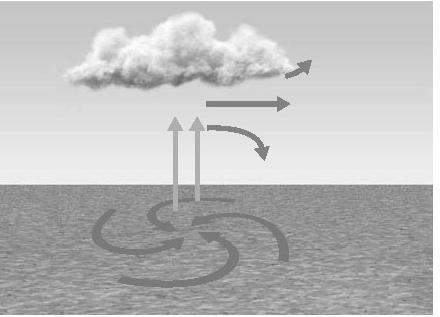
Which type of pressure system is pictured?
a)
high
b)
low
c)
medium
d)
none
64.
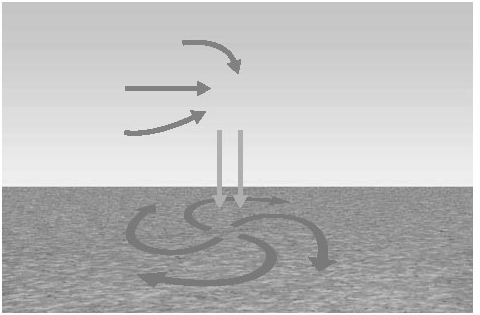
Which type of pressure system is pictured?
a)
high
b)
low
c)
medium
d)
none
65.
When air contains as much moisture as possible at a specific temperature, it is:
a)
at its dew point
b)
saturated
c)
at its dew point AND saturated
d)
none of the rest
66.
The temperature at which air is saturated and condensation forms is the:
a)
dew point
b)
rain point
c)
wind point
d)
relative humidity
67.
Why do hurricanes inflict more damage than tornadoes?
a)
they are larger
b)
longer duration
c)
also associated with flooding and strong rains
d)
all of the rest
68.
Cold air traveling south from Canada is:
a)
continental tropical
b)
continental polar
c)
maritime tropical
d)
maritime polar
69.
Warm air moving upwards from the Gulf of Mexico is:
a)
continental tropical
b)
continental polar
c)
maritime tropical
d)
maritime polar
70.
Warm air mass that does not carry water:
a)
continental tropical
b)
continental polar
c)
maritime tropical
d)
maritime polar
71.
Cold air mass that is carrying water is:
a)
continental tropical
b)
continental polar
c)
maritime tropical
d)
maritime polar
72.
This weather tool measures wind speed and direction
a)
thermometer
b)
barometer
c)
anemometer
d)
psychrometer
73.
Humidity is the...
a)
Amount of Water Vapor in the Air
b)
Amount of Wind in the Air
c)
Amount of Precipitation in the Air
d)
Amount of Pressure in the Air
74.
________________ are made of water vapor that condenses in the troposphere.
a)
dew
b)
clouds
c)
evaporation
d)
transpiration
75.
__________ a two-thermometer instrument slung around a rod or pole that is also referred to as a wet dry bulb used to measure relative humidity.
a)
thermometer
b)
barometer
c)
sling psychrometer
d)
anemometer
76.
Warm air near the Earth’s surface rises and then cools and drops, this creates a _________________ in the atmosphere.
a)
run-off
b)
Greenhouse Effect
c)
convection current
d)
water cylce
77.
Where does a hurricane form?
a)
Over a cold body of water
b)
Over a warm body of water
c)
Over cold land
d)
Over warm land
78.
What type of cloud looks like cotton and is in the lower altitudes?
a)
Cumulus
b)
Stratus
c)
Cirrus
79.
What is relative humidity?
a)
humidity that is related to other humidity
b)
condensation
c)
clouds
d)
the amount of water in the air compared to the amount of water the air can hold - a ratio
80.
If the air is only holding one-third as much moisture as it can possibly hold, what is the relative humidity?
a)
50%
b)
25%
c)
33%
d)
67%
81.
Which type of air has a relative humidity of 100%?
a)
space
b)
hot
c)
dry
d)
saturated
82.
If the dew point temperature is 20 °C and the relative humidity is 58 %, what is the dew point?
a)
5 degrees celsius
b)
12 degrees celsius
c)
15 degrees celsius
d)
38 degrees celsius
83.
A student using a weather instrument measured a wet-bulb temperature of 10 °C and a dry- bulb temperature of 16 °C. What was the dew point?
a)
-10 °C
b)
45 °C
c)
6 °C
d)
4 °C
84.
What is the dew point when the dry-bulb temperature is 12 °C and the wet-bulb temperature is 7 °C?
a)
1 °C
b)
-5 °C
c)
28 °C
d)
48 °C
85.
Air has a dry-bulb temperature of 2 °C and a wet-bulb temperature of -2 °C, what is the relative humidity?
a)
11%
b)
20%
c)
36%
d)
67%
86.
A dry-bulb temperature of 30°C and a wet-bulb temperature of 29°C were recorded at a weather station. What are the relative humidity and the most likely weather conditions?
a)
Relative humidity is 29% with clear skies
b)
Relative humidity is 29% with a good chance of snow
c)
Relative humidity is 93% with clear skies.
d)
Relative humidity is 93% with a good chance of rain.
87.
What is the dew point when the dry-bulb temperature is 8°C and the wet-bulb temperature is 2°C?
a)
28°C
b)
6°C
c)
3°C
d)
-9°C
88.
What is the dew point when the air temperature is 26°C and the relative humidity is 77%?
a)
3°C
b)
20°C
c)
22°C
d)
23°C
89.
What is the dew point when the dry-bulb temperature is 24°C and the wet-bulb temperature is 21°C?
a)
0°C
b)
10°C
c)
20°C
d)
100°C
90.
What is the dew point when the dry-bulb temperature is 24°C and the wet-bulb temperature is 21°C?
a)
16°C
b)
18°C
c)
20°C
d)
21°C
91.
If the air is "saturated", that means:
a)
the air is full of water
b)
the air is partially full of water
c)
it's amount of water vapor in the atmosphere right now
d)
how much liquid water it potentially can hold
92.
Water vapor is one of the components of the air in the atmosphere. What change causes the vapor in the air to form clouds?
a)
A. As air rises in the atmosphere, it becomes warmer and cannot hold as much water.
b)
B. As air cools, water vapor in the air condenses to liquid or solid state.
c)
C. Air rises, the water becomes heavier and changes form.
93.
As the air temperature increases, the air's capacity for water vapor:
a)
increases
b)
decreases
c)
remains the same
d)
is unrelated to air temperature and can either increase or decrease
94.

What direction is the cold front moving?
a)
Northwest
b)
Southeast
c)
Northeast
d)
Southwest
95.
A temperature of 100°C is equal to a temperature of
a)
370°K
b)
211°F
c)
212°F
d)
373°K
96.
A psychrometer is used to determine which weather variables?
a)
wind speed and wind direction
b)
percentage of cloud cover and cloud height
c)
air pressure and air temperature
d)
relative humidity and dewpoint
97.
The greatest chance of precipitation will occur if the air temperature and dew point are
a)
close together
b)
far apart
c)
the same
98.

In which city would a pressure of 1022 be possible?
a)
Boise
b)
Kansas City
c)
Austin
d)
Denver
99.
What is the dewpoint when the dry bulb temperature is 20°C and the relative humidity is 17%?
a)
–5°C
b)
11°C
c)
–2°C
d)
15°C
100.
An air temperature of 70°C is equal to
a)
345 K
b)
340 K
c)
158 °F
d)
160 °F
101.
Temperature decreases in which two layers of the atmosphere?
a)
stratosphere & thermosphere
b)
troposphere & mesosphere
c)
troposphere & stratosphere
d)
mesosphere & thermosphere
102.
In which layer of the atmosphere is most water vapor found?
a)
thermosphere
b)
mesosphere
c)
stratosphere
d)
troposphere
100 %

