
 Worksheets
science review
Total questions: 49
Worksheet time: 49mins
Name
Class
Date
1.
In a parasitic relationship, one organism is ___________ and one organism is benefiting.
a)
helped
b)
harmed
c)
not effected
d)
happy
2.
In a mutual relationship, both organisms are ________________.
a)
hurt
b)
not effected
c)
harmed
d)
benefiting
3.
Commensalism is where one organism is benefiting and the other organism is _____________________.
a)
not effected
b)
helped
c)
harmed
d)
hurt
4.

1. A bee and a flower work together to benefit each other. This is an example of _________________. The bee helps the flower by pollinating it and the flower helps the bee by providing it with nectar.
a)
commensal relationship
b)
parasitic relationship
c)
mutual relationship
5.
A dog is harmed by a tick when it sucks the dog’s blood. The tick is benefiting because it is getting nutrients from the dog. This is an example of a ________________.
a)
parasitic relationship
b)
mutual relationship
c)
commensal relationship
6.

When a dog and a tick are in a relationship. The dog is being harmed and the tick is benefiting. The tick is using the dog as it's ____________.
a)
harmer
b)
host
c)
parasite
7.

A clown fish and a sea anemone are in a close relationship. The sea anemone provides shelter and protection for the clown fish. However, the sea anemone is not harmed. This is an example of ______________________.
a)
commensalism
b)
parasitic relationship
c)
mutualism
8.

A tapir and a song bird work together to help each other find food. The tapir follows the sound of the song bird to the tree filled with sap. The tapir has sharp claws and is able to rip open the section of the tree that contains the sap. Without the tapir, the bird would not be able to access the sap for food. This is an example of a _________________ relationship.
a)
mutual
b)
commensal
c)
parasitic
9.

A tick is a parasite to a horse. Which statement best describes the relationship between the tick and the horse?
a)
a. The tick helps the horse get food.
b)
a. The tick harms the horse by feeding on its blood.
c)
a. The horse harms the tick by feeding on its blood.
d)
The tick does not affect the horse.
10.

A shark has barnacles that attach to his skin. The barnacles get a free ride from the shark. The shark is not helped by this relationship. This is an example of _________.
a)
commensalism
b)
parasitism
c)
mutualism
d)
competition
11.

Mrs. Bush’s cat has fleas. A flea is a parasite that gets its energy from Dante’s blood. How are the flea and the cat affected in this relationship?
a)
Both organisms are helped.
b)
Both organisms are not affected.
c)
One organism is helped and one organism is not effected.
d)
One organism is helped and another organism is harmed.
12.
Which is an example of commensalism?
a)
Two different kinds of organisms harming each other.
b)
Two different kinds of organisms are neither helping nor harming each other.
c)
One kind of organism is being helped, but the other one is not harmed or helped.
d)
One kind of organism is being helped, but the other is harmed.
13.

Lichens are made of fungi and algae that benefit from growing together. Which of these best describes this relationship?
a)
parasitic
b)
commensal
c)
competetive
d)
mutual
14.

Which organism do the owl and the weasel compete for in the food web?
a)
Hawk
b)
Spider
c)
Grasshopper
d)
Shrew
15.

Which of the following is a herbivore?
a)
cricket
b)
frog
c)
hawk
d)
shrew
16.

How many carnivores are shown in this food web?
a)
6
b)
4
c)
5
d)
3
17.
What might happen if you remove a primary consumer from the ecosystem?
a)
There would be more food for secondary consumers.
b)
The number of primary consumers would increase.
c)
The number of plants would increase.
d)
The number of secondary consumers would increase.
18.

Which of the following would be the most likely effect, if there were a sudden increase in the cricket population?
a)
There would be a decrease in the small bird population.
b)
There would be a decrease in the grass/flowers population.
c)
There would be a decrease in the mice population.
d)
There would be an increase in the grass/flowers population.
19.
A consumer that hunts is called:
a)
a producer.
b)
an omnivore.
c)
a predator.
d)
a herbivore.
20.

Which of the following best describes the small bird in the food web above?
a)
primary and secondary consumer
b)
secondary and tertiary consumer
c)
primary consumer only
d)
secondary consumer only
21.
A frog eats a fly. The frog and fly are demonstrating ________.
a)
mutualism
b)
competition
c)
predator/prey
d)
parasitism
22.
Which of the following best describes the small bird in the food web above?
a)
primary and secondary consumer
b)
secondary and tertiary consumer
c)
primary consumer only
d)
secondary consumer only
23.
A tick and a dog have this type of relationship.
a)
mutualism
b)
commensalism
c)
neutralism
d)
parasitism
24.
Plants both trying to get sunlight are
a)
commensalism
b)
mutualism
c)
compeition
d)
parasitism
25.
Example of a consumer
a)
worm
b)
bacteria
c)
mushroom
d)
hawk
26.
Example of a decomposer
a)
fungus
b)
mouse
c)
plants
d)
frogs
27.
A tree is a ....
a)
composer
b)
decomposer
c)
producer
28.
Humans are considered...
a)
consumers
b)
decomposers
c)
producers
29.
Worms are considered...
a)
producer
b)
consumer
c)
decomposer
30.

Where do all life forms get their energy?
a)
Earth's Core
b)
Water
c)
Plants
d)
The Sun
31.
The arrows in a food chain or web represents what?
a)
They point to the organism that is being eaten.
b)
It shows how sunlight flows within an ecosystem.
c)
They show what direction the energy is flowing between organisms.
d)
They represent how water is transferred within a habitat.
32.

What is this called?
a)
Food Web
b)
Food Chain
c)
Abiotic Factors
33.
If a frog is the prey, what could be the predator?
a)
Grass
b)
Insect
c)
Snake
d)
Snail
34.

In this food chain, what will happen if the frogs become extinct?
a)
The snakes will increase.
b)
The grasshoppers will decrease.
c)
The eagles will remain the same.
d)
The grasshoppers will increase.
35.

A food chain shows the transfer of ___ from one organism to another.
a)
matter
b)
consumers
c)
energy
d)
habitat
36.
Which of the following food chains shows the correct energy flow left to right?
a)
rabbit-coyote-grass
b)
grass-rabbit-coyote
c)
coyote-rabbit-grass
d)
grass-coyote-rabbit
37.
What is a PUSH or PULL of an object?
a)
Motion
b)
Force
c)
Friction
d)
Gravity
38.
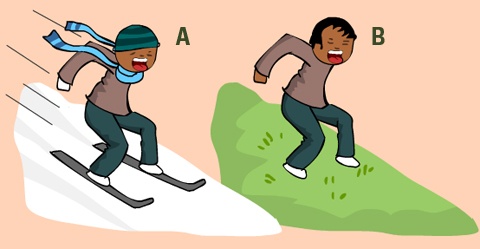
Why is it harder for the boy in Image B to get down the hill?
a)
Motion
b)
Friction
c)
Work
d)
Displacement
39.
Which force produces a change in motion?
a)
unbalanced force
b)
balanced force
c)
gravitational force
d)
frictional force
40.
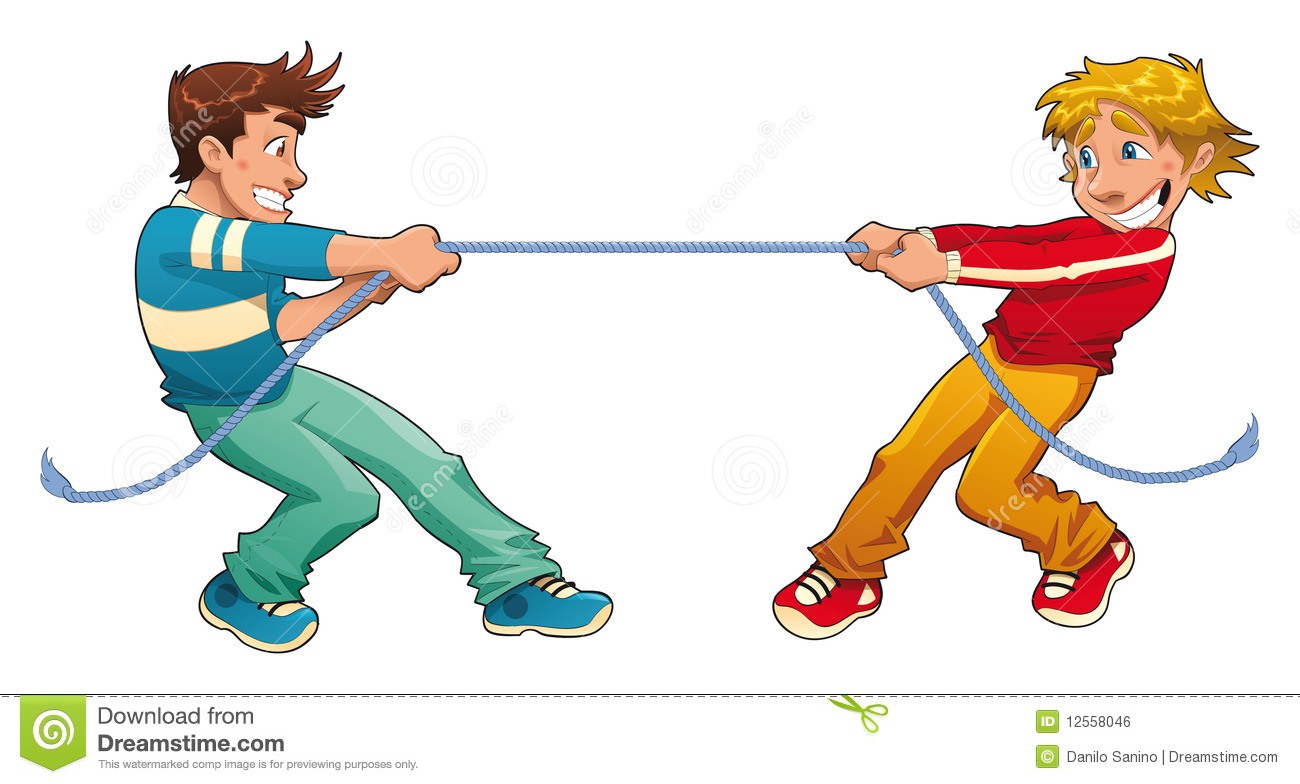
If these boys are pulling with the same amount of force. What will happen?
a)
The boy in blue will win.
b)
They will not move at all.
c)
The boy in red will win.
d)
Both will fall down.
41.
_______________ is how fast an object changes over time.
a)
speed
b)
velocity
c)
momentum
d)
acceleration
42.
What happens when two forces act in the same direction?
a)
They cancel each other out.
b)
The stronger one prevails.
c)
Their strengths are added.
d)
Their sum divided by the two is the total force.
43.
Any time the forces are unbalanced, an object will remain at rest. True or false?
a)
true
b)
false
44.
When you tell the direction and speed of an object, you give its
a)
motion
b)
velocity
c)
acceleration
d)
mass
45.
Which of the following statements is true?
a)
Balanced forces cause a change in motion.
b)
Unbalanced forces cause a change in motion.
c)
Forces do not effect the change in motion.
46.
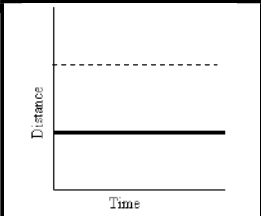
What does this graph represent?
a)
Constant speed
b)
Acceleration
c)
Not moving
47.
Speed is equal to
a)
Distance/Time
b)
Time/Distance
c)
Time x Distance
d)
Acceleration
48.

During which interval is the object speeding up?
a)
A to B
b)
B to C
c)
D to E
d)
E to F
49.

What is this graph showing?
a)
Constant Speed
b)
Acceleration (speeding up)
c)
Deceleration (slowing down)
d)
No motion
100 %

