
 Worksheets
Electricity and Magnetism
Total questions: 21
Worksheet time: 14mins
Name
Class
Date
1.

This is an example of a _______ circuit
a)
open
b)
series
c)
parallel
d)
square
2.
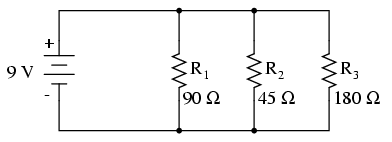
This is an example of a ______ circuit
a)
Series
b)
Parallel
c)
Open
d)
Dihexihedral
3.

What kind of circuit is this?
a)
Series
b)
Consecutive
c)
Parallel
d)
Training
4.
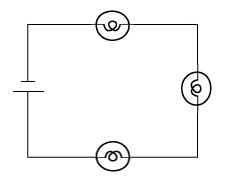
The picture shows an electrical circuit. This circuit is a series circuit because:
a)
It has 3 light bulbs.
b)
The same current flows through all three light bulbs.
c)
It uses a single battery.
d)
The electrical current is divided between the three light bulbs.
5.
wood is a _____?
a)
conductor
b)
insulator
6.
brass is a _____?
a)
insulator
b)
conductor
7.
A material in which electrons are able to move easily
a)
Circuit
b)
Insulator
c)
Resistance
d)
Conductor
8.

What will happen if one light bulb is removed from this circuit?
a)
The other bulbs will go out.
b)
The other bulbs will get brighter.
c)
The other bulbs will get dimmer.
d)
The battery will become stronger.
9.

This circuit does not work because…
a)
the bulbs are not connected properly
b)
the single cell is not powerful enough
c)
there is a break in the circuit
d)
there is a short crcuit
10.
Ms Jo Jo rubbed two balloons with a piece of wool. What will happen when the balloons are brought near each other?
a)
The balloons will repel each other.
b)
The balloons will attract each other.
c)
The balloons will become positively (+) charged.
d)
The balloons will pop.
11.
What is the major difference between static electricity and current electricity?
a)
Current electricity involves a continuous flow of neutrons; static electricity is a sudden transfer of protons
b)
Current electricity can be deadly; static electricity is almost always safe
c)
In current electricity, there's a single transfer of electrons; in static electricity, there's a steady flow of electrons
d)
Current electricity involves a flow of electrons; static electricity involves a single transfer of electrons
12.
Materials which can conduct electricity better than insulator,but not as well as conductors. This is the definition of
a)
diode
b)
semiconductor
c)
conductor
d)
insulator
e)
superconductor
13.

Diodes...
a)
allow current to flow in one direction
b)
allow current to flow in two directions
c)
are resistors
d)
give off light
14.
Semiconductors are used to make all of the following EXCEPT
a)
Solar cells
b)
TV remotes
c)
Transistor radios
d)
incandescent light bulbs
15.
Which component controls the flow of electricity by opening and closing the circuit?
a)
switch
b)
d cell
c)
wire coil
d)
core
16.
A _______________ is a current-carrying coil of wire with many loops
a)
electromagnet
b)
solenoid
c)
magnet
d)
compass
17.
The strength of a magnet can be changed by
a)
adding less loops to the coil.
b)
adding more loops to the coil.
18.
Electrical insulators have _________ resistance to the movement of electrons.
a)
high
b)
low
c)
no
19.
The coil of current-carrying wire with an iron core is called a(n)
a)
ferromagnet
b)
electromagnet
c)
compass
d)
maglev
20.
Magnetic field lines are closet together at the __________.
a)
poles
b)
lines
21.
What are magnets used for today?
a)
Electronics
b)
Computers
c)
Making Electricity
d)
All of these
100 %

