
 Worksheets
Food Webs and Adaptations Review
Total questions: 23
Worksheet time: 20mins
Name
Class
Date
1.

Which organism do the owl and the weasel compete for in the food web?
a)
Hawk
b)
Spider
c)
Grasshopper
d)
Shrew
2.

Which of the following is a herbivore?
a)
cricket
b)
frog
c)
hawk
d)
shrew
3.
What might happen if you remove a primary consumer from the ecosystem?
a)
There would be more food for secondary consumers.
b)
The number of primary consumers would increase.
c)
The number of plants would increase.
d)
The number of secondary consumers would increase.
4.

Which of the following would be the most likely effect, if there were a sudden increase in the cricket population?
a)
There would be a decrease in the small bird population.
b)
There would be a decrease in the grass/flowers population.
c)
There would be a decrease in the mice population.
d)
There would be an increase in the grass/flowers population.
5.
A consumer that hunts is called:
a)
a producer.
b)
an omnivore.
c)
a predator.
d)
a herbivore.
6.

Which of the following best describes the small bird in the food web above?
a)
primary and secondary consumer
b)
secondary and tertiary consumer
c)
primary consumer only
d)
secondary consumer only
7.
The space, conditions and all the living and non-living things around an organism is its _________________.
a)
home
b)
environment
c)
neighborhood
d)
ecosystem
8.
An organism that hunts and feeds on another organism is a ______________________.
a)
prey
b)
producer
c)
predator
d)
decomposer
9.
An animal that is hunted as food
a)
prey
b)
predator
c)
decomposer
d)
producer
10.
An inherited trait that helps those organisms that have it to survive
a)
niche
b)
structure
c)
characteristic
d)
adaptation
11.

Coloring or another physical characteristic that help an organism blend in with its environment
a)
mimicry
b)
camouflage
c)
hibernation
d)
migration
12.
A natural process in which new organisms are created and the species continues
a)
population
b)
niche
c)
reproduction
d)
behavior
13.

The role an organism plays in its ecosystem
a)
niche
b)
behavior
c)
structure
d)
function
14.

When an organism copies a characteristic of something else in order to better its chances for survival and reproduction
a)
hibernation
b)
camouflage
c)
mimicry
d)
migration
15.
An example of a physical adaptation is...
a)
a turtle hiding inside its shell
b)
The spikes on a porcupine fish
c)
a rabbit burrowing underground
d)
a viper biting when threatened
16.
Which adaptation would NOT help a hawk catch a mouse?
a)
Hollow Bones
b)
Good eye sight
c)
Talons
d)
Camouflage
17.

Which feature helps an animal hide from other animals?
a)
looking like a dangerous animal
b)
being the same color as the place it lives (camoflauge)
c)
having sharp claws or a strong shel
d)
having only a few young and caring for them
18.

The Prickly Pear Cactus can grow in a dry environment because.....
a)
it is able to story water
b)
it has spiny leaves
c)
is carnivorous
d)
collects salt
19.
What is the scientific term for an animal that is eaten by another animal?
a)
predator
b)
dinner
c)
prey
d)
stupid
20.
A trait that helps a living thing survive.
a)
instinct
b)
mimicry
c)
camouflage
d)
adaptation
21.
Which adaptation (for the underlined animal) serves the function of defense?
a)
A walking stick looks like the twig on which it rests.
b)
A porcupine’s quills cause a predator to seek another meal.
c)
A whale filters plankton and krill from the water in which it swims.
d)
A penguin is dark on top and white below to blend in with the water.
22.

What is the order of succession shown in this figure?
a)
A, B, C, D
b)
B, A, D, C
c)
C, D, A, B
d)
D, A, B, C
23.
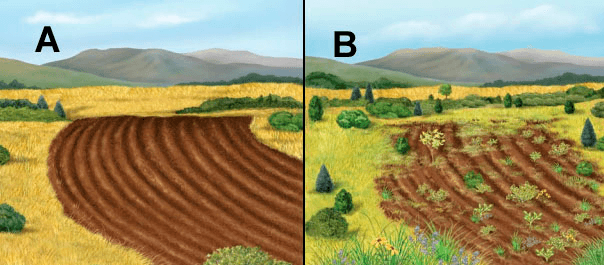
What type of succession is shown going from figure A to figure B?
a)
primary succession
b)
ecological succession
c)
secondary succession
d)
intermediate
100 %

