wayground logo

Free Printable Worksheets

Font size

S
M
L
XL
Worksheets

GSCE CHEMISTRY UNIT 1 YEAR 10

Total questions: 211

Worksheet time: 3hrs 11mins

Name
Class
Date
1.
The basic unit of matter is
a)
a mixture
b)
a substance
c)
an atom
d)
a compound
2.
Carbon and oxygen atoms can combine to form the gas called carbon dioxide.
a)
is a molecule, so it no longer has atoms
b)
is a molecule made of atoms
c)
has atoms, so it is not a molecule
d)
is a new kind of atom
3.
A substance that contains only one type of atom is a(n)
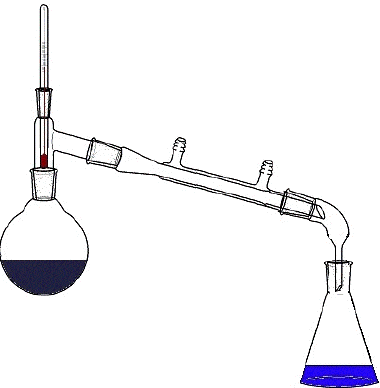
a)
compound
b)
element
c)
heterogeneous mixture
d)
homogeneous mixture
4.
Which of these is a pure substance?
a)
bread
b)
table salt
c)
garden soil
d)
sea water
5.
Which of these is an example of a molecule?
a)
a small nugget of pure gold
b)
the smallest grain of salt in a salt shaker
c)
 a small drop of sugar water
d)
two oxygen atoms joined to a carbon atom
6.
Which of these is not an example of a molecule?
a)
CH4
b)
C
c)
C6H12O6
d)
H2O
7.
Which of these is a mixture?
a)
Uncooked chocolate chips and cookie dough blended together with a spoon.
b)
Distilled water
c)
A nugget of gold
d)
A molecule of Oxygen
8.
Atoms of an element always have a certain number of
a)
neutrons
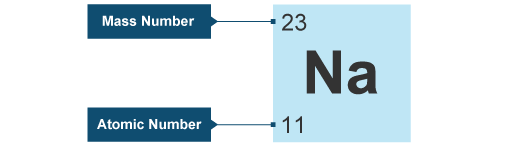
b)
protons
c)
electrons
d)
ions
9.
Two or more elements chemically combined:
a)
an atom
b)
a compound
c)
a mixture
d)
a pure substance
10.
Which of the following would be an example of a chemical equation?
a)
C6H12O6
b)
2 H2+ O2 -> 2 H2O
c)
F= ma
d)
H2O
11.
Which of the following would be an example of a chemical formula:
a)
C6H12O6
b)
F= ma
c)
2 H2 + O2 -> 2 H2O
d)
6.02 x 10 23
12.
What molecule is this? 
a)
Carbon Dioxide
b)
Methane
c)
Water
d)
Sodium Chloride 
13.
What molecule is this? 
a)
Carbon Dioxide
b)
Methane
c)
Water
d)
Sodium Chloride 
14.
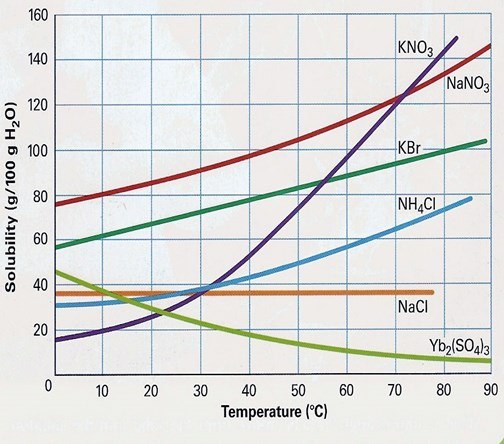
What molecule is this? 
a)
Carbon Dioxide
b)
Methane
c)
Water
d)
Sodium Chloride 
15.
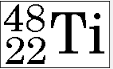
How many protons does this isotope of titanium have?
a)
48
b)
22
c)
26
d)
70
16.
How many neutrons does the isotope of lithium have?
a)
8
b)
3
c)
4
d)
5
17.
What do these isotopes of carbon all have in common?
a)
neutrons & mass number
b)
atomic number and neutrons
c)
atomic number and electrons
d)
protons, atomic number, and mass number
18.
In a correctly written symbol what would be located in the "A" position?
a)
number of neutrons
b)
atomic number
c)
number of electrons 
d)
mass number
19.
What quantities vary between isotopes of an element?
a)
protons, electrons, and atomic mass
b)
protons, electrons, and atomic number
c)
neutrons and electrons
d)
neutrons and atomic mass
20.
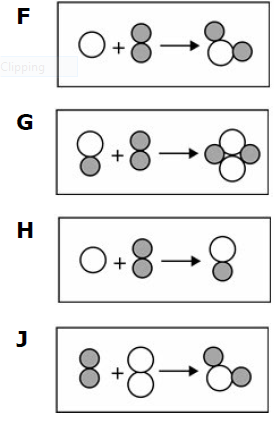
Which of the following models best demonstrates a balanced chemical equation?
a)
F
b)
G
c)
H
d)
J
21.
The formula below represents the most common carbohydrate known as glucose. Which information can be determined from the chemical formula?
C6H12O6
a)
The structural arrangement of the atoms in a glucose molecule
b)
The color of a glucose molecule
c)
The size of a glucose molecule
d)
The number of atoms of each element in a glucose molecule
22.

How many atoms in all are in a molecule of serotonin?

C10H12N2O

a)
22
b)
24
c)
25
d)
4
23.
Evidence of a chemical reactions is anything that shows - 
a)
a new substance has formed
b)
a solid dissolved in a liquid
c)
interaction between 2 gases
d)
a change in the state of matter
24.
One of the signs of a chemical reaction taking place is:
a)
Bubbles are produced 
b)
Reactants are not combining
c)
Products are not forming
d)
Color is not changing
25.
Which of the following describes a precipitate?
a)
a liquid forms when a block of metal is heated
b)
a solid forms when one liquid is poured into another
c)
a gas forms when a solid is placed in a liquid
d)
bubbles form when an acid is poured on a rock
26.
Which is NOT an indication of a chemical change?
a)
temperature change
b)
formation of a precipitate
c)
shape change
d)
production of light
27.
You know you a chemical reaction has occurred if 
a)
there is a precipitate.
b)
there is a color change.
c)
there is a temperature change.
d)
All of these answers are evidence.
28.
A clear liquid from a flask is poured into another clear liquid in a beaker. Which of the following results of this procedure would indicate a new substance was formed?
a)
The level of the substance in the beaker is higher after the other liquid is added.
b)
A yellow solid forms and then settles to the bottom of the beaker.
c)
Small white crystals are left behind in the flask that held the first liquid.
d)
The mass of the combined liquids is greater than either original liquid.
29.
In an exothermic reaction, heat is ...
a)
taken in
b)
given out
30.
Two or more substances that are mixed together but not chemically combined is a ___
a)
compound
b)
mixture
c)
keratin
d)
chromatography
31.
The physical separation of mixtures into individual components is..
a)
chromatography
b)
opacity 
c)
latent
d)
trace evidence 
32.

Ink can be separated by a method of -----------------------------------------------

a)

distillation

b)

filtration

c)

chromatography

d)

sedimentation

33.
chromatography separates the mixture of dyes on the basis of their ----------------------------
a)
density
b)
solubility
c)
gravity
d)
boiling point
34.
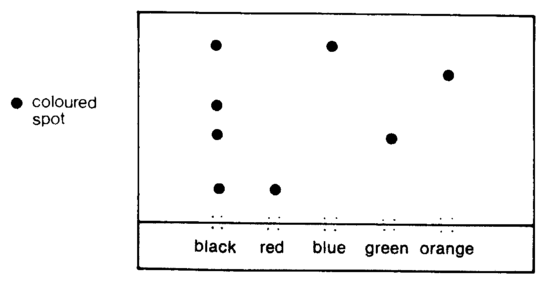
On the chromatogram given -------------- is mixture.
a)
red
b)
orange
c)
green
d)
black
35.
A pure substance shows ------------------ spot on chromat gram
a)
0
b)
1
c)
2
d)
3
36.

What is the first step in the process of distillation?

a)

Collecting the distillate

b)

Heating a mixture to boiling point

c)

Passing vapor through the condenser

d)

Reducing the temperature of a mixture

37.

Distillation is used to separate mixtures on the basis of what physical property?

a)

Freezing point

b)

Boiling point

c)

Cooling point

d)

Heating point

38.

Where does evaporation take place?

a)

In the beaker

b)

In the conical flask

c)

In the condenser

d)

None of the above

39.
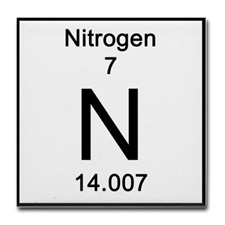
What is the number of protons that the element in this image contain?
a)
14
b)
7
c)
15
d)
18
40.
The first energy level can hold up to how many electrons?
a)
8
b)
4
c)
2
d)
5
41.
What is the atomic mass of "F"
a)
9
b)
18
c)
17
d)
19
42.
The positive particles of an atom are 
a)
electrons 
b)
positrons 
c)
neutrons 
d)
protons 
43.
the central region of an atom where its neutrons and protons are is its 
a)
nucleus 
b)
electron cloud
c)
core 
d)
center 
44.
an atom with atomic number 6 would have how many protons 
a)
6
b)
12
c)
3
d)
cannot be determined 
45.
Particles in an atom that are neutral and have no charge are 
a)
negatrons 
b)
electrons 
c)
neutrons 
d)
protons 
46.
An atoms overall charge is 
a)
positive 
b)
depends on its mood 
c)
neutral 
d)
negative 
47.
Which of the following is a negatively charged subatomic particle?
a)
Electron
b)
Proton
c)
Neutron
d)
Quark
48.
The particles that are found in the nucleus of an atom are
a)
neutrons and electrons
b)
electrons only
c)
protons and neutrons
d)
protons and electrons
49.
The atomic number of an elements is the total number of which particles in the nucleus?
a)
neutrons
b)
protons
c)
electrons
d)
protons and electrons
50.
Where are electrons of an atom found?
a)
Nucleus
b)
Electron Cloud
c)
Some are in the nucleus and some in the electron cloud.
d)
They are moving everywhere.
51.
"C" is the element symbol for which element?
a)
calcium
b)
carbon
c)
chlorine
d)
cadmium
52.
What is the atomic symbol for sodium?
a)
Na
b)
So
c)
NaCl
d)
S
53.
What is the atomic number for an element with three protons?
a)
2
b)
1
c)
3
d)
6
54.
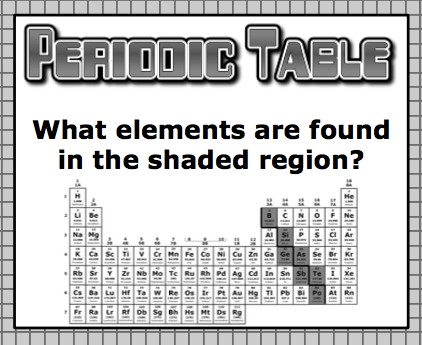
a)
Periods
b)
Groups
55.
a)
Periods
b)
Groups
56.
a)
energy levels
b)
valence electrons
c)
protons
d)
neutrons
57.
a)
energy levels
b)
valence electrons
c)
protons
d)
neutrons
58.
a)
Same group
b)
Same period
59.
a)
Group 1
b)
Group 17
c)
Group 2
d)
Group 18
60.
a)
Group 1
b)
Group 17
c)
Group 18
d)
Group 2
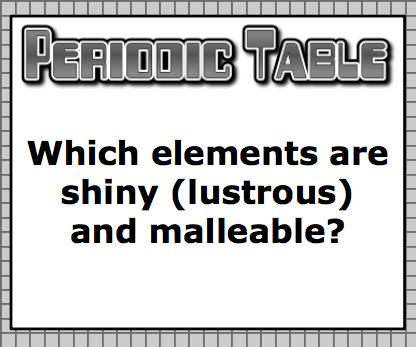
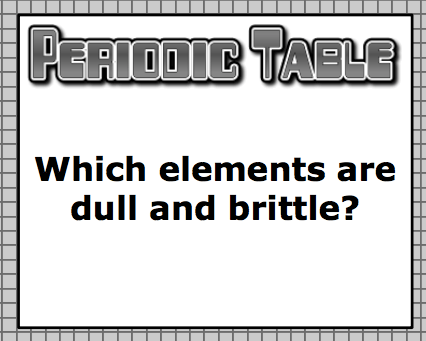
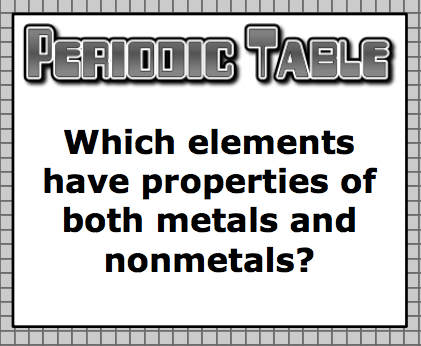
61.
a)
Metals
b)
Nonmetals
c)
Metalloids
62.
a)
Metals
b)
Nonmetals
c)
Metalloids
63.
a)
Metals
b)
Nonmetals
c)
Metalloids
64.
a)
Metals
b)
Nonmetals
c)
Metalloids
65.
a)
Metals
b)
Nonmetals
c)
Metalloids
66.
a)
Metals
b)
Nonmetals
c)
Metalloids
67.
a)
Metals
b)
Nonmetals
c)
Metalloids
68.

Which alkali metal has the electron configuration 2.8.1

a)

Sodium

b)

Potassium

c)

Lithium

d)

Rubidium

69.

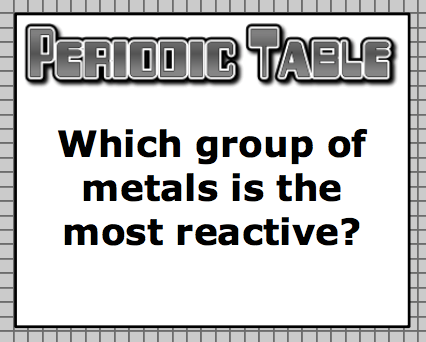
Which alkali metal is most reactive out of the following

a)

rubidium

b)

potassium

c)

sodium

d)

lithium

70.

How many electrons do the alkali metals have in their outer shell?

a)

1

b)

2

c)

8

d)

7

71.

What happens to the reactivity of the alkali metals as you move down the group?

a)

increases

b)

decreases

72.

What happens to the atomic radius of the alkali metals as you move down the group?

a)

increase

b)

decrease

73.

Which alkali metal has the symbol Cs

a)

Caesium

b)

Ceasium

c)

Calcium

d)

Sodium

74.

Is hydrogen an alkali metal?

a)

no

b)

yes

c)

maybe

75.

What is the name of the product formed when lithium reacts with chlorine?

a)

Lithium chloride

b)

Lithium chlorine

c)

Lithium chlorate

d)

Lithium oxide

76.

What is the formula of a group 1 metal hydroxide?

a)

MOH

b)

M2OH

c)

M(OH)2

d)

MO

77.

Which alkali metal reacts with water to produce a violet flame?

a)

K

b)

Na

c)

Li

d)

DuNo

78.

What happens to the melting point of the alkali metals as you move down the group?

a)

decreases

b)

increases

79.

Which gas is released when the alkali metals react with water?

a)

hydrogen

b)

oxygen

c)

hydroxide

d)

carbon dioxide

80.

How does a group 1 metal atom form an ion?

a)

lose 1 electron

b)

lose 2 electrons

c)

gain 1 electron

d)

gain 2 electrons

81.

Which of the following is NOT a property of group 1 metals?

a)

More dense than water

b)

less dense than water

c)

low melting point

d)

soft

82.

What happens to the colour of water when an alkali metal reacts with it?

a)

Remains colourless

b)

Turns blue/purple

c)

Turns red

d)

Turns green

83.

What is the formula of hydrogen gas?

a)

H2

b)

H

c)

h2

d)

h

84.

Which alkali metal has the electron configuration 2.1?

a)

lithium

b)

potassium

c)

sodium

d)

rubidium

85.

Which alkali metal forms a molten ball when reacting with water?

a)

Li

b)

Na

c)

K

86.

Which alkali metal is the least reactive?

a)

lithium

b)

sodium

c)

potassium

d)

rubidium

87.

What is the formula of a group 1 metal oxide?

a)

M2O

b)

MO

c)

MO2

d)

Mo

88.

How many protons does a sodium atom have?

a)

11

b)

23

c)

12

89.

Where are the"Halogens" located in periodic table?

a)

In 1A group

b)

In 2A group

c)

In 7A group

d)

In 8A group

90.

Which of the "Halogens" is found in liquid state at room temperature?

a)

Flourine

b)

Astatine

c)

Iodine

d)

Bromine

91.

Which of the "Halogens" has yellowish green color?

a)

Chlorine

b)

Bromine

c)

Flourine

d)

Iodine

92.

Which of the "Halogens" could able to make the strongest ionic bond with Sodium metal?

a)

Iodine

b)

Bromine

c)

Chlorine

d)

Flourine

93.

Which of the followings is not a use of Chlorine?

a)

Swimming pool cleaner

b)

Drinking water disinfectant agent

c)

Sterilizer for surgeries and medical tools

d)

Beaching fabrics and papers

94.

Which "Halogen" can able to replace Chlorine in Sodium Chloride?

a)

Flourine

b)

Bromine

c)

Iodine

d)

Astatine

95.

Which of the "Halogens" is produced in electrolysis of brine solution?

a)

Chlorine

b)

Flourine

c)

Iodine

d)

Bromine

96.
The name given to the rows of the Periodic Table
a)
Groups
b)
sections
c)
clusters
d)
Periods
97.
This group of elements react with metals to form salts. The react so quickly that they occur in nature as compounds
a)
Actinides
b)
Halogens
c)
Alkali Earth
d)
Lanthanides
98.
This family is HIGHLY reactive and do not occur freely in nature. These metals are very soft and the least dense
a)
Halogen
b)
Alkali metals
c)
Alkali Earth Metals
d)
Noble Gases
99.
The Group 7 elements are all..
a)
metals
b)
non-metals
c)
metalloids
100.
At room temperature, iodine is a....
a)
Gas
b)
Liquid
c)
Solid
101.
At room temperature, chlorine is...
a)
a yellow-green gas
b)
a brown gas
c)
a yellow-green liquid
102.
What colour is bromine?
a)
orange-brown
b)
orange-red
c)
yellow-green
d)
yellow
103.
What state is fluorine at room temperature?
a)
solid
b)
liquid
c)
gas
104.
As you go down the group, the melting points
a)
increase
b)
decrease
105.
The total number of protons and neutrons in an atom is called the...
a)
Atomic number
b)
Proton number
c)
Mass number
d)
Weight number
106.
Is this atom neutral?
a)
Yes, because the protons = neutrons
b)
Yes, because the protons = electrons
c)
No, because the outside ring is not full
d)
No, it is missing electrons
107.
Flame colour for calcium ions
a)
Blue
b)
Brick Red
c)
Green
d)
Yellow
108.
Flame colour for sodium ions
a)
Blue
b)
Red
c)
Green
d)
Yellow
109.
Flame colour for lithium ions
a)
Blue
b)
Crimson
c)
Green
d)
Yellow
110.
Metal ion with a lilac flame
a)
Na+
b)
K+
c)
Na2+
d)
K2+
111.
Colour of precipitate when sodium hydroxide is added to a copper(II) ion solution.
a)
White
b)
Brown
c)
Green
d)
pale Blue
112.
Colour of precipitate when sodium hydroxide is added to a iron(II) ion solution.
a)
White
b)
Brown
c)
Green
d)
Blue
113.
Colour of precipitate when sodium hydroxide is added to a iron(III) ion solution.
a)
White
b)
Reddish-Brown
c)
Green
d)
Blue
114.
Test for bromide ions is....
a)
Add hydrochloric acid. creamy precipitate 
b)
Add barium chloride, creamy precipitate 
c)
Add nitric acid then silver nitrate, creamy precipitate 
115.
Test for carbonate ions is....
a)
Add acid, test CO2 gas with limewater
b)
Add barium chloride, test CO2 gas with limewater
c)
Add silver nitrate, test CO2 gas with limewater
116.
Test for sulphate ions is....
a)
Add acid only. forms white precipitate that is insoluble in the acid
b)
Add barium chloride and then some acid. forms white precipitate that is insoluble in the acid
c)
Add silver nitrate and then some acid . forms white precipitate that is insoluble in the acid
117.
Flame colour for Barium ions
a)
blue streaks
b)
brick Red
c)
apple Green
d)
Yellow
118.
When Potassium bromide is mixed with silver nitrate what happens?
a)
White precipitate
b)
cream precipitate
c)
lilac colour
d)
no change
119.
5. How do you test for Carbon Dioxide gas?
a)
a) Lime water goes milky/cloudy
b)
b) Relights a glowing splint
c)
c) Lighted splint gives a squeaky pop.
d)
d) Bleaches damp indicator paper.
120.
6. How do you test for Oxygen gas?
a)
a) Lime water goes milky/cloudy
b)
b) Relights a glowing splint
c)
c) Lighted splint gives a squeaky pop.
d)
d) Bleaches damp indicator paper.
121.
7. How do you test for Hydrogen gas?
a)
a) Lime water goes milky/cloudy
b)
b) Relights a glowing splint
c)
c) Lighted splint gives a squeaky pop.
d)
d) Bleaches damp indicator paper.
122.
Which of these is not a noble gas?
a)
Helium
b)
Argon
c)
Nitrogen
d)
Krypton
123.

6.15: Which of these is not a property of noble gases?

a)

Colourless

b)

Odourless

c)

Flammable

d)

Gas at room temperature

124.
True or false: Noble gases react with water
a)
True
b)
False
125.
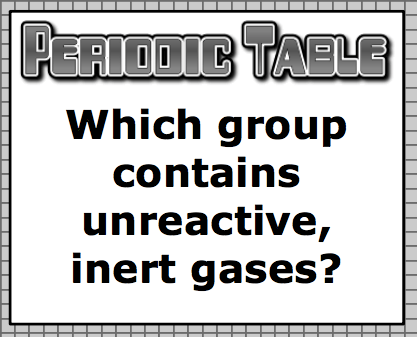
Name the group that contains inert (nonreactive) elements.
a)
noble gases
b)
halogens
c)
alkali metals
d)
alkaline earth metals
126.
In which group would you find the Noble Gases?
a)
5
b)
6
c)
7
d)
8
127.
Which of these could have been used in the Hindenburg rather than hydrogen?
a)
Argon
b)
Krypton
c)
Neon
d)
Helium
128.
What is the first step in the water treatment process?
a)
coagulation
b)
filtration
c)
flocs
d)
concentation
129.
What does chlorination do to the water?
a)
Removes microorganisms
b)
Cleans the water
c)
Makes the water taste nice
d)
Removes twigs and sediment
130.
Why is fluoride added to the water?
a)
to kill the bacteria
b)
to raise the pH
c)
to prevent cavities
d)
to improve the taste of water
131.
This process kills germs and bacteria and makes water safe to drink
a)
Sedimentation
b)
Chlorination
c)
Carbonation
d)
Filtration
132.
This process uses activated carbon to remove smaller insoluble particles from water
a)
Sedimentation
b)
Chlorination
c)
Carbonation
d)
Filtration
133.
This process uses aluminium sulfate and lime to remove larger insoluble particles
a)
Sedimentation
b)
Chlorination
c)
Carbonation
d)
Filtration
134.
Which process is the first step after twigs and large objects have been removed by metal grills?
a)
Sedimentation
b)
Chlorination
c)
Carbonation
d)
Filtration
135.
Which procedure follows sedimentation?
a)
Saltification
b)
Chlorination
c)
Carbonation
d)
Filtration
136.
Which procedure follows filtration?
a)
Sedimentation
b)
Chlorination
c)
Carbonation
d)
Floculation
137.
What name is given to the large storage lakes that water is stored in?
a)
Toilets
b)
Reservoirs
c)
Rivers
d)
Ponds
138.
What word means the solid particles that have settled out during the sedimentation process.
a)
sediment
b)
solubility
c)
settlement
d)
solidifying
139.
At what stage is aluminium sulfate added?
a)
Storage
b)
Sedimentation
c)
Filtration
d)
Chlorination
140.
The water cycle changes weather and creates rain.
a)
True
b)
False
141.
What is the process where water at the surface turns into water vapors?
a)
Sublimation
b)
Evaporation
c)
Condensation
d)
Precipitation
142.
________  includes all the policies, strategies and activities to sustainably manage the natural resource of fresh water, to protect the hydrosphere, and to meet the current and future human demand.
a)
Sublimation
b)
Infiltration
c)
Water Conservation
d)
Runoff
143.
Can you separate salt from water using filtration?
a)
yes
b)
no
144.
Water and alcohol are easily separated by distillation because of their
a)
 different melting points
b)
different colours
c)
different densities
d)
different boiling points
145.

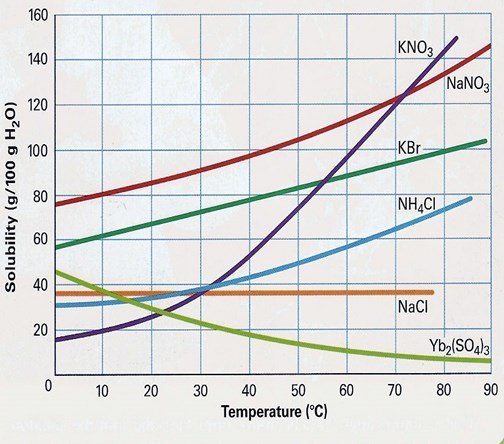
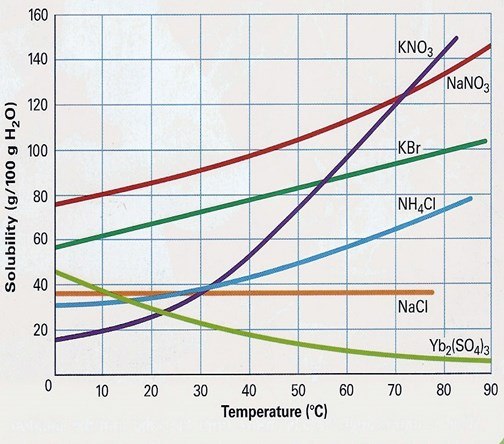
At 30'C, which substance has the lowest solubility?

a)

KNO3

b)

KBr

c)

NaCl

d)

Yb2(SO4)3

146.

At which temperature do KBr and KNO3 have the same solubility?

a)

60

b)

55

c)

50

d)

Never

147.

At 80'C, KBr's solubility is:

a)

100

b)

90

c)

80

d)

0

148.

How could you change a saturated solution to an unsaturated solution?

a)

Add solvent

b)

Add solute

149.

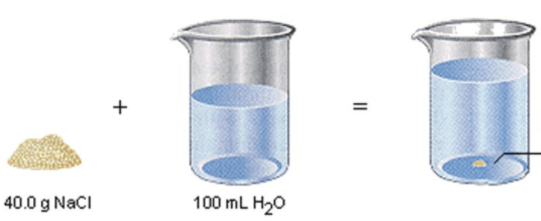
Identify the saturation associated with the product of this experiment.

a)

Unsaturated

b)

Saturated

c)

Supersaturated

150.

Identify a method to decrease the dissolving rate of a solution:

a)

decrease the temperature

b)

add KE

c)

stir the solution

d)

increase the temperature

151.
Hard water contains which ions?
a)
Calcium and Manganese
b)
Calcium and Magnesium
c)
Carbon and Manganese
d)
Carbon and Magnesium
152.
Which of the following is a problem with hard water?
a)
Formation of scum
b)
Formation of slime
c)
Lemonscale
d)
Too many bubbles
153.
What is a pro of hard water?
a)
Can protect against liver problems
b)
Can protect against lung problems
c)
Good for headaches
d)
Good for your teeth and bones
154.
What are the 3 methods for treating hard water?
a)
Boiling, adding Lithium carbonate, Atom exchange
b)
Heating, adding Calcium carbonate, Atom exchange
c)
Boiling, adding Calcium carbonate, Ion exchange
d)
Heating, adding Lithium carbonates, Ion exchange
155.
Which compositional layer is made of iron and some nickel?
a)
crust
b)
mantle
c)
core
156.
Which physical layer is the thinnest?
a)
crust
b)
mantle
c)
core
157.
Which layer of the core is solid?
a)
inner
b)
outer
158.
Which layer is made up of iron and nickel?
a)
Crust
b)
Mantle
c)
Inner Core
d)
Lithosphere
159.
What are the two types of crust?
a)
top crust,bottom crust
b)
oceanic crust, continental crust
c)
water,land
d)
none of the above 
160.
What is the correct layers of the earth starting with the surface?
a)
crust, outer core, inner core, mantle
b)
mantle, outer core, inner core ,crust
c)
crust, mantle, outer core, inner core
d)
outer core, inner core , crust, mantle
161.
Which layer of Earth is liquid metal?
a)
Outer Core
b)
Mantle
c)
Inner Core
d)
Asthenosphere
162.
The type of plate boundary where two plates come together is a .....
a)
Convergent Boundary
b)
Divergent Boundary
c)
Transform Boundary
d)
Plate Boundary
163.
Which of the following causes Earth's tectonic plates to move?
a)
Energy from the Sun
b)
Magnetic Pole Reversal
c)
Convection currents in the mantle
d)
Faults in Mountain Ranges
164.
What type of plate boundary is this?
a)
Plate
b)
Divergent
c)
Convergent
d)
Transform
165.
What type of event will occur at this boundary?
a)
Earthquake
b)
Volcano Eruption
c)
Tornado
d)
Mountain Building
166.
A divergent boundary occurs when plates ....
a)
Pull apart
b)
Come together
c)
Slide past each other
d)
subducting
167.
Which of the following is the name of the ancient supercontinent formed 28 Million Years ago.
a)
Pangea
b)
Gondwanda
c)
Laurasia
d)
Neverland
168.
The theory that says Earth's continents once made up an ancient supercontinent, and have been drifting apart ever since, is called the theory of...
a)
Pangea
b)
Plate Tectonics
c)
Natural Selection
d)
Gravity
169.
Islands can from from magma which is pushed up at a __________ plate boundary
a)
Divergent
b)
Convergent
c)
Transform
170.
Mountains are created when....
a)
Two continental plates collide
b)
Two oceanic plates pull apart
c)
An Oceanic plate subducts under a Continental Plate
d)
Two continental plates pull apart
171.
Which gas in our atmosphere is most abundant?
a)
Argon
b)
Oxygen
c)
Nitrogen
d)
Carbon Dioxide
172.
What percentage of our atmosphere is made up of other gases such as argon, water vapor, and carbon dioxide?
a)
1%
b)
21%
c)
78%
d)
90%
173.
What is the percentage of oxygen in Earth's atmosphere?
a)
1%
b)
21%
c)
78%
d)
90%
174.
What is the percentage of nitrogen in Earth's atmosphere?
a)
1%
b)
21%
c)
78%
d)
90%
175.
What are the 2 most abundant gases in Earth's atmosphere?
a)
carbon dioxide and oxygen
b)
carbon dioxide and nitrogen
c)
nitrogen and oxygen
d)
nitrogen and hydrogen 
176.
What two elements made up the early atmosphere?
a)
Nitrogen and Oxygen
b)
Carbon Dioxide and Oxygen
c)
Hydrogen and Helium
d)
Water Vapor and Oxygen
177.
Has the Earth's atmosphere remained constant throughout time?
a)
Yes
b)
No
178.
What produced oxygen within the early stages of our atmosphere?
a)
Plants
b)
Volcanos
c)
Galactic Debris
d)
Bacteria
179.
The second atmosphere, volcanoes appeared and released ________ and _____________.
a)
water and oxygen
b)
carbon dioxide and nitrogen
c)
nitrogen and water
d)
Helium and carbon dioxide
180.
The first plant was ______________.
a)
kelp
b)
seaweed
c)
blue-green algae
d)
pine tree
181.
What's the key in making oxygen for animals to survive? 
a)
water
b)
sunlight
c)
the moon
d)
plant respiration
182.
The greenhouse gas having the greatest role in human-caused global warming is
a)
methane
b)
carbon dioxide
c)
CFCs (chlorofluorocarbons)
d)
ozone
183.
As greenhouse gases increase, oceans are becoming
a)
clearer
b)
saltier
c)
more acidic
d)
muddier
184.
The main human activity that releases greenhouse gases is
a)
using bottled water
b)
burning fossil fuels
c)
texting on cellphones
d)
eating meat
185.
Deforestation contributes to greenhouse gases by
a)
loss of trees that would otherwise remove carbon dioxide from the air
b)
burning wood releases carbon dioxide
c)
Both are correct
186.
Water vapor is a greenhouse gas
a)
True
b)
False
187.
Some greenhouse gases are naturally present in the Earth's atmosphere
a)
True
b)
False
188.
Worldwide, temperatures have been increasing for more than 100 years.  Is this evidence of global warming?
a)
yes
b)
no
189.
Which of the following is contributing to an increase in carbon dioxide in the atmosphere?
a)
deforestation
b)
photosynthesis
c)
oceans
d)
all of the above
190.
Things you can do to help decrease global warming include:
a)
Eat more ice cream.
b)
Keep your freezer door open.
c)
Keep your air conditioner on high.
d)
Turn off your lights when you’re not using them.
191.
Melting of glaciers and polar ice caps....
a)
will result in cooler temperatures in the Arctic
b)
will result in sea-levels rising
c)
Will have no effect on ecosystems
d)
None of the above
192.
Carbon is stored in
a)
Trees and other living things
b)
Oceans
c)
underground in soil and fossil fuels
d)
All are correct
193.
The warming of the atmosphere by the trapping of heat being radiated to space is called
a)
evaporation
b)
condensation
c)
the greenhouse effect
d)
radiation
194.

Which of the following is not a cause of acid rain?

a)

Volcanic Eruptions

b)

Burning of fossil fuels

c)

electric cars

d)

combustion engins

195.

Coal, oil and gas are examples of

a)

Shell Fuels

b)

Bone fuels

c)

Fossil fuels

d)

Sea fulels

196.

What human activity is the primary source of acid rain?

a)

Cars

b)

Deforastation

c)

Coal powerplants

d)

Volcanoes

197.

Pollution causes the pH of rain water fall below 6. What is such type of rain called?

a)

Acid rain

b)

Low PH rain

c)

High PH rain

d)

Polluted rain

198.

Which Substance could be used to neutralize the acidic soil?

a)

Weak acid

b)

Lemon juice

c)

Lime

d)

Bleach

199.
Rate of chemical reaction means
a)
amount of product formed
b)
speed of reaction
c)
concentration of reacting particles
d)
combining reactants with products
200.
Which factors increase the rate of a reaction.
a)
increasing temperature
b)
increasing concentration
c)
increasing surface area
d)
all of these
201.
Increase in temperature of the reactants can do one of the following
a)
Slow collision frequency
b)
Allow less effective collision between the particles
c)
Neutralise the reaction
d)
increase collision between the particles thus increasing the rate.
202.
Why does a catalyst increase the rate of reaction?
a)
it produces extra energy for the reactants
b)
it increases the speed of the reactant particles
c)
it increases the frequency of particle collisions
d)
it reduces the activation energy of the reaction 
203.
Reactions that give out heat to the surrounding are classified as one of the following:
a)
Spontaneous
b)
Sluggish
c)
Exothermic
d)
Endothermic
204.
You make a space much smaller hoping to increase the reaction rates.
a)
temperature
b)
concentration
c)
catalyst
d)
pressure
205.
You double the electricity available to make the bumper cars go even faster hoping for more collisions.
a)
temperature
b)
pressure
c)
surface area
d)
concentration
206.
You lower the high jump bar so everyone can get over it.
a)
temperature
b)
catalyst
c)
pressure
d)
surface area
207.
Why don't all collisions between particles cause a reaction?
a)
the particles also need to collide with a catalyst
b)
not all the particles collide with enough energy
c)
not all the particles collide at a high enough temperature
d)
the particles need to collide with each other twice
208.
Why does a higher temperature increase the rate of a reaction?
a)
it increases both the frequency and energy of particle collisions
b)
it only increases the frequency of particle collisions
c)
it only increases the energy of particle collisions
d)
it reduces the activation energy of the reaction
209.
What method can NOT be used to collect gas?
a)
Using a gas syringe
b)
Collecting it in a measuring cylinder under water
c)
Measuring the change in mass
d)
Seeing how quickly the solution goes cloudy
210.
What is the activation energy?
a)
The energy of the products
b)
The energy of the reactants
c)
The minimum energy needed by the reactants to form the products.
d)
The energy lost in the reaction
211.
What do we use limewater to test for?
a)
Hydrogen
b)
Oxygen
c)
Carbon Dioxide
d)
Chlorine