
 Worksheets
STAAR Review - Physics
Total questions: 74
Worksheet time: 56mins
Name
Class
Date
1.
Energy due to motion is ____________ energy.
a)
Potential
b)
Energy
c)
Kinetic
d)
Friction
2.
The faster an object moves, the ________ kinetic energy it has.
a)
more
b)
less
c)
none of the above
d)
all of the above
3.
__________ is stored energy.
a)
Potential
b)
Kinetic
c)
None of the above
d)
All of the above
4.
When you are holding a book, energy is stored between the book and Earth; this type of energy is called ________ potential energy.
a)
Kinetic
b)
Potential
c)
Gravity
d)
Friction
5.
Gravitational potential energy depends on the ________ and ________ of the object.
a)
Height and mass
b)
Friction and movement
c)
Mass and Movement
d)
Height and Friction
6.
Elastic potential energy is energy stored in object that are compressed or __________.
a)
movement
b)
stored
c)
harnessed
d)
pulled
7.
When you stretch a rubber band, you are storing __________ energy.
a)
kinetic
b)
potential
c)
none of the above
d)
all of the above
8.
Food has _________ energy.
a)
Potential
b)
Kinetic
c)
None of the above
d)
All of the above
9.
Energy of motion is known as ____________.
a)
potential
b)
electrical
c)
mechanical
d)
kinetic
10.
The two factors that determine the amount of kinetic energy in an object are______________ and____________>
a)
height and mass
b)
speed and velocity
c)
height and gravity
d)
mass and velocity
11.
The faster an object moves, the ________ kinetic energy it has.
a)
more
b)
less
c)
none of the above
d)
all of the above
12.
Which information is needed to determine how fast a truck is traveling?
a)
direction and mass
b)
distance and time
c)
size and speed
d)
time and weight
13.
Soccer ball A goes 15 feet in 3 seconds, and Ball B goes 12 feet in 2 seconds. Which ball moved the fastest?
a)
Soccer Ball A
b)
Soccer Ball B
c)
Their speeds are equal.
14.

What is the formula to calculate speed?
a)
S = t/d
b)
S = d/t
c)
S = d x t
d)
S = t x d
15.

What is speed?
a)
how far you go
b)
how much distance is covered over a period of time
c)
how fast you accelerate
d)
the change in the location of a object
16.

Allen travels 100 km in 5hrs. Find his average speed in km/h
a)
5km/hr
b)
10km/hr
c)
50km/hr
d)
20km/hr
17.
What is the speed of an object that travels 20 meters in 4 seconds?
a)
80 m/s
b)
0.2 m/s
c)
5 m/s
d)
24 m/s
18.

A worm traveled 50 centimeters in 5 minutes. What is the average speed of the snail?
a)
10 cm/m
b)
25 cm/m
c)
250 cm/m
d)
1 cm/m
19.
What is the speed of a car that travels 400 m in 20 minutes?
a)
20 miles/hr
b)
20 m/min
c)
800 m/min
d)
200 miles/hr
20.

What does this graph represent?
a)
Constant Speed
b)
Acceleration
c)
Not moving
21.

What is happening at D?
a)
Stationary
b)
Accelerating
c)
Fast steady speed; moving away from the starting position
d)
Slower steady speed; moving away from the starting position
22.
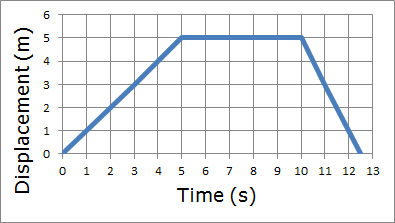
According to the graph how far does the person travel in the first 5 seconds?
a)
2 m
b)
10 m
c)
0 m
d)
5 m
23.

Which runner won the race?
a)
A
b)
B
c)
C
24.

Which runner had a head start?
a)
A
b)
B
c)
C
25.
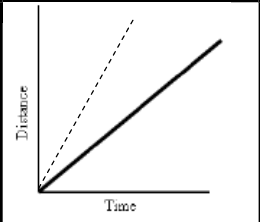
What does this graph represent?
a)
Constant Speed
b)
Acceleration
c)
Not moving
26.

How long did it take this object to travel 10 m?
a)
0 s
b)
10 s
c)
15 s
d)
20 s
27.
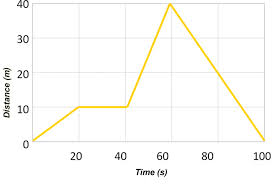
How long did it take this object to travel back to its reference/starting point?
a)
20 s
b)
30 s
c)
60 s
d)
100 s
28.
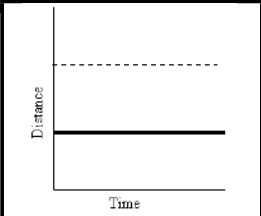
What does this graph represent?
a)
Constant speed
b)
Acceleration
c)
Not moving
29.

What is happening at D?
a)
Stationary
b)
Accelerating
c)
Fast steady speed; moving away from the starting position
d)
Slower steady speed; moving away from the starting position
30.

"For every action, there is an equal and opposite reaction."
a)
Newton's 1st Law
b)
Newton's 2nd Law
c)
Newton's 3rd Law
d)
Newton's 4th Law
31.

Force = Mass x Acceleration
a)
Newton's 1st Law
b)
Newton's 2nd Law
c)
Newton's 3rd Law
d)
Newton's 4th Law
32.

"An object in motion (or at rest) will to stay in motion (or at rest) until an outside force acts upon it."
a)
Newton's 1st Law
b)
Newton's 2nd Law
c)
Newton's 3rd Law
d)
Newton's 4th Law
33.

The tendency of an object to resist changes in its motion is...
a)
inertia
b)
force
c)
acceleration
d)
velocity
34.

The tendency of a moving object to resist changes in its motion is...
a)
momentum
b)
force
c)
acceleration
d)
velocity
35.

Any push or pull on an object.
a)
force
b)
velocity
c)
inertia
d)
momentum
36.

The force that opposes motion between two surfaces in contact with each other.
a)
inertia
b)
friction
c)
momentum
d)
gravity
37.

The force of attraction between all matter.
a)
inertia
b)
friction
c)
net force
d)
gravity
38.

A force that opposes motion between a surface in contact with the atmosphere.
a)
air resistance
b)
gravity
c)
momentum
d)
terminal velocity
39.

Which of the following is the units for acceleration?
a)
kg*m/sec/sec
b)
kg*m/sec
c)
m/sec/sec
d)
m/sec
40.

Which of the following is the units for velocity?
a)
kg*m/sec/sec
b)
kg*m/sec
c)
m/sec/sec
d)
m/sec
41.
A Newton is a unit of...
a)
force
b)
inertia
c)
acceleration
d)
velocity
42.

An archer pulls the bowstring back, then releases the string and the arrow flies forward. Pulling the string back is the...
a)
action force
b)
reaction force
c)
net force
d)
inertia
43.

An archer pulls the bowstring back, then releases the string and the arrow flies forward. The arrow flying forward is the...
a)
action force
b)
reaction force
c)
net force
d)
inertia
44.

A cannonball with a mass of 0.5 kg is flying at an acceleration of 10 m/sec/sec. What is it's force?
a)
50 Newtons
b)
5 Newtons
c)
20 Newtons
d)
9.5 Newtons
45.

A cannonball with a mass of 10 kg is flying at an acceleration of 5 m/sec/sec. What is it's force?
a)
50 Newtons
b)
5 Newtons
c)
20 Newtons
d)
9.5 Newtons
46.

The net force on a ball thrown on Earth is... (you are no longer touching the ball)
a)
there is none
b)
forward
c)
down and backward
d)
forward and down
47.

Mass x acceleration = ?
a)
force
b)
inertia
c)
momentum
d)
velocity
48.

In the picture, the blocks are flying out of the truck based on which of Newton's laws?
a)
Newton's 1st Law
b)
Newton's 2nd Law
c)
Newton's 3rd Law
d)
Newton's 6th Law
49.

In the picture, the vehicle will move because of...
a)
Newton's 1st Law
b)
Newton's 2nd Law
c)
Newton's 3rd Law
d)
Newton's 9th Law
50.

To compare the two pictures would require...
a)
Newton's 1st Law
b)
Newton's 2nd Law
c)
Newton's 3rd Law
d)
Newton's 11th Law
51.
The Law of Inertia
a)
Newton's
1st
Law of Motion
1st
Law of Motion
b)
Newton's
2nd
Law of Motion
2nd
Law of Motion
c)
Newton's
3rd
Law of Motion
3rd
Law of Motion
52.
F=ma
a)
Newton's
1st
Law of Motion
1st
Law of Motion
b)
Newton's
2nd
Law of Motion
2nd
Law of Motion
c)
Newton's
3rd
Law of Motion
3rd
Law of Motion
53.
For every action, there is an equal and opposite reaction.
a)
Newton's
1st
Law of Motion
1st
Law of Motion
b)
Newton's
2nd
Law of Motion
2nd
Law of Motion
c)
Newton's
3rd
Law of Motion
3rd
Law of Motion
54.
An automobile you are riding in suddenly stops, but you continue to go forward.
a)
Newton's
1st
Law of Motion
1st
Law of Motion
b)
Newton's
2nd
Law of Motion
2nd
Law of Motion
c)
Newton's
3rd
Law of Motion
3rd
Law of Motion
55.
When the force on a car is doubled, the acceleration is doubled.
a)
Newton's
1st
Law of Motion
1st
Law of Motion
b)
Newton's
2nd
Law of Motion
2nd
Law of Motion
c)
Newton's
3rd
Law of Motion
3rd
Law of Motion
56.
A stationary bumper car is set in motion by the outside force of another bumper car colliding with it.
a)
Newton's
1st
Law of Motion
1st
Law of Motion
b)
Newton's
2nd
Law of Motion
2nd
Law of Motion
c)
Newton's
3rd
Law of Motion
3rd
Law of Motion
57.
A skater pushes another skater forward, but the one pushing moves backwards.
a)
Newton's
1st
Law of Motion
1st
Law of Motion
b)
Newton's
2nd
Law of Motion
2nd
Law of Motion
c)
Newton's
3rd
Law of Motion
3rd
Law of Motion
58.
The harder you hit a baseball, the faster it accelerates.
a)
Newton's
1st
Law of Motion
1st
Law of Motion
b)
Newton's
2nd
Law of Motion
2nd
Law of Motion
c)
Newton's
3rd
Law of Motion
3rd
Law of Motion
59.

A wheeled cart is moving to the right at a constant speed. Two forces of equal magnitude are acting upon the cart. Which of the following best describes the forces and motion of the cart?
a)
Balanced Forces, Constant Speed
b)
Balanced Forces, Acceleration
c)
Unbalanced Forces, Constant Speed
d)
Unbalanced Forces, Acceleration
60.
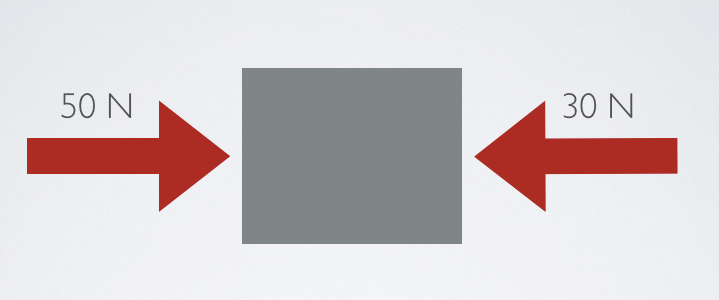
How will this object move?
a)
It won't move.
b)
It will move to the right.
c)
It will move to the left.
d)
It will move up.
61.

What is the net force?
a)
30 N left
b)
25 N right
c)
5 N left
d)
55 N right
62.

What is the net force?
a)
40 N left
b)
0 N Balalnced
c)
400 N right
d)
40 N right
63.
Which could be an example of a balanced force?
a)
An asteroid moving at a constant speed through space
b)
A car accelerating from a stop sign
c)
A box of dishes falling from a counter
d)
A rocket taking off
64.
Which could be an example of an unbalanced force?
a)
A plate sitting on a dining table
b)
A ball at the top of a hill that is not moving
c)
Earth orbiting the Sun
d)
A baseball that has been thrown to home plate.
65.
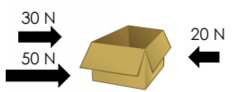
Calculate the Net Force.
a)
60N, Left
b)
40N, Right
c)
0N
d)
60N, Right
66.

Calculate the Net Force.
a)
40N, Left
b)
40N, Right
c)
0N, Balanced
d)
75N, Right
67.
You and your dad are moving the couch from one side to another. Your dad pushes with a force of 35 N to the right and you push with a force of 25 N right. What is the net force on the couch?
a)
60 N right
b)
10 N left
c)
60 n right
d)
50 N left
68.

What is the net force?
a)
10 N
b)
0 N
c)
25 N
d)
1 N
69.

A ____________ is a push or a pull on an object.
a)
friction
b)
force
c)
magnet
d)
gravity
70.
What is the unit to MEASURE force?
a)
Kilogram
b)
Meter
c)
Pascal
d)
Newton
71.
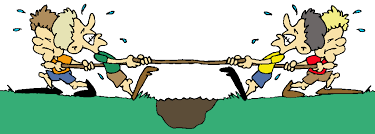
If these teams are pulling with the same amount of force what will happen?
a)
The boy in blue will win.
b)
They will not move at all.
c)
The boy in red will win.
d)
Both will fall down.
72.

Balanced or unbalanced?
a)
balanced
b)
unbalanced
73.

Forces that have a net force of zero
a)
Balanced force
b)
Unbalanced force
74.
The sum of all forces acting on an object.
a)
Contact Force
b)
Balanced Force
c)
Unbalanced Force
d)
Net Force
100 %

