

Wayground logo

Free Printable Worksheets

Font size

S
M
L
XL
Worksheets

AP Biology Photosynthesis and Cellular Respiration

Total questions: 48

Worksheet time: 49mins

Name
Class
Date
1.
How is cellular respiration related to photosynthesis?
a)
Both require oxygen to start
b)
respiration is the opposite of photosynthesis
c)
Both start with glycolysis
d)
Both end with 38 ATP for cells
2.
Which of the following statements are false?
a)
Glycolysis can occur with or without oxygen
b)
Glycolysis is the first step in both anaerobic and aerobic respiration
c)
Glycolysis occurs in the mitochondria
d)
Glycolysis produces 2 ATP, 2 Pyruvates, and 2 NADH
3.
What are the products (things that are made) in cellular respiration
a)
ATP
b)
Carbon dioxide (CO2)
c)
Water
d)
All of the above
4.
Glucose is broken down into pyruvate in a process known as 
a)
glycolysis
b)
electron transport
c)
the Krebs cycle
d)
phosphorylation
5.
This term refers to the production of ATP without oxygen being present.
a)
anaerobic
b)
prokaryotic
c)
biogenic
d)
organic
6.
What is the correct equation for cellular respiration?
a)
6O2 + C6H12O6 -> 6CO2 + 6H2O + Energy
b)
6O2 + C6H12O6 + Energy -> 6CO2 + 6H2O
c)
6CO2 + 6H2O -> 6O2 + C6H12O6 + Energy
d)
6CO2 + 6H2O + Energy -> 6O2 + C6H12O6
7.
What is cellular respiration?
a)
the breakdown of glucose  to release ATP
b)
the breakdown of glucose to release NADH
c)
the breakdown of glucose to release FADH
d)
the breakdown of glucose to release carbon
8.
Which of these molecules is released during the Kreb's cycle
a)
nitrogen
b)
oxygen
c)
hydrogen sulfide
d)
Carbon Dioxide (CO2)
9.
What is the main job of the electron carriers in cellular respiration? 
a)
Transport electrons and hydrogen atoms to the electron transport chain 
b)
Capture energy throughout the process of cellular respiration
c)
Provide the reactants for the process of cellular respiration
d)
Pump positive hydrogen ions and shuttle electrons across the electron transport chain and contribute to chemiosmosis
10.
Glycolysis is a _______ process
a)
Anabolic
b)
Catabolic
c)
Single Step
d)
Strictly Eukaryotic
11.
NADH is a ______ form of NAD+.
a)
Reduced
b)
Oxidized
c)
Catabolized
d)
Hydrolized
12.
How many ATP are gained through glycolysis?
a)
0
b)
2
c)
4
d)
30-38
13.
Which molecule enters Kreb's Cycle?
a)
Pyruvate
b)
Glucose
c)
Acetyl CoA
d)
reducing powers
14.
What enzyme in the ETC is responsible for generating the ATP molecules?
a)
ATPase
b)
ATP synthase
c)
Hexokinase
d)
none of the above
15.
Where does ETC occur?
a)
Mitochondrial matrix
b)
Outer mitochondrial membrane
c)
Inner mitochondrial membrane
d)
Cytosol
16.

after strenuous exercise, a muscle cell would contain decreased amounts of ______ and increased amounts of ______ ____

a)

glucose; ATP

b)

ATP; glucose

c)

oxygen; lactic acid

d)

lactic acid; ATP

17.
site of the krebs cycle
a)
1
b)
2
c)
3
d)
4
18.
Two different species of bacteria are examined. Scientists find that species X always produces CO2 and H2O during cellular respiration. Species Y always produces ethyl alcohol and CO2. Which conclusion can be made from these observations?
a)
Only species Y is aerobic.
b)
Only species Y is anaerobic
c)
Both species X and Y are aerobic.
d)
Both species X and Y are anaerobic.
19.

A weightlifter is using heavy weights in short bursts for a competition. Because his muscle cells are not able to take in enough oxygen to make very much ATP the weightlifter begins to get fatigue in his muscles. Which of the following processes is most likely going on in the muscles of the weightlifter as he competes in his event?

a)

As the cells run out of oxygen they switch to anaerobic respiration (fermentation), which allows the cell to make small amounts of ATP in the absence of oxygen.

b)

As the cells run out of oxygen, they die off gradually and the weightlifter's muscles have fewer contracting muscle cells.

c)

The cells will never run out of oxygen if the weightlifter is breathing.

d)

As the cells run out of oxygen, they will continue to make the same amount of ATP, since oxygen is not required to make ATP.
20.
What are the reactants in the equation for cellular respiration?
a)
oxygen and lactic acid
b)
carbon dioxide and water
c)
glucose and oxygen
d)
water and glucose
21.
What process is found in both aerobic and anaerobic metabolism?
a)
the Kreb's cycle
b)
oxidative phosphorylation
c)
the citric acid cycle
d)
glycolysis
22.
At the end of the Kreb's cycle, where is most of the energy from the original glucose stored?
a)
in CO2
b)
in ATP
c)
in NADH
d)
in pyruvate
23.
During chemiosmosis
a)
H+ ions serve as the final electron acceptor
b)
a concentration gradient is generated when H+ ions are passively transported from the matrix to the intermembrane space of the mitochondrion
c)
energy is released as H+ ions move freely across the mitochondrial membrane
d)
ATP is synthesized when H+ ions move through a channel in ATP synthase
24.
What are the stages of cellular respiration in order?
a)
glycolysis, oxidative phosphorylation, the citric acid cycle
b)
oxidative phosphorylation, glycolysis, the citric acid cycle
c)
glycolysis, the citric acid cycle, oxidative phosphorylation
d)
the citric acid cycle, oxidative phosphorylation, glycolysis
25.
In yeast cells
a)
alcohol is produced during the citric acid cycle
b)
lactic acid is produced during the citric acid cycle
c)
alcohol is produced after glycolysis
d)
lactic acid is produced after glycolysis
26.
What is the main purpose of the Krebs cycle?
a)
to produce ATP
b)
to produce electron donators
c)
to produce water
d)
to produce carbon dioxide
27.
The final electron acceptor of aerobic respiration is
a)
oxygen
b)
water
c)
carbon dioxide
d)
NAD+
28.
The main purpose of anaerobic respiration is to
a)
produce oxygen
b)
replenish NAD+ for glycolysis
c)
replenish oxaloacetic acid for the Krebs cycle
d)
produce ATP
29.
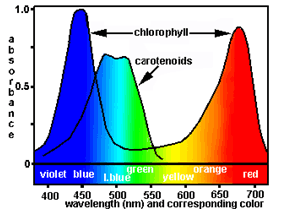
What is one function of the other pigments  besides chlorophyll, in the chloroplast?
a)
to block damaging wavelengths of light
b)
to absorb different wavelengths than the chloroplasts
c)
to provide different colors to the leaves
d)
to transfer energy to a separate photosystem beside the one using chlorophyll a and b.
30.
What is the primary function of the light reactions of photosynthesis?
a)
To produce glucose
b)
To produce NADPH and ATP
c)
To use ATP
d)
To produce RuBP
31.
What supplies the electrons that are lost in PS I?
a)
the electrons from PS II
b)
water
c)
glucose
d)
oxygen
32.
What is the function of NADP+?
a)
It absorbs light
b)
It is an electron carrier
c)
It is a light-reflecting pigment
d)
It acts as long-term energy storage
33.
Which of the following molecules is not needed for the Calvin Cycle?
a)
CO2
b)
ATP
c)
NADPH
d)
H2O
34.
Green plants reflect ________ light.
a)
Red
b)
Green
c)
All
d)
Red and Violet
35.
The light reactions occur in the ________ and the dark reactions take place in the ________.
a)
Chloroplast / thylakoid membrane
b)
stroma / thylakoid
c)
mesophyl / stomata
d)
thylakoid membrane / stroma
36.
Where does the carbon come from that is used to form glucose?
a)
The soil
b)
CO2 in the air
c)
From other carbohydrates
d)
Calvin Cycle
37.
When oxygen is released as a result of photosynthesis, it is a direct by-product of
a)
reducing NADP+
b)
splitting water molecules
c)
chemiosmosis
d)
electron transfer in photosystem II and I
38.
What is the primary function of the Calvin cycle?
a)
regenerate ATP for use in the light reactions of photosynthesis
b)
produce carbon dioxide for use in the light reactions of photosynthesis
c)
produce oxygen by oxidizing water
d)
produce simple sugars from carbon dioxide
39.
Plants with the largest amount of which pigment will be best suited for growing conditions where light has a green hue.
a)
Chlorophyll A
b)
Chlorophyll B
c)
Carotenoids
d)
A combination of all 3
40.
The H+ concentration gradient is used to 
a)
make NADPH
b)
split a water molecule
c)
generate ATP
d)
form water
41.
The main source of energy for all life comes from ____.
a)
the Earth
b)
the moon
c)
the sun
d)
the food we eat/make
42.
Which of the following is the correct equation for PHOTOSYNTHESIS?
a)
6CO2 + 6H2O --> 6O2 + C6H12O6
b)
6CO2 + C6H12O6 + 6H2O --> O2 
c)
6O2 + 6H2O --> 6CO2 + C6H12O6
d)
C6H12O6 + 6O2 ---> 6H2O + 6CO2 
43.
Where does a plant absorb the water that it uses during photosynthesis?
a)
Leaves
b)
Stem
c)
Roots
d)
Petals
44.
Which of the following are products of the light reactions of photosynthesis that are utilized in the Calvin cycle?
a)
CO2 and glucose
b)
H2O and O2
c)
electrons and H+
d)
ATP and NADPH
45.
Which of the following is directly associated with Photosystem I?
a)
harvesting light energy to make ATP
b)
receiving electrons from the thylakoid membrane ETC
c)
generation of molecular oxygen
d)
extraction of hydrogen electrons from the splitting of water
46.
Which of the following events occurs in the light reactions of photosynthesis?
a)
NADP+ is produced
b)
ATP is consumed to yield ADP
c)
carbon dioxide is fixed in organic molecules
d)
light is absorbed and funneled to reaction-center chlorophyll a
47.
What is the primary function of cyclic electron flow?
a)
to produce additional NADPH
b)
to produce additional ATP
c)
to produce additional oxygen
d)
to produce additional carbon dioxide
48.

Which of the following statements best represents the relationships between the light reactions and the Calvin cycle?

a)

The light reactions provide ATP and NADPH to the Calvin cycle, and the Calvin cycle returns ADP, ℗i, and NADP+ to the light reactions.

b)

The light reactions provide ATP and NADPH to the carbon fixation step of the Calvin cycle, and the Calvin cycle provides water and electrons to the light reactions.

c)

The light reactions supply the Calvin cycle with CO2 to produce sugars, and the Calvin cycle supplies the light reactions with sugars to produce ATP.

d)

The light reactions provide the Calvin cycle with oxygen for carbon fixation, and the Calvin cycle provides the light reactions with sugars to produce ATP.