wayground logo

Free Printable Worksheets

Font size

S
M
L
XL
Worksheets

Refraction and Lenses

Total questions: 49

Worksheet time: 1hrs 19mins

Name
Class
Date
1.
Is a concave lens thicker or thinner in the middle? 
a)
Thicker 
b)
Thinner 
2.
Is a convex lens thicker or thinner in the middle?
a)
Thicker 
b)
Thinner 
3.

What type of lens do humans have in their eyes?

a)

Concave, Converging Lens

b)

Convex, Converging Lens

c)

Concave, Diverging Lens

d)

Convex, Diverging Lens

4.
In which case will refraction be greatest?
a)
light entering glass from water
b)
light entering air from glass
c)
light entering a diamond from air
d)
light entering water from air
5.

What happens to the incident ray when it enters the second medium?

a)

Does not change direction

b)

Bends away from normal

c)

Bends toward normal

6.

What happens to the incident ray when it enters the second medium?

a)

Does not change direction

b)

Bends away from normal

c)

Bends toward normal

7.

Where should the fisherman aim to get the fish on the end of his harpoon?

a)

Below the fish that he sees

b)

Above the fish that he sees

c)

Directly at the fish that he sees

d)

He should leave the poor fish alone

8.

In the diagram what does the light do when it enters the second medium?

a)

speeds up

b)

slows down

c)

maintains the same speed

9.

What kind of lens is a magnifying glass?

a)

Convex converging lens

b)

Concave converging lens

c)

Convex diverging lens

d)

Concave diverging lens

10.
A converging lens has a focal length of 30 cm. A 5 cm tall candle is placed at a distance of 10 cm in front of the lens. Determine the image distance.
a)
- 45 cm
b)
-30 cm
c)
-15 cm
d)
6 cm
11.
What type of image is formed when rays of light actually intersect?
a)
real
b)
virtual
c)
projected
d)
curved
12.

This image formed by the lens shown is...

a)

Inverted and smaller

b)

inverted and bigger

c)

not inverted and smaller

d)

not inverted and bigger

13.

An incident ray that is parallel to the optical axis of a converging lens ...

a)

will reflect parallel to the principal axis

b)

will refract through the focal point

c)

will reflect through the center of curvature

d)

will continue along the same path through the lens

14.
a real image...
a)
is produced by virtual rays and can be projected on a screen
b)
is produced by real rays and cannot be projected on a screen
c)
is produced by virtual images and cannot be projected on a screen
d)
is produced by real rays and can be projected on a screen
15.

Convex lenses can produce...

a)

Real images

b)

Virtual images

c)

Real and Virtual images

d)

no images form

16.

An object of height 4 cm is placed 10 cm away from a concave lens of focal length 6 cm as shown in the diagram. The image produced is:

a)

virtual.inverted

b)

virtual,upright

c)

real,inverted

d)

real,upright

17.

One way to determine how much a light ray will bend when it enters a medium

a)

index of refraction

b)

reflection

c)

thermogram

d)

mirage

18.
Light has the highest velocity in which medium?
flint glass n=1.70
barium glass n=1.60
crown glass n=1.523
water n=1.33
diamond n=2.45
a)
diamond
b)
water
c)
flint glass
d)
barium glass
19.
Light has the lowest velocity in which medium?
flint glass n=1.70
barium glass n=1.60
crown glass n=1.523
water n=1.33
diamond n=2.45
a)
diamond
b)
water
c)
flint glass
d)
barium glass
20.

A candle is placed 30 cm from a convex lens with a focal length of 10 cm. The image formed will be

a)

Real, inverted, and reduced

b)

Real, inverted, and enlarged

c)

Real, upright, and enlarged

d)

Virtual, upright, and enlarged

21.
an image that forms where light seems to come from
a)
virtual image
b)
real image
c)
diffuse reflection
d)
regular reflection
22.

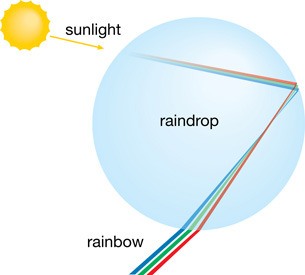
Which is not a correct statement about rainbows?

a)

they are really circular

b)

they form because of dispersion of light

c)

the sunlight is internally reflected in the rear of a raindrop

d)

they form because different colors of light refract at the same angle

23.
A converging lens has a focal length of 30 cm. A 5 cm tall candle is placed at a distance of 10 cm in front of the lens. Determine the image distance.
a)
- 45 cm
b)
-30 cm
c)
-15 cm
d)
6 cm
24.
Critical angle is the angle of incidence that produces an angle of refraction at......
a)
180 degrees
b)
90 degrees
c)
20 degrees 
d)
120 degrees
25.
Total internal reflection is the complete reflection of a light ray back into its original medium. 
a)
true 
b)
false 
26.
What is the index of refraction of a material if light travels 2x10⁸m/s in it?
a)
6
b)
1.5
c)
0.67
d)
1.67
27.
If the angle of incidence of light traveling through air, and then striking water is 30 degrees what is the angle of refraction? (n=1 air, n=1.33 water)
a)
15 degrees
b)
22 degrees
c)
43 degrees
d)
17 degrees
28.
Rainbows are produced when
a)
light exits many raindrops at different angles
b)
the sun causes a rainstorm
c)
the spectrum causes a rainstorm
d)
the sun comes out after a storm
29.
A student placed a pencil in a cup of water.  The pencil appears broken because light-
a)
always travels in a straight line
b)
bends when it passes through water
c)
makes the water in the glass evaporate
d)
reflects the pencil on the water's surface
30.
Which of the following describes what will happen to a light ray incident on a glass-to-air boundary at greater than the critical angle?
a)
total internal reflection
b)
total external transmission
c)
partial reflection, partial transmission
d)
partial reflection, total transmission
31.
Which of the following allows fiber optic cables to transmit data?
a)
total bending of light
b)
total dispersion of light
c)
total internal combustion
d)
total internal reflection
32.
When a red light ray travels from air into a glass block, its
a)
velocity increases and its wavelength decreases 
b)
velocity decreases and its frequency stays the same
c)
velocity decreases and its frequency increases
d)
velocity remains the same and its wavelength decreases
33.

True or false: A penny looks deeper than it actually is the in the bottom of the pool due to refraction of light.

a)

True

b)

False

34.

A beam of light travels fastest in

a)

a vacuum

b)

air

c)

water

d)

a diamond

35.

The separation of light into its individual frequencies is

a)

refraction

b)

reflection

c)

transparency

d)

dispersion

36.
What is the protective covering over your eye?
a)
refraction
b)
cornea
c)
puppies
d)
eyeballs
37.
What is the hole that lets light into the eye?
a)
Pupil
b)
Eyelashes
c)
Farsighted
d)
Opaque
38.

What is the part of your eye that helps you focus on things that are both near and far away?

a)

vitreous humor

b)

eyelash

c)

retina

d)

lens

39.
If a person can see things clearly far away they are?
a)
Farsighted
b)
Nearsighted
40.

If a person is myopic they are ____________ and the real image appears ____________ the retina?

a)

Farsighted, before

b)

Nearsighted, before

c)

Farsighted, after

d)

Nearsighted, after

41.

If a person is Farsighted they are ____________ and the real image appears ____________ the retina?

a)

hyperoptic, before

b)

myoptic, before

c)

hyperoptic, after

d)

myoptic, after

42.

What type of lenses does a Telescope use?

a)

Convex, converging lens

b)

Convex, diverging lens

c)

Concave, converging lens

d)

Concave, diverging lens

43.

This image formed by the lens shown is...

a)

a real inverted image

b)

a virtual inverted image

c)

a real upright image

d)

a virtual upright image

44.

This image formed by the lens shown is...

a)

A virtual image formed by a convex lens

b)

A real image formed by a convex lens

c)

A virtual image formed by a concave lens

d)

A real image formed by a concave lens

45.
Light bending as it passes through a rain drop is an example of...
a)
Refraction
b)
Reflection
46.
Glass has a _____________ index of refraction than air.
a)
Equal
b)
Greater
c)
Less
d)
Impossible to say
47.
Light has the lowest velocity in which medium?
flint glass n=1.70
barium glass n=1.60
crown glass n=1.523
water n=1.33
diamond n=2.45
a)
diamond
b)
water
c)
flint glass
d)
barium glass
48.

The light bouncing off the back of the raindrop is an example of...

a)

Total Internal Refraction

b)

Total Internal Reflection

c)

Diffraction

d)

Dispersion

49.

The light separating into colors as it goes through the raindrop is an example of...

a)

Total Internal Refraction

b)

Total Internal Reflection

c)

Diffraction

d)

Dispersion