
 Worksheets
Year 10 Motion Revision Quiz 2
Total questions: 45
Worksheet time: 1hrs 7mins
Name
Class
Date
1.
Which force produces a change in motion?
a)
unbalanced force
b)
balanced force
c)
gravitational force
d)
frictional force
2.
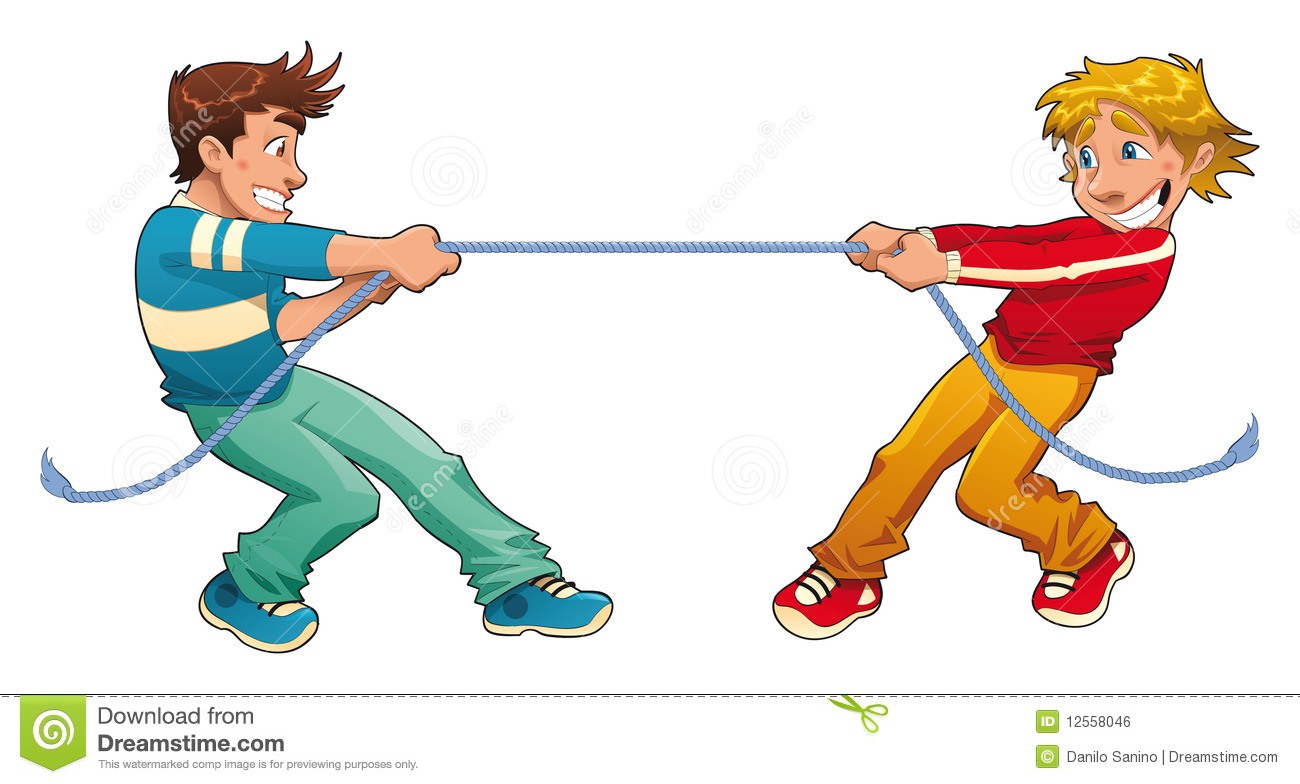
If these boys are pulling with the same amount of force. What will happen?
a)
The boy in blue will win.
b)
They will not move at all.
c)
The boy in red will win.
d)
Both will fall down.
3.
Any time the forces are unbalanced, an object will remain at rest. True or false?
a)
true
b)
false
4.
When you tell the direction and speed of an object, you give its
a)
motion
b)
velocity
c)
acceleration
d)
mass
5.
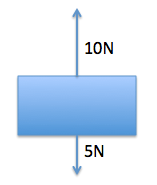
What is the net force on the block? (click on the words to view the picture)
a)
5 Newtons up
b)
5 Newtons down
c)
15 Newtons up
d)
15 Newtons down
6.
Which of the following statements is true?
a)
Balanced forces cause a change in motion.
b)
Unbalanced forces cause a change in motion.
c)
Forces do not effect the change in motion.
7.
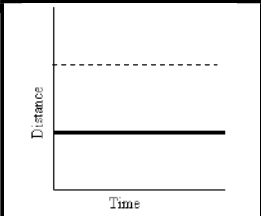
What does this graph represent?
a)
Constant speed
b)
Acceleration
c)
Not moving
8.
If a 10 kilogram object accelerates suddenly at 15 m/s2, how much force was applied to the object?
a)
150 Newtons
b)
15 Newtons
c)
150 kilograms
d)
100 kilograms
9.
Speed is equal to
a)
Distance/Time
b)
Time/Distance
c)
Time x Distance
d)
Acceleration
10.
Speed is different from velocity because
a)
Velocity has a direction
b)
Speed uses Distance /Time
c)
Velocity doesn't include time
d)
Velocity doesn't include distance
11.

During which interval is the object speeding up?
a)
A to B
b)
B to C
c)
D to E
d)
E to F
12.

What is this graph showing?
a)
Constant Speed
b)
Acceleration (speeding up)
c)
Deceleration (slowing down)
d)
No motion
13.
8 N to the left , and 4 N to the right. Find the net force. Is this balanced
a)
12 N Right No
b)
4 N Left No
c)
12 N Right Yes
d)
4 N Left Yes
14.

What is a force?
a)
a push or pull
b)
speed or acceleration
c)
potential or kinetic energy
d)
balanced or unbalanced force
15.

What is the force that causes everything to be pulled down to the Earth?
a)
friction
b)
gravity
c)
balanced
d)
unbalanced
16.

Force is measured in....
a)
Galileos
b)
Newtons
c)
Di Vincis
d)
Einsteins
17.

Friction helps objects to move easier.
a)
true
b)
false
18.
Scott travels north 5 miles and then goes west 3 miles before coming straight back south 2 miles. What is his distance?
a)
10
b)
7
c)
8
d)
6
19.
What kind of quantity has both a magnitude and a direction?
a)
scalar
b)
vector
c)
frame of reference
d)
time
20.
Bill runs 400 meters to Andy's house, turns around, and runs 400 meters back home. What is Bill's distance?
a)
0 meters
b)
400 meters
c)
800 meters
d)
1600 meters
21.
Bill runs 400 meters to Andy's house, turns around, and runs 400 meters back home. What is Bill's displacement?
a)
0 meters
b)
400 meters
c)
800 meters
d)
1600 meters
22.
Which of the following is NOT a scalar quantity?
a)
time
b)
distance
c)
displacement
d)
speed
23.
Which of the following could never be negative?
a)
a distance
b)
a velocity
c)
a displacement
d)
a vector
24.
Vector quantities need both a magnitude and a _____.
a)
distance
b)
displacement
c)
direction
d)
velocity
25.
A persons walks 50 meters directly north, stops, and then travels 32 meters directly south. What is their distance traveled?
a)
82 meters
b)
18 meters
c)
32 meters
26.
What is the formula to calculate speed?
a)
Speed = time/distance
b)
Speed = distance/time
c)
Speed = distance x time
d)
Speed = time x distance
27.

According to the graph how far does the person travel in the first 5 seconds?
a)
2 m
b)
10 m
c)
0 m
d)
5 m
28.

At 60 seconds, how far had this object traveled?
a)
0 m
b)
10 m
c)
20 m
d)
40 m
29.
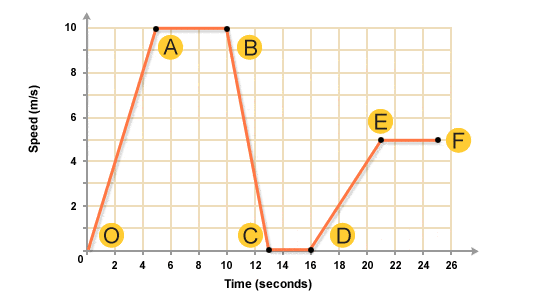
What is happening in this graph from point B to C?
a)
The object is going down a hill.
b)
The object is returning to its starting location.
c)
The object is slowing down.
d)
The object is staying still.
30.

What is happening at E?
a)
Stationary
b)
Accelerating
c)
Fast steady speed; moving away from the starting position
d)
Steady speed; returning to start position
31.

Which runner won the race?
a)
A
b)
B
c)
C
32.

Drake races in the 100 meter dash. It takes him 10 seconds to finish. What is his average speed?
a)
10 m/s
b)
1000 m/s
c)
100 seconds
d)
10 seconds
33.

Force = Mass x Acceleration
a)
Newton's 1st Law
b)
Newton's 2nd Law
c)
Newton's 3rd Law
d)
Newton's 4th Law
34.

"For every action, there is an equal and opposite reaction."
a)
Newton's 1st Law
b)
Newton's 2nd Law
c)
Newton's 3rd Law
d)
Newton's 4th Law
35.

"An object in motion (or at rest) will to stay in motion (or at rest) until an outside force acts upon it."
a)
Newton's 1st Law
b)
Newton's 2nd Law
c)
Newton's 3rd Law
d)
Newton's 4th Law
36.

The tendency of an object to resist changes in its motion is...
a)
inertia
b)
force
c)
acceleration
d)
velocity
37.
The definition of acceleration is
a)
change in position over time
b)
speed with direction
c)
change in velocity over time
38.

How far did a plane travel going 8m/s in 100s?
a)
800 m
b)
12 m
c)
100 m
39.

The picture of the position vs. time graph shows an object that is...
a)
accelerating/speeding up
b)
moving at a constant speed
c)
not moving
d)
accelerating/slowing down.
40.
Acceleration: is the rate of change in ___________.
a)
speed
b)
distance
c)
velocity
d)
displacement
41.

Which image shows an object speeding up in the positive direction?
a)
1
b)
2
c)
3
d)
4
42.

Which image shows an object slowing down in the positive direction?
a)
1
b)
2
c)
3
d)
4
43.

Which shows a constant speed?
a)
1
b)
2
c)
3
d)
4
44.

Which image shows the fastest object?
a)
1
b)
2
c)
3
d)
4
45.

Which shows the slowest object?
a)
1
b)
2
c)
3
d)
4
100 %

