
 Worksheets
Electricity & Magnetism (VA SOL PS.9) Gr8 Science SOL Review
Total questions: 47
Worksheet time: 35mins


How are the balloons sticking to the wall?
current electricity
static electricity
an electromagnet
a permanent magnet
What direction does the energy flow in a circuit?
positive to negative
neutral to positive
neutral to negative
negative to positive
Which type of circuit is the best for modern homes and buildings?
series circuit
parallel circuit
This device converts mechanical energy into electrical energy.
electric motor
battery
electric generator
circuit
What are the three things that will make an electromagnet stronger? PICK THE THREE CORRECT ANSWERS.
thicker wire
more wire coils
more voltage
longer wire
more metal in the core
Why are electromagnets useful in technology?
they stay magnetized all the time
they can be turned on and off
they use renewable energy
they will stay on even if the circuit is broken in one place
When charges build up on an object (charging by friction, charging by induction, charging by contact), it is called _____.
current electricity
static electricity
parallel circuit
alternating current

What kind of circuit is this?
Series
Parallel
Electric motors convert _______ energy to ______ energy.
electrical, mechanical
chemical, electrical
mechanical, electrical
mechanical, chemical
Which of the following is a semiconductor?
plastic
glass
nickel
silicon
Using the movement of conductor through a magnetic field to generate electricity is called _____.
a magnetic field
an electric field
conduction
electromagnetic induction
What is the purpose of a diode?
It acts as a magnet when current is turned on.
It burns out and breaks a circuit when there is a short-circuit.
It is a semiconductor that only allows current to flow in one direction.
It turns mechanical energy into electrical energy.
What happens to the metal in an electromagnet when the current is turned off?
it stays magnetic permanently
it becomes stronger
it loses its magnetism
it becomes weaker
When a switch is closed (forming a closed circuit), what happens to the current in a circuit?
it turns off
it short-circuits
it turns on
Which of the following are insulators? SELECT ALL THAT APPLY.
an aluminum can
a nickel
a glass bottle
a plastic bottle cap
a copper wire
A transistor is used to make switches and amplify signals in electronic devices. Which device would contain a transistor to amplify the electrical signal?
generator
motor
heater
radio
LEDs (light-emitting diodes) are a type of diode. These are made from a material that is called ______.
an insulator
a conductor
a semiconductor
an electromagnet
Which of the following are good conductors? SELECT ALL THAT APPLY.
copper
aluminum
dry air
rubber
salt water
On a magnet, where is the magnetic field strongest?
near the north pole
near the south pole
near both poles
in the middle
Which of the following statements are true about Earth's magnetic field? CHOOSE ALL THAT APPLY
When charged solar particles hit it and get drawn into the poles, it creates the aurora.
It is strongest near the equator.
It protects life on earth from solar radiation and other cosmic radiation.
It helps migrating animals navigate.
It causes a compass to point north and helps humans navigate.
When a switch is closed (forming a closed circuit), what happens to the current in a circuit?
it turns off
it short-circuits
it turns on
During a lab a balloon was rubbed with a wooly fabric. This is an example of which type of charging?
conduction
friction
induction
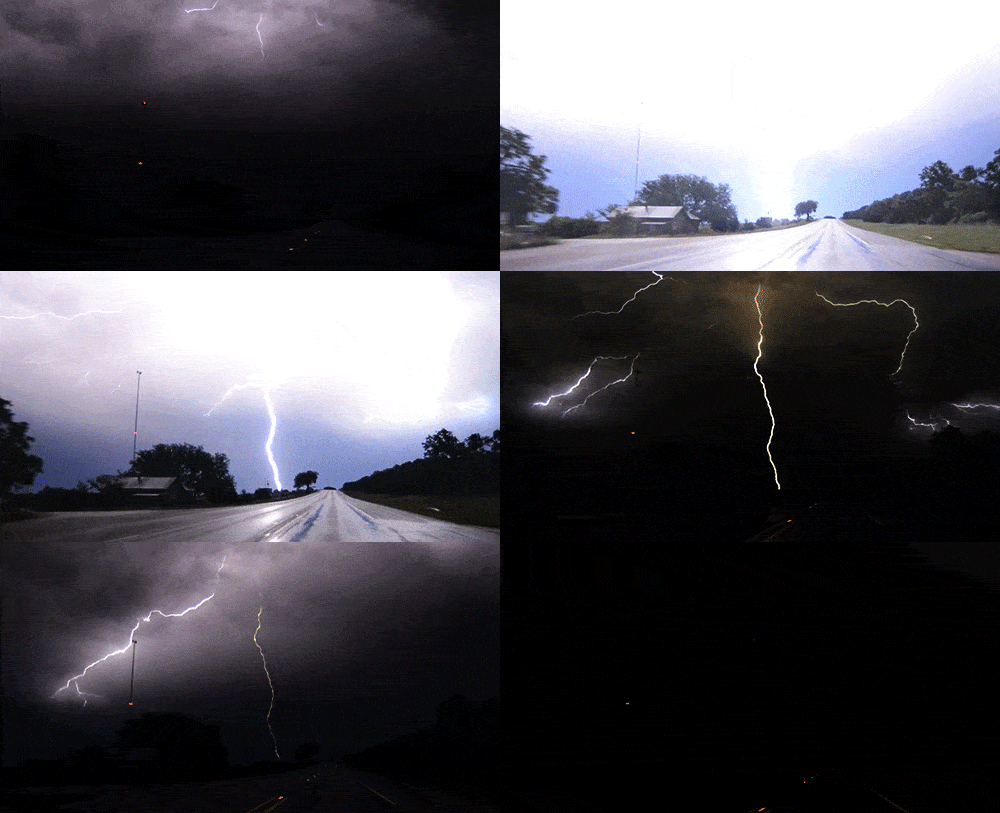
Lightning occurs because ___.
the negative charges at the bottom of clouds are attracted to the positive charges on the ground.
the positive charges at the bottom of clouds are attracted to the negative charges on the ground.
the positive and negative charges inside clouds are attracted to each other
All of these reasons are correct.
The rate of electron flow in a circuit
Voltage
Resistance
Current
Opposition to the flow of electrons
Current
Voltage
Resistance
Measured using an ammeter
Voltage
Current
Resistance
Measured using a Voltmeter
Voltage
Current
Resistance
Unit is Ohms Ω
Current
Resistance
Voltage
Unit is Volts (V)
Current
Voltage
Resistance
Increases as you add more bulbs to a series circuit
Resistance
Current
Voltage
This device converts mechanical energy into electrical energy.
electric motor
battery
electric generator
circuit
Why are electromagnets useful in technology?
they stay magnetized all the time
they can be turned on and off
they use renewable energy
they will stay on even if the circuit is broken in one place

If lamp 1 is unscrewed from its holder, what will happen to lamp 2?
It will get brighter
It will stay the same brightness
It will go out
Nothing will happen

If lamp 2 is unscrewed from its holder, what will happen to lamp1?
It will stay lit
It will go out
It will get dimmer
It will dissapear

What needs to be done to this circuit so that the lamp lights up?
Close the switch
Add a source and close the switch
Add another lamp
Add another lamp and a switch

What is the resistance of a lightbulb that experiences 9 Volts and 3 amps of current?
1/3 ohms
3 ohms
27 ohms
9 ohms

What is the voltage of a circuit with 4 ohms of resistance and 3 amps of current?
12 V
21 V
4/3 V
3/4 V

25 V
10 V
2.5 V
0.4 V
The mathematical relationship among voltage, current, and resistance is known as ---
Faraday's Law
Tesla's Law
Edison's Law
Ohm's Law

