
 Worksheets
2018 Spring Final Review - 7th Grade
Total questions: 123
Worksheet time: 1hrs 17mins
Name
Class
Date
1.
Something that takes up space and has mass.
a)
volume
b)
matter
c)
mass
d)
density
2.
A state of matter that has a definite volume and shape.
a)
solid
b)
liquid
c)
gas
d)
matter
3.
A watermelon has more matter than a grape, so it has more
a)
mass
b)
eat
c)
solid
d)
greater
4.
__________ are the building blocks of life.
a)
solids
b)
gases
c)
atoms
d)
nutrients
5.
Liquid matter takes the shape of _______.
a)
a gas
b)
water
c)
a pet
d)
Its container
6.
The measurement system used by scientist around the world.
a)
metric system
b)
customary systerm
c)
calorie system
d)
science system
7.
__________ has a definite shape and volume.
a)
liquid
b)
solid
c)
gas
8.
______________ does not have a definite shape or volume.
a)
liquid
b)
solid
c)
gas
9.
What are the states of matter?
a)
solid, liquid, and juice
b)
solid and liquid
c)
solid and gas
d)
solid, liquid, and gas
10.
A description of objects that can be measured and observed.
a)
gas
b)
mustangs
c)
physical properties
d)
melting point
11.
Example for Physical Property
a)
Taste
b)
explodes
12.
A physical property can be observed with your
a)
Eyes
b)
Ears
c)
Tastes
d)
All of the above
13.
Cutting an orange is a physical change.
a)
True
b)
False
14.
An example of a physical property is
a)
flammability
b)
acidic
c)
color
d)
ability to rust
15.
What causes a change in the state of matter?
a)
physical properties
b)
chemical energy
c)
temperature
16.
Which change can occur when you add heat energy to water?
a)
The water can change from a liquid to a solid
b)
The water can change from a gas to a liquid
c)
The water can change from a liquid to a gas
d)
The water can change from a solid to a liquid
17.
Changing the way matter looks without changing it into NEW matter is a:
a)
Chemical change
b)
Physical change
c)
Energy change
d)
BOTH a chemical and a physical change
18.
Which of the following could be a characteristic that changes in matter during a PHYSICAL CHANGE?
a)
Size
b)
State
c)
Texture
d)
All of the above
19.
Chopping wood is an example of a:
a)
Physical change
b)
Chemical change
20.
Water freezing to ice is an example of a:
a)
Physical change
b)
Chemical change
21.
Burning wood to ash is an example of a:
a)
Physical change
b)
Chemical change
22.
I am the smallest whole particle of matter.
a)
atom
b)
compound
c)
molecule
d)
mixture
23.
I am two or more atoms chemically bonded.
a)
atom
b)
compound
c)
molecule
d)
mixture
24.
Which of the following is an example of a chemical property?
a)
melting
b)
bending a paper clip
c)
rusting
d)
boiling water
25.
C6H12O11
a)
Chemical Mixture
b)
Chemical Formula
c)
Chemical Equation
d)
Single Atom
26.
H2O
a)
ratio is 1 to 1 or 1:1
b)
ratio is 2 to 1 or 2:1
c)
there is no ratio
d)
ratio is 4 to 1 or 4:1
27.
Which 2 kinds of particles make up the nucleus of an atom?
a)
electrons and neutrons
b)
electrons and nuclei
c)
protons and neutrons
d)
protons and kryptons
28.
Which particle is equal to the Atomic Number
a)
# of electrons
b)
# of neutrons
c)
# of protons
29.
Which particle carries a negative charge?
a)
protons
b)
neutrons
c)
electrons
30.
A pure substance that cannot be broken down into any other substance by chemical or physical means. There are about 100 of us shown in the Periodic Table
a)
compound
b)
mixture
c)
molecule
d)
element
31.
When you see steam, fog or clouds, which state of matter is it?
a)
solid
b)
liquid
c)
gas
32.

Which state of matter has particles that are tightly packed?
a)
liquid
b)
gas
c)
solid
33.
____________ can join to form molecules.
a)
atom
b)
molecule
c)
electron
34.
The idea that everything is made up of small particles called atoms...
a)
Big idea
b)
Atomic Theory
c)
Einstein's Theory
35.
Type of matter made of two or more elements...
a)
element
b)
mixture
c)
compound
36.

Substance with NO definite volume or shape...
a)
solid
b)
liquid
c)
gas
37.

Substance with a DEFINITE volume, but NO definite shape...
a)
solid
b)
liquid
c)
gas
38.
Different materials placed together, but each keeps its own properties...
a)
Solution
b)
Mixture
39.
Different materials placed together that spread out evenly and do not settle...
a)
Mixture
b)
Solution
40.

Lucky Charms and milk is an example of a...
a)
Mixture
b)
Solution
41.

Lemonade is an example of a...
a)
Mixture
b)
Solution
42.
The smallest particle of a compound that still has the compound characteristics...
a)
Atom
b)
Molecule
43.

Which particles are found in an atom's nucleus?
a)
Protons
b)
Neutrons
c)
Electrons
d)
Both protons and neutrons
44.
Which particles are found in the energy rings (levels) surrounding an atom's nucleus?
a)
Protons
b)
Neutrons
c)
Electrons
d)
Both protons and electrons
45.
True or False: A CHEMICAL CHANGE is a change in some properties of matter WITHOUT forming a different kind of matter.
a)
True
b)
False
46.
Baking a cake is an example of a...
a)
Physical Change
b)
Chemical Change
47.
Sugar is added to water and stirred unit it completely dissolves. Which of the following correctly describes something that has happened to the sugar?
a)
The mass of the sugar decreased.
b)
The sugar disappeared an no longer exists.
c)
The sugar is evenly distributed in the water.
d)
The crystal of sugar have entered the atmosphere.
48.
Which property would best separate a mixture of sand and iron filings?
a)
density
b)
electrical conductivity
c)
melting point
d)
magnetism
49.
The number of protons in an element can be found by:
a)
looking up the group the element is in.
b)
subtracting the atomic mass from atomic number
c)
looking up the atomic mass
d)
looking up the atomic number
50.
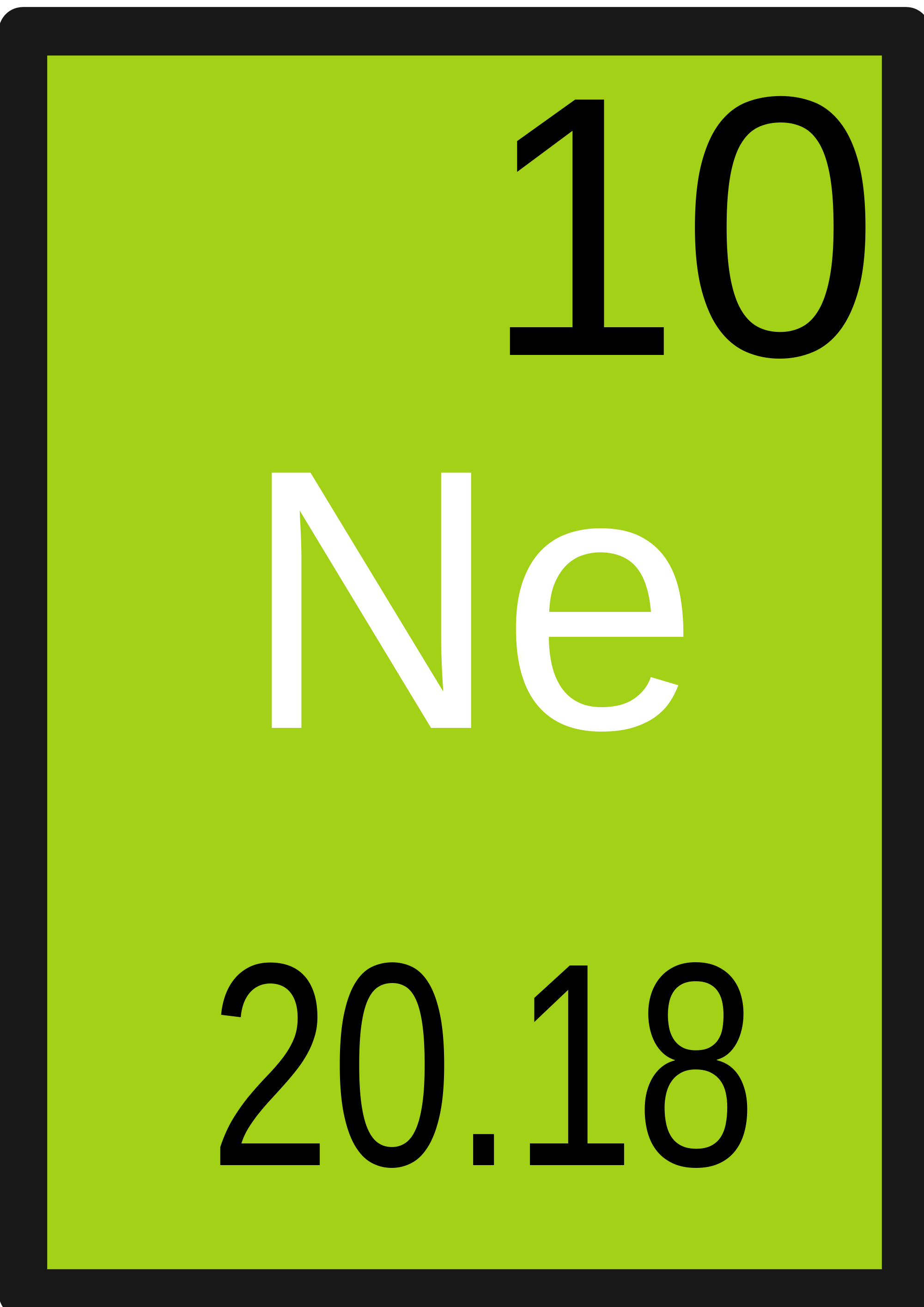
What is the atomic mass of Neon?
a)
10
b)
20.18
c)
10.18
d)
30.18
51.
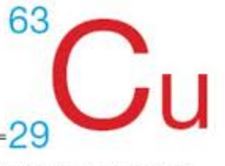
How many electrons does a Copper atom have?
a)
63
b)
29
c)
92
d)
34
52.

How many neutrons does a Hydrogen atom have?
a)
1
b)
2
c)
3
d)
0
53.
What is the atomic number for an element with 41 neutrons and a mass number of 80?
a)
39
b)
41
c)
80
d)
121
54.

How many neutrons does this isotope of lithium have?
a)
8
b)
3
c)
4
d)
5
55.
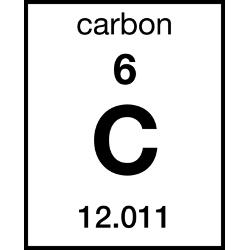
What does the 6 represent above the C
a)
Symbol
b)
Name
c)
Mass Number
d)
Atomic Number
56.
Atomic mass - Atomic Number =
a)
protons
b)
neutrons
c)
electrons
d)
Average Mass
57.
An element is defined by its number of
a)
protons
b)
electrons
c)
neutrons
d)
protons + electrons
58.
Which of the subatomic particles is the lightest
a)
all have the same mass
b)
protons
c)
neutrons
d)
electrons
59.
Which of the subatomic particles is the heaviest?
a)
electrons
b)
protons
c)
neutrons
d)
protons and neutrons have equal mass
60.
Particles in an atom's nucleus that are neutral and have no charge are
a)
megatrons.
b)
electrons.
c)
neutrons.
d)
protons.
61.
A negatively charged particle that moves around the nucleus is a(n)
a)
proton
b)
neutron
c)
electron
d)
quark
62.
Most of an atom's mass is found in the
a)
electrons.
b)
nucleus.
63.
This subatomic particle has a positive charge
a)
proton
b)
neutron
c)
electron
64.
To find neutrons
a)
use the atomic number
b)
equal to protons
c)
mass number - atomic number
65.
What characteristic do all renewable resources share?
a)
Produced by waste products
b)
Form underground from dead organisms.
c)
Replaced in a short period of time
d)
Allow energy to pass through them easily
66.
Which of the following is a fossil fuel?
a)
Wind
b)
Coal
c)
Solar
d)
Biomass
67.
Hydroelectric power produces electricity using.....
a)
Wind
b)
Sunlight
c)
Moving water
d)
Dung
68.
Energy from the sun is known as.........
a)
hydroelectric energy
b)
geothermal energy
c)
solar energy
d)
wind energy
69.
The cleanest burning fossil fuel is ______.
a)
coal
b)
oil
c)
wind
d)
natural gas
70.
Fossil fuels are classified as nonrenewable because they.......
a)
require expensive equipment
b)
take millions of years to replace
c)
can be found all over
d)
provide all the energy we use
71.
What is biomass?
a)
energy from the sun
b)
energy from water
c)
energy from wind
d)
energy from plant and animal waste
72.
What are two advantages of geothermal energy?
a)
cheap and a lot pollution
b)
expensive and a lot of pollution
c)
cheap and little pollution
d)
expensive and little pollution
73.

Why are fossil fuels more widely used than solar energy?
a)
Solar energy is harder to find
b)
Fossil fuels are much cheaper
c)
Fossil fuels are more abundant
d)
The sun's energy can never be harnessed
74.

What percentage of our energy use comes from fossil fuels?
a)
25%
b)
45%
c)
61%
d)
86%
75.

What is the largest concern we have with adding too much CO2 to the atmosphere?
a)
makes too many clouds
b)
contributes to a warmer planet
c)
affects our breathing
d)
disrupts solar energy
76.
A type of energy that is made by splitting uranium atoms is
a)
solar energy
b)
nuclear energy
c)
biomass energy
d)
water energy
77.
What do geothermal and solar energy have in common?
a)
. Sunlight is needed for both to generate energy.
b)
Both of these energy resources are non-renewable.
c)
Neither resource produces greenhouse gases.
d)
Neither requires expensive machinery to produce power.
78.
What is a major disadvantage of using nuclear power to generate electricity?
a)
A small amount of power is produced
b)
No greenhouse gases are produced
c)
The power plants are inexpensive to build
d)
The by-product of nuclear power is radiation
79.
5. Wind turbines make pollution.
a)
True
b)
False
80.

Energy that uses heat that comes from within the Earth is called what?
a)
Geophysical
b)
Geography
c)
Geothermal
d)
Geographic
81.
A main disadvantage to solar energy is it
a)
Produces too much energy.
b)
Causes wind.
c)
Is expensive.
d)
Causes heat.
82.
Which of the following is a fossil fuel?
a)
Wind
b)
Coal
c)
Solar
d)
Biomass
83.
Hydroelectric power produces electricity using.....
a)
Wind
b)
Sunlight
c)
Moving water
d)
Dung
84.
The careful use of a resource is....
a)
recycling
b)
pollution
c)
depositing
d)
conservation
85.
Energy from the sun is known as.........
a)
hydroelectric energy
b)
geothermal energy
c)
solar energy
d)
wind energy
86.
Energy is defined as the ability to cause
a)
heat
b)
change
c)
electricity
d)
chemicals to glow
87.
The law of _____ of energy states that energy cannot be created or destroyed, only transformed or changed.
a)
renewal
b)
refreshing
c)
battery storage
d)
conservation
88.
Oil, Natural Gas, Nuclear, Coal - What do these items have in common?
a)
They are examples of inexhaustible energy resources.
b)
They are examples of renewable energy resources.
c)
They are examples of energy resources that do not cause pollution.
d)
They are examples of nonrenewable energy resources.
89.
How many different elements are in this chemical formula: C2H2ClK3
a)
6
b)
8
c)
2
d)
4
90.
Which of the following atomic symbols is written correctly?
a)
ee
b)
hE
c)
C
d)
CL
91.
Which of the following atomic symbols is written correctly?
a)
OH
b)
oH
c)
fe
d)
H
92.
Which of the following is a pure substance?
a)
O2
b)
Al2CO5
c)
C6H12O6
d)
SiO2
93.
Which of the following chemical formulas represents a compound?
a)
C3
b)
O2
c)
CH3CHO
d)
H2
94.
Can be found on the periodic table
a)
Element
b)
Compound
c)
MIxture
95.

What is krypton?
a)
element
b)
compound
c)
mixture
96.

What is gold?
a)
element
b)
compound
c)
mixture
97.

What is sugar?
a)
element
b)
compound
c)
mixture
98.

Which item on this element square is the chemical symbol?
a)
Copper
b)
29
c)
Cu
d)
63.546
99.
Which statement best describes an element?
a)
made from mixture
b)
thousands in the world
c)
pure, made of only one atom
d)
can be separated
100.
Which one has more than one type of atom in it?
a)
Element
b)
Compound
101.
Carbon is considered an element while carbon dioxide is considered a compound. This is because carbon dioxide is –
a)
a gas at room temperature.
b)
made of two different elements.
c)
given off by green plants.
102.
Compounds are different than elements because compounds are -
a)
A combination of two or more elements.
b)
B)not able to be broken down into parts
B)not able to be broken down into parts
c)
made from the same type of atoms
d)
a pure substance, elements are not
103.

A pure substance containing only one kind of atom.
a)
element
b)
mixture
c)
compound
104.
Which of the following causes Earth's tectonic plates to move?
a)
Energy from the Sun
b)
Magnetic Pole Reversal
c)
Convection currents in the mantle
d)
Faults in Mountain Ranges
105.
Which of the following is the name of the ancient supercontinent formed 28 Million Years ago.
a)
Pangea
b)
Gondwanda
c)
Laurasia
d)
Neverland
106.
Which of the following is NOT evidence to support the theory of plate tectonics?
a)
Fossils
b)
Mountains
c)
Glaciers
d)
Sand Erosion
107.
The theory that says Earth's continents once made up an ancient supercontinent, and have been drifting apart ever since, is called the theory of...
a)
Pangea
b)
Plate Tectonics
c)
Natural Selection
d)
Gravity
108.
Mountains are created when....
a)
Two continental plates collide
b)
Two oceanic plates pull apart
c)
An Oceanic plate subducts under a Continental Plate
d)
Two continental plates pull apart
109.
How is it possible for new crust to be formed without increasing the surface area of the Earth?
a)
Crust is destroyed at the same time it is created
b)
New crust is underwater where it sinks
c)
New crust breaks more easily than old crust
110.
This layer of Earth is solid Iron and Nickel
a)
Outer Core
b)
Mantle
c)
Inner Core
d)
Crust
111.
What are the two types of crust
a)
continental and oceanic
b)
ocean and upper
c)
lower and upper
d)
pizza and subway
112.
Which layer has convection currents?
a)
Inner Core
b)
Outer Core
c)
Mantle
d)
Crust
113.
The type of plate boundary where two plates come together is a .....
a)
Convergent Boundary
b)
Divergent Boundary
c)
Transform Boundary
d)
Plate Boundary
114.

What type of event will occur at this boundary?
a)
Earthquake
b)
Volcano Eruption
c)
Tornado
d)
Mountain Building
115.
A divergent boundary occurs when plates ....
a)
Pull apart
b)
Come together
c)
Slide past each other
d)
subducting
116.
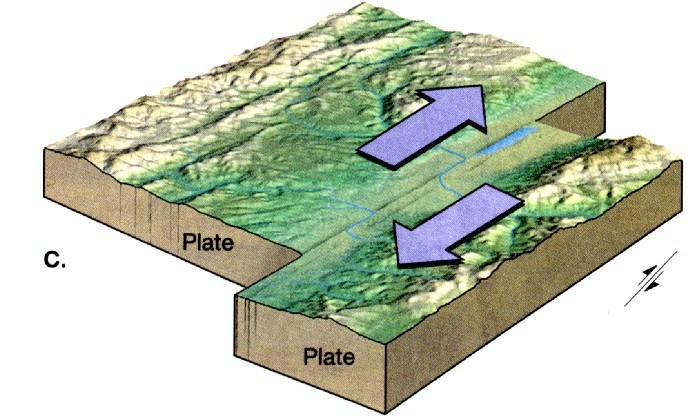
What type of plate boundary is this?
a)
Transform
b)
Convergent
c)
Divergent
d)
Plate
117.
Oceanic Trenches are formed by _______ plate boundaries
a)
Convergent
b)
Transform
c)
Plate
d)
Divergent
118.
Islands can from from magma which is pushed up at a __________ plate boundary
a)
Divergent
b)
Convergent
c)
Transform
119.
The Great Rift Valley in Africa and the Mid-Ocean Ridge were all created by this boundary
a)
Divergent
b)
Convergent
c)
Reform
d)
Transform
120.
Earthquakes and volcanoes are most likely found in which locations?
a)
At plate boundaries
b)
in oceans
c)
in the middle of continents
d)
in the middle of plates
121.
Which of the following is NOT a tectonic boundary?
a)
Convergent
b)
Divergent
c)
Sedergent
d)
Transform
122.
The area where two tectonic plates meet.
a)
mantle
b)
focus
c)
plate boundary
d)
convection
123.
A mid-ocean ridge occurs at a ________ plate boundary.
a)
transform
b)
convergent
c)
divergent
100 %

